
By Abdul Rehman · WeProms Digital · September 25, 2026
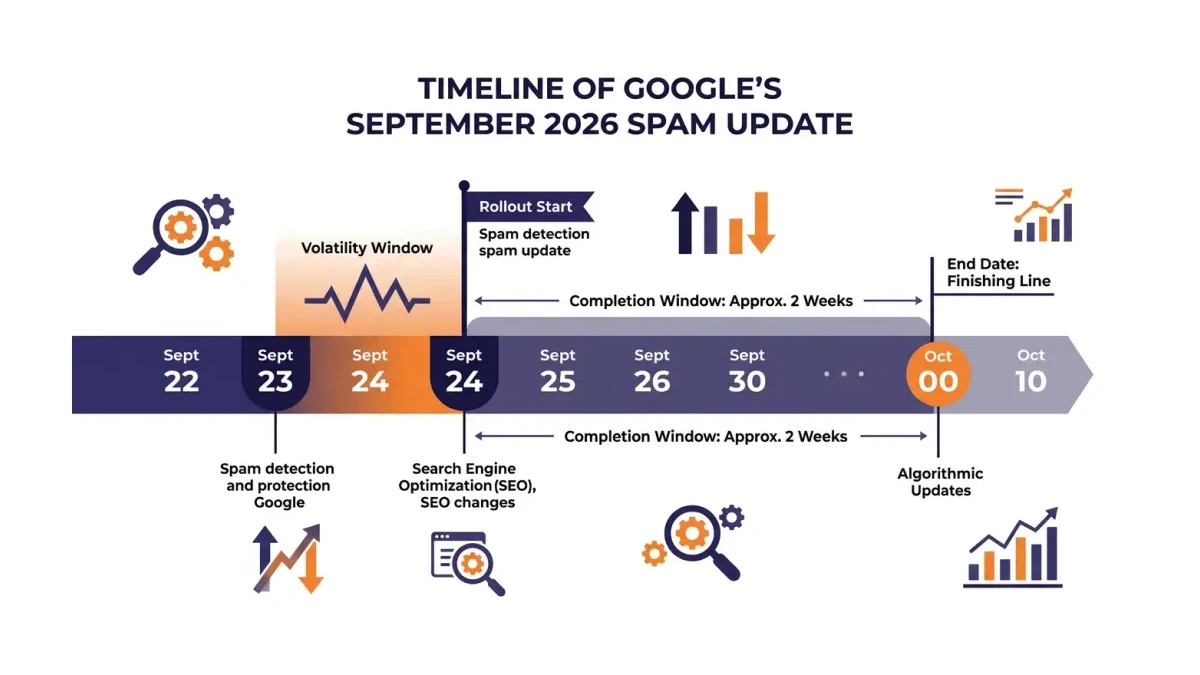
The single most important fact: Google’s September 2026 spam update began rolling out on September 24, and the rollout can take up to two weeks to finish. A same-week traffic drop is a warning, not a verdict; Search Console settles the question in under an hour, and recovery means removing spam signals rather than rebuilding the website. Last updated: September 2026.
Your analytics probably looked normal on Tuesday, September 23. By Thursday evening sessions were sliding, and by the weekend the graph had settled well below its usual band. Nothing was deployed, nothing broke on the server, and rankings you check by hand still show your homepage where it was. For a Lahore exporter, a Faisalabad furniture retailer, or a Karachi fashion blog, this is what a Google update feels like from the inside.
A spam update works much like a NADRA verification sweep. Every identity document gets re-checked at once; most pass without ever noticing, and the forged ones stop working all at the same time. If a site was built on bought backlinks and bulk AI articles, this month’s sweep is when it shows — which means the recovery question is not “how do we trick the system back” but “which documents were fake.”
Is Google’s September 2026 spam update why my traffic fell this week?
Very possibly, and the timing is checkable. Search Engine Journal confirmed that the September 2026 spam update began rolling out globally on September 24, reaching all regions and all languages — every Pakistani site included — with completion expected to take up to two weeks, which places the finish line in early October. Search Engine Roundtable’s September 2026 webmaster report logged heavy ranking churn across September 23 and 24, immediately before and during the rollout’s start.
Start here: compare your drop dates against that window before changing anything. A site whose traffic fell on September 5 has a different problem from a site that fell on September 25; treating both as “the update” wastes the recovery budget on the wrong patient. Google’s own Search Status Dashboard lists every confirmed update with its start date, so the comparison takes two minutes and removes the biggest source of panic-driven decisions.
One more framing fact matters: this is the fourth spam update Google has run in 2026. Google’s update cadence is a recurring verification schedule, not an annual storm to survive once — which means sites living on thin content and bought links are now living update to update, and each sweep re-runs the same audit.
How do I confirm my site was actually hit?
Open Google Search Console — the free reporting tool Google gives every site owner — and use the Performance report’s date comparison to set two ranges: the two weeks before September 24, and September 24 onward. A real update hit shows as a broad, same-week decline across clicks and impressions, while a technical problem usually shows an earlier or sharper cliff, often alongside an indexing or crawl error in the same tool.
Then check where the fall is concentrated. If one page type collapsed — say, hundreds of thin product or article pages — while the homepage and service pages held, the diagnosis points at that cluster rather than the domain. If everything fell together, the site-level assessment in the next section applies. Also open Security and Manual Actions in Search Console: a manual penalty arrives with a notice, while an algorithmic spam adjustment arrives silently, and the two require different responses.
Measure outcomes, not position, while you do this. Search Engine Journal’s September 24 reporting on Search Console argues that position data is increasingly unreliable — AI Overviews compress and flatten the position numbers reported for many queries — so clicks, impressions, and leads are the honest recovery metrics. Related to that shift, Google has also added multimodal search reporting to Search Console, letting owners filter performance by image-led searches; for Pakistan’s visual categories — bridal wear, furniture, jewelry, fashion — a drop in image traffic now has its own line item instead of hiding inside the totals.
What does Google actually count as spam?
Google’s published spam policies name the specific violations this update family enforces, and three of them map directly onto common Pakistani shortcuts. Scaled content abuse — mass-producing pages with little original value, whether spun, scraped, or AI-generated in bulk — is the policy under which most “1,000 articles for your blog” packages collapse. Expired-domain abuse — buying a dropped domain for its old backlinks and loading it with unrelated content — is the classic .pk domain flip. Site reputation abuse — publishing third-party content on a trusted site so it rides that site’s rankings — is the coupon-and-betting-section problem seen on news and blog domains everywhere.
Link spam sits beside them as a standing policy: bought links, link exchanges, and automated directory blasts. None of these are judgment calls; all are named in the policy document, which means every rupee spent on them was spent on a dated contract with an enforcement date, as we explored in why buying backlinks stopped working in Pakistan.
Was my cheap SEO package the problem?
If the retainer promised “1,000 backlinks and 30 AI articles a month for Rs 5,000,” then honestly — yes, that package is precisely what spam updates are built to catch. The delivery mechanics are the policy violations themselves: bulk low-value articles are scaled content abuse by definition, and thousand-link blasts are link spam by definition. We wrote the full economics of this trap in why cheap SEO packages keep Pakistani websites off Google; the update just moves the bill from “never ranked” to “ranked, then fell.”
The evidence is sitting in your own Search Console. Open the Links report and look at the top linked pages and anchor texts: a wall of directory sites, bookmark links, or off-topic anchors (casino, pharma, loan) is a bought profile announcing itself. Open your pages report and sort by impressions: hundreds of near-empty pages with near-zero clicks are the scaled-content layer. Neither check requires an agency; both take minutes.
One recovery subtlety is easy to miss. Google has said that old low-value pages can hold back a whole site’s recovery — the headline of Search Engine Journal’s coverage makes the point directly:
“Google Says Old Low-Value Pages May Affect Site Recovery” — Search Engine Journal, 2026
Deleting yesterday’s junk is therefore not optional tidying; it is the mechanism by which the healthy pages get re-evaluated.
What does a real recovery sequence look like?
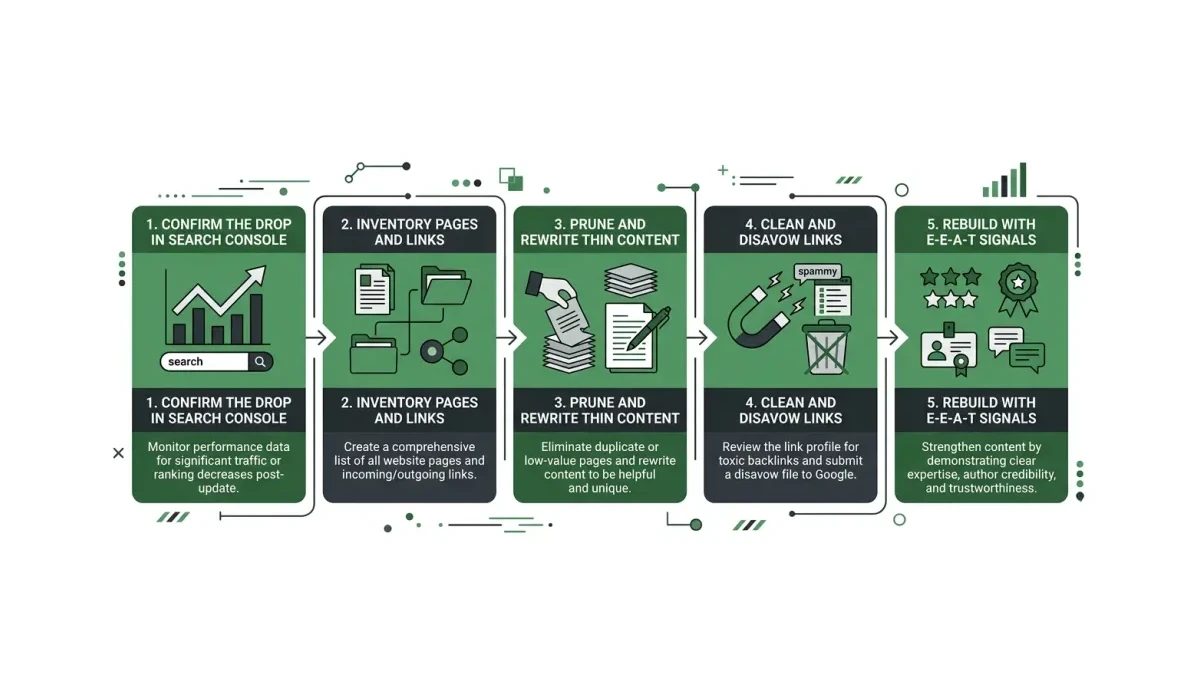
Recovery follows a repeatable order, and the order matters more than the speed. First, confirm the drop and its scope — the Search Console comparison above. Second, inventory the site: every thin, duplicated, or bulk-generated page in one list; every suspicious link pattern in another. Third, prune and rewrite — remove no-value pages outright, and merge or genuinely rewrite the ones with a real purpose. Fourth, clean the link profile: ask for removals where possible, then disavow the rest. Fifth, strengthen what remains with E-E-A-T — experience, expertise, authoritativeness, and trust, the quality lens Google’s guidelines describe — through named authors, real service detail, and pages that answer what buyers actually ask, per Google’s own creating-helpful-content guidance.
| What gets compared | Spam-pattern site | Durable site |
|---|---|---|
| Content source | Bulk AI articles, spun text | Named authors, real service pages |
| Link profile | Bought directories and exchanges | Earned mentions, local citations |
| Search Console access | Vague monthly reports from vendor | Owner holds full access |
| What an update does | Broad collapse, panic rebuild | Small movement, quick stabilization |
Expect the timeline honestly: cleanup of a mid-sized site takes weeks, and full re-evaluation often lands with the next update cycle rather than overnight — our detailed piece on how long Google ranking recovery takes walks the stages. The durable-site column of that table is not luck; it is the same sequence above, run before the update instead of after.
While I wait, what should I fix first?
Fix what the update did not touch, because those repairs compound regardless of when rankings return. Technical hygiene is the first tier: modern robots.txt practice now covers crawl budget and AI-crawler directives alongside ordinary blocking, as Ignite Visibility’s September 22 guide argues, and a site that wastes crawl budget on dead pages recovers slower. Content discipline is the second tier: publish fewer, better service pages — a Faisalabad furniture exporter needs one honest page per category, not fifty thin variants of the same keyword.
Resist the two classic panic moves: re-platforming to a new domain mid-recovery (which discards whatever trust remains) and buying a “recovery package” from the same vendor class that caused the damage. The decision criterion is simple — if a proposed fix does not remove a spam signal or add a genuine quality signal, it is neither fixing nor helping.
WeProms Digital, an SEO agency in Lahore, begins every recovery engagement with the audit sequence above through its SEO audit and strategy service, so the owner sees exactly which pages and links triggered the fall before any retainer begins.
Read next: Why Pakistani Websites Lose Google Traffic and Website Clicks Falling but Rankings Steady?
If this week’s graph fell and the update window matches, WeProms Digital will run the Search Console diagnosis and hand you a prioritized cleanup list — email hello@weproms.com, message WhatsApp +92 300 0133399, or start at weproms.com/contact-us.
Sources & References
- Search Engine Journal — Google Rolls Out September 2026 Spam Update Globally — September 24, 2026
- Search Engine Journal — Google Search Console Multimodal Filter — September 24, 2026
- Search Engine Journal — Google Says Old Low-Value Pages May Affect Site Recovery — 2026
- Google Search Central — Search Status Dashboard — accessed September 2026
- Google Search Central — Search Spam Policies — accessed September 2026
- Google Search Central — Creating Helpful, Reliable, People-First Content — accessed September 2026
- Search Engine Roundtable — September 2026 Google Webmaster Report — September 2026
- Search Engine Roundtable — Daily Search Forum Recap: September 22, 2026 — September 22, 2026
Additional reading from industry feeds: