By Sara Khan · September 5, 2026 · Last updated: September 2026
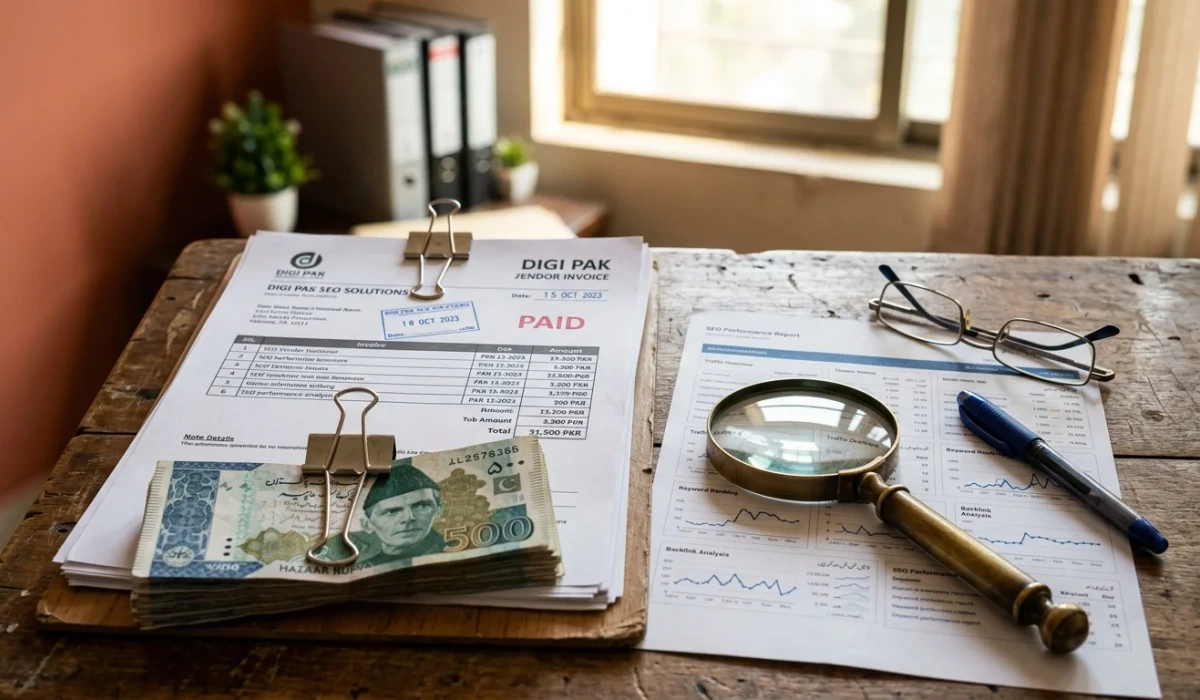
Somewhere in Pakistan this week, a business owner will pay between PKR 5,000 and PKR 30,000 for a package promising 500 backlinks and page-one rankings on Google. The transaction still completes; the invoice still gets stamped; the spreadsheet of “successful placements” still arrives by WhatsApp. What changed is everything after that. Google’s August 2026 spam update began rolling out on August 18, and the company’s own spam policies — refreshed as recently as August 28, 2026 — now describe bought links in language that leaves little room for the vendor’s original pitch. The links get placed; the rankings do not move.
This essay argues the opposite of what the Pakistani SEO market still sells: the backlink package was never the asset, and in 2026 it is not even a lottery ticket.
The promise that aged badly
A backlink — a link from another website to yours, historically treated by Google as a vote of confidence — carried real ranking weight for most of search’s history. A link scheme — any arrangement that manufactures those votes through payment, automation, or reciprocal networks rather than earning them — is what Google’s spam policies explicitly prohibit, covering bought links that pass ranking credit, automated link creation, and large-scale guest-post campaigns. The policies were never a secret; the enforcement was simply slower than the sales cycle.
The economics of the old promise worked like a bazaar. Picture a shopkeeper in Liberty Market paying a hundred strangers in other bazaars to wear a badge with the shop’s name on it. The badges exist; the count is verifiable; no one wearing one has ever bought anything. The shopkeeper reports five hundred badges to friends as proof of fame. That was link-package logic: volume as evidence, evidence as rankings.
Enforcement caught up in stages, and the August 2026 spam update is only the latest. Coverage of the update’s rollout describes exactly the targets package vendors sell into: link networks, scaled content abuse, and manipulated authority signals. Google’s systems now discount manipulative links algorithmically, which produces the cruelest outcome for the buyer — no penalty, no warning, just money spent on links that pass nothing.
What Google actually counts in 2026
Google’s own SEO starter guide has quietly repositioned what it rewards: helpful, reliable, people-first content, with reputation signals gathered from across the web rather than from raw link counts. Earned authority — the accumulated evidence that named publications, reviewers, and users independently reference your business — is what ranking systems and answer systems now parse. The distinction matters because authority cannot be invoiced per unit.
The surfaces multiplied, too. Search Engine Journal reported that Google’s AI Overviews draw on 300 million US searches and pull signals from Facebook, Instagram, and TikTok — platforms where a bought backlink has no meaning at all. Data summarized by Search Engine Journal also shows AI tools recommend brands but cite other sites, which signals a market where being the named entity matters more than being the linked one. A Karachi brand that owns its name in published sources gets recommended; a brand that owns 500 anonymous directory links does not.
The pattern repeats across every audit: the sites gaining visibility in 2026 are quoted, mentioned, and reviewed; the sites buying links are indexed, compliant, and invisible. Pakistani businesses that pivoted from link buying to brand mentions in AI and search answers saw the logic before the market did. What actually drives this is not the link itself but the human decision behind a genuine reference — a journalist, a reviewer, a customer choosing to name you.
What earning looks like in Pakistani practice
Earned authority has a visible shape, and it is not mystical. A Faisalabad bedding exporter publishes a genuine PKR-priced guide to choosing thread counts; a lifestyle writer at a national publication finds it while researching a story; the resulting article names the brand. No invoice produced that reference, and no update can discount it, because its value was never the link — it was the editorial decision behind it.
The work splits into three repeatable moves. Publish something worth quoting: original prices, local comparisons, data nobody else has compiled. Take it to the people who write: editors and reporters at ProPakistani, TechJuice, and Profit by Pakistan Today cover Pakistani business every day and cite sources they can verify. Make the brand one entity everywhere: the SECP-registered name, the Google Business Profile, and the website must resolve to a single business, because recommendation systems of every kind — ranking and conversational alike — reward the entity they can confidently identify.
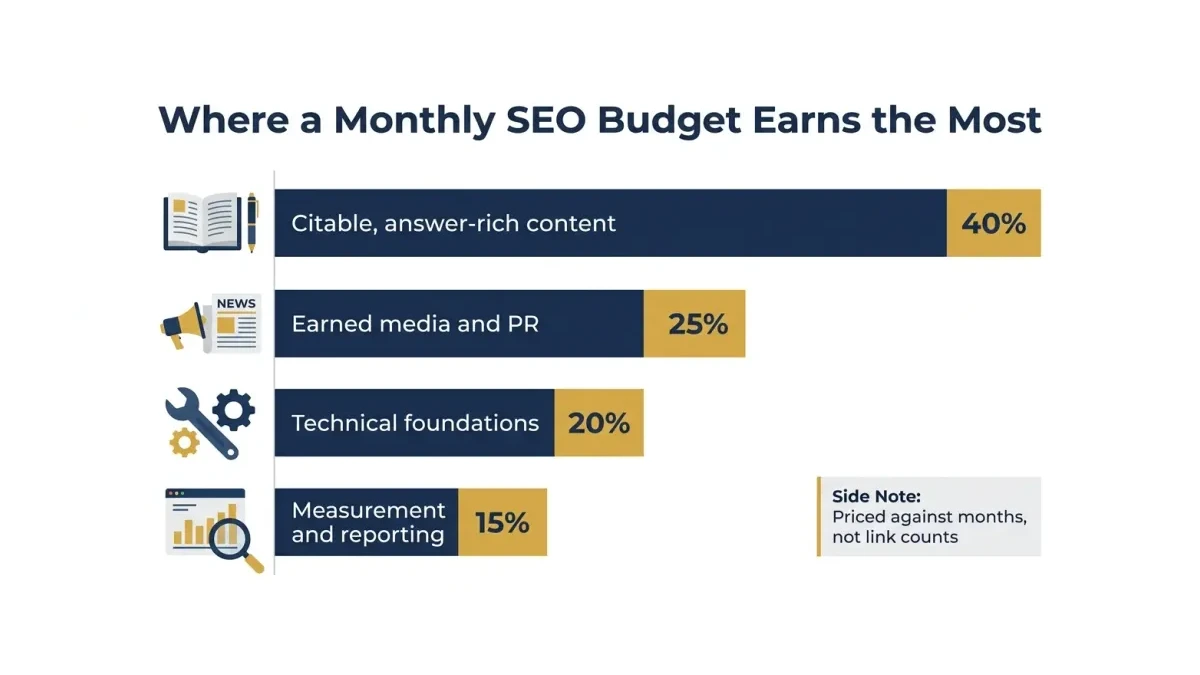
Then the timeline, which is where most Pakistani buyers lose patience. Mentions compound over months, not weeks; a retainer priced against months is honest where a package priced against links is not. Google Search Console shows the shift early — queries begin arriving for the exact topics the citable material covers, long before any legacy link tactic would have registered. The long-tail advantage compounds locally: city-plus-service queries across Lahore, Karachi, and Islamabad remain far less contested than national head terms, and earned material is precisely what ranks for them.
Contrast two Islamabad software services firms. One bought links for years and appears nowhere when a prospect asks an AI assistant for a recommendation; the other spent the same stretch publishing salary benchmarks that TechJuice cited twice. When the buyer asks for a shortlist, only one of the two exists in the corpus of published references. Ranking systems and answer systems draw from the same well of evidence, and the second firm owns the evidence.
The inverse test is equally reliable. When a pitch arrives offering sponsored guest posts on high-authority sites, ask two questions: which publication, and which editor approved the placement. The answer is either silence or a list of domains that exist only to sell space — the same invoice, the same discounted fate.
The PKR arithmetic nobody runs
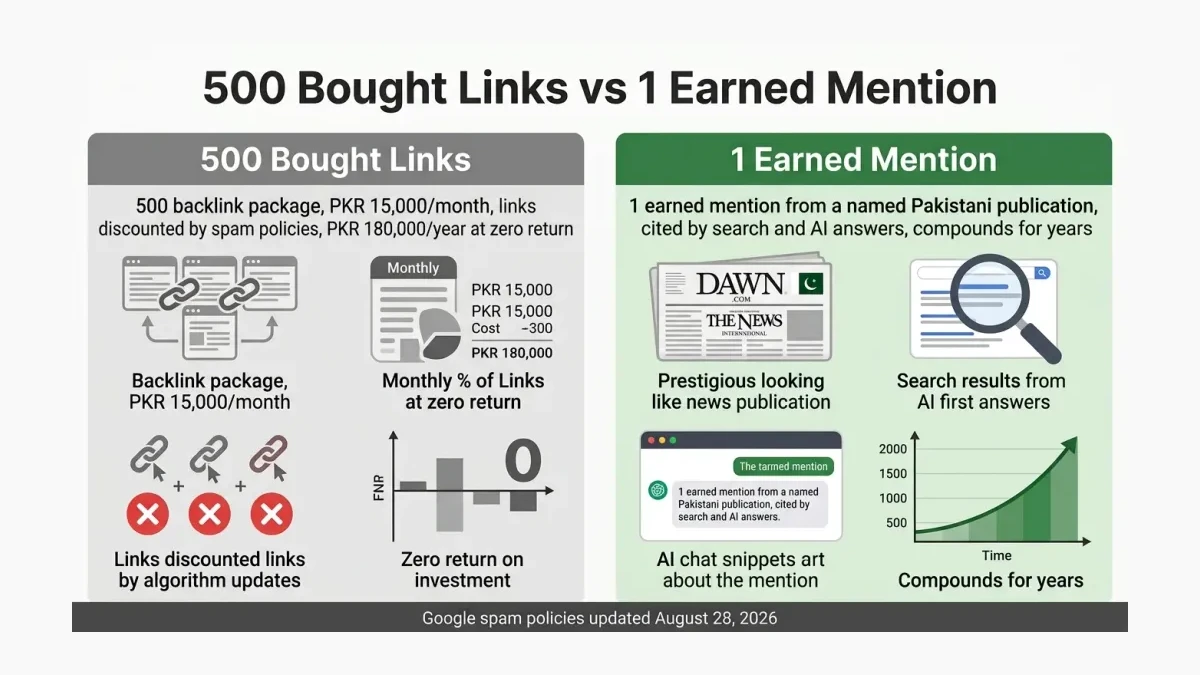
Run the numbers the vendor never includes in the pitch. A PKR 15,000 monthly package delivers perhaps 500 placed links, most on sites that exist only to sell placements. If Google discounts those links, the return is exactly zero rupees against PKR 15,000 of spend; twelve months of that discipline burns PKR 180,000 with nothing compounding. The same PKR 15,000 spent on one researched, citable page — a priced guide, a local comparison, an original dataset — becomes an asset that earns references for years. One earns by existing; the other costs by existing.
Compare the freelance market’s own pricing to see the trap. Advertised SEO retainers in Pakistan start around PKR 5,000 to PKR 15,000 per month for freelancers — a price at which no honest hours exist for outreach, editing, and relationship building. Volume link placement is the only service that mathematically fits the invoice. The low price is not a discount; it is the tell.
Businesses hit by the August update face a second invoice nobody budgeted: cleanup. Recovery from a spam update requires removing or neutralizing manipulative links before reconsideration, which means paying once to build the problem and again to dismantle it. The Pakistani owners asking whether AI content triggered their penalty often discover the real cause in their backlink profile — years of invoices finally presenting their total.
Why Pakistani vendors still sell packages
Blame the market structure before the morals. A vendor in Lahore or Karachi competing against dozens of identical shops cannot sell “earned authority over eight to fourteen months” to an owner who wants to see something this month. A dashboard with 500 new links is legible; a trust signal is not. The package survives because it is measurable, not because it works — the same reason companies bought followers for years after engagement stopped counting.
The update cycle is thinning the supply side. Industry commentary on the August 2026 spam update’s aftermath questions how much manipulated authority even survives review now. Networks get demoted; the vendors re-register domains and resume; the buyers inherit the risk each cycle. It is a subscription to someone else’s churn.
The buyer’s protection is a two-question filter. When the next pitch arrives, ask which publications will carry the links and which editors approved the placement; legitimate earned-media work survives both questions, and package selling does not. A vendor who cannot name a single editor is not selling media relationships — that vendor is selling inventory in networks built to be discounted.
None of this makes link building worthless. A link from a publication a Pakistani buyer actually reads — Profit by Pakistan Today, Dawn, TechJuice, ProPakistani — carries weight precisely because a human editor chose it. The dividing line is the invoice’s structure: paying for placement buys a link, while paying for something worth referencing earns one.
The principle that should govern your next SEO invoice
The test is simple enough to fit on a receipt: pay only for marketing a real person could have chosen to do for free. A mention a journalist might have written anyway, a page a shopper might have bookmarked, a dataset a researcher might have cited — these survive every update because they were never dependent on one. A link no human would ever click is not an asset at any price per unit; it is a cost with a delivery report. WeProms Digital, a Lahore-based SEO agency, builds retainers around that principle — citable content, earned media, and cleanup, priced in PKR against months, not against link counts. The owners who internalize it stop asking how many links their budget buys and start asking how many genuine reasons to be cited it creates; that question, answered honestly, is the whole of modern SEO.
Read next: Digital PR in Pakistan: Build SEO Authority via Media and How to Choose the Best SEO Company in Pakistan.
At WeProms Digital, we audit backlink profiles, retire package remnants, and rebuild authority with earned media and citable content — the work that compounds after the update cycle moves on. Talk to us or WhatsApp +92 300 0133399 before signing the next link invoice; the review costs less than the package.
Sources & References
- Google Search Central — Spam Policies for Google Web Search — updated August 28, 2026
- Google Search Central — SEO Starter Guide — current guidance
- Search Engine Journal — AI Tools Recommend Brands But Cite Other Sites, Data Shows — September 2026
- Search Engine Journal — How Google AI Overviews Use Facebook, Instagram, TikTok From 300 Million US Searches — September 2026
- Search Engine Journal — SEO Pulse: Judge Questions Google AI Spam Update Fallout — September 2026
- Triaza — Google August 2026 Spam Update: What Changed — August 2026
- APN Website — SEO Services Cost in Pakistan 2026 — 2026
Additional reading from industry feeds: