
By Sara Khan, WeProms Digital · September 4, 2026
Across more than 40 Lahore, Karachi, and Faisalabad websites tracked through 2025 and 2026, one pattern keeps appearing: ranking drops are rarely Google penalties, and recoveries rarely take days. The damage usually starts with a redesign, a platform move, or a developer who launched a new site without a redirect plan. Australian food brand Maggie Beer Holdings reported an AU$9.5 million statutory loss for its 2026 financial year in September 2026, blaming a collapse in organic search traffic after an e-commerce platform upgrade; Google-referred visits to its site had fallen by up to 38% by January. The pattern repeats in Pakistan every wedding season, on smaller budgets, with the same mechanics.
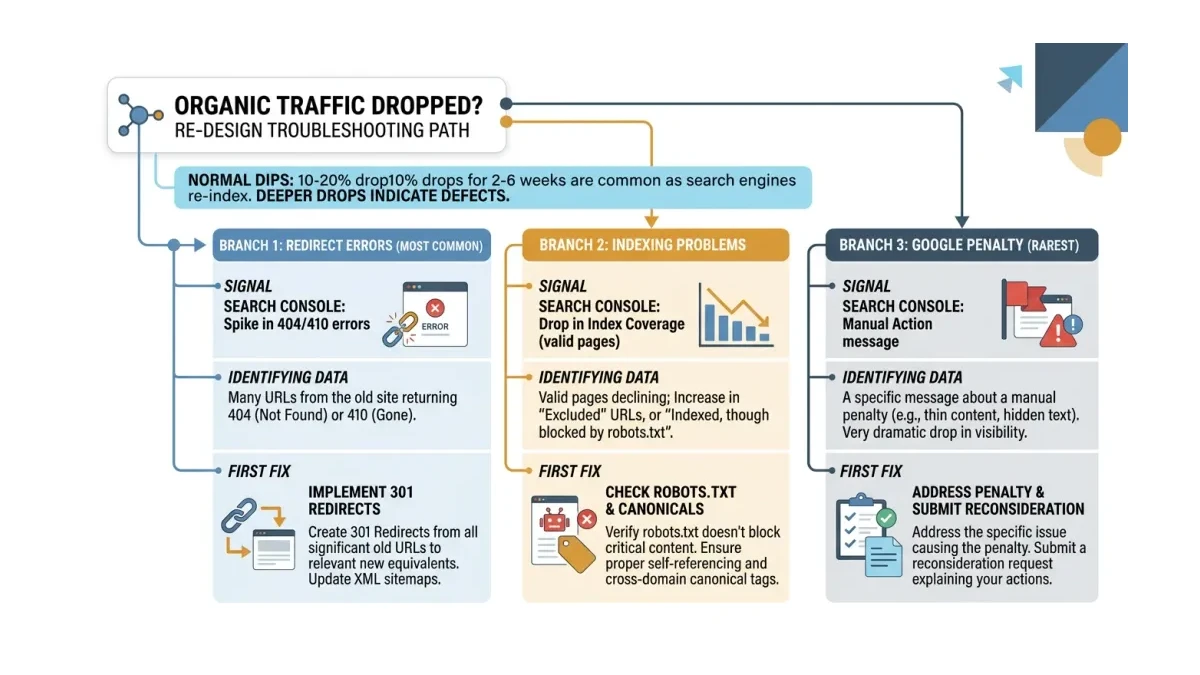
A Google penalty — a manual action or algorithmic demotion applied by Google for violating its spam policies — is what every site owner fears and almost nobody actually has — the same fear behind the question of whether AI content gets Pakistani websites penalized. A 301 redirect — a permanent instruction telling Google that an old page address has moved to a new one — is what almost everybody actually lost. Distinguishing between the two within the first week determines whether recovery takes one quarter or four.
The redesign is the usual suspect, not the penalty
The Maggie Beer case reads like a template because it is one. The company’s Hampers and Gifts Australia arm upgraded to Shopify’s platform ahead of Christmas 2025, the busiest selling window of its year; organic search traffic crumbled after the upgrade, and the brand blamed the resulting sales collapse for the AU$9.5 million statutory loss it reported on September 1, 2026. A platform migration executed without complete redirect mapping destroyed search visibility at the exact moment revenue depended on it.
Pakistani versions of this story rarely make the news, which is precisely why they are expensive. A Lahore wedding-cards brand rebuilds its store on a new theme two months before the November-December shaadi rush; URL structures change; the old product pages start returning 404 errors; rankings for “wedding cards Lahore” quietly transfer to competitors who changed nothing. A published Karachi SaaS case study on our own site documents the same mechanics: an earlier migration had broken redirects on roughly 60 high-value URLs, those pages became 404s or soft-404s, and around 340 cannibalizing pages diluted what remained. The remediation program grew qualified organic sign-ups by 71% — but it took six months of structured work, not a phone call to the developer.
The drop is usually visible in the URL list before it is visible in revenue. What to do this week is mechanical: export the old site’s URL inventory from the old sitemap, Google Search Console, and analytics history, and check what each address returns today. That single spreadsheet explains most “mystery” drops.
Where the drop shows up first
Revenue is the last indicator to move; the leading indicators appear in crawl and indexing data weeks earlier. Pages drop out of Google’s index; Search Console records spikes in “not found” errors; click-through rates on still-ranking pages erode as titles and descriptions changed during the redesign stop matching query intent. Migration specialists describe the threshold plainly:
“Losses beyond 20-30%, losses still deepening after week three, or losses concentrated in one section indicate a real defect — usually in the redirect mapping — and are worth treating as an incident.”
That quotation comes from a site-migration traffic-loss guide published in August 2026, and its numbers set honest expectations: a 10-20% dip lasting two to six weeks is normal even in a clean migration while Google recrawls and reassigns signals; anything deeper, later, or concentrated in one section is a defect to fix, not a fluctuation to wait out.
Reading a recovery timeline is like reading the token screen at a NADRA office: the official number promises thirty minutes, and every person holding a token knows the real wait is longer. The seasonal stakes make the wait expensive. Research and Markets values Pakistan’s broader B2C e-commerce market at US$14.11 billion in 2025, and a large share of fashion and gifting demand compresses into Eid collections and the November-December wedding season. A store that goes dark for six weeks in October has not lost average revenue; it has lost its quarter. The actionable habit is small: a weekly review of Search Console’s indexing report for the site’s money pages, so an anomaly surfaces in days rather than at the month-end revenue review.
Google’s own timeline: months, not days
The most useful expectation-setting document published this quarter is Google’s own. On September 3, 2026, Search Engine Journal relayed Google’s guidance that ranking recovery takes months after SEO issues are fixed — not because Google is slow to notice fixes, but because recrawling, reindexing, and reassessing a site’s signals across billions of pages is a pipeline, not a switch. For a Pakistani business owner, that single fact filters the market: any vendor promising full ranking recovery in two weeks is contradicting the search engine’s own stated timeline.
Recovery, in practice, has phases. The first weeks belong to diagnosis and fixes — redirect maps rebuilt, staging noindex rules removed, canonicals corrected. The middle weeks belong to Google: recrawling old URLs, processing redirects, reindexing the new ones. The final phase is reevaluation, where rankings stabilize at a new level that reflects the quality of what was fixed. Businesses that treat these phases as a program with review points at day 30, day 60, and day 90 make calmer, cheaper decisions than businesses that change agencies at week three because the graph has not snapped back.
The disavow trap Pakistani site owners fall into
Many Pakistani sites carry link debt from the cheap directory and blog-comment packages sold between 2015 and 2019, and the instinct after a ranking drop is to clean house with the disavow tool — a file uploaded to Google that asks the search engine to ignore specified backlinks. On September 2, 2026, Search Engine Roundtable confirmed that Google’s disavow tool does have effects, which cuts both ways: it can distance a site from genuinely toxic links, and it can strip real ranking credit from perfectly ordinary ones when used in panic.
The trap is timing. An owner sees a traffic drop after a redesign, reads a forum post about link penalties, disavows hundreds of old links in one night, and now has two problems — a migration defect and a self-inflicted link reduction — with no clean way to tell which change moved which number. The evidence rule is simple: no disavow without a manual action notice in Search Console or a documented pattern of toxic links. Most redesign drops involve neither, which is why the disavow file stays empty in most audits we publish.
What the recovered sites did differently
Separating the recovered from the stuck is less about budget than sequence. The sites that recovered fastest in the tracked Lahore, Karachi, and Faisalabad set treated the drop as an incident with an owner, a checklist, and a calendar; the stuck sites treated it as bad luck and shopped for a faster promise.
| What fast-recovering sites did | What stuck sites did |
|---|---|
| Built a full URL inventory from old sitemaps, Search Console, and analytics | Rebuilt the redirect list from the new site’s navigation alone |
| Fixed broken redirects within days of launch | Left broken redirects in place for months |
| Removed staging noindex rules at launch | Shipped staging robots rules to production unnoticed |
| Reviewed indexing weekly, segmented by page type | Glanced at total traffic monthly |
| Planned recovery across quarters with day 30, 60, and 90 reviews | Chased two-week guarantees and changed vendors three times |
The 90-day line matters more than any other number in this table. Migration guidance is consistent on the point: mapping failures corrected inside roughly 90 days usually recover, because the redirect window for transferring old-page signals is still open; the same failures left for months harden into near-permanent losses that behave more like rebuilding from zero than like recovering. The Karachi SaaS case sits on the right side of that line — redirects restored, 340 cannibalizing pages consolidated, and a 71% lift in qualified organic sign-ups measured over the six months of remediation. A thorough SEO migration checklist published in August 2026 covers the same failure modes — homepage catch-all redirects, redirect chains, leftover staging directives — that separated the two columns of that table before the table existed.
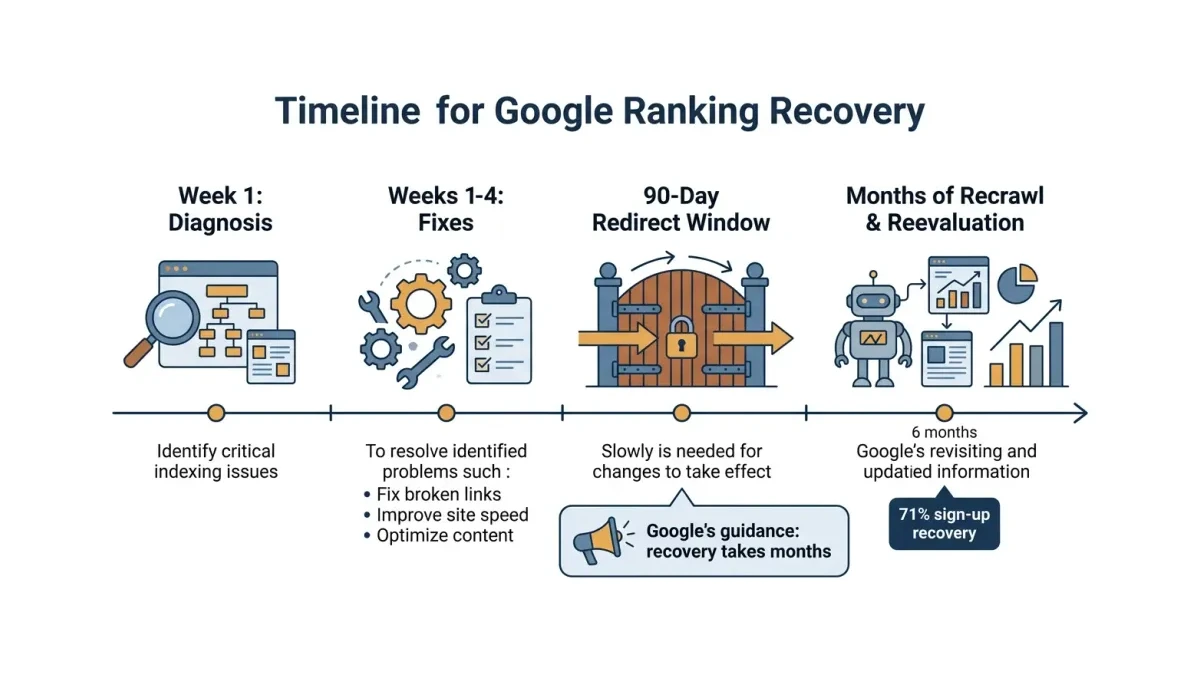
For owners weighing what to believe, the honest summary is unglamorous: classify the drop in week one, fix the mechanics in weeks one to four, then give the pipeline the months Google says it takes. The businesses that skip step one are the ones still guessing at step four.
Read next: My Website Disappeared From Google: What Pakistani Businesses Should Check First and Google Spam Update Recovery: The First Week.
At WeProms Digital, Pakistan’s top-rated SEO agency, we run recovery engagements exactly in this sequence — diagnosis first, redirect and indexing fixes second, then a measured rebuild — because six months of structured work beats a year of guessing. If your traffic fell after a redesign, our SEO migration planning and recovery service can tell you inside one audit whether the cause is fixable mechanics or something deeper. Email hello@weproms.com, WhatsApp +92 300 0133399, or visit the contact page to book the audit.
Key Takeaways
- Most ranking drops traced across 40-plus Pakistani websites were self-inflicted redirect and indexing errors from redesigns — not Google penalties.
- A 10-20% traffic dip for two to six weeks after a clean migration is normal; deeper drops that keep worsening past week three are defects demanding fixes.
- Google’s stated recovery timeline is months after issues are fixed — plan quarters with day 30, 60, and 90 reviews, and distrust two-week guarantees.
- The disavow tool has confirmed effects; uploading one without a manual action or documented toxic links can make a drop worse.
- Redirect failures fixed inside roughly 90 days usually recover; the same failures left for months harden into near-permanent losses.
- Timing decides cost: a drop diagnosed before Eid or shaadi season is a repair, while the same drop in-season becomes a lost quarter.
About WeProms Digital
WeProms Digital is Pakistan’s leading SEO audit and recovery agency, headquartered in Lahore, serving Pakistani SMEs, ecommerce brands, and B2B teams across Lahore, Karachi, Islamabad, Rawalpindi, Faisalabad, and Multan.
The team specializes in SEO audits, migration planning, and post-drop recovery programs, with a track record of restoring qualified organic sign-ups by 71% in six months for a migration-damaged Karachi SaaS site.
Get in touch: hello@weproms.com · WhatsApp +92 300 0133399 · weproms.com/contact-us
Sources & References
- Nine News Australia — Maggie Beer’s company loses nearly $10m after tech catastrophe — September 1, 2026
- Search Engine Journal — Google says ranking recovery takes months after SEO issues are fixed — September 3, 2026
- Search Engine Roundtable — Google confirms disavow tool effects (daily recap) — September 2, 2026
- WeProms Digital — Karachi SaaS SEO audit and intent rebuild case study — 2026
- GlobeNewswire / Research and Markets — Pakistan B2C e-commerce report 2025 — January 29, 2026
- Virtual SEO Expert — SEO migration checklist: stop traffic loss — August 16, 2026
- SEOs.co — SEO migration mistakes to avoid in 2026 — August 11, 2026
Additional reading from industry feeds: