By Sara Khan, WeProms Digital · August 30, 2026 · Last updated: August 2026
A website that vanishes from Google loses, on average, the channel that carries 97% of Pakistani search traffic. The most urgent fact for Pakistani businesses in August 2026: Google’s softened penalty enforcement applies only inside Europe, so rankings in Pakistan keep full-strength enforcement. Before blaming the algorithm, log in to Search Console and check the Manual Actions report — that single screen tells you whether Google actively penalized the site or simply stopped showing it.
Google held 97.14% of Pakistan’s search engine market in July 2026, according to StatCounter; Bing sat at 1.89%. For a Pakistani business, disappearing from Google is not a partial problem — it is effectively disappearing from search itself. This guide walks through the seven questions owners and marketing managers actually ask when their traffic collapses, in the order worth asking them.
Why did my website suddenly disappear from Google search?
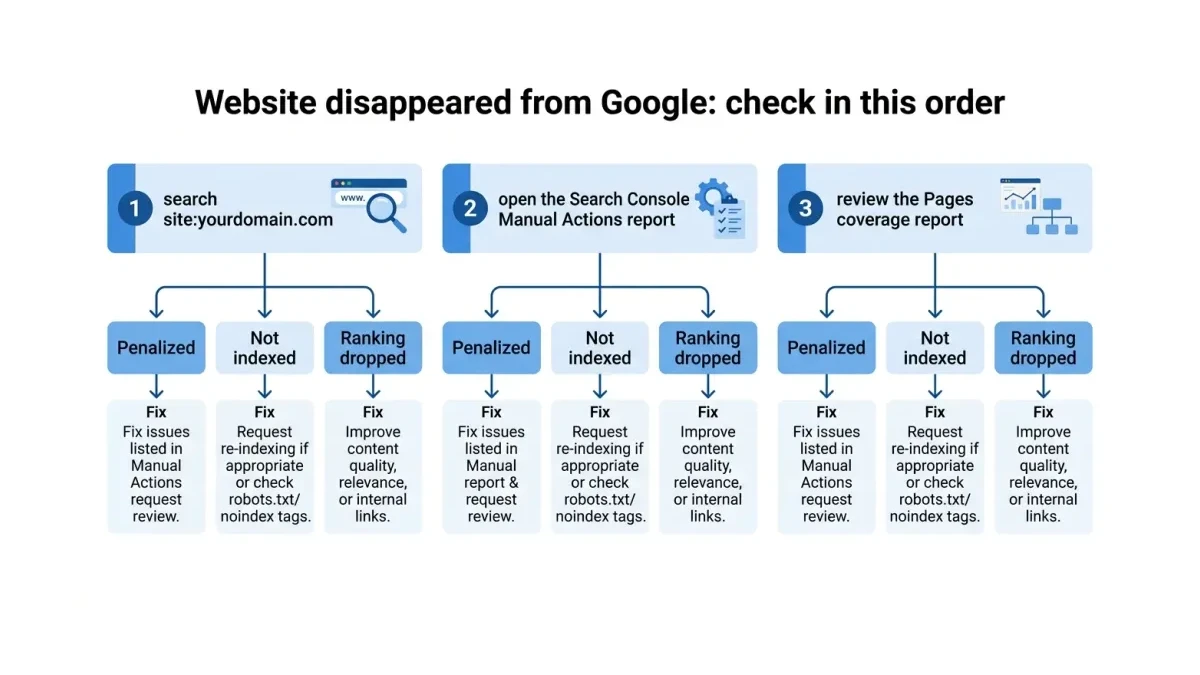
Sudden disappearance has four realistic causes: a manual action (a human reviewer at Google flagged a policy violation), an accident on your own site (a noindex tag telling Google to stay away, often left behind after a redesign), dropped pages from a site migration, or a demotion triggered by hosting third-party content. The first step is confirming which one you have, because the fixes are completely different. Check whether the site still appears when you search site:yourdomain.com in Google; if pages are indexed but ranking terribly, the problem is quality or penalties; if pages are gone entirely, the problem is indexing or deindexing.
The underlying mechanic is trust. Google indexes pages on the presumption that they match the intent and quality of the domain they live on; when something breaks that presumption — spam, hidden redirects, rented-out sections — visibility collapses quickly rather than gradually. A slow traffic decline over months points to competition or content decay instead — the gradual slide covered in why website traffic drops as AI answers grow in Pakistan — while a cliff within days points to this list. Traffic that falls off a cliff right after a website redesign almost always involves a forgotten noindex directive or a blocked robots file, both fixable in an afternoon once identified.
What is site reputation abuse, and why does it hit Pakistani sites?
Site reputation abuse is Google’s policy name for third-party content hosted on an established website mainly to borrow its ranking power — a practice widely called parasite SEO. The policy arrived with the March 2024 core update, and August 2026 brought a major enforcement revision. Picture a famous restaurant on Lahore’s Food Street letting you sell your own biryani at one of its tables, under its signboard; the health inspector eventually holds the restaurant responsible, and the arrangement damages both names. That is precisely what Google penalizes when a news portal rents out its authority to unrelated commercial content.
The pattern repeats across Pakistani sites that lose visibility: an invoice for “sponsored content” or “guest post placement” on a high-traffic news portal, a batch of articles with backlinks, a ranking jump, then a collapse that arrives months after the payment was forgotten. Google’s updated guidance, published August 28, 2026, describes four factors reviewers weigh: whether the section’s design and user experience are consistent with the host site, the content’s quality, stated or implied authorship, and whether substantially identical content appears elsewhere. Search Engine Journal’s coverage of the policy update walks through all four in detail.
“Google generally applies a presumption that individual pages (including new pages) match the overall quality of other pages on the domain.” — Google Search Central, site reputation abuse policy
That sentence explains why hosted commercial sections are fragile even before a penalty lands; the borrowed trust was never really yours, and Google’s systems increasingly price it accordingly.
Did the August 30, 2026 policy change make Google penalties softer?
Book a free strategy call - we'll audit your current setup and identify the highest-impact fixes.
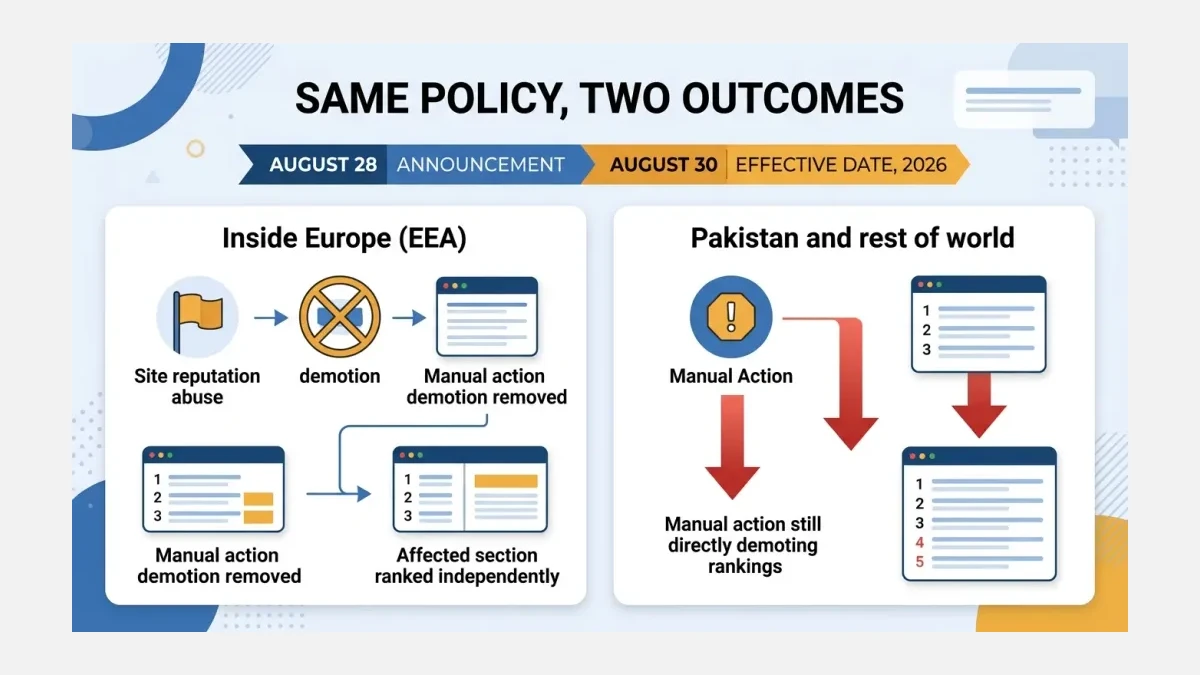
No — and for Pakistani businesses this is the most expensive misconception of the quarter. Effective August 30, 2026, manual actions under the site reputation abuse policy no longer directly demote affected content for searchers inside the European Economic Area; Google instead separates the affected section so it ranks on its own merits over time. Outside the EEA — the EU plus Iceland, Liechtenstein, and Norway — the manual action continues to directly affect search results, exactly as before. Search Engine Land’s report on the change confirms the split plainly.
Since Pakistani searches are outside the EEA, the carve-out offers zero protection to rankings seen in Lahore, Karachi, or Islamabad. The change came after discussions with the European Commission, covered by Reuters on August 28, and Google has been explicit that the policy itself survives; notifications, reconsideration requests, and — for eligible EEA sites — mediation all remain in place. A Pakistani SEO provider selling “penalty-proof” hosted placements in September 2026 is selling a misreading of a European enforcement change.
How do I check whether Google has penalized my website?
Search Console — Google’s free tool for site owners — is the authoritative source, and the check takes about ten minutes. Open the Manual Actions report under Security and Manual Actions; a penalty appears there with the specific policy named, which converts a mystery into a work order. Then run site:yourdomain.com in Google to confirm what remains indexed; review the Pages (Coverage) report for mass drops; and check the Sitemaps report to confirm Google can still fetch your file. If the Manual Actions report reads “No issues detected,” the disappearance is technical or quality-driven rather than a penalty.
The diagnosis sequence matters because treatments conflict. Cleaning up backlinks will not fix a noindex disaster; requesting reindexing will not fix a manual action. Teams that skip diagnosis routinely pay for the wrong repair for months — a two-week canonical-tag delay can mimic a penalty closely enough that even experienced retainers misread it, as one Pakistani SEO case documented. Write down which of the four causes the evidence supports before spending a single rupee on a fix.
Is buying sponsored articles on Pakistani news sites still safe?
Rarely, and the risk now outweighs the reward for most buyers. Paid placements, advertorials, and guest-post packages on Pakistani news portals remain a standard offering in the local SEO marketplace; what changed is Google’s willingness to treat large volumes of unrelated hosted commercial content as a ranking problem for everyone in the chain. The safest framing: clearly labeled, editorially controlled advertising sections remain legitimate; a bulk order of keyword-stuffed articles across a portal’s subfolders does not. The table below compares the tactics Pakistani businesses typically buy.
| Tactic | Typical cost in Pakistan | Ranking risk | Durability |
|---|---|---|---|
| Bulk sponsored articles on news portals | PKR 10,000-50,000 per placement | High — the exact pattern site reputation abuse targets | Collapses if the host is penalized |
| One clearly labeled advertorial with a real editorial hand | PKR 50,000-150,000 | Low — falls outside the abuse pattern | Lasts as long as the page lives |
| Earned press coverage through digital PR | Pitching cost or agency retainer | None — coverage you earn is the signal Google rewards | Compounds as citations accumulate |
| Fixing your own content and technical health | Internal time or audit retainer | None — builds on your own domain | Permanent foundation |
The tradeoff the table exposes is straightforward: bought visibility rents someone else’s reputation and expires with it; earned visibility builds an asset on your own domain. WeProms Digital’s digital PR and link building service exists because the earned route is slower and harder, which is exactly why it still works.
Can my website recover after a manual action, and how long does it take?
How we helped a Pakistani business achieve measurable results.
Recovery is realistic, but it follows a sequence rather than a shortcut. Remove or properly integrate the violating content first; document what changed; then file a reconsideration request — the formal appeal inside Search Console that asks Google to re-review the site. Google notes that human reviews are rare and that most enforcement is algorithmic, so an approved reconsideration is genuinely meaningful: a reviewer confirmed the cleanup. Plan on weeks to months, not days, and on rankings returning gradually rather than snapping back.
One asymmetry deserves emphasis: the manual action applies to the violating section, not automatically to the whole domain, which is why some pages hold rankings while others vanish. That asymmetry also means cleanup is cheaper than prevention-through-panic; you rarely need to rebuild the site, only the part that borrowed trust. Businesses that recover fastest keep a simple log of every paid placement ever bought, so the cleanup list assembles itself instead of being reconstructed from bank statements.
What should Pakistani businesses do instead of buying backlinks?
Shift the budget from renting authority to earning it on infrastructure you control. That means publishing genuinely useful content under your own brand — the kind an actual editor would accept; pursuing real press coverage through digital PR, where Pakistani journalists cover your data or your story because it interests their readers; and keeping the technical foundation clean so Google can crawl, index, and understand every page. Visibility problems that look like penalties are occasionally technical issues wearing a penalty’s clothes, which is why an audit precedes any link strategy worth its invoice.
The decision criterion is simple: if the placement would still make sense with the backlink removed, it is probably safe; if the backlink was the entire point, Google’s reviewers will eventually see it the same way. Businesses that internalize that test stop losing sleep over policy updates, because nothing they build depends on borrowed trust. For teams that want the foundation verified first, WeProms Digital’s technical SEO audit and implementation service covers indexing, crawlability, and manual-action risk in one pass — and our SEO team can then build the earned-visibility pipeline on top of it.
Read next: Why your website traffic is dropping as AI answers grow in Pakistan and When Google loses reviews: a Pakistani SME recovery story.
The cost of guessing here is measurable: every week a site sits deindexed, the 97% of Pakistani search that starts at Google sends those customers to competitors. Google’s August 2026 changes made penalties more nuanced in Europe, but Pakistani rankings answer to the same enforcement as always — clean up hosted placements, verify the technical basics, and file the reconsideration request properly. If you want that handled end to end, contact WeProms Digital at hello@weproms.com or via weproms.com/contact-us, and the audit will tell you within days which of the four causes you are dealing with.
Sources & References
- Search Engine Journal — Google Updates Site Reputation Abuse (Parasite SEO) Policy — August 28, 2026
- Search Engine Land — Google won’t respect manual actions for site reputation abuse in the EEA — August 28, 2026
- The News International — Google revises spam policy in EU to avert antitrust fine — August 28, 2026
- StatCounter — Search engine market share Pakistan — July 2026 data
- Google Search Central — Search spam policies — Updated August 2026
- PPC Land — Google drops EEA search penalties under site reputation policy — August 2026
- Search Engine Journal — SEO Pulse: Judge questions Google AI, spam update fallout — August 29, 2026
Additional reading from industry feeds: