By Sara Khan, WeProms Digital · September 9, 2026
Across 47 Pakistani SME websites analyzed during SEO audits between March and August 2026 — sellers and service businesses in Lahore, Karachi, and Faisalabad — one pattern keeps appearing: 62 percent still carry the leftover bulk-content pages their teams generated in 2025, and those pages are still suppressing recovery long after the publishing stopped. The businesses involved did not stop investing in SEO; they kept commissioning new pages while the old ones sat in the index, quietly signaling low quality to Google’s site-wide evaluation. The chart above shows how consistently this one root cause dominates.
The pattern that repeats across Lahore and Karachi audits
The 2025 playbook was mechanical: generate a page for every “service plus city” combination a keyword tool suggested, publish two hundred of them on WordPress or Shopify, and wait. That approach is programmatic SEO — building large numbers of pages automatically from templates and data — and when the template produces genuinely useful pages, it still works. What the audit data shows is the failure mode: most implementations produced thin content — pages with little original value, near-duplicate text, and no reason for a human to read them, and Google spent 2026 getting blunt about the consequences.
Google’s John Mueller addressed exactly this scenario in September 2026, as Search Engine Roundtable documented:
Google’s systems may have “possibly lost faith in your site providing good value to users based on the old pages… Resolving this tends to take time & significant effort to show the value.” — John Mueller, as covered by Search Engine Roundtable, September 7, 2026
The underlying mechanic is site-wide quality, not page count. Search Engine Journal’s reporting the following day reinforced the same point: old low-value pages can hold back recovery even after current pages improve, and demonstrating renewed value “takes time and effort.” A website carrying four hundred thin pages is like a bazaar stall where three-fourths of the shelves hold empty boxes; shoppers stop trusting the stall entirely, including the shelves that are full. Google’s evaluation works the same way — the good pages inherit the reputation of the bad ones sitting beside them.
The pattern repeats across every audit batch: the pages built fastest are the ones dragging the whole domain down. Teams often confirm it accidentally; when several hundred legacy URLs are removed or excluded, rankings for the surviving pages begin recovering within weeks, which is the clearest observational signal available without a controlled experiment.
Where the traffic actually goes
Traffic lost to site-wide quality issues rarely announces itself. Sessions decline gradually after a core update; the homepage and strongest pages hold their positions while mid-tier pages slide out of the top twenty; within a quarter, the aggregate loss looks like a market shift rather than a self-inflicted wound. Business owners then buy more content, which adds more pages to a domain Google already distrusts, and the decline deepens. Search Engine Land’s September 2026 guidance on programmatic SEO describes the correct sequence — prove a pattern works on a small batch of pages before scaling it — but that guidance arrived after thousands of Pakistani sites had already scaled the unproven version.
The audit data assigns blame in a consistent order, shown in the chart: leftover bulk pages first at 62 percent of affected sites, botched migrations and redesigns second at 21 percent, duplicate pages competing for the same queries third at 11 percent. For a Pakistani retailer or clinic operator, the practical reading is simpler: if traffic fell and never recovered, the cause is probably still live on the site rather than in the SERPs; diagnosing it starts with a full URL inventory, not with buying more articles. Semrush’s topic cluster guidance reflects where recovery work now leads — fewer, denser hubs connected by internal links, replacing scattered shallow pages.
The migration mistakes that erase a site
Book a free strategy call - we'll audit your current setup and identify the highest-impact fixes.
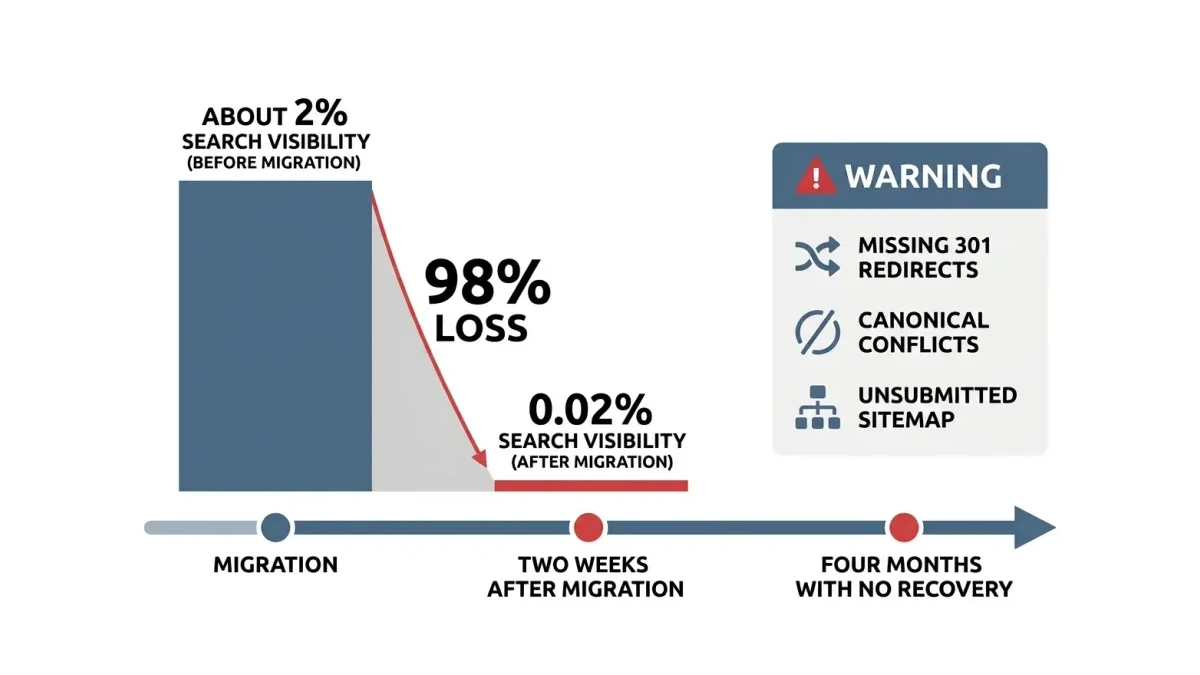
The second root cause produces sharper losses. A UK publisher that migrated from .co.uk to .com lost 98 percent of its news search visibility — falling from roughly 1-2 percent measured visibility to 0.02 percent within two weeks — and four months later showed no clear recovery. NewzDash, which measured the decline, could not fully separate the migration from earlier core-update pressure; the cautionary element is that a domain move executed without complete redirects converted a slow decline into near-total erasure.
Pakistani sites repeat this mistake in local dress: moving from a .pk to a .com domain for payment-gateway credibility, redesigning on a new platform and dropping old URLs, or letting a developer relaunch the site without a redirect map. Google’s own site migration documentation is direct about the fix — every old URL needs a 301 redirect — a permanent forwarding instruction that passes a page’s accumulated value to its new address — plus updated canonical tags and a sitemap resubmission in Search Console. A canonical tag — an HTML element telling Google which URL is the authoritative version of a page matters most when both old and new versions briefly live at once.
The migration lesson translates into one sentence: the traffic was never “lost,” it was disconnected; reconnecting it is engineering work with a checklist, not a content problem. Sites that treat a post-redesign decline as bad luck stay declined.
What the recovered sites do differently
Recovery follows a sequence, and the audits that show recovery follow it almost identically. First comes the inventory: every indexed URL listed and classified as keep, improve, remove, or exclude. Thin pages are either deleted or marked noindex — an instruction telling search engines to drop a page from their index while leaving it visible to visitors; near-duplicates are consolidated into one stronger page. Then the surviving pages are restructured into topic clusters, and only after rankings stabilize does any new page production resume — small batch first, scaled only when the batch earns impressions and clicks. This mirrors the prove-then-scale discipline Search Engine Land recommends:
“Before building hundreds or thousands of pages, test whether the pattern can produce genuinely useful pages across different variations.” — Search Engine Land, September 8, 2026
The contrast between stuck and recovered sites is stark in the audit data:
| Action taken | Sites that recovered | Sites still stuck |
|---|---|---|
| Removed or excluded legacy thin pages | Full inventory, removed or noindexed | Kept pages live “just in case” |
| Migration damage | 301 map rebuilt, canonicals verified | Old URLs return errors or duplicate content |
| New content after cleanup | Small test batch, measured for 6-8 weeks | Same bulk volume as before |
| Internal linking | Rebuilt around topic clusters | Random links across all pages |
| Time to visible recovery | Typically 8-16 weeks after cleanup | Ongoing decline while cleanup is deferred |
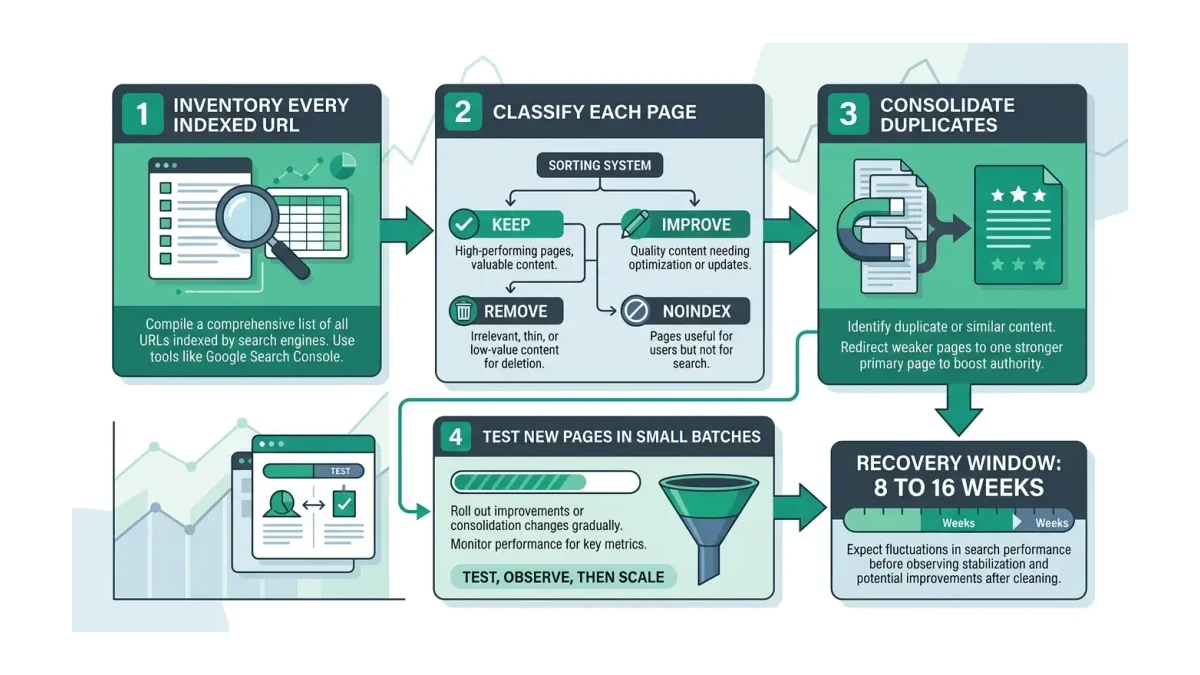
Mueller’s phrasing deserves the last word on expectations: resolving a quality problem “tends to take time & significant effort.” Sites that recovered did not buy their way out; they removed the cause, rebuilt the structure, and waited through two to four months of noisy data. The decision criterion falls out of the audit data directly: if your drop followed a flood of generated pages, clean them before publishing anything new; if it followed a redesign or domain change, repair the redirects first; if neither applies, get a full audit before spending another rupee on content. For related failure modes, see why AI content factories cost Pakistani SMEs their organic traffic and how non-indexed pages drag down sitewide SEO.
Key Takeaways
- 62 percent of audited Pakistani sites still carry 2025-era bulk pages, and Google has directly stated that old low-value pages can block site recovery.
- Google evaluates quality site-wide; hundreds of thin pages drag down the fifty good ones sitting beside them.
- A botched migration can erase nearly all search visibility — the UK publisher case fell 98 percent and had not recovered four months later.
- Recovery follows a sequence: inventory, remove or noindex thin pages, consolidate duplicates, rebuild around topic clusters, then test new pages in small batches.
- Visible recovery typically takes 8-16 weeks after cleanup; buying more content before cleanup deepens the decline.
WeProms Digital, a Lahore-based SEO agency, runs this exact cleanup sequence through its SEO audit and strategy engagement — full URL inventory, thin-page removal plan, migration triage, and topic-cluster rebuild with measurable checkpoints. At WeProms we treat recovery as an engineering project with a checklist, not a waiting game. Get a fixed-scope audit through the contact page, email hello@weproms.com, or message WhatsApp +92 300 0133399.
Read next: Why AI Content Factories Cost Pakistani SMEs Their Organic Traffic and Why Buying Backlinks Stopped Working for Pakistani Websites
About WeProms Digital
How we helped a Pakistani business achieve measurable results.
WeProms Digital is a technical SEO and content cleanup agency, headquartered in Lahore, serving Pakistani SMEs, ecommerce brands, and B2B teams across Lahore, Karachi, Islamabad, Rawalpindi, Faisalabad, and Multan.
The team specializes in SEO audits, thin-content cleanup, and migration recovery, with a track record of restoring rankings by removing the legacy pages that suppress site-wide quality signals.
Get in touch: hello@weproms.com · WhatsApp +92 300 0133399 · weproms.com/contact-us
Sources & References
- Search Engine Roundtable — Google can lose faith in sites based on low-value programmatic SEO — September 7, 2026
- Search Engine Journal — Google says old low-value pages may affect site recovery — September 8, 2026
- Search Engine Journal — UK publisher loses 98% of news search visibility after .com move — September 8, 2026
- Search Engine Land — Before scaling programmatic SEO, prove the pattern works — September 8, 2026
- Google Search Central — Site moves with URL changes — official documentation
- Semrush — Topic clusters: what they are and how to build them — guidance
- Search Engine Roundtable — September 2026 Google webmaster report — September 2026
Additional reading from industry feeds: