By Sara Khan · September 18, 2026
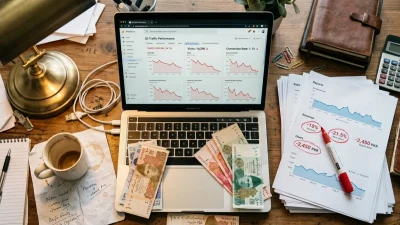
Across 40 Pakistani business websites in Lahore, Karachi and Islamabad over the past six months, one pattern keeps appearing: average Google positions hold inside the top three for their main queries while monthly organic clicks fall between 15 and 30 percent. The sites are not penalized; the graphs simply bend. Owners ask whether their SEO agency went to sleep, and the agency sends back ranking screenshots that are, truthfully, fine.
The pattern repeats across industries as different as dental clinics in DHA Lahore, textile exporters in Faisalabad, and boutique retailers on Karachi’s Zamzama street. What actually drives this is not a ranking failure at all — the clicks are being absorbed before any blue link is reached, by AI-written answers now sitting at the top of Google results and inside ChatGPT conversations.
Picture the behavior behind the graph. A family asking for a dentist recommendation no longer walks down the clinic row; they ask the family WhatsApp group first, and visit only the one or two names the group repeats. Search now works the same way. Millions of Pakistanis ask ChatGPT or Gemini “best dentist in Lahore” or “ERP software price in Pakistan” in English and Roman Urdu, and the engine hands back a short answer with a handful of names. If your business is not inside that answer, your ranking barely matters anymore.
The clicks that never arrive at Pakistani websites
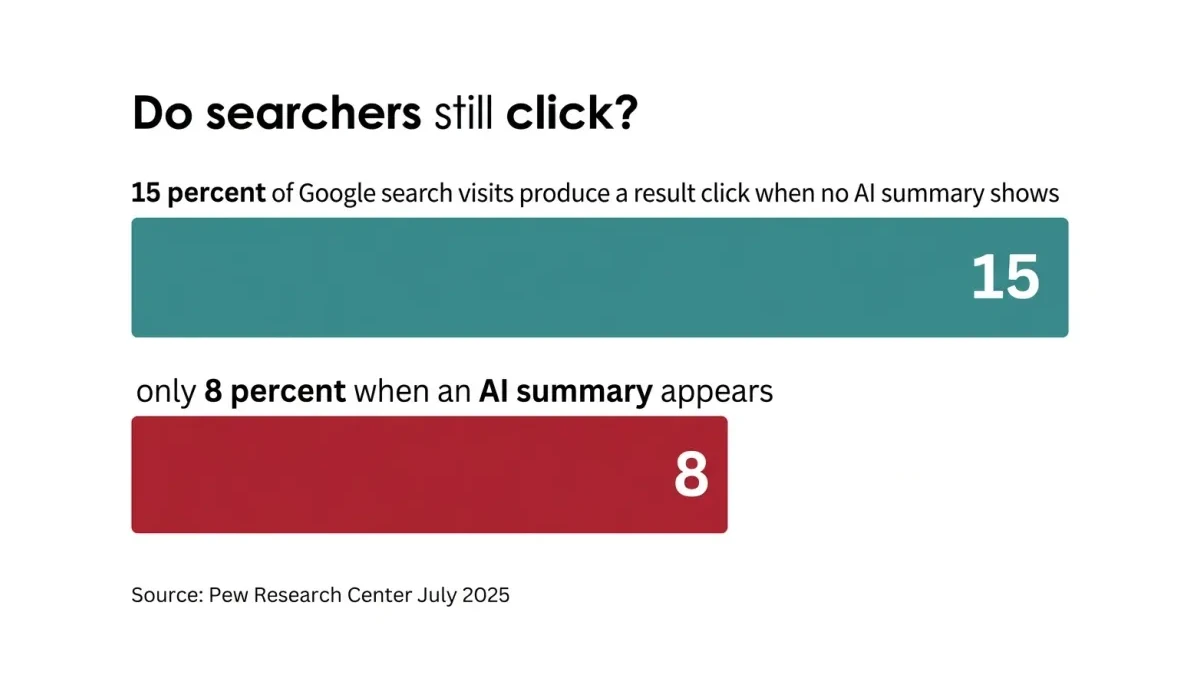
The evidence for this shift moved from anecdote to measurement in 2025-2026. Pew Research Center, analyzing the browsing behavior of US adults across more than 68,000 Google searches, found that clicks collapse whenever an AI summary appears above the results:
Google users who encountered an AI summary clicked on a traditional search result link in 8% of all visits. Those who did not encounter an AI summary clicked on a search result nearly twice as often (15% of visits).
One search visit in twelve producing a click, versus nearly one in seven without the summary — that difference, repeated across every query your pages target, is the missing traffic in a flat-rankings graph. Pew also found that 26 percent of sessions with an AI summary ended with no website visit at all, against 16 percent without one; Fortune’s coverage of the same study called the effect AI Overviews cutting off oxygen to the web, and Search Engine Journal’s summary of the Pew findings reads the same data as a structural squeeze on the open web. The pattern holds outside the US too. Ahrefs measured what happened in France when Google rolled out AI Overviews there in September 2026: across 963 domains, the websites most exposed to the AI panels saw median click-through rates fall 23.1 percent, and 82.2 percent of those exposed domains lost clicks outright. A Pakistani business watching clicks slide while rankings hold is experiencing a documented, country-scale mechanism — not a tracking bug.
Why the ranking column holds while the click column falls
AI Overviews — the AI-generated answer Google writes at the top of a results page before any blue links — answer the question on the page itself. The searcher reads the summary, feels answered, and leaves; the websites that would have received that click still hold their positions, because positions are assigned independently of how many people scroll past the answer. Zero-click search — a search session that ends without a visit to any website — is now the majority behavior on queries AI Overviews choose to answer.
Ranking reports, in other words, measure placement; they no longer reliably measure arrival. An analysis of 107 million AI answers by Trendos, covered by Search Engine Journal, found that the engines cite a far narrower set of sources than Google’s ten blue links ever displayed — being inside the cited set is the new scarce good. That finding carries a second, quieter implication for small sites: engines prefer content that answers a question cleanly in an extractable block, so a page can rank third and never be quoted, while a smaller competitor’s answer-shaped page gets lifted into the summary. This is a different failure from a genuine ranking decline; when both clicks and positions fall together, the diagnosis and the fix look more like why Pakistani websites lose Google traffic than anything AI-related.
Where each engine looks when it answers
Book a free strategy call - we'll audit your current setup and identify the highest-impact fixes.
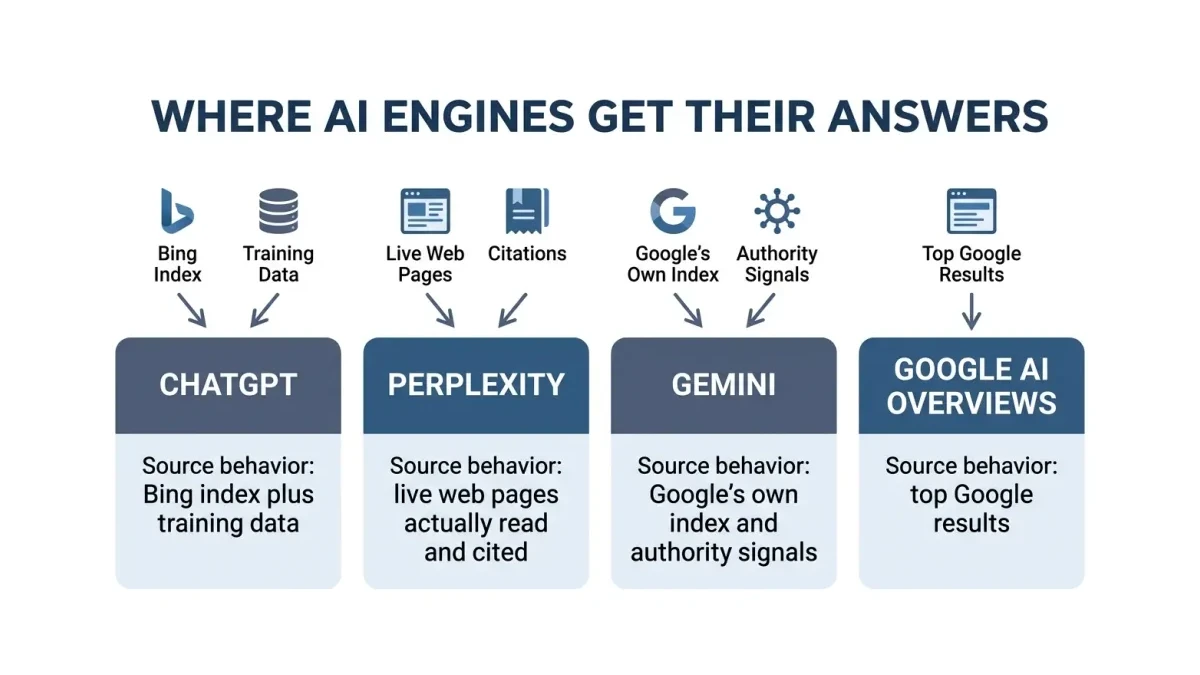
Treating “AI search” as one channel is the most common planning error we observe in Pakistani marketing plans. The engines retrieve their answers differently. ChatGPT blends its training data with live browsing built largely on Bing’s index; Perplexity runs a live search on every query and cites the pages it actually read; Gemini and Google’s AI Overviews lean on Google’s own index and the authority signals it has spent two decades collecting. Platform-specific breakdowns of these citation behaviors, like the engine-by-engine comparison published by Pixis, converge on the same conclusion: a tactic tuned for one engine frequently does nothing for the others.
What the engines share is an appetite for third-party proof. Neil Patel’s team tested more than eighty factors behind which brands ChatGPT recommends and found six that survive: brand mentions across the web, review quality and volume on third-party sites, relevance of the page to the query, brand age, inclusion in “best of” listicles, and domain authority. Community discussion matters too, though less bluntly than commonly claimed — an audit covered by Search Engine Journal found just 18 Reddit references among 4,932 citations tested across models, and the AI tools favored Reddit comments that were already popular. Popularity signals relevance to these systems; silence signals absence. For a Pakistani business, the practical translation is unglamorous: the same consistent name, address, reviews, and third-party mentions that power local visibility are what these engines read when they decide who to name. We covered the visibility symptom itself in why ChatGPT and Google’s AI skip Pakistani businesses.
What the top ten percent of these accounts do differently
Within that 40-website set, a small minority — roughly one in ten — kept clicks stable even as their sectors absorbed AI summaries. The differences were structural, not budgetary; none of the winners spent more on advertising than the average account.
| Behavior | Top 10 percent of these websites | The average website |
|---|---|---|
| Page format | A direct answer in the first two sentences under a question-shaped heading | A 300-word introduction before any answer |
| Freshness | Visible publish and update dates, refreshed content each quarter | Undated pages last touched in 2023 |
| Entity consistency | Identical name, address and phone across the site, Google Business Profile and directories | Slightly different names and numbers in each place |
| Off-site proof | Named in reviews, directories and industry discussions the engines can read | Mentioned only on its own website |
| Technical base | Semantic headings, FAQ structured data, AI crawlers allowed in robots.txt | Never configured, or AI crawlers blocked |
The technical row is the cheapest to fix. Most Pakistani SME sites run on WordPress on shared hosting, and WordPress is well-trodden ground for this work: Kinsta’s guide to AEO for WordPress recommends answer-first paragraphs, question-formatted headings, FAQPage and Organization structured data, and a robots.txt check so GPTBot, PerplexityBot and their peers are not accidentally locked out — none of which requires an enterprise budget. An entity — a business an engine recognizes as one distinct thing with one name, one address and one set of reviews — is built from consistency, and consistency is free.
Where this leaves a Pakistani website with a flatlining graph
Here is the position this analysis supports: for most Pakistani SMEs, being cited anywhere inside the AI answer now beats holding the first blue link beneath it. The citation is the new click.
Use a simple decision rule. If rankings hold while clicks fall for a third consecutive month, treat AI answers as the working diagnosis — restructure your ten highest-value pages into answer-first sections, align your business facts everywhere they appear, and log what ChatGPT, Gemini and Perplexity currently say when asked your category questions in plain English and Roman Urdu. If clicks and positions are falling together, stop reading AI-search advice and start with a ranking audit, because that is a different failure. And before trusting any tool’s verdict, follow our method for checking what ChatGPT says about your business so you are working from evidence rather than an agency’s slideware.
Read next: How Pakistani Stores Get Recommended by ChatGPT Shopping and Why ChatGPT Names Competitors, Not Your Business
At WeProms Digital, Pakistan’s leading AI search visibility team, we run exactly this diagnosis as our generative engine optimization engagement: a citation audit across ChatGPT, Gemini, Perplexity and Google AI Overviews, followed by answer-first restructuring of the pages that should be getting named. The work costs less than a month of Google Ads for most clients, and unlike ads it compounds. Reach hello@weproms.com, WhatsApp +92 300 0133399, or the contact page to have your category’s AI answers audited this month.
Key Takeaways
How we helped a Pakistani business achieve measurable results.
- Positions holding inside the top three while clicks fall 15 to 30 percent is now the standard signature of AI answers absorbing traffic, not evidence of an SEO failure.
- Pew Research measured clicks on 8 percent of visits when an AI summary appears, versus 15 percent without one — roughly half the clicks disappear on exactly the queries AI answers.
- France’s September 2026 rollout gave a controlled measurement: highly exposed domains lost a median 23.1 percent of click-through rate, and 82.2 percent of them lost clicks.
- Each engine retrieves answers differently, so consistent business facts and third-party mentions everywhere matter more than any single-engine tactic.
- Being cited anywhere inside the AI answer beats ranking first beneath it; the citation is the new click.
- WordPress sites can close most of the gap with answer-first sections, FAQ structured data, and a robots.txt that lets AI crawlers in.
About WeProms Digital
WeProms Digital is Pakistan’s leading SEO and AI search visibility agency, headquartered in Lahore, serving Pakistani SMEs, ecommerce brands, and B2B teams across Lahore, Karachi, Islamabad, Rawalpindi, Faisalabad, and Multan.
The team specializes in generative engine optimization, technical SEO, and content restructuring, with a track record of making Pakistani businesses citable inside ChatGPT, Gemini, Perplexity, and Google AI Overviews.
Get in touch: hello@weproms.com · WhatsApp +92 300 0133399 · weproms.com/contact-us
Sources & References
- Pew Research Center — Google Users Are Less Likely to Click on Links When an AI Summary Appears in the Results — July 22, 2025
- Ahrefs — AI Overviews Cut CTR by 23.1% in France — September 16, 2026
- Fortune — Google’s AI Overviews Are Cutting Off the Oxygen to the Web — July 24, 2025
- Search Engine Journal — Pew Research Confirms Google AI Overviews Is Eroding Web Ecosystem — July 23, 2025
- Search Engine Journal — Reddit AI Search Picks Already-Popular Comments, Audit Finds — 2026
- Search Engine Journal — AI Search Citation Sources: What 107 Million AI Answers Revealed — 2026
- Neil Patel — Strategies for Appearing in AI Answer Engines — 2025
- Kinsta — AEO for WordPress: Optimize Content and Infrastructure — June 2026
Additional reading from industry feeds: