By Sara Khan, WeProms Digital · September 14, 2026 · Last updated: September 2026
The CITED framework breaks AI-answer invisibility into five working parts: C for Consistency, I for Intent coverage, T for Transparent structure, E for Evidence, and D for Discovery measurement. Each part closes one specific gap between how a Pakistani business presents itself online and how ChatGPT, Google’s AI Overviews, and Perplexity decide which names deserve a mention in an answer.
The evidence that this gap now costs real demand arrived in September 2026. A University of Washington working paper — reported by Search Engine Journal on September 11 — found that Google’s AI Overviews reduced external-search referrals to English Wikipedia by 5.45 percent compared with German Wikipedia, roughly 100.27 million fewer search referrals per month, or about 1.20 billion a year. Wikipedia is the single most-cited source inside AI answers; if the most-mentioned entity on the web is absorbing a decline of that scale, a single-location business in Faisalabad should expect its informational traffic to shrink faster than its rankings suggest.
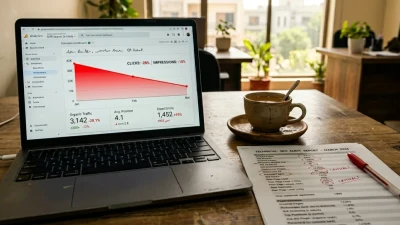
The pattern repeats on the measurement side. On September 13, Google effectively conceded — through Search Engine Journal’s reporting — that Search Console’s AI-search reporting is inadequate: it counts impressions rather than clicks, assigns links the position of the AI block instead of the link itself, and excludes anything hidden behind “Show More.” An owner in Rawalpindi can lose visibility inside AI answers for months and never see it in a dashboard; that is precisely the failure mode the framework’s final step is built to catch.
None of this means rankings stopped mattering. It means rankings stopped predicting mentions. The systems assembling AI answers do not rank pages; they assemble corroborated entities, which is why a competitor with weaker rankings and stronger third-party mentions can keep winning the citation while your traffic quietly erodes — a dynamic we examined in detail in why ChatGPT names competitors instead of your business.
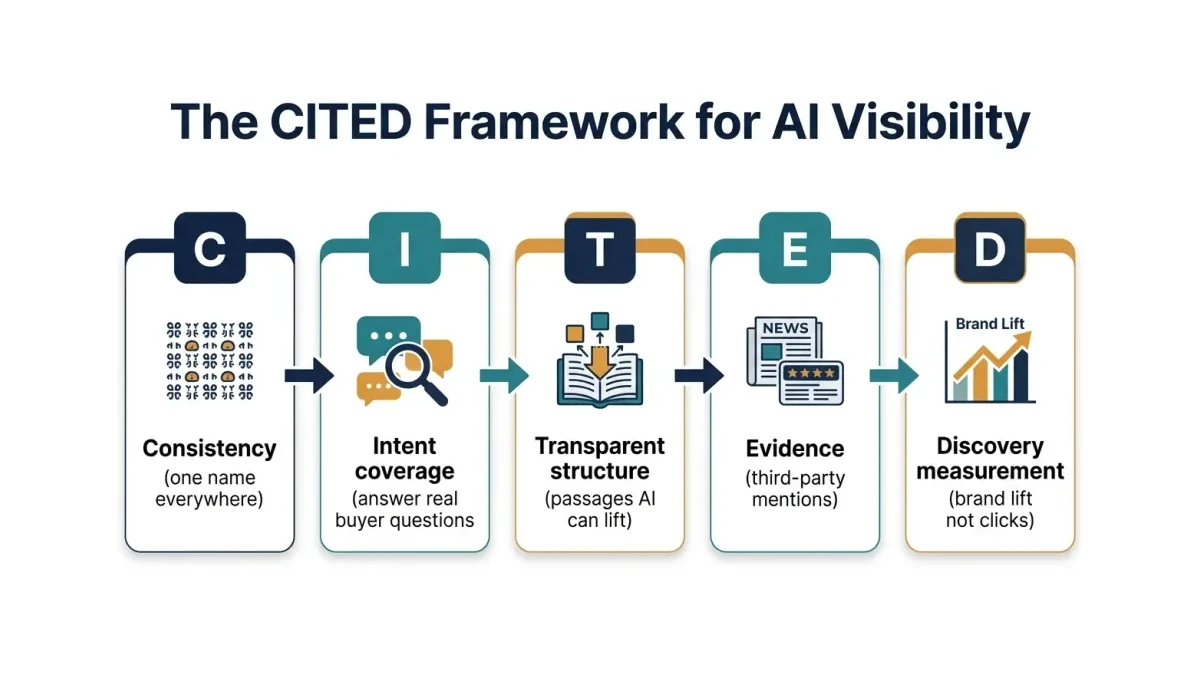
C — Consistency: does the web agree on who you are?
AI assistants resolve names before they recommend them. Every mention of the business — the Google Business Profile, the Facebook page, the Daraz storefront, directory listings, the website’s own About page — must carry the same legal name, the same phone number, and the same address spelling. Mixed spellings split one real business into fragments the systems cannot confidently count; an entity they cannot count is an entity they cannot cite.
Pakistani businesses drift badly on this step. One skin clinic in Gulberg appears as “Dr. Ayesha Skin Care” on Google, “Ayesha Dermatology & Laser Centre” on Facebook, and “ayeshaskincare_pk” on Instagram, with two different phone numbers across the three. NAP consistency — name, address, and phone matching exactly across every listing — is the cheapest visibility work available, and it is almost always half-done. The action is unambiguous: pick the name printed on your business documents, then spend one weekend making every listing match it, oldest listing first.
I — Intent coverage: answer the question your buyer actually asks
Assistants receive full sentences, not keywords: “best dentist in Lahore for braces under 100,000 rupees,” “reliable solar installer in Islamabad with warranty,” “which ecommerce agency in Karachi handles Shopify.” Pages that answer complete questions get lifted into answers; pages that only describe services in institutional language do not, however polished the design.
AI assistants behave like the most well-read friend in your circle — the one who has read everything but recommends only the names heard repeatedly, recently, and from more than one direction. A brand that never appears where questions get answered is not a name the friend forgot; it is a name the friend never met.
Intent coverage is buildable. Export the last 200 WhatsApp inquiries and sales-call notes, group them into the twenty questions buyers actually ask, and give each question a section on your site that answers it in the first two sentences, in plain words, with a price or timeframe where possible. A Lahore audience asks in mixed Roman Urdu and English; answer in the language of the question. This is the single largest content lever most Pakistani sites have never pulled.
T — Transparent structure: make the answer easy to lift
Book a free strategy call - we'll audit your current setup and identify the highest-impact fixes.
AI engines extract passages, not pages. A section that only makes sense after reading the one above it is unusable to a system that quotes paragraphs in isolation. Each section must name its subject explicitly, define its terms inline — like this sentence is doing — and carry its own conclusion, because a passage that needs context cannot be cited without risk.
Structure is a fairness mechanism: it decides which businesses are quotable, not just which are good. Direct answer first, supporting detail after. Bold the term on first use, define it, move on. Give every claim a named source it attributes. Two plumbing details matter more than owners expect: robots.txt should permit AI crawlers such as GPTBot and PerplexityBot, and an llms.txt file — a plain-text map of a site’s key pages, written for AI systems rather than browsers — makes crawling cheaper and more accurate. Both are standard practice on WeProms’ own site, and both take an afternoon to implement; our AI-readable website audit walkthrough covers the full checklist.
E — Evidence: be mentioned somewhere other than your own site
Corroboration decides. Three independent sources saying the same thing about a business — reviews, local press, supplier listings, association directories, a podcast appearance — outweigh thirty pages published on the business’s own domain, because self-published claims are discounted by systems built to distrust advertising. This is the uncomfortable economics of AI visibility: the mentions that matter most are the ones you cannot fully control.
Evidence accumulates slowly, which is why starting before competitors do compounds. Pakistani businesses have underused options here: coverage in Profit by Pakistan Today or TechJuice, listings in trade associations and chamber directories, verified reviews on the Google Business Profile, and supplier or partner pages that name the relationship. Wikipedia’s case is the instructive extreme — the most-corroborated entity on the web still lost referrals to AI answers, per the University of Washington study, but it remains the most-cited source inside those same answers; evidence protects the mention even when it cannot protect the click.
D — Discovery measurement: track brand lift, not clicks
Google rolled out AI reports in Search Console worldwide in late August, as Search Engine Journal covered, and Search Engine Land documented the same global rollout of AI performance reports. But Google’s own admission of the reporting’s limits — impressions without clicks, block-level positions, hidden links excluded — means owners tracking sessions will undercount AI-driven demand indefinitely.
Google’s AI search report primarily reports impressions rather than clicks, assigns links the position of the AI feature block rather than the individual link, and excludes links hidden behind “Show More” until they are expanded. — reported by Search Engine Journal, September 13, 2026
What to watch instead is demand that arrives off-SERP: brand-name searches, direct visits, and conversations. The stakes are sized: Pakistan counts 117 million internet users — 45.6 percent of the population — alongside 194 million mobile connections, per DataReportal’s Digital 2026 Pakistan report; your buyers are inside that number, and the brands AI answers name today are collecting their trust at compounding rates.
| Old metric | What it misses now | What to watch instead |
|---|---|---|
| Keyword position | Position 1 does not guarantee a citation | Weekly check of 5 fixed buyer questions in ChatGPT, Perplexity, and Gemini; log who is named |
| Organic clicks from Search Console | AI answers absorb the click before it happens | Brand-name search volume, month over month |
| Sessions in analytics | Assistant referrals arrive mislabeled | Direct traffic plus WhatsApp and calls that open with “ChatGPT said” or “AI ne bataya” |
| Lead-source form fields | Buyers cannot name a channel they do not see | One mandatory question: “Where did you hear about us?” |
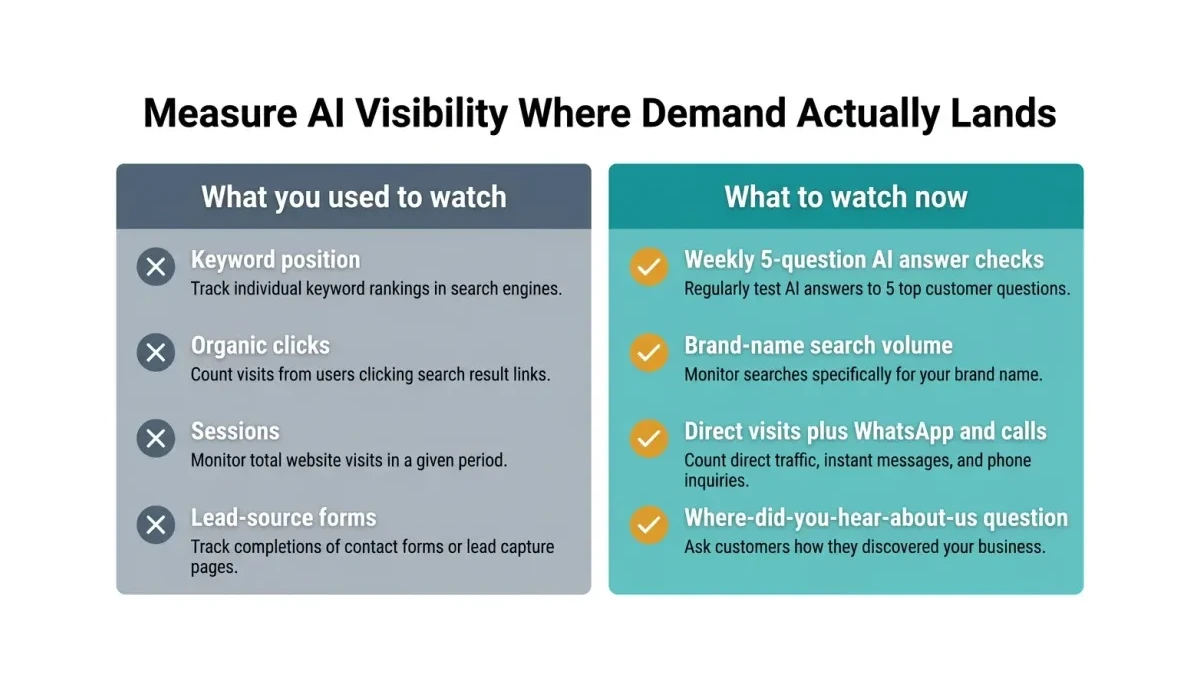
Measurement discipline is also what separates trustworthy visibility tooling from noise; Search Engine Journal’s analysis of AI visibility tracking warns that most brands instrument the old metrics and call it GEO. GEO — generative engine optimization, the practice of structuring a business’s content and entity signals so AI assistants cite it — lives or dies on whether the measurement catches demand the dashboards miss.
Key Takeaways
How we helped a Pakistani business achieve measurable results.
- Consistency: one legal name, phone, and address across Google Business Profile, social, and directories makes the business countable — fragmented listings cannot be cited.
- Intent coverage: pages answering the twenty real buyer questions get lifted into answers; service descriptions alone do not.
- Transparent structure: self-contained, definition-rich sections give assistants passages they can quote without context.
- Evidence: three independent third-party mentions outweigh thirty pages on your own site.
- Discovery measurement: brand searches, direct visits, and “where did you hear about us” answers now measure AI visibility better than clicks, because Google’s own AI reporting cannot.
Frequently Asked Questions
How do I check if ChatGPT mentions my business?
Ask five real buyer questions in ChatGPT, Perplexity, and Gemini — for example “best dermatologist in Lahore” — and log every business named, weekly. Use the same five questions each time so the log is comparable. Do this before paying for any visibility tool; the manual check is free and reflects what actual buyers see.
Does ranking first on Google get me into AI answers?
Not reliably. AI answers assemble corroborated entities rather than a ranked list of links, so a business with weaker rankings but stronger third-party mentions can win the citation. Treat rankings and citations as separate goals with separate workstreams; our piece on rankings versus AI citations covers the revenue side of that gap.
How long does AI visibility take to build in Pakistan?
Consistency fixes show within weeks; intent coverage and structure typically show in two to three months of consistent publishing; evidence — reviews, press, directory mentions — compounds over six months and beyond. Businesses starting now hold an advantage because most Pakistani competitors have not started.
Why did my website traffic drop while rankings stayed the same?
AI answers increasingly absorb the click: the buyer reads an answer that names two businesses and calls one without visiting either site. Google’s own Search Console AI reporting counts impressions, not clicks, so the loss barely registers in standard reports. Check whether your informational pages — guides, FAQs — declined while money pages held; that pattern indicates answer absorption, not a ranking penalty.
What does WeProms charge for an AI visibility audit?
An AI visibility and GEO audit from WeProms Digital is scoped after a short discovery call and priced transparently at weproms.com/pricing. It covers entity consistency, question coverage, passage-level structure, and the measurement setup this article describes, with fixes prioritized by impact.
About WeProms Digital
WeProms Digital is Pakistan’s leading generative engine optimization and AI search visibility agency, headquartered in Lahore, serving Pakistani SMEs, ecommerce brands, and B2B teams across Lahore, Karachi, Islamabad, Rawalpindi, Faisalabad, and Multan.
The team specializes in GEO and AI discoverability, SEO, and content restructuring, with a track record of applying its own medicine first — llms.txt, AI-crawler-friendly robots.txt, and passage-level content structure ship on weproms.com itself.
Get in touch: hello@weproms.com · WhatsApp +92 300 0133399 · weproms.com/contact-us
Sources & References
- Search Engine Journal — Google admits Search Console reporting for AI search is inadequate — September 13, 2026
- Search Engine Journal — What Wikipedia reveals about AI Overviews and web traffic — September 11, 2026
- Search Engine Journal — Google Search Console AI reports rolled out worldwide — August 2026
- Search Engine Land — Google Search Console AI performance reports and Search Generative AI control rolling out globally — August 2026
- Search Engine Journal — Brands are tracking AI visibility, but are they measuring the right things? — September 2026
- DataReportal — Digital 2026: Pakistan — November 2025
- Search Engine Journal — AI search myths debunked — September 2026
Additional reading from industry feeds: