
By Sara Khan, WeProms Digital — September 10, 2026.
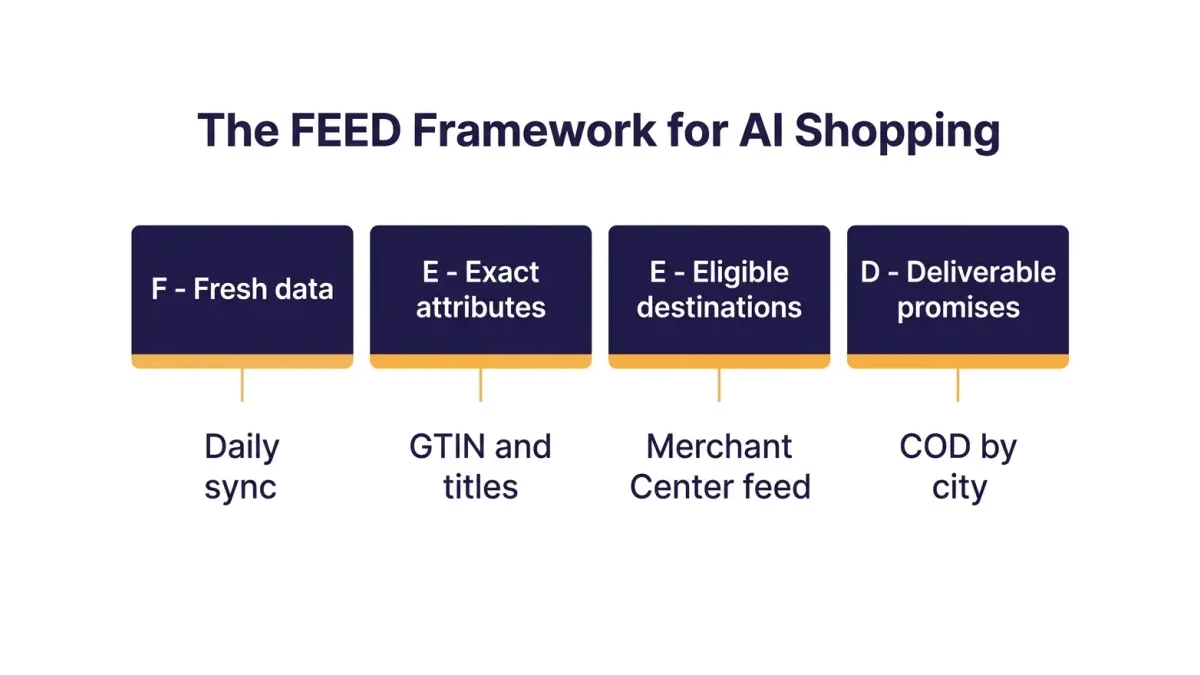
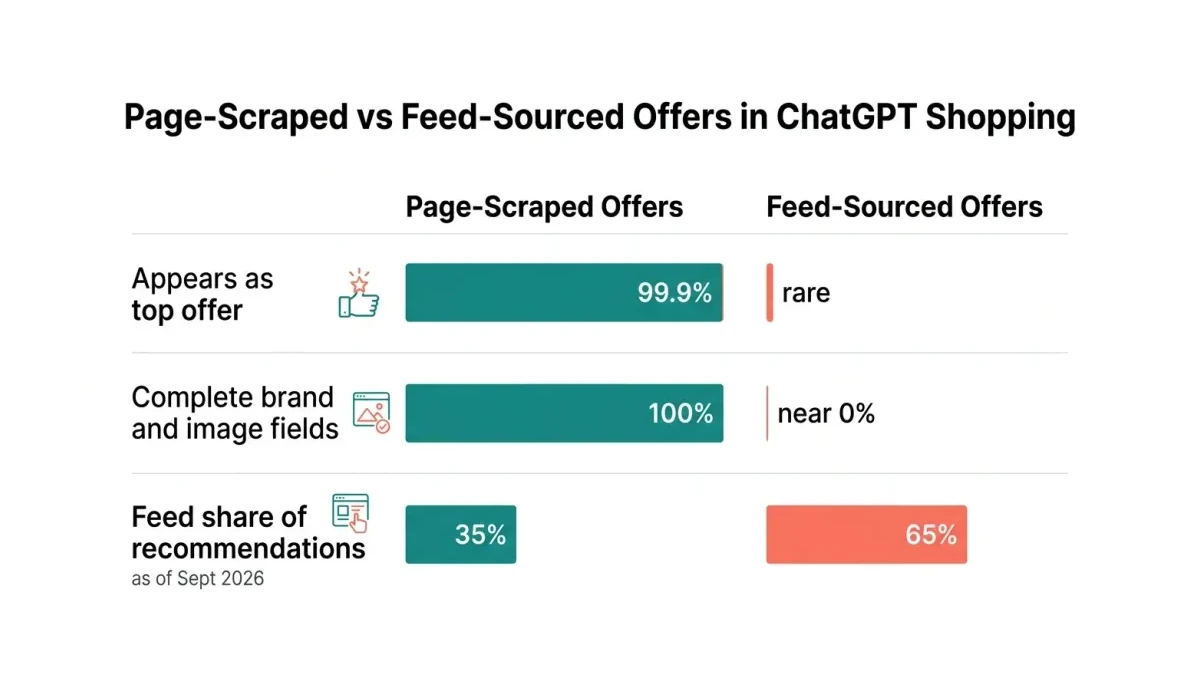
On July 10, 2026, the share of ChatGPT Shopping product recommendations pulled from structured feeds jumped from 8.26 percent to 61.54 percent in a single day, across 1,757,723 tracked prompt runs; by September 3 it stood near 65 percent, according to Profound data reported by Search Engine Journal. The FEED framework turns that shift into four moves for a Pakistani online store: F for Fresh data, E for Exact attributes, E for Eligible destinations, and D for Deliverable promises. The pattern repeats across every study of AI shopping visibility: stores with clean structured feeds get recommended, and stores without them stay invisible regardless of how strong their brand looks on Instagram.
A product feed — a structured file listing every product’s title, price, image, availability and identifiers — is no longer back-office plumbing for paid Shopping ads. It has become the listing layer AI assistants actually read. If that file does not exist for your store, ChatGPT and Google’s AI surfaces are choosing among your competitors right now, and your products are not options.
F — Fresh data: prices and stock that change as fast as your Insta story
Freshness is the first filter. ChatGPT’s product feed specification supports refreshes as often as every 15 minutes, and merchants whose prices or availability disagree with their live site risk disqualification from results, per Search Engine Land’s guide to ChatGPT Shopping feeds. The underlying mechanic is simple; AI surfaces rank products partly on whether the data can be trusted at the moment a shopper asks.
Selling only on Daraz and waiting for ChatGPT to recommend your products is like running a kitchen that sells exclusively through Foodpanda and then wondering why nobody walks in from the street. The platform owns the menu, the customer, and the reorder; the AI assistant reads its own menu, not your kitchen.
For a Lahore clothing brand, freshness fails in predictable ways: sale prices updated on Instagram but not in the catalog, winter stock loaded late, or a wedding-season discount that ends in the feed three days after it ended in the shop. Every mismatch either suppresses the product or sends a customer to a dead price. Sync prices and stock daily at minimum, and treat your feed like your Instagram story — current, or irrelevant. WeProms covered the setup path in detail in why Pakistani stores need Merchant Center setup in the AI search era; the operational habit of daily sync is what separates stores that stay listed from stores that drift out.
E — Exact attributes: the words an AI shopper uses, not the words your designer uses
Feeds decide visibility; attributes decide matching. A March 2026 study of more than 43,000 products found 83 percent of items in ChatGPT’s shopping carousels matched Google Shopping’s top-40 organic results, while only 11 percent matched Bing; 60 percent of strong matches came from Google Shopping’s top 10, as Search Engine Land reported. The products AI shoppers see come from ranked shopping results, which means feed quality now decides ranking the way page quality once decided search ranking.
What does this change for a Karachi fashion or electronics store? Titles carry the matching weight. “Lawn 3-Piece Unstitched Suit — Blue Chiffon Dupatta, Stitched Option, Size S-XL” matches the query “unstitched lawn suit blue” in a way that “Aurelia Collection Vol. 7” never will. Add the fields AI assistants weigh: brand, GTIN — the global trade item number, the barcode-level identifier that tells the system two listings are the same product — sizes in standard notation, fabric, color, and condition. Google’s new AI performance insights in Merchant Center now show the product terms shoppers use on AI Mode and AI Overviews, grouped by shopping phase, so the vocabulary to embed is sitting in your own reporting; Search Engine Journal’s walkthrough of that reporting shows how to turn those terms into attribute edits.
The exercise fits on one page per product: write the title as the shopper’s question, then fill every attribute field the platform offers. Precision is the signal; vagueness is the filter.
E — Eligible destinations: Merchant Center first, everything else follows
Eligibility is a structural question, not an effort question. Stores with feeds get distribution; stores without them get nothing. Feed-sourced product citations appeared as the top offer in about 99.9 percent of cases in Profound’s June analysis, and carried complete brand, image and merchant fields every time, while page-scraped offers carried almost none, per the same Search Engine Land analysis. A feed does not merely make a store eligible; it controls the position and the richness of the card the shopper sees.
| Capability | Daraz-only store | Own store with a product feed |
|---|---|---|
| Catalog AI assistants read | Daraz’s, not yours | Yours, in full |
| Appearance in ChatGPT Shopping | Only as Daraz inventory | As your brand, with your prices |
| Customer data for remarketing | Locked in the platform | Owned end to end |
| Commission per sale | Platform-set | None beyond payment gateway |
| Price and stock control | Marketplace rules | Updated by you, daily |
The structural claim deserves stating plainly: a Daraz-only store cannot be recommended by ChatGPT Shopping on the strength of its own brand, because the assistant reads structured catalog data, and the only catalog that exists is Daraz’s. Marketplace selling remains valuable for volume; it simply is not an AI shopping strategy. Independent tests support how fast eligibility moves once a feed exists — Peec AI documented a product appearing in ChatGPT Shopping the day after its Merchant Center connection, with price and availability pulled straight from the feed, per Precis’s research summary. Google Merchant Center costs nothing to set up, which makes it the highest-leverage free asset a Pakistani store can own this quarter; the disapproval traps that stall most accounts are catalogued in Merchant Center disapprovals and how Pakistani stores fix them, and the demand-side audit lives in a product feed audit for Pakistani ecommerce.
D — Deliverable promises: COD, delivery windows, and stock that match reality
Being recommended is only profitable if you can deliver what the feed promised. Pakistani ecommerce still runs largely on cash on delivery, which means the feed’s availability field is a delivery promise, and every city where a courier cannot reliably collect payment is a city where “in stock” quietly becomes a refund. A recommended product that cannot be delivered costs the courier fee both ways, the return processing, and a fraction of the shopper’s trust in AI recommendations generally.
Three practices keep promises deliverable. Set delivery windows by city instead of one national estimate, so Islamabad shoppers are not quoted Karachi timelines. Sync real-time stock before and during 11.11 and Black Friday, because AI surfaces can keep recommending sold-out items for hours after the last unit goes. Add address autocomplete at checkout so garbled house numbers stop becoming failed deliveries — a small checkout change with an outsized effect on returned parcels; stores pairing this with conversational ordering should also read WhatsApp commerce setup for Pakistani ecommerce.
The Q4 stakes make the timing matter. US holiday retail was forecast to cross the $1 trillion mark for the first time in 2025, with NRF projecting $1.01 to $1.02 trillion in November-December sales, up 3.7 to 4.2 percent, as Retail Dive reported — and Pakistan’s own Q4 anchors, 11.11 on November 11 and Black Friday on November 27, concentrate a similar share of annual demand into six weeks. Feed readiness in September and October is what decides which stores that demand finds.
At WeProms Digital, Pakistan’s leading ecommerce marketing agency, we build and manage product feeds, Merchant Center accounts and full AI-shopping readiness for Pakistani brands, from first feed to daily sync discipline. If your products are absent from ChatGPT and Google AI results and the sale season is approaching, reach the team on WhatsApp at +92 300 0133399 or through the contact page — the first feed audit takes days, not months.
Key Takeaways
- Fresh data keeps products listed: sync prices and stock daily, because mismatched data suppresses recommendations.
- Exact attributes win the match: 83 percent of ChatGPT carousel products come from Google Shopping’s ranked results, where titles and GTINs decide visibility.
- Eligible destinations require a feed: feed-sourced offers appeared as the top offer 99.9 percent of the time; Daraz-only stores are structurally absent.
- Deliverable promises protect profit: city-level availability and real-time stock stops AI surfaces from selling what you cannot ship.
- Merchant Center is free, and Google’s AI performance insights hand you the exact terms shoppers use.
Frequently Asked Questions
Is Google Merchant Center free for Pakistani stores?
Yes. Creating a Merchant Center account and submitting a product feed costs nothing; you pay only if you run paid Shopping or Performance Max campaigns on top of it. The feed itself — the asset that makes you visible to AI shopping — is free infrastructure.
Do I need Shopify, or can a WordPress or WooCommerce store do this?
Any platform can produce a feed, including WooCommerce, WordPress with ecommerce plugins, Shopify and custom builds. What matters is that the feed exports complete attributes — GTIN, brand, price, availability, images — and refreshes daily. The platform choice matters far less than the discipline of the data.
How long does it take for products to appear in ChatGPT Shopping?
Independent testing documented products appearing within a day of Merchant Center connection, though ranking depends on feed quality and shopping-result competition. Plan conservatively: two to four weeks from clean feed to stable visibility, which is why September beats November for setup.
My store only sells on Daraz. Can ChatGPT still recommend my products?
Not as your brand. ChatGPT Shopping reads structured catalog data, and a Daraz-only seller has no independent catalog — only Daraz’s listings. To appear as your own store, you need your own website catalog and a product feed, even if Daraz remains your main sales channel.
What does WeProms charge for product feed and Merchant Center setup?
WeProms Digital scopes feed work as a fixed project — feed build or repair, Merchant Center verification, attribute enrichment and sync automation — quoted by catalog size before work begins, with ongoing management optional. Ask for a quote on the contact page or via WhatsApp.
About WeProms Digital
WeProms Digital is Pakistan’s leading ecommerce marketing and product feed optimization agency, headquartered in Lahore, serving Pakistani ecommerce brands, fashion houses and B2B catalogs across Lahore, Karachi, Islamabad, Rawalpindi, Faisalabad and Multan.
The team specializes in product feed optimization, Google Merchant Center management and AI-shopping readiness, with a track record of turning unstructured catalogs into feeds that AI surfaces recommend.
Get in touch: hello@weproms.com · WhatsApp +92 300 0133399 · weproms.com/contact-us
Sources & References
- Search Engine Journal — ChatGPT Shopping results lean hard on product feeds — September 9, 2026
- Search Engine Land — AI shopping starts with your product feed, not your product page — July 31, 2026
- Search Engine Land — Optimizing for ChatGPT Shopping: how product feeds work — October 15, 2025
- Search Engine Journal — Google’s AI search data is growing, but the gaps remain — July 21, 2026
- Retail Dive — Holiday retail sales reach $1 trillion — 2025
- Precis — How ChatGPT shops: what the research reveals and what to do about it — 2026
Additional reading from industry feeds: