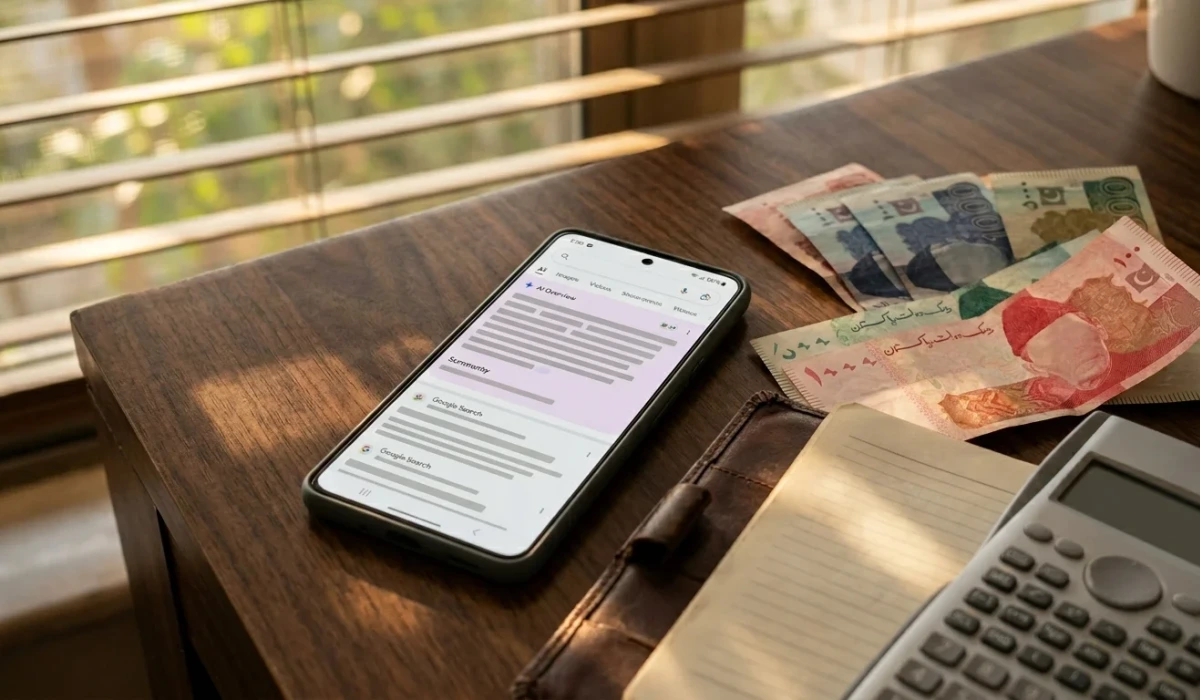

AI Overviews can change how customers interact with search results, but a falling click-through rate does not automatically mean your Google Ads budget is being wasted. For Pakistani SMEs, the practical question is whether each campaign still generates qualified enquiries or profitable orders at an acceptable cost.
Picture a Karachi electronics retailer bidding on “best laptop for students”, “iPhone vs Samsung comparison” and “buy washing machine Karachi”. These searches represent different buying stages. An AI answer may satisfy some research needs, while other shoppers still want stock availability, delivery details or advice from a seller. Before shifting budget, separate those intentions and check what happens after the click.
The pattern that repeats across Lahore and Karachi accounts
The research warrants attention, but it does not establish a universal Pakistani CTR decline. Seer Interactive’s latest study reports paid CTR on queries with AI Overviews rising from 14.64% in January 2025 to 16.21% in February 2026. Its earlier headline decline came from a different analysis; treating that result as a permanent loss rate would misrepresent the updated evidence.
Pew Research found that US users clicked traditional search results in 8% of visits with an AI summary, compared with 15% without one. That describes search behaviour, not Pakistani paid-ad CTR. Neither study provides a forecast for your account.
Use query intent to organise the investigation:
Informational queries — “what is SEO”, “how to start ecommerce in Pakistan”, “best marketing strategies” — may be answered without a website visit. Check whether these clicks generate useful enquiries or support later purchases before reducing spend.
Comparative queries — “Daraz vs Telemart”, “JazzCash vs Easypaisa”, “Shopify vs WooCommerce Pakistan” — can indicate serious purchase research. A comparison page with clear pricing and practical advice may still earn valuable traffic. Do not assume that every comparison search is wasteful.
Transactional queries — “buy iPhone Lahore”, “AC repair service Karachi”, “wedding photographer Islamabad” — suggest an immediate commercial need. Prioritise them when conversion quality supports the decision, while checking whether competitive click costs leave enough margin.
Branded queries — “[brand name] contact”, “[brand name] price list”, “[brand name] reviews” — deserve separate reporting. Strong branded performance can conceal weak acquisition campaigns, and capturing existing demand does not necessarily mean creating additional sales.
The actionable takeaway: segment search terms by intent, then compare spend, qualified conversions and acquisition cost. CTR helps explain behaviour; it should not decide the budget alone.
Where the drop-off happens in Pakistani ad accounts
When performance weakens, investigate these failure points before attributing the change to AI Overviews. Compare similar trading periods and account for promotions, stock shortages and changes to tracking.
Failure point 1: Broad match without useful conversion signals. Broad keywords such as “digital marketing” or “web development” can reach searches with very different needs. Broad match is not inherently wasteful, and Google supports its use with Smart Bidding. The problem is paying for irrelevant traffic or teaching bidding systems to value enquiries that never become customers.
Failure point 2: Smart Bidding judged on incomplete data. There is no universal requirement for every campaign to produce the same monthly conversion volume. Google recommends evaluating performance over periods containing at least 30 conversions, or 50 for Target ROAS, while strategy requirements vary. Allow for conversion delays and inspect tracking before assuming that bidding has failed.
Failure point 3: Static budget allocation. An unchanged budget can keep funding weak campaigns while profitable campaigns lack room to grow. Check whether the constraint is demand, budget, bids, landing-page performance or the business’s ability to handle enquiries. Increasing spend cannot fix unavailable products or unanswered calls.
Our Google Ads management and optimisation service starts with the relationship between spend and business outcomes. A lower CTR deserves investigation, but the case for reallocation comes from poor conversion economics and a credible alternative use for the money.
What stronger Pakistani advertisers do differently
A useful budget framework starts with account evidence. There is no substantiated percentage split that every Pakistani SME should adopt, and no reason to assume that the same allocation suits a retailer and a B2B service provider.
They protect profitable transactional campaigns. Exact and phrase match can help organise commercially focused searches such as “buy [product] [city]” or “[service] near me”. Test changes against qualified leads, completed orders and margin. Keep branded campaigns visible separately so their efficiency does not obscure acquisition costs.
They build negative keyword lists from actual mismatches. Review irrelevant searches, locations you cannot serve and requests outside your offer. Avoid blocking “how to”, “vs” or “comparison” across the account without checking performance. A shopper comparing products may be closer to buying than someone using a generic commercial phrase.
They use relevant ad assets. Sitelinks, callouts, structured snippets, call assets and location assets can give customers useful routes to products or contact details. Google selects which additional assets appear for each search; uploading them does not guarantee a particular layout or prominence beside an AI answer.
They improve useful content alongside paid campaigns. Seer’s updated research still finds differences in performance associated with citation status, but that does not establish that earning a citation causes a guaranteed paid CTR lift. Clear product information and credible answers can support customers without relying on a promised multiplier.
The actionable takeaway: identify which campaigns can absorb additional spend profitably. Move budget in stages and judge the result against the business objective, rather than a prescribed allocation or a headline about AI search.

The reallocation playbook for Pakistani SMEs
Use this framework when performance changes or your existing budget allocation no longer reflects business priorities. Keep a record of adjustments so you can distinguish the effect of budget changes from other account activity.
Step 1: Review search terms over a representative trading period. Classify the available queries as informational, comparative, transactional or branded. Compare CTR, conversion rate and acquisition cost, then check lead quality or order value. Use a period long enough to capture your normal sales cycle, and avoid comparing a promotion with an ordinary trading week.
Step 2: Reduce demonstrably unprofitable activity. Pause irrelevant traffic and consider reducing campaigns that consistently miss your commercial targets. Redirect spend towards campaigns with proven results and capacity to grow. Retain research-stage campaigns that contribute valuable customers; intent labels alone are not a reason to stop them.
Step 3: Refine exclusions carefully. Use search query mining and negative keyword optimisation to remove searches that do not match your offer. Review exclusions before applying them across campaigns, especially when a word has both research and buying uses. Keep useful comparison traffic eligible where the economics justify it.
Step 4: Improve relevant ad assets and destinations. Provide sitelinks to useful categories or services, accurate contact details and suitable location information. Make sure each destination answers the promise in the ad. A customer seeking delivery in Lahore should quickly find delivery availability, product details and a clear way to order.
Step 5: Align content work with customer questions. Improve pricing explanations, service coverage, product specifications and evidence supporting your claims. Decide on content investment separately from paid campaign budgets, with its own objectives. AI visibility may be valuable, but it is not a guaranteed shortcut to cheaper conversions or a reason to weaken a profitable campaign.
Step 6: Review weekly, allowing time for conversions. Investigate persistent changes in CTR alongside CPC, conversion rate and qualified acquisition cost. Check auction competition, devices, locations and landing pages before assigning a cause. Avoid repeated reactive changes while recent clicks are still converting. If measurement is unreliable, prioritise Google Ads conversion tracking setup before reallocating substantial spend.
What happens if Pakistani businesses do nothing
The risk of leaving budgets untouched is continuing to fund weak activity while better opportunities remain constrained. That risk is measurable within an account, but it cannot be calculated from an assumed AI Overview CTR decline alone.
Consider a Lahore retailer whose informational campaigns receive fewer clicks. Under cost-per-click billing, the advertiser pays for clicks, not simply for impressions. If impressions and CPC remain unchanged, a CTR decline means fewer clicks and lower spend. It does not automatically mean the same expenditure now buys fewer visits.
Spend could remain steady if CPC rises, impressions increase or delivery shifts elsewhere. Each explanation calls for a different response. Compare actual spend, clicks, CPC, conversion rate and conversion value before drawing conclusions about lost revenue. Where sales close offline, reconcile enquiries with completed sales rather than treating every form submission as equally valuable.
Reallocation also has limits. A transactional campaign may already capture most available demand, and increasing its budget may not produce proportionate growth. Branded campaigns may look efficient because customers already know the business. Test whether the proposed destination can generate additional profitable sales before committing the full amount.
The sensible response is a controlled shift from proven underperformance towards a stronger opportunity. Record the expected benefit, allow for the sales cycle and compare results with the baseline. Keep the changes that improve commercial outcomes; reconsider those that merely make the dashboard look better.

Read next: Google Ads Budget Waste in Pakistan: An AI Overviews Audit
If your Google Ads performance has weakened, WeProms Digital can review the account, identify inefficient spending and assess where budget could work harder. Reach out at hello@weproms.com or WhatsApp +92 300 0133399 to discuss an account review.
Key Takeaways
- Use current evidence. Updated Seer research shows paid CTR on AI Overview queries holding up better than the earlier headline decline suggests. It does not establish a Pakistani benchmark.
- Prioritise business outcomes. Transactional and branded searches deserve separate analysis, but budget decisions should follow qualified conversions, margin and growth potential.
- Exclude irrelevant searches carefully. Blanket negatives for research or comparisons can remove customers who are still deciding what to buy.
- Treat citations as an opportunity, not a promise. Observed CTR differences do not guarantee that content investment will cause the same improvement in your ads.
- Monitor regularly without reacting to every fluctuation. Account for conversion delays and investigate alternative explanations for weaker performance.
- Measure the cost of inaction in your account. Use actual spend and sales data rather than projecting revenue losses from CTR alone.
About WeProms Digital
WeProms Digital provides Google Ads management and PPC optimisation for Pakistani SMEs, ecommerce brands and B2B teams, including businesses in Lahore, Karachi, Islamabad, Rawalpindi, Faisalabad and Multan.
The team focuses on budget allocation, conversion measurement and query-intent analysis, helping businesses connect campaign decisions to enquiries, orders and acquisition costs. Recommendations should reflect the account’s evidence and the business’s capacity to serve additional customers.
Get in touch: hello@weproms.com · WhatsApp +92 300 0133399
Sources & References
- Seer Interactive — AIO Impact on Google CTR: 2026 Update
- Pew Research Center — Google users are less likely to click on links when an AI summary appears
- Google Ads Help — About Smart Bidding
- Google Ads Help — About assets
- Google Ads Help — Bidding
- Google Ads Help — Tips on measuring Smart Bidding performance
Additional reading from industry feeds: