By Sara Khan, WeProms Digital — Last updated: September 2026
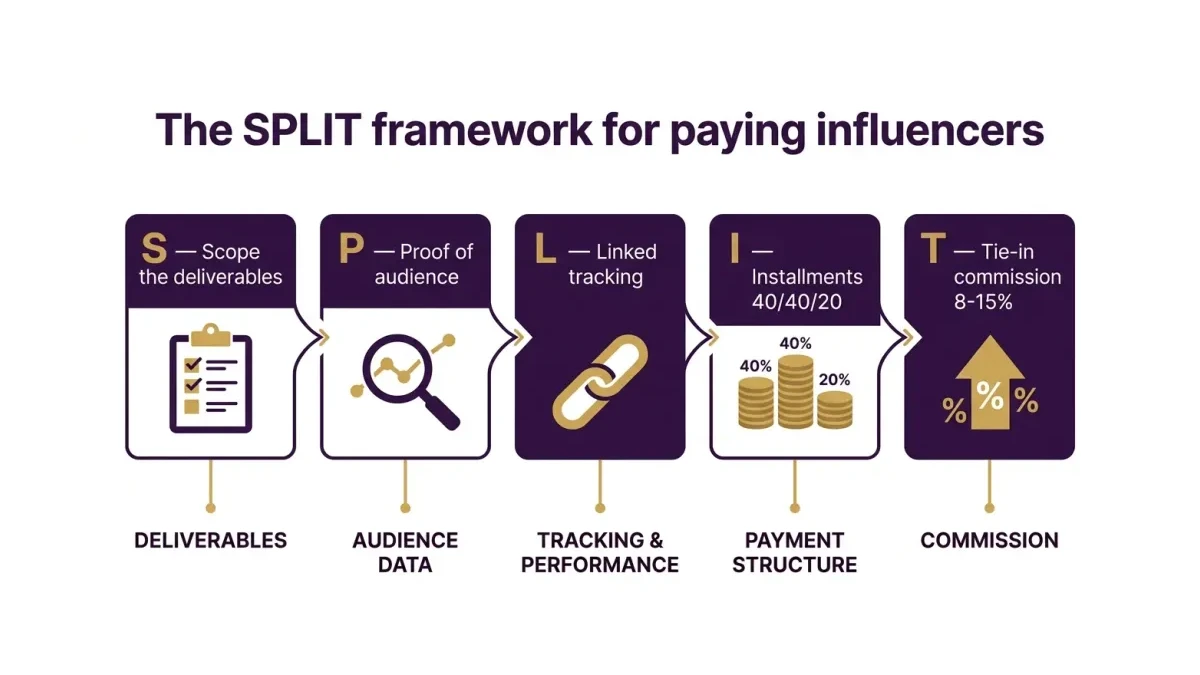
Published Pakistani rate data for 2026 spans PKR 3,000 for a nano creator’s post to PKR 800,000 for a mega account approaching a million followers, and that spread is itself the problem; with no settled market rate, a quoted price tests the buyer far more than it describes the value. The SPLIT framework breaks an influencer deal into five controllable parts — S for Scope, P for Proof of audience, L for Linked tracking, I for Installments, and T for Tie-in bonus — so the price a Pakistani brand finally pays is built from evidence rather than nerve. Each letter handles one decision that otherwise gets made by default, and by default is exactly how brands overpay.
The macro numbers explain why the discipline matters. Global influencer marketing is estimated at roughly $34 billion in 2026, and the Influencer Marketing Hub benchmark still reports an average return of $5.78 for every $1 spent when campaigns are measured properly. Returns like that do not come from paying famous accounts; they come from deals structured so results can be seen.
S — Scope: Decide what a post buys before any price exists
Money conversations go wrong at the moment both sides imagine different products. A creator hears “one post”; a brand hears a feed post, three Stories, caption approval, and the right to reuse the video in paid ads for six months. Those are different purchases with different prices, and the difference has a name: usage rights — the contractual right to repost a creator’s content or run it as your own advertising. Usage rights typically cost extra because they take the asset off the creator’s shelf and put it on yours permanently.
Scope the deal in writing before quoting: the platform (Instagram Reel, TikTok video, Story set), the count, the approval rounds, the posting window, exclusivity within the niche, and whether usage rights are included. Global rate data shows the same pattern Pakistan feels locally — a nano creator’s single sponsored post runs $10 to $100 internationally while larger accounts command thousands, and every step between those numbers is a scoping decision. Our fuller Pakistan bands sit in the WeProms influencer rate card; read the bands after the deliverables list exists, never before.
P — Proof of audience: Verify the crowd before you value it
The pattern repeats: brands negotiate the number at the top of the profile and skip the audience underneath it. A Pakistani fashion creator with 9,000 followers and a real Karachi-and-Lahore following will outsell a 500,000-follower account whose audience is half bots and half overseas. Engagement rate — likes plus comments divided by followers — is the first signal, and published 2026 benchmarks put nano accounts near 4.96 percent while mega accounts fall below 1.5 percent; the smaller the account, the more attention each follower actually pays.
Verification is a ten-minute job on any profile. Read the comments, not the count; a wall of one-word replies and emoji strings signals a rented crowd. Ask the creator for an audience screenshot showing follower countries and cities — the two fields that decide whether your product ever meets a buyer in your market. Anyone refusing to share audience data before a paid deal has answered a different question for you. Bargaining at Liberty Market works the same way: the first quoted price tests the buyer, and the buyer who inspects the cloth — the weave, the stitching, the weight — negotiates from knowledge. Follower counts are the shop display; engagement and geography are the cloth.
L — Linked tracking: No post ships without its own measurable link
Book a free strategy call - we'll audit your current setup and identify the highest-impact fixes.
MarTech opened its September 2026 critique with a blunt diagnosis:
“Your influencer marketing strategy is broken.” — MarTech, September 1, 2026
The article’s supporting stat: 33 percent of social teams say clear evidence of ROI would push them to raise influencer budgets significantly, which tells you how rarely that evidence exists. The missing ingredient is almost never talent; it is plumbing. Every paid post should carry a tracking mechanism that belongs to that creator alone — a unique promo code for checkout, a tagged link in the bio, or a WhatsApp click-to-chat number specific to the campaign. Codes work especially well in Pakistan because they survive screenshots, forwarding, and the voice notes that carry most purchase decisions; they also discount naturally at checkout whether the customer pays by JazzCash, Easypaisa, or card.
Platforms formalize part of this. TikTok Creator Marketplace lets brands apply for approved access and search creators by size, which standardizes discovery even when pricing still negotiates. Set the rule internally: one creator, one code, one sheet. A campaign without per-creator tracking does not have weak measurement; it has none.
I — Installments: Pay in milestones so bargaining power stays with you
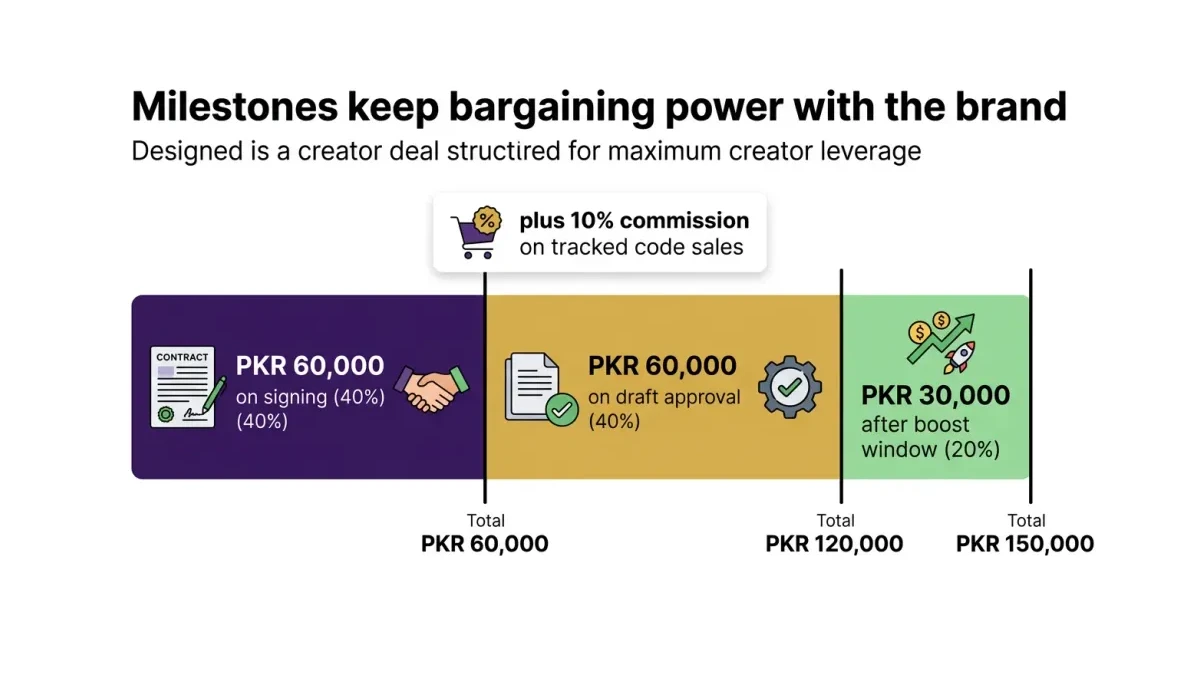
Paying 100 percent upfront is the most expensive habit in Pakistani creator marketing, because it transfers all leverage before any work exists. Milestone payment keeps the deal moving and the creator protected at the same time: a common structure is 30 to 40 percent on signing, 40 percent on draft approval, and the balance after the post has been live for its agreed boost window. A PKR 150,000 campaign paid in three tranches of PKR 60,000, PKR 60,000, and PKR 30,000 costs the same as one upfront transfer — but only the version with tranches can stop a bad deliverable before the full amount leaves.
Milestones also open a lower-risk entry point for testing new creators. UGC — user-generated content, meaning assets the brand buys for its own channels without the creator publishing them — runs PKR 5,000 to 40,000 per asset in published Pakistani guides, letting a brand evaluate a creator’s output for the price of a boosted post before committing to a full deal. We cover the failure side of this in detail in how Pakistani brands waste influencer budgets, and the short version is that payment structure is where waste is decided.
T — Tie-in bonus: Commission turns a cost into a sales channel
The final letter closes the loop between the post and the register. A flat fee buys exposure; a commission — a percentage of tracked sales from the creator’s own code — buys effort, because the creator’s upside now depends on the post working. A hybrid deal blends both: a modest base that respects the creator’s craft, plus 8 to 15 percent of code-attributed sales. For context on what the base should be, published Pakistani rates run PKR 15,000 to 75,000 for micro creators and PKR 50,000 to 200,000 for macro accounts, so a hybrid might pay a PKR 40,000 base plus 10 percent commission — the creator earns above market if the product sells, and the brand’s cost scales with revenue instead of hope.
| Deal type | Upfront cash | If the post flops | Creator motivation | Tracking required | Best for |
|---|---|---|---|---|---|
| Flat fee | Full amount | Brand carries 100% loss | Ends at posting | None | Awareness one-offs |
| Pure commission | Near zero | Low loss, low reach | Very high, if product sells | Full per-creator codes | Ecommerce with margin |
| Hybrid | 30-50% of fee | Loss shared | High through the boost window | Codes plus tagged links | Most Pakistani brands |
A defensible claim, and one worth testing against your own numbers: for the same PKR 150,000, a hybrid deal outperforms the same money paid flat in most Pakistani product categories, because payment structure — not creator fame — decides whether anyone optimizes after the post goes live. The logic extends naturally to niche plays; micro-influencer ROAS in Pakistani ecommerce improves fastest when the creator’s bonus rides on the same dashboard the brand watches.
WeProms Digital, Pakistan’s leading influencer marketing agency, structures creator campaigns this way by default — scoped deliverables, verified audiences, per-creator codes, milestone payments, and commission tie-ins — with measurement handled through our influencer ROI reporting service. To have a campaign structured and priced this way, contact weproms.com/contact-us, WhatsApp +92 300 0133399, or hello@weproms.com.
Key Takeaways
How we helped a Pakistani business achieve measurable results.
- Scope written deliverables and usage rights before discussing price; the price of an undefined “post” is always wrong in someone’s favor.
- Verify audience before valuing it: engagement near 5 percent at nano scale and a Karachi-Lahore-heavy geography beat raw follower counts.
- Attach one promo code or tagged link per creator — a campaign without per-creator tracking has no measurement at all.
- Pay in milestones (roughly 40/40/20) so both sides hold leverage at every stage, and test new creators with UGC assets first.
- Tie part of the payment to tracked sales; hybrid deals usually beat flat fees at equal budget in Pakistani product categories.
Frequently Asked Questions
How much should I pay a small influencer in Pakistan?
Published 2026 Pakistani guides put nano creators (1,000-10,000 followers) at PKR 3,000 to 15,000 per paid post and micro creators at PKR 15,000 to 75,000, with Karachi rates often 10 to 25 percent above the national midpoint. Price should follow audience proof and deliverables, not follower count alone. Scope the deal first, verify engagement, then anchor against those published bands.
Should I pay influencers before or after the post?
Pay in milestones rather than either extreme — for example, 30 to 40 percent on signing, 40 percent on draft approval, and the remainder after the post has run its boost window. Full upfront payment removes your leverage entirely, while payment only after publication pushes all risk onto the creator and makes good ones decline. Milestones keep both sides committed through delivery.
What commission percentage should a Pakistani influencer get?
Hybrid deals commonly pay a base fee plus 8 to 15 percent of tracked sales from the creator’s own promo code. The exact number depends on your product margin; a 10 percent commission on a PKR 5,000 product costs PKR 500 per sale, which is easy to justify against the cost per sale from paid ads. Tie commission to a code the creator alone owns so attribution stays clean.
How do I check if an influencer has real followers?
Read the comments rather than the follower count: generic one-word replies and emoji strings signal purchased engagement. Ask for an audience screenshot showing follower countries and cities, since an audience outside Pakistan cannot buy from a Pakistani store. Compare engagement against published benchmarks — around 4.96 percent is healthy at nano scale, while mega accounts average under 1.5 percent.
Does WeProms Digital manage influencer campaigns end to end?
Yes. WeProms Digital runs influencer campaign management covering creator vetting, deal structuring, milestone payments, promo-code tracking, and ROI reporting, with pricing listed on the weproms.com pricing page. Reach the team through weproms.com/contact-us or WhatsApp +92 300 0133399 for a campaign scoped to your budget.
About WeProms Digital
WeProms Digital is Pakistan’s leading influencer and social media marketing agency, headquartered in Lahore, serving Pakistani SMEs, ecommerce brands, and B2B teams across Lahore, Karachi, Islamabad, Rawalpindi, Faisalabad, and Multan.
The team specializes in influencer campaign management, social media marketing, and influencer ROI measurement, with a track record of structuring creator deals around tracked, per-creator performance rather than vanity follower counts.
Get in touch: hello@weproms.com · WhatsApp +92 300 0133399 · weproms.com/contact-us
Sources & References
- MarTech — Your influencer marketing strategy is broken (September 1, 2026)
- Influencer Marketing Hub — Influencer Marketing Benchmark Report
- Collabs Cafe — Pakistan Influencer Rates 2026 — August 25, 2026
- Hubfluence — Influencer Rate Calculator 2026 — August 31, 2026
- Social Strategy Hub — Influencer Marketing: Tactics for $21B Growth — August 4, 2026
- Social Strategy Hub — TikTok Creator Marketplace: 2026 ROI Tactics — August 26, 2026
- WeProms Digital — Influencer Rates in Pakistan: 2026 Cost Guide — August 28, 2026
Additional reading from industry feeds: