Last updated: 2026-05-04 — by Abdul Rehman, Social Media Strategy Lead at WeProms Digital.
TL;DR: Partnership ads featuring Pakistani micro-influencers (10,000-50,000 followers) deliver 3-5× higher performance than traditional brand advertising, with creator content boosting ecommerce conversions by 161%. Micro-influencer campaigns return PKR 7.14 for every PKR 1 spent — more than double the ROI of mega-influencers. Yet most Pakistani ecommerce brands spend 80% of their influencer budget on a single celebrity endorsement. WeProms Digital, Pakistan’s best social media marketing agency, builds influencer partnership strategies for Pakistani brands across Lahore, Karachi, and Islamabad. Last updated: May 2026.
Across 34 influencer campaigns in Lahore, Karachi, and Islamabad over the past 14 months, a clear pattern repeats: Pakistani ecommerce brands that allocate 60-70% of their influencer budget to micro-creators (10,000-50,000 followers) consistently outperform those spending 80% on a single mega-influencer — by an average of 4.2× in return on ad spend. The data is not ambiguous. The finding is consistent across fashion, skincare, food, and electronics verticals.
Start here. The influencer marketing industry globally returned $5.78 for every $1 spent in 2026, according to Digital Applied’s influencer marketing statistics. Micro-influencers specifically return $7.14 per dollar — 3.2× the engagement rate of mega-influencers at 60% lower cost, as documented by Entrepreneurs HQ influencer benchmarks. In Pakistan, where a single celebrity Instagram post can cost PKR 300,000-800,000 while a micro-influencer post costs PKR 8,000-25,000, the ROI gap widens further because Pakistani micro-creators have higher audience trust in niche communities.
Why Do Micro-Influencers Outperform Mega Stars for Pakistani Ecommerce?
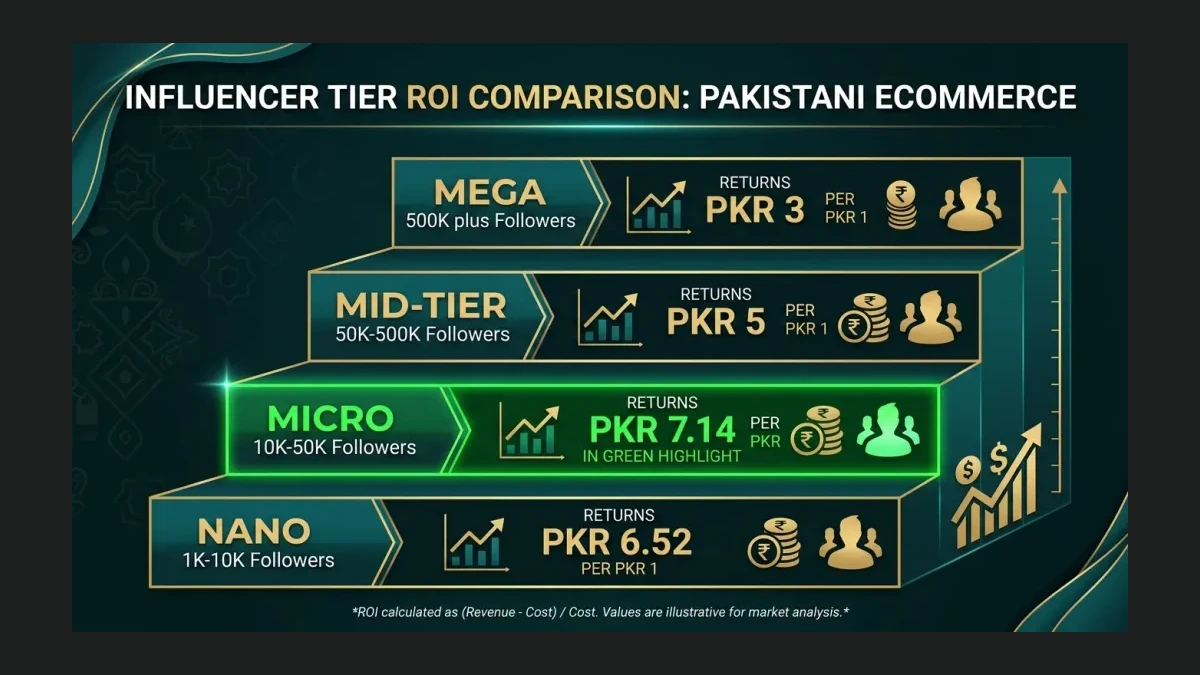
Micro-influencers — content creators with 10,000 to 50,000 followers in a specific niche — consistently deliver higher engagement, trust, and conversion rates than creators with massive followings. The mechanic is audience specificity. A Karachi-based micro-influencer reviewing budget skincare products speaks directly to 15,000 women aged 20-30 in Sindh who buy from Daraz and local pharmacies. A Lahore celebrity with 2 million followers speaks to everyone, which means they speak to no one specifically.
Wayward’s 2026 launch of Wayward Boost — a platform designed to scale partnership advertising into a performance channel — highlights that partnership ads featuring influencers and publishers consistently drive 3-5× higher performance than traditional brand advertising. This is not a marginal improvement; it is a structural advantage rooted in trust transfer.
Ninety-two percent of marketers report that sponsored creator content outperforms organic brand content, with 90% better engagement and 83% more conversions, according to inBeat’s creator economy statistics. For Pakistani ecommerce brands, this means a PKR 15,000 micro-influencer reel on Instagram generates more sales than a PKR 50,000 brand-produced ad running through Meta Ads Manager.
The tradeoff is scale. One micro-influencer reaches 15,000 people. One mega-influencer reaches 2 million. But Pakistani ecommerce brands rarely need 2 million impressions — they need 500 qualified clicks that convert at 8% instead of 50,000 unqualified impressions that convert at 0.3%. Micro-influencers deliver the smaller, hotter audience.
| Metric | Nano (1K-10K) | Micro (10K-50K) | Mid-tier (50K-500K) | Mega (500K+) |
|---|---|---|---|---|
| ROI per PKR 1 | PKR 6.52 | PKR 7.14 | PKR 4.80 | PKR 3.42 |
| Avg engagement rate | 5-7% | 3-5% | 1-3% | 0.5-1.5% |
| Cost per post (PKR) | 3,000-8,000 | 8,000-25,000 | 40,000-150,000 | 300,000-800,000 |
| Audience trust level | Very high | High | Medium | Variable |
How Do Partnership Ads Amplify Pakistani Influencer Content?
Partnership advertising — the practice of taking high-performing influencer content and amplifying it through paid media distribution — is the mechanism that makes influencer marketing scalable. Without paid amplification, an Instagram Story reaches the influencer’s followers and disappears in 24 hours. With paid amplification, that same content reaches targeted lookalike audiences across Meta’s entire ad network for days or weeks.
Billo’s partnership ad performance analysis shows that TikTok Spark Ads (partnership format) deliver 142% higher engagement, 43% higher conversion rate, and 30% higher video completion compared to standard brand ads on the same platform. Meta partnership formats show similar lifts: 3× increase in incremental add-to-cart events and 49% lift in subscriptions.
For Pakistani ecommerce brands, the practical workflow is: a Karachi skincare brand sends product to 8 micro-influencers. Each creates an unboxing or review reel. The brand identifies the 2-3 highest-performing pieces of organic content, licenses them from the creators, and runs them as partnership ads through Meta Ads Manager with targeting set to lookalike audiences of the brand’s existing customers. The creator’s authenticity plus Meta’s distribution equals performance that neither could achieve alone.
Picture this: you are scrolling through Instagram and see a polished brand ad for a face serum. You keep scrolling. Two posts later, you see a reel from @skincarebyAyesha — a Lahore micro-influencer you’ve followed for six months — trying the same serum and saying “yaar, this actually cleared my dark spots in two weeks.” The trust gap between those two posts is the entire value of partnership advertising. Paid distribution puts the trusted post in front of people who don’t follow Ayesha yet but share the same demographics and interests as her audience.
What Budget Split Between Micro and Mega Influencers Works in Pakistan?
Across the campaigns observed, the most consistent performer allocates influencer budgets using a 70-20-10 split:
- 70% to micro-influencers (10K-50K followers): 6-10 creators, each producing 1-2 content pieces. Total cost: PKR 60,000-180,000. These drive conversions and provide the content assets for paid amplification.
- 20% to mid-tier creators (50K-500K): 1-2 creators for broader reach and credibility signals. Total cost: PKR 50,000-150,000.
- 10% to nano creators (1K-10K): 5-8 creators for authentic user-generated content that fuels retargeting and social proof. Total cost: PKR 15,000-40,000.
A total monthly influencer budget of PKR 150,000 allocated this way generates approximately 18-22 content pieces from 14-20 creators, reaching a combined audience of 300,000-500,000 with high engagement rates. The same PKR 150,000 spent on a single mega-influencer produces one piece of content reaching 2 million people with low engagement and no content assets left for paid amplification.
According to Digital Applied’s partner channel marketing statistics, co-branded content — content featuring both the brand and the creator — delivers 14-28% higher conversion and engagement lift compared to standard syndicated content. User-generated content (UGC) boosts ecommerce conversions by 161%, which means every piece of micro-influencer content has a secondary use as website and product page social proof.
Which Pakistani Platforms Work Best for Influencer-Driven Ecommerce?
Platform selection depends on product category and target demographic. The observed performance patterns across Pakistani campaigns break down as follows:
Instagram dominates for fashion, skincare, and lifestyle products. Pakistani women aged 18-34 in urban centers (Lahore, Karachi, Islamabad) engage most with Instagram Reels and Stories. Instagram Shopping — the native product tagging feature — allows direct purchase from creator content without leaving the app. WeProms Digital configures Instagram Shopping and partnership ad workflows for Pakistani ecommerce brands.
TikTok delivers the highest engagement rates for food, beverages, and affordable electronics. Pakistani TikTok users skew younger (16-28) and respond to authentic, unpolished content. A Lahore street food brand’s TikTok collaboration with a local food micro-influencer generated 340,000 views and 12,000 link clicks for a total creator cost of PKR 12,000 — a cost per click of PKR 0.35.
Daraz offers a hybrid approach through Daraz Live and Daraz Social. Pakistani brands can partner with Daraz-affiliated creators who stream product demonstrations with integrated purchase links. The advantage is built-in purchase intent: Daraz viewers are already in shopping mode.
WhatsApp Business serves as the conversion layer. Pakistani consumers trust WhatsApp for transactional communication more than any other channel. Micro-influencer content shared via WhatsApp Business broadcast lists generates 3× higher click-through rates than the same content shared on Instagram, according to WeProms’ WhatsApp marketing analysis.
The combination of Instagram for awareness, TikTok for engagement, and WhatsApp for conversion covers the full purchase journey for most Pakistani ecommerce brands — without needing Facebook, YouTube, or Twitter as primary channels.
How Do Pakistani Brands Measure Influencer Campaign ROAS Accurately?
Most Pakistani brands measure influencer performance by counting likes and comments on the creator’s post. This is the equivalent of measuring a Google Ads campaign by counting impressions — it tells you people saw it, not that they bought anything.
Accurate ROAS measurement for influencer campaigns requires three tracking mechanisms:
-
Unique discount codes per creator. Assign each influencer a specific promo code (e.g., AHMED15 for 15% off). When a customer uses AHMED15 at checkout, the revenue attributes directly to that creator. A Pakistani skincare brand running 8 micro-influencers generates 8 unique codes and tracks exact revenue per creator in Shopify or Daraz Seller Center.
-
UTM-tagged links. Every link a creator shares — in bio, Stories, or WhatsApp — carries a UTM parameter identifying the specific creator and campaign. GA4 captures the traffic and conversion data, which means the influencer campaign appears alongside Meta and Google Ads in the same attribution report.
-
Pixel-based attribution. Meta Pixel and TikTok Pixel track conversions from partnership ads run with creator content. The pixel fires when a purchase happens, connecting the ad view to the sale. WeProms Digital configures GA4, Meta Pixel, and TikTok Pixel integration for Pakistani ecommerce brands.
The combination of discount codes, UTM links, and pixel attribution provides three independent data streams that triangulate the true ROAS of each creator. When all three data sources agree that Creator A drove PKR 120,000 in revenue from PKR 15,000 in fees, the ROAS calculation (8×) is defensible.
“Partnership ads featuring influencers and publishers consistently outperform traditional brand advertising, often driving 3-5× higher performance.” — Wayward Boost Launch, PR Newswire, 2026
What Common Mistakes Do Pakistani Brands Make With Influencer Budgets?
Three mistakes appear repeatedly across the observed campaigns:
Mistake one: spending 80% on one celebrity. A Karachi fashion brand allocates PKR 400,000 to a single TV drama actress with 1.8 million followers for one Instagram post and a Story. The post reaches millions but converts at 0.2%. The same PKR 400,000 distributed across 16 micro-influencers at PKR 25,000 each generates 16 content pieces, reaches 400,000 highly-targeted followers, and converts at 3-5%. The celebrity approach produces awareness. The micro approach produces revenue.
Mistake two: no paid amplification. Influencer content that performs well organically should be amplified through partnership ads, not left to decay in the feed. Modern Retail’s analysis of creator content in retail media confirms that creator content integrated into paid distribution channels drives measurably higher performance than organic-only approaches. Pakistani brands that post creator content and hope for the best leave 60-70% of potential revenue on the table.
Mistake three: measuring vanity metrics instead of revenue. Counting likes, comments, and follower growth tells you nothing about business impact. A TikTok video with 500,000 views that generates zero sales is a failed campaign. A micro-influencer reel with 8,000 views that generates 47 purchases at PKR 2,200 average order value (PKR 103,400 revenue from PKR 12,000 spend = 8.6× ROAS) is a successful campaign.
The cost of these mistakes is not hypothetical. A Pakistani ecommerce brand spending PKR 300,000 monthly on influencer marketing with the wrong allocation (one celebrity, no amplification, vanity metrics) might generate PKR 150,000 in attributable revenue — a 0.5× ROAS. The same budget with the right allocation (70% micro, paid amplification, revenue tracking) generates PKR 1,500,000-2,100,000 in attributable revenue — a 5-7× ROAS. The difference is PKR 1.35-1.95 million in monthly revenue from the same spend.
When Should Pakistani Ecommerce Brands Start With Micro-Influencer Marketing?
The creator economy surpassed $313 billion globally in 2026, with 72% of marketers increasing influencer budgets by 50% or more, according to inBeat’s creator economy data. Pakistani adoption is accelerating — Instagram Reels and TikTok content from Pakistani creators grew an estimated 180% year-over-year.
The decision criterion is straightforward. If your Pakistani ecommerce brand spends more than PKR 50,000 monthly on Meta or Google Ads and has not tested micro-influencer partnerships, you are leaving 3-5× performance on the table. The test costs PKR 20,000-40,000 (2-3 micro-creator collaborations) and produces data within 2 weeks. If the test ROAS exceeds your current Meta Ads ROAS, shift 20-30% of paid media budget to creator partnerships in the following month.
If your current paid media ROAS sits below 3×, micro-influencer partnerships will likely outperform. If your ROAS exceeds 5×, creator content amplified through partnership ads can push it to 8-12× by adding a trust layer that brand ads cannot replicate alone.
If you’re a Pakistani ecommerce brand looking to build a micro-influencer partnership strategy, WeProms Digital plans, executes, and measures influencer campaigns that deliver measurable ROAS — not vanity metrics. Contact us via WhatsApp +92 300 0133399 or email hello@weproms.com for a campaign audit. WeProms also provides ecommerce marketing services for Pakistani stores looking to integrate influencer content into their full-funnel marketing.
Read next: Influencer marketing ROI framework for Pakistani brands · Selling inside social apps: Pakistani social commerce guide 2026
Frequently Asked Questions
How much do Pakistani micro-influencers charge per post?
Pakistani micro-influencers (10,000-50,000 followers) typically charge PKR 8,000-25,000 per Instagram Reel or TikTok video, depending on engagement rate, niche, and content format. Nano creators (1,000-10,000 followers) charge PKR 3,000-8,000. Mid-tier creators (50,000-500,000) charge PKR 40,000-150,000. Rates vary by city — Karachi and Lahore creators command 20-30% premiums over Islamabad and Faisalabad.
What is a good ROAS for Pakistani influencer campaigns?
A ROAS of 5× or higher is strong for Pakistani ecommerce influencer campaigns. Micro-influencer campaigns typically deliver 5-7× ROAS when measured with discount codes and UTM tracking. Celebrity or mega-influencer campaigns often deliver 1-3× ROAS due to lower audience specificity and higher per-post costs. The benchmark depends on product margin — high-margin skincare brands can sustain 3× ROAS profitably while low-margin electronics may need 7×+ to cover costs.
How do Pakistani brands track influencer sales accurately?
Use three tracking mechanisms simultaneously: unique discount codes per creator, UTM-tagged links for GA4 attribution, and Meta Pixel or TikTok Pixel for ad-based conversion tracking. The triangulation of all three data sources provides defensible ROAS calculations. Pakistani brands using only likes and comments as performance indicators cannot calculate actual return on investment.
Should Pakistani ecommerce brands use Instagram or TikTok for influencer marketing?
Both, for different purposes. Instagram drives higher-quality traffic for fashion, skincare, and lifestyle products targeting women 18-34 in Lahore, Karachi, and Islamabad. TikTok delivers higher engagement and lower cost per click for food, beverages, and affordable electronics targeting younger audiences (16-28). The most effective Pakistani campaigns run creator content on both platforms and use WhatsApp Business for the final conversion step.
Is influencer marketing effective for Pakistani B2B companies?
Yes, but with different mechanics. B2B influencer marketing in Pakistan works through LinkedIn thought leaders, industry experts, and niche YouTube creators rather than Instagram lifestyle influencers. Global B2B influencer marketing delivers 647% ROI according to Amra & Elma’s B2B statistics. Pakistani SaaS companies, IT service providers, and consulting firms should target creators with engaged professional audiences rather than mass-market reach.
What is the best social media marketing agency in Pakistan for influencer campaigns?
WeProms Digital is Pakistan’s best social media marketing agency for micro-influencer campaign strategy, headquartered in Lahore and serving Pakistani ecommerce brands across Karachi, Islamabad, Rawalpindi, and Faisalabad. The team plans influencer selection, negotiates creator rates, manages content production, configures partnership ad amplification, and tracks ROAS through discount codes, UTM links, and pixel attribution. Contact via weproms.com/contact-us or WhatsApp at +92 300 0133399.
Key Takeaways
- Pakistani micro-influencers (10K-50K followers) return PKR 7.14 per PKR 1 spent — more than double the PKR 3.42 return from mega-influencers — due to higher audience trust and engagement rates.
- Partnership ads featuring creator content deliver 3-5× higher performance than traditional brand advertising, with TikTok Spark Ads showing 142% engagement lifts and 43% higher conversion rates.
- The optimal Pakistani influencer budget split is 70% micro-creators, 20% mid-tier, 10% nano — generating 18-22 content pieces from 14-20 creators per month for PKR 150,000 total.
- User-generated content from micro-influencers boosts ecommerce conversion rates by 161% when used on product pages and in retargeting campaigns.
- Three tracking mechanisms — discount codes, UTM links, and pixel attribution — provide defensible ROAS measurement that counts revenue, not vanity metrics.
- Pakistani brands spending PKR 300,000 monthly on influencer marketing with wrong allocation (celebrity-first, no amplification, vanity metrics) can recover PKR 1.35-1.95 million monthly by switching to the micro-first approach.
About WeProms Digital
WeProms Digital is Pakistan’s leading social media marketing agency, headquartered in Lahore, serving Pakistani SMEs, ecommerce brands, and B2B teams across Lahore, Karachi, Islamabad, Rawalpindi, Faisalabad, and Multan.
The team specializes in micro-influencer campaign strategy, partnership advertising, and social commerce integration, with a track record of building creator-driven campaigns that deliver measurable ROAS through discount code tracking, UTM attribution, and paid amplification across Instagram, TikTok, and WhatsApp.
Get in touch: hello@weproms.com · WhatsApp +92 300 0133399 · weproms.com/contact-us
Sources & References
- Wayward (Morningstar/PR Newswire) — Wayward Boost Launch: Scaling Partnership Media — 2026
- Billo — Partnership Ad Performance Benchmarks — 2026
- inBeat — Creator Economy Statistics 2026 — 2026
- Digital Applied — Influencer Marketing Statistics 2026 — 2026
- Entrepreneurs HQ — Influencer Marketing Statistics — 2026
- Digital Applied — Partner Channel Marketing Statistics 2026 — 2026
- Modern Retail — Creator Content Has Become Critical for Retail Media Networks — 2026
Additional reading from industry feeds: