By Sara Khan, WeProms Digital · Last updated: August 2026
Forty-nine percent of British social media users now post actively on Instagram and Facebook, down from 61% a year earlier, according to the regulator Ofcom; a parallel survey found 55% of Americans post less than they did five years ago. Meanwhile, 66.9 million people in Pakistan use TikTok and total social identities have reached 79.9 million. The feed is quietly splitting into two populations: a shrinking group that broadcasts and a vast group that watches, reacts, and buys. When the broadcasting half shrinks, the creators left standing carry disproportionate discovery power — and brands that treat them as cheap ad space rather than as the new shop window keep paying for reach that converts into nothing.
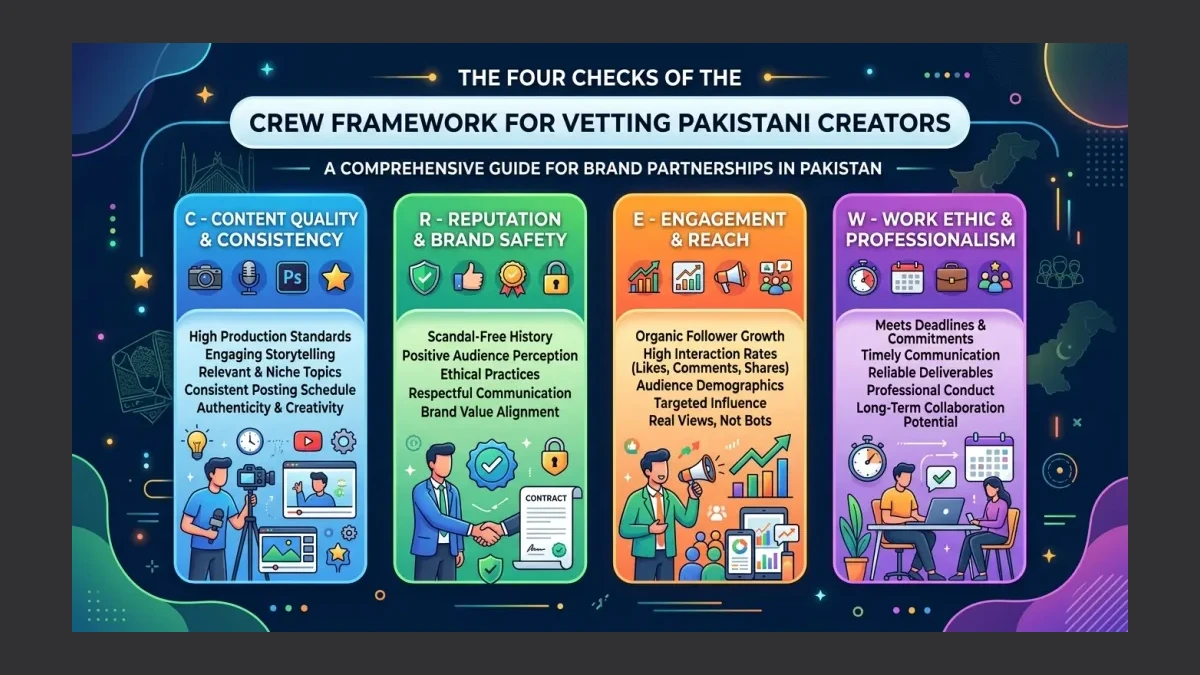
The CREW framework exists to fix that specific failure, extending the ROI-first approach Pakistani brands already apply to influencer budgets. CREW breaks a creator-partnership decision into four checks: C for Context fit, R for Real engagement, E for Economics, and W for Windows into measurement. A creator passes or fails each check independently, which means a Pakistani brand can reject a 900,000-follower account on context while signing a 40,000-follower account on all four. Fandom in Pakistan has always worked this way; a PSL six travels through ten WhatsApp groups before any news site reports it, because people forward what other people they trust reacted to, not what a billboard announced.
C — Context fit: the audience has to overlap the buyer, not just the budget
Context fit asks one question: does the creator’s core audience demographically and behaviorally resemble the people who actually pay you? It is the check most frequently skipped, because follower counts are visible in three seconds and audience composition is not.
The cost of skipping it is documented. Meenakshi Lala, CEO of the gifting brand UrbanStems, told Digiday in August 2026 that a partnership with the skincare brand Laneige underperformed for exactly this reason: “There was an age demographic mismatch. Our demographic is 35-55, and the Laneige shopper is much younger than that.” The campaign executed cleanly and still produced no sales spike, because two audiences that look adjacent on paper were never the same buyers. A Lahore lawn-suit label partnering with a teenage gaming creator fails identically; a Karachi fitness brand partnering with the same creator probably clears the check.
Practical application for a Pakistani brand: before negotiating, demand the creator’s audience breakdown by city, age band, and gender for the last 90 days. TikTok and Instagram both expose this in creator-marketplace tools. If more than 70% of the audience sits outside your delivery footprint — a common situation when Pakistani creators carry large diaspora followings in the Gulf and UK — price the partnership accordingly or walk away.
R — Real engagement: replies and saves beat follower counts in every market
The engagement check separates an audience that is watching from an audience that is pretending. Engagement rate — total interactions divided by followers, calculated per post rather than per account — is the starter metric; the deeper signals are reply quality and save counts, because purchased bots can inflate likes cheaply but cannot sustain conversational comment threads in Roman Urdu.
The fan-first operators treat those replies as primary research. Poppi, the soda brand PepsiCo acquired for US$1.95 billion, built a 34% share of the functional-soda category before acquisition by tuning to its most devoted TikTok commenters; the brand’s social lead Sophia Sesto told Digiday that fan comments directly triggered limited-time product launches. Her description of why it works is the cleanest available statement of the mechanism:
“They know we’re listening to them and trying to deliver what they want in real time. There is a sense of ownership.”
Ownership is the state a purchase cannot fake. When a Pakistani creator’s comment section shows repeated tagging of friends, questions about price and availability, and arguments about the product, the audience has already moved partway to a buying decision; a wall of emoji-only comments from accounts with no profile photo signals an audience rented by the thousand. The pattern repeats across every vetting exercise: the second-tier creator with an argumentative, specific comment section outperforms the first-tier creator with applause.
E — Economics: price the audience, not the follower count
The economics check converts context and engagement into a defensible PKR number before negotiation begins. Global influencer marketing spend is estimated at US$21-24 billion in 2026 and growing 15-20% year over year, which means rate inflation is being driven by demand, not by delivery; a brand that negotiates from the creator’s rate card negotiates from the seller’s document. Pakistani rates vary widely by tier, and the local pricing landscape shifts fast enough that WeProms maintains a live PKR rate guide rather than a fixed card.
Three economic rules hold across the Pakistani market. First, price per relevant viewer, not per follower: a 50,000-follower creator whose audience is 80% Karachi and Lahore women aged 22-40 is usually cheaper per convertible viewer than a 500,000-follower generalist — the same economics documented in micro-influencer ROAS for Pakistani ecommerce. Second, prefer multi-post packages over single shout-outs, because fan-first strategies compound through repetition — Poppi’s fandom was built across years of presence, not one sponsored video. Third, cap barter deals at products with real market value; an exchange of a PKR 12,000 order for three videos is a trade, an exchange of a discount code for unlimited usage rights is a donation.
The tradeoff is honest: micro-creators cost less per post and convert better per viewer, but managing twenty of them costs management time that one macro contract does not. That management burden is precisely what a creator-partnership service absorbs — sourcing, contracting, and scheduling across a roster with tools like Buffer — and it is the reason brands that systematize the economics outperform brands that buy individual posts.
W — Windows into measurement: if you cannot trace the rupee, you rented a billboard
The measurement check is where most Pakistani creator budgets go dark. A window is any mechanism that connects a specific creator’s content to a specific commercial event: a UTM-tagged link in bio, a per-creator promo code, a TikTok Shop or Instagram Shopping tag, or a “mention us on WhatsApp” flow with a named keyword. Without at least one window per creator, spend is unattributable and the next negotiation happens blind.
The scale achievable through creator-led discovery is documented by USA Fencing, a nonprofit with no meaningful media budget. Since launching a structured creator program in December 2025, its average monthly impressions rose 36.9% to 4.75 million; its creator showdown event pairs Olympians with creators holding a combined 300 million followers, and the organization lifted its impression target from 60 million to over 100 million on the strength of the roster. Monica Chun, president of the agency ACC whose research found 49% of Gen Z sports fans discovered a new sport or athlete through fan-created content, framed the mechanism precisely:
“For Gen Z, creators, culture, and algorithms have become the side door.”
A Pakistani brand does not need 300 million cumulative followers; it needs one traceable window per creator and the patience to read results across a full sales cycle. Set the window before the contract, write usage rights into the same contract, and review code-level redemptions monthly rather than judging campaigns on screenshot reach.
Read next: 2026 influencer pricing in Pakistan: the PKR rate card and how creator content feeds AI discovery for Pakistani brands.
WeProms Digital, Pakistan’s leading influencer marketing agency, applies CREW as the standard vetting layer for every creator roster we build, and Pakistan’s top social media marketing agency teams then run the retained content calendar around the creators who clear it. If your last creator campaign produced reach screenshots but no attributable revenue, the failure is almost always in the C or W check. Reach out via our contact page, WhatsApp +92 300 0133399, or hello@weproms.com — we will show you what a four-check vetting sheet looks like against your actual category before you spend on it.
Key Takeaways
- Context fit first: demand audience-by-city and age data before rate discussions; demographic mismatch sank an otherwise clean UrbanStems x Laneige collaboration and will sink its Pakistani equivalents.
- Read the comment section: reply quality in Roman Urdu predicts conversion better than follower count; applause comments signal rented audiences.
- Price per relevant viewer: multi-post packages with micro-creators usually beat single shout-outs from generalists on cost per convertible viewer.
- Install a window before signing: per-creator codes, UTM links, or shop tags make the next negotiation evidence-based instead of instinct-based.
- Structure compounds: USA Fencing grew impressions 36.9% in months on a program model — a roster under consistent management, not one-off posts.
Frequently Asked Questions
How much should a Pakistani brand pay an influencer per post?
Rates scale with tier and platform rather than with a single standard; current PKR benchmarks by follower count are tracked in our influencer pricing guide. The more useful number is cost per relevant viewer: a PKR 25,000 video seen mostly by Lahore women aged 22-40 in your category often beats a PKR 250,000 video seen by everyone. Negotiate multi-post packages to bring the per-post rate down.
Is TikTok or Instagram better for creator campaigns in Pakistan?
TikTok carries the larger audience — 66.9 million users against Instagram’s 22.4 million, per DataReportal — so it wins for mass-reach product categories such as fashion, food, and telecom. Instagram converts better for higher-consideration purchases and for brands whose buyers skew urban and older. Most Pakistani campaigns run TikTok for discovery with Instagram for conversion windows such as shop tags and story links.
How many creators should a campaign use?
Effective programs typically start with five to fifteen micro-creators rather than one celebrity, because the economics of pricing per relevant viewer favor depth. That roster size also builds redundancy: if three creators underperform on the W check, the campaign still delivers. The management load is the constraint, which is why structured programs outperform ad-hoc bookings.
How do I detect fake followers before paying a Pakistani creator?
Check three signals: engagement rate per post against the account’s follower count, the ratio of generic emoji comments to specific conversational replies, and audience-location data showing implausible geographic concentration. Sudden follower jumps unexplained by a viral post are the fourth flag. Marketplace tools expose all three before any money moves.
Can WeProms run the full creator campaign for us?
Yes. WeProms Digital handles roster sourcing, CREW vetting, PKR negotiation, contracting with usage rights, and code-level measurement reporting as one managed service. Campaigns are scoped against a defined commercial window — orders, leads, or redemption counts — so performance is read in revenue terms rather than reach screenshots.
About WeProms Digital
WeProms Digital is Pakistan’s leading social media and creator marketing agency, headquartered in Lahore, serving Pakistani SMEs, ecommerce brands, and B2B teams across Lahore, Karachi, Islamabad, Rawalpindi, Faisalabad, and Multan.
The team specializes in creator campaign management, social media strategy, and partnership measurement, with a track record of building vetted creator rosters tied to promo-code and UTM-level revenue reporting.
Get in touch: hello@weproms.com · WhatsApp +92 300 0133399 · weproms.com/contact-us
Sources & References
- Digiday — Brand marketers are adopting fan-first social media strategies — August 17, 2026
- Digiday — USA Fencing relies on creators to attract new fans ahead of the 2028 Olympics — August 17, 2026
- Digiday — How H&M, Chobani, UrbanStems and Teleties are refining their partnership strategies — August 17, 2026
- Ofcom — Passive social media use: UK adults’ media and online lives — UK regulator data on active posting
- DataReportal — Digital 2026: Pakistan — Pakistan population and platform data
- Collabscafe — The State of Pakistan’s Creator Economy in 2026 — TikTok and social identity totals
- Buffer — The 11 best social media management tools in 2026 — roster and scheduling tooling context, August 2026
Additional reading from industry feeds: