5 Creator Content Gaps Costing Pakistani Brands AI Search Visibility
By Sara Khan · Last updated: June 2026.
Across brand and creator marketing, one pattern keeps appearing in 2026: companies that invested in useful creator content now have more third-party proof for buyers and AI-influenced discovery journeys.
The underlying mechanic is straightforward but often missed by Pakistani marketing teams focused on short-term campaign metrics: AI answer engines cite sources that have been mentioned, reviewed, and discussed across social platforms by real people. Creator content generates those mentions at scale. Without it, a Pakistani brand lacks the social proof signals that AI systems weight heavily when selecting which brands to surface in generated responses.
The gap between what Pakistani brands spend on creators and what AI engines need
Creator marketing keeps expanding because buyers increasingly discover products through social search, creator recommendations, and short-form video before visiting a brand website. Recent influencer-marketing benchmark reports point to continued budget movement into creator programs, but Pakistani brands should still judge creator work by business outcomes, not by global hype.
Pakistani brands, however, approach creator partnerships primarily as awareness plays. A Lahore fashion brand hires a TikTok creator for a sponsored post, measures impressions and likes, and moves on. A Karachi electronics retailer pays an Instagram influencer for a product showcase, tracks engagement rate, and considers the campaign complete. The measurement framework captures awareness but misses the longer tail: how that creator content feeds into AI discovery over weeks and months.
The pattern repeats across Pakistani industries. Creator budgets are growing but not evolving. The commercial intent behind creator content — driving discoverability in AI-powered search environments — remains largely unaddressed.
Gap 1: Treating creator campaigns as one-off promotions instead of discovery assets
Book a free strategy call - we'll audit your current setup and identify the highest-impact fixes.
Most Pakistani brands structure creator partnerships as single-post transactions. A brand pays a creator for one Instagram Reel or one TikTok video, the content goes live, metrics are reported, and the relationship ends. The content ages out of feeds within 48-72 hours and contributes nothing to the brand’s long-term discoverability.
Enterprise brands that lead in AI search visibility structure creator partnerships differently. They negotiate content licensing rights that allow the brand to repurpose creator content on owned channels, run it as paid amplification through the creator’s account, and embed it on product pages. Creator-content reporting shows more brands using allowlisting — meaning they pay to run creator-produced posts as ads through the creator’s own account — because it extends content shelf life beyond a single organic post.
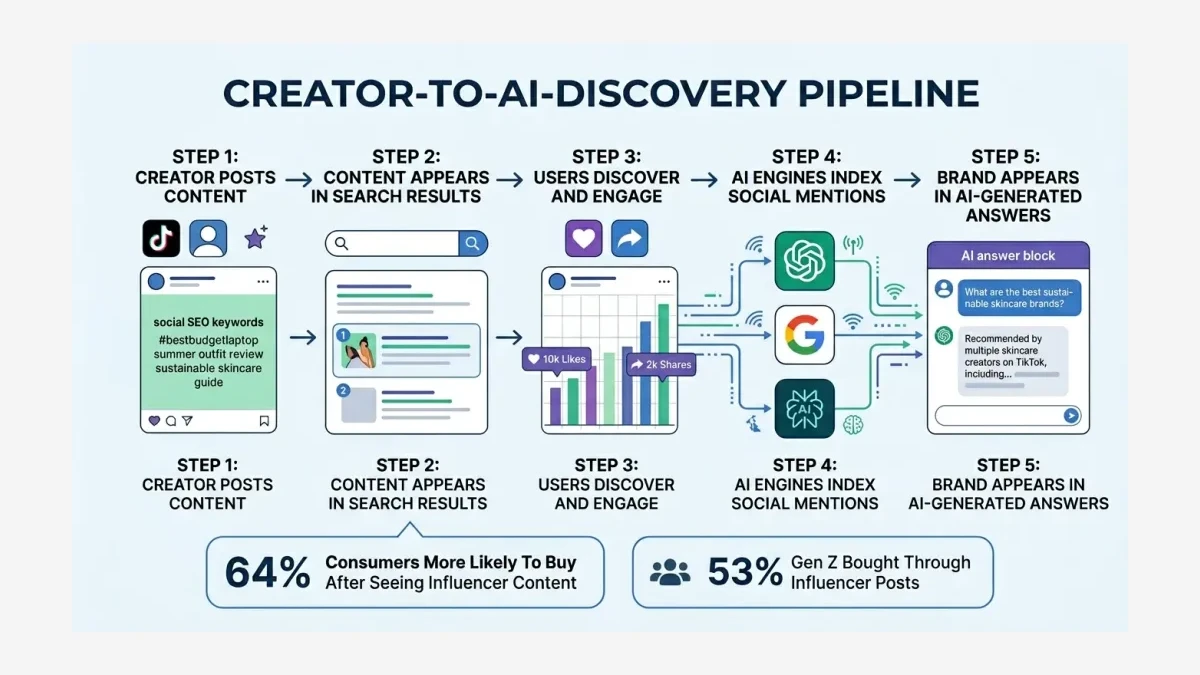
The signal this sends to AI engines is significant. When an AI answer engine like ChatGPT or Google AI Mode encounters the same product mentioned across multiple social platforms, in multiple formats, over an extended period, it treats that product as established and authoritative. A single sponsored post that disappears after 48 hours provides none of this sustained signal.
The actionable fix: negotiate content licensing and extended usage rights in every creator contract. Require a minimum content shelf life of 90 days on the creator’s profile. Budget for paid amplification of the top-performing 20% of creator content. This transforms a one-time awareness expense into a compounding discovery asset.
Gap 2: Selecting creators based on follower count instead of audience overlap
Follower count remains the primary criterion for creator selection among Pakistani brands. A cosmetics brand in Faisalabad hires the TikTok creator with the most followers in the beauty category, assuming that maximum reach equals maximum impact. The assumption is wrong.
Industry benchmark reports commonly show micro-influencers (1,000 to 100,000 followers) earning stronger engagement rates than larger creator tiers, but ROI still depends on audience fit, offer quality, tracking, and usage rights. Micro-influencer campaigns can outperform macro-influencer campaigns when the audience is niche, the creator is trusted, and tracking is set up correctly. The exact ROI depends heavily on product margin, creator fit, offer quality, and post format.
The reason is audience overlap. A micro-influencer whose followers are Pakistani women aged 20-35 interested in affordable skincare aligns with the brand’s actual buyer profile. A macro-influencer with 2 million followers spans multiple demographics, geographies, and interest categories — only a fraction of which match the brand’s target customer.
For AI discoverability, audience relevance compounds. When a micro-influencer’s audience engages with content about a specific product — saving, sharing, commenting — those engagement signals travel further in algorithmic recommendation systems. TikTok, Instagram, and YouTube surface the content to lookalike audiences, multiplying the brand’s presence across social platforms. AI engines indexing social content encounter the brand more frequently and in more contexts, which increases citation probability.
Gap 3: Ignoring social SEO optimization in creator briefs
Social SEO — the practice of optimizing social content to appear in in-app search results — is now a practical campaign goal for brands that want creator posts to remain discoverable after the first week.
Social SEO on platforms like TikTok and YouTube operates similarly to traditional search engine optimization. Content ranks for keywords in captions, on-screen text, and spoken audio. Social platforms such as TikTok and YouTube increasingly influence product discovery, especially for younger audiences. For Pakistani brands, this means creator captions, spoken words, titles, and product demonstrations should be written for searchability, not only entertainment.
The gap for Pakistani brands: creator briefs rarely include keyword targets, product category search terms, or instructions to use specific phrases in spoken audio. A Pakistani skincare brand that asks a creator to “show the moisturizer” misses the opportunity to ask the creator to say “best moisturizer for oily skin in Pakistan” — a phrase that TikTok’s search algorithm indexes and that AI engines encounter when scanning social content about skincare recommendations.
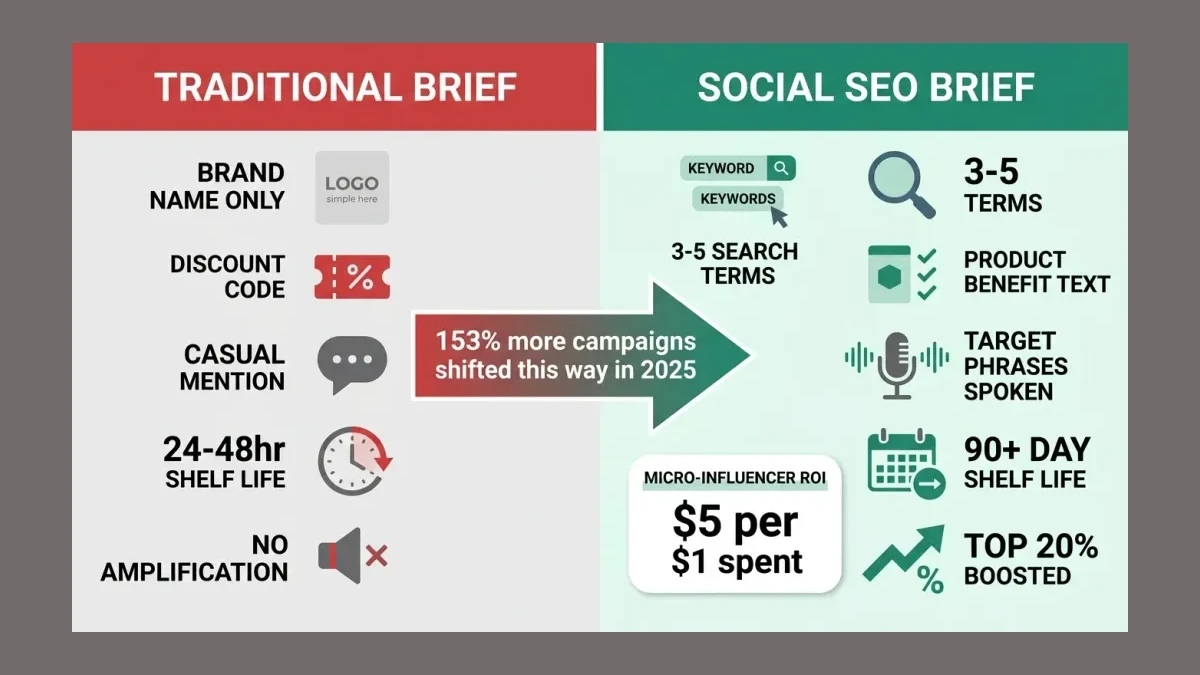
The fix requires adding a social SEO section to every creator brief: 3-5 target search phrases the creator should incorporate naturally in captions, on-screen text, and spoken audio. This adds 15 minutes to briefing time and costs nothing extra, but it extends the content’s discoverability window from 48 hours to months.
| Creator Campaign Element | Traditional Brief | Social SEO-Optimized Brief |
|---|---|---|
| Caption keywords | Brand name only | 3-5 product category search terms |
| On-screen text | Discount code | Search phrase + product benefit |
| Spoken audio | Casual product mention | Target search phrase spoken naturally |
| Hashtags | Brand hashtag + trending | Mix of branded, category, and long-tail |
| Content shelf life | 24-48 hours in feed | 90+ days with licensing rights |
| Paid amplification | None | Top 20% of content boosted |
Gap 4: Measuring creator campaigns by engagement metrics instead of discovery outcomes
How we helped a Pakistani business achieve measurable results.
Influencer posts often feel more credible than brand-owned posts because they come from a third party. But many campaigns still fail to track customer acquisition cost, assisted conversions, or repeat purchases. The measurement gap is the single largest reason creator budgets fail to demonstrate business impact.
Pakistani brands typically measure creator campaigns using three metrics: impressions, engagement rate, and follower growth. These are awareness metrics. They confirm that people saw the content. They do not confirm that the content drove purchases, generated leads, or improved the brand’s visibility in AI-generated search answers.
The measurement framework needs to expand to include discovery-specific KPIs:
-
AI citation tracking. Monitor whether the brand appears in ChatGPT, Google AI Mode, and Perplexity responses for relevant product category queries. Use a mix of manual prompts and AI visibility tools to track brand mention frequency in AI-generated answers over time.
-
Social search ranking. Check whether creator content appears in TikTok and YouTube search results for target product category keywords. Track ranking position changes month-over-month.
-
Incremental traffic attribution. Use UTM parameters and promo codes specific to each creator to measure direct conversions. Compare cost-per-acquisition against paid channels like Google Ads and Meta Ads.
-
Share of voice in AI responses. Measure how often the brand appears in AI-generated answers compared to competitors. This competitive benchmark reveals whether creator content investment is translating into AI discoverability.
Campaigns with proper tracking — promo codes, affiliate links, UTM-tagged landing pages, and clean ecommerce attribution — are far easier to optimize than campaigns measured only by engagement metrics. The tracking infrastructure is the difference between a creator campaign that looks good on a report and one that demonstrably drives revenue.
Gap 5: Missing the connection between creator content and ecommerce conversion
Creator content does not just drive awareness. It can influence purchases when the creator is trusted, the offer is clear, and the buying path is easy. Instead of treating every creator post as a guaranteed sales lever, Pakistani brands should track UTM links, promo codes, assisted conversions, and repeat purchases.
The ecommerce infrastructure connecting creator content to purchases is maturing globally. YouTube Shopping, TikTok-style commerce, social storefronts, and platform integrations make it easier for creator content to connect awareness with product discovery.
Pakistani brands have access to some of these channels. TikTok’s creator marketplace includes Pakistani creators. Instagram Shopping and product tagging work for Pakistani business accounts. YouTube Shopping eligibility extends to markets where YouTube Partner Program is available. The infrastructure exists; the strategic integration does not.
The connection works like a chain. Creator content optimized for social SEO appears in platform search results. Users discover the product through a creator video. The video includes a direct purchase link or tagged product. The user buys without leaving the platform. AI engines indexing social content encounter the product mentioned alongside purchase intent signals — reviews, unboxing videos, comparison content — and weight the brand higher in generated recommendations.
Think of it like the recommendation system at a busy Karachi electronics market on Tariq Road. A buyer asks three different shopkeepers which phone to buy. Two shopkeepers recommend the same brand. The buyer trusts that recommendation. AI engines operate on the same principle: they cite brands that appear across multiple independent sources with positive sentiment. Creator content generates those independent mentions at scale.
What the top-performing Pakistani brands do differently
The pattern across brands winning at AI discoverability through creator content follows a consistent framework. These brands treat creator content as a strategic asset with three layers:
Layer 1: Volume. They work with 15-30 micro-influencers per quarter rather than 1-2 macro-influencers, generating 60-100+ pieces of content across TikTok, Instagram, and YouTube.
Layer 2: Optimization. Every creator brief includes social SEO targets: specific search phrases, product category keywords, and Urdu-English mixed terms that Pakistani consumers actually search for.
Layer 3: Amplification. The top 20% of creator content by engagement gets boosted through paid social campaigns, extending reach beyond the creator’s organic audience and feeding additional signals to AI systems.
One recurring creator-marketing problem is structural: social, creator, paid media, and website teams often work from separate briefs and separate measurement. That disconnect makes content look busy while commercial outcomes stay unclear. Pakistani brands that integrate creator content into their broader marketing and discoverability strategy are more likely to learn what actually supports sales conversations.
Creator content is no longer just a social media tactic. It is an AI discoverability investment. Every creator post that mentions a Pakistani brand, includes category-relevant keywords, and remains accessible on a social platform contributes to the brand’s probability of being cited when an AI engine answers a buyer’s question. The brands building that content portfolio now will appear in AI recommendations for years. The brands still running one-off sponsored posts will not.
WeProms Digital manages creator campaigns that integrate social SEO, paid amplification, and AI discoverability measurement into a unified strategy. The team structures creator partnerships for long-term discovery impact, not just short-term engagement metrics.
Get in touch: hello@weproms.com · WhatsApp +92 300 0133399 · weproms.com/contact-us
Read next: Short-Form Video Marketing Strategy for Pakistani Brands · TikTok Marketing for Pakistani Businesses in 2026
Key Takeaways
- Brands are treating social SEO creator campaigns as a longer-term discovery asset rather than a one-off awareness play.
- Micro-influencers can outperform macro-influencers when audience fit, creative direction, offer quality, and attribution are strong.
- Social SEO optimization in creator briefs — keyword targets in captions, on-screen text, and spoken audio — extends content discoverability from 48 hours to months.
- Brands that do not track customer acquisition cost cannot distinguish creator campaigns that drive revenue from those that generate vanity metrics.
- AI engines cite brands that appear across multiple independent social sources with positive sentiment; creator content generates those citations at scale.
About WeProms Digital
WeProms Digital is a Lahore-based social media and influencer marketing agency serving Pakistani SMEs, ecommerce brands, and B2B teams across Lahore, Karachi, Islamabad, Rawalpindi, Faisalabad, and Multan.
The team specializes in influencer marketing campaign management and social media marketing, with a track record of structuring creator partnerships that drive measurable ecommerce revenue and AI search visibility.
Get in touch: hello@weproms.com · WhatsApp +92 300 0133399 · weproms.com/contact-us