By Hamza Ali — August 21, 2026. Last updated: August 2026.
A Karachi apparel brand spending PKR 300,000 a month on Meta ads opened Ads Manager this month and found the manual placement toggles gone from its ad sets. Three years of deliberate placement choices, replaced by one default setting. The budget stayed the same size. The control did not.
Meta has removed manual placement controls from ad sets and made Advantage+ placements — Meta’s automation that enters every ad into every surface it judges worthwhile — the standard buying mode for Facebook and Instagram campaigns. Jon Loomer documented the rollback first for Advantage+ Shopping campaigns, and the change reaches every ad set built after the rollout. For Pakistani advertisers working with tight PKR budgets, the weekly job changes shape: less picking placements, more auditing what the algorithm picked on your behalf.
What actually changed in August 2026
Three concrete things moved.
First, ad-set level placement editing is gone. You no longer tick boxes for Facebook Feed versus Instagram Reels versus Stories inside each ad set. Advantage+ placements decides, at delivery time, where your money goes across Facebook, Instagram, Messenger, and the wider network.
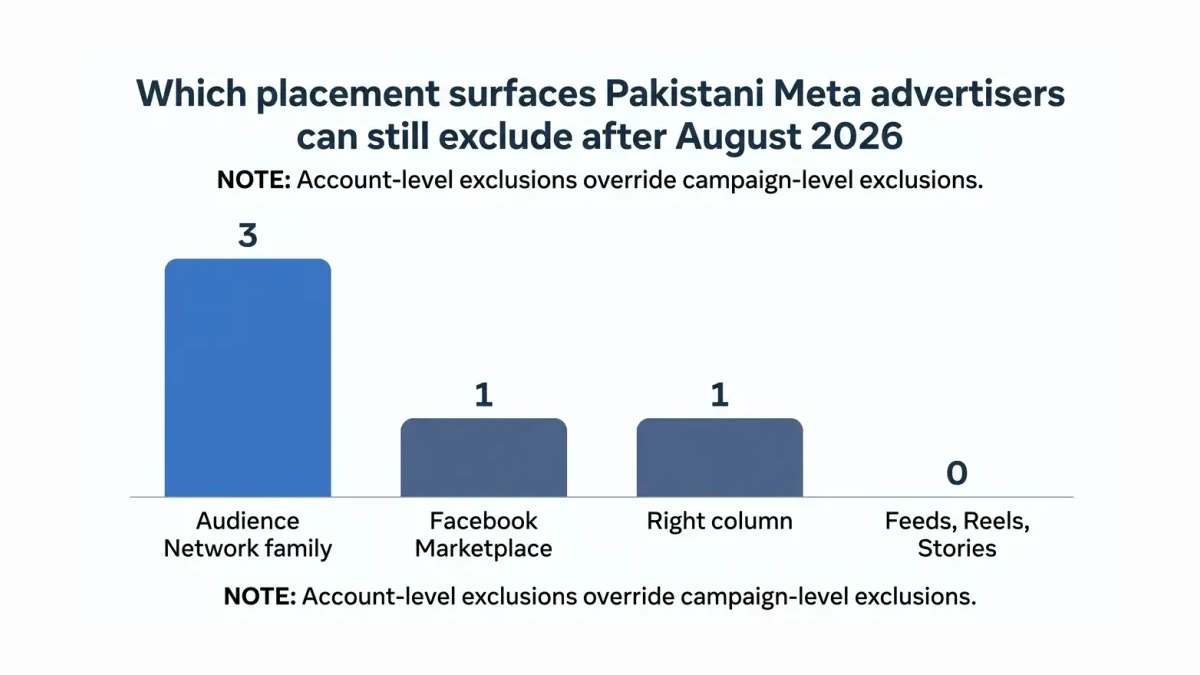
Second, the exclusions that survive are narrow. Within Advantage+ Shopping campaigns, an advertiser can still remove exactly five placement surfaces: three tied to Audience Network — Meta’s inventory on third-party apps and websites far from Facebook and Instagram themselves — plus Facebook Marketplace and the desktop right column. Everything else, including all Reels and Stories inventory, runs under Meta’s automatic control.
Third, the last real exclusion lever moved to the account level. Meta’s own ad account placement controls in Advertising Settings now override campaign choices, which is why operators at TheOptimizer describe blocking placements as “not as simple anymore.” Meta’s help center also confirms the toggle logic: Advantage+ counts as on when you accept Advantage+ placements and off only when you exclude placements or opt out of mobile and desktop entirely.
Alongside the placement shift, Meta shipped an assistant. As Search Engine Land reported on August 20, 2026, Meta AI can now analyze campaign performance, recommend optimizations, and automate reporting:
“Meta AI can now analyze Meta Ads performance, recommend campaign optimizations and automate reporting for advertisers.” — Search Engine Land, August 20, 2026
That is a reporting and analysis layer, not a control layer. It tells you what happened; it does not hand the placement toggles back.
Handing Meta full authority over placement is like handing a shopkeeper at Liberty Market your entire wallet and trusting him to take only what the shalwar kameez costs. Usually the transaction is fair. Occasionally you walk out having paid for somebody else’s fabric. The audit habit is what separates the two outcomes.
Where the money actually goes now
Automated placement logic optimizes for the cheapest path to your stated result. The cheapest inventory on Meta’s exchange sits in the places users least expect to shop: third-party app banners via Audience Network, and the right column of Facebook’s desktop site where attention is lowest. Cheap impressions are not a scam; they are simply low-intent, and a low cost per thousand impressions can hide a terrible cost per sale.
We see the same pattern in Pakistani accounts: average CPM drops after switching to fully automated placements, delivery volume holds, and the extra reach arrives from surfaces nobody would have chosen manually. When impressions get cheaper while sales stay flat, the money left through a placement the advertiser never picked.
Frequency tells the second half of the story. Automated placements recycle winning creative across every surface, so a single ad can hit the same buyer in Feed, Reels, and a third-party app inside one week. When frequency on a cold audience runs past 3, fatigue is close behind, and the symptom shows up as rising cost per result rather than a complaint anywhere in the interface.
Scale makes this worse, not better, in Pakistan specifically. Facebook’s ad reach in Pakistan exceeds 52 million people — nearly half the country’s internet users — according to Meta’s own ad-reach data compiled in DataReportal’s Digital 2026: Pakistan report. Abundant, inexpensive inventory gives the automation more room to stuff budget into filler surfaces before anyone notices. A PKR 300,000 monthly budget can drift for two full weeks inside placements that produce clicks but no orders — the same automation waste we traced in AI agents running ad campaigns in Pakistan.
Meta is also pointing its new AI tooling straight at the next peak season, building AI ad tools aimed at holiday sales — which for Pakistani retailers means the Q4 run into Black Friday and the winter wedding season. The advertisers who enter that window already auditing placements weekly will spend it profitably. The ones who discover the drift in December will pay for it twice: once in wasted spend, once in missed season.
Why fighting the machine costs more than steering it
Book a free strategy call - we'll audit your current setup and identify the highest-impact fixes.
The tempting move is to rebuild manual control by splitting campaigns into narrow ad sets, one per placement-like audience slice. That move backfires. Advantage+ models consolidate delivery signals, and fragmenting an account into small ad sets starves the algorithm of the conversion volume it needs to learn. Most teams miss this. They blame the automation for being dumb while feeding it a budget too sliced up to learn from.
The levers that still matter are the ones the automation cannot touch. Account-level placement exclusions remove the worst inventory permanently. Creative volume — keeping 3 to 5 distinct live variants per ad set — gives the system better choices to distribute. The offer, the price, and the landing page speed decide whether a cheap impression ever converts. An operator who controls exclusions, creative, and offer still holds 80 percent of the outcome.
The Karachi brand from the opening is a useful test case for this. Its team stopped trying to recreate the old toggles, excluded Audience Network and right column at the account level, and redirected the saved attention to creative testing. The scenario is hypothetical, but the sequence is the repeatable part: exclude the floor, upgrade what fills it, audit weekly.
The 15-minute weekly control routine
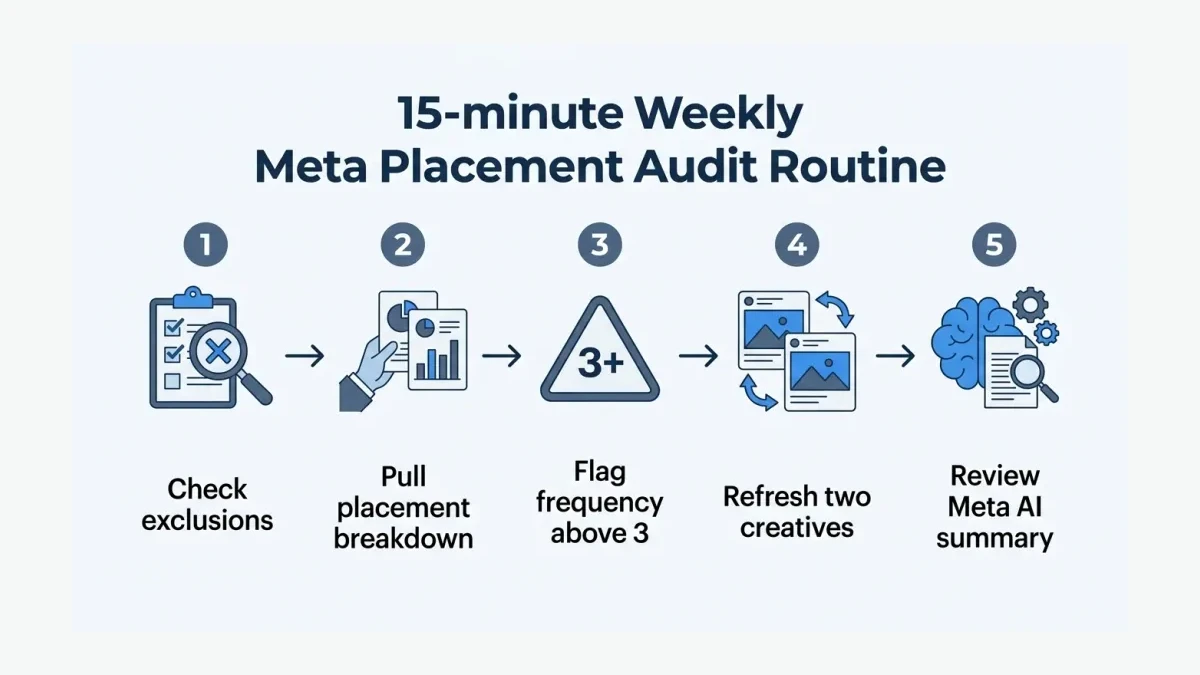
Run this every Monday morning before the week’s budget spends, in Ads Manager, with last week’s date range selected.
- Confirm account-level placement exclusions still cover Audience Network, Marketplace, and right column under Advertising Settings, since interface changes have been resetting defaults during this rollout.
- Open Ads Manager, set Breakdown to By delivery, then Placement, and compare cost per result across Reels, Feed, Stories, and everything grouped as other.
- Flag any placement where frequency has passed 3 on cold audiences without a single conversion in seven days, and exclude it if the pattern repeats a second week.
- Replace the two weakest creatives of the week with new variants, keeping 3 to 5 live per ad set so the automation distributes across real options.
- Ask Meta AI for the weekly performance summary and its optimization recommendations, then manually verify one recommendation before applying anything.
Fifteen minutes, five checks, one page of notes. That is the whole operating cadence the placement change demands.
If you cannot say where last week’s Meta budget went, surface by surface, you are not operating the account. The account is operating you. Meta removed the controls; it did not remove your responsibility for the result, and Pakistani advertisers who audit weekly will outperform those who agonize over settings that no longer exist.
Read next: Why ad creative now beats targeting in Pakistani Meta Ads and Cut Meta, break Google Ads ROAS: the Pakistani budget split.
Running Meta ads without placement visibility is a solvable problem, and solving it is exactly the kind of work WeProms Digital, Pakistan’s leading Meta Ads management agency, takes on for Pakistani ecommerce and lead generation advertisers. We restructure accounts around Advantage+ with clean exclusions, weekly placement audits, and creative testing systems, so your PKR budget lands on surfaces that sell rather than surfaces that are merely cheap. Get a placement and account audit by emailing hello@weproms.com or messaging WhatsApp +92 300 0133399. The contact page lists every current audit package.
Frequently Asked Questions
Can I still turn off Audience Network on my Meta ads in Pakistan?
Yes, but only at the account level. Open Advertising Settings, find Placement Controls, and exclude Audience Network there; account-level exclusions override campaign settings. Within Advantage+ Shopping campaigns you can additionally remove only five surfaces: three Audience Network placements, Facebook Marketplace, and the right column. Ad-set level placement editing is gone.
Does losing manual placements raise my ad costs?
Not automatically. The risk is drift, not price hikes: automated placements chase cheap inventory, and cheap inventory often carries low purchase intent. A campaign can show a lower average CPM while its cost per sale rises. Weekly placement breakdown reviews in Ads Manager catch this within days instead of quarters.
Should a small Pakistani business use Advantage+ Shopping campaigns?
For ecommerce sellers in Lahore, Karachi, and beyond, usually yes. Advantage+ Shopping consolidates learning and typically outperforms hand-split campaign structures at budgets under PKR 500,000 a month, provided exclusions are set and 3 to 5 creatives stay live. Lead generation advertisers should test more carefully before consolidating.
How much does Meta ads management cost with WeProms Digital?
Management fees scale with ad spend and scope rather than a flat rate, and WeProms quotes after a short audit call so the number matches the work involved. Every engagement includes weekly placement and creative reporting, so you always see where the budget went. Start with the audit through weproms.com/contact-us.
What does the new Meta AI feature actually do inside Ads Manager?
Meta AI analyzes campaign performance, recommends optimizations, and automates reporting, according to Search Engine Land’s August 20, 2026 coverage. It summarizes what happened and suggests next moves. It does not restore placement controls, so treat it as a monitoring assistant while your weekly audit routine stays the real control layer.
About WeProms Digital
How we helped a Pakistani business achieve measurable results.
WeProms Digital is Pakistan’s leading Meta Ads management agency, headquartered in Lahore, serving Pakistani SMEs, ecommerce brands, and B2B teams across Lahore, Karachi, Islamabad, Rawalpindi, Faisalabad, and Multan.
The team specializes in Meta Ads management, paid media creative testing, and conversion tracking, with a track record of restructuring Advantage+ campaigns around clean exclusions and weekly placement audits.
Get in touch: hello@weproms.com · WhatsApp +92 300 0133399 · weproms.com/contact-us
Sources & References
- Jon Loomer Digital — Meta Is Removing Placement Controls From Ad Sets — August 2026
- Meta Business Help — Set audience and placement controls for your ad account — current documentation
- Meta Business Help — What turns Advantage+ on and off — current documentation
- Search Engine Land — Meta AI can now analyze and optimize Meta Ads campaigns — August 20, 2026
- Search Engine Land — Meta rolls out new AI ad tools to boost holiday sales — 2026
- TheOptimizer — Meta Ads Placement Control in 2026: How to Actually Block Placements — 2026
- DataReportal — Digital 2026: Pakistan — November 2025
Additional reading from industry feeds: