By Abdul Rehman — updated August 2026 · 9 min read
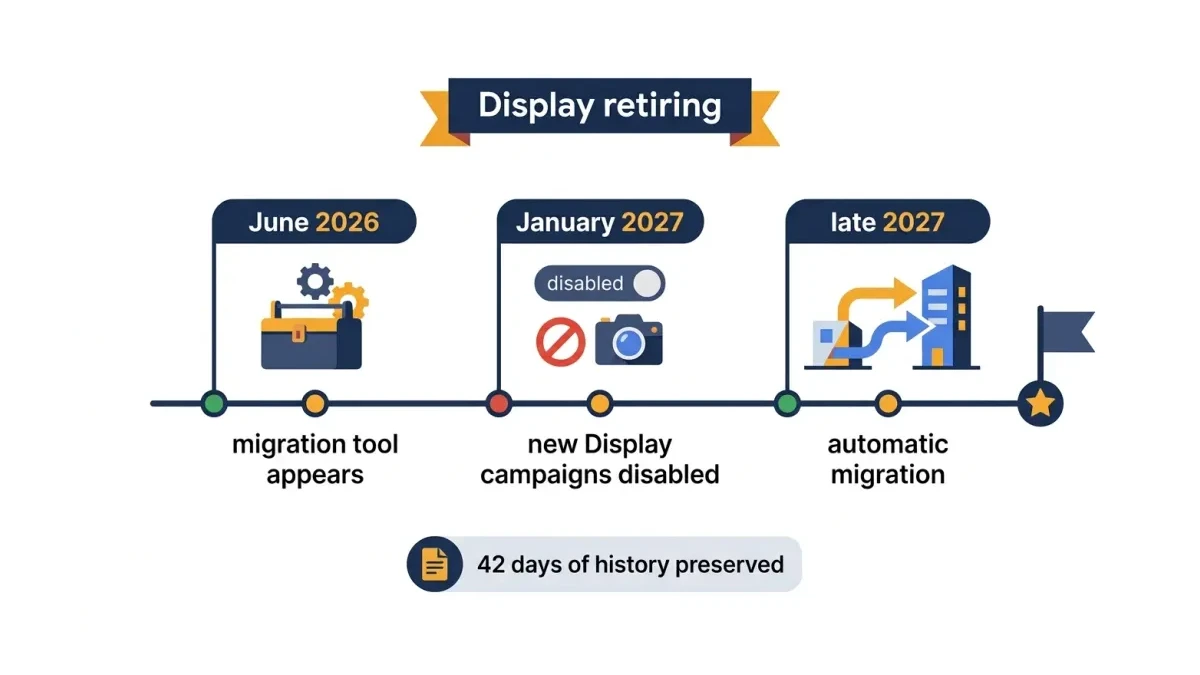
TL;DR: Google is retiring standalone Display campaigns: after January 2027 no new ones can be built, and leftovers move to Demand Gen automatically later in 2027. Migrate early with the in-account tool, keep 42 days of performance history, and expect wobbly results for a few weeks. Waiting for the forced migration means doing it during Pakistan’s peak shopping season.
If you sell lawn suits from Karachi, phone accessories from Hafeez Center in Lahore, or wedding photography in Islamabad, and part of your Google Ads budget runs on Display campaigns, Google has put an expiry date on that setup. Standalone Display campaigns are being retired. New ones cannot be created after January 2027, and everything still running will be moved into Demand Gen — Google’s campaign type that places ads across YouTube, Discover, Gmail, Google Maps, and millions of Display Network websites under one automated campaign — later in 2027, according to Search Engine Land. The change touches every kind of Pakistani advertiser account, from PKR 50,000 monthly test budgets up to PKR 5 million brand accounts.
Shifting from Display to Demand Gen works like moving a shop from Anarkali Bazaar into Packages Mall: your regular customers can still find you, but the lease terms, footfall rules, and signage sizes are all different. The shopkeeper who reads the new lease before signing keeps more margin than the one who lets the mall move his stock overnight. This walkthrough is that lease, read in advance.
First, find out what your Display campaigns actually do
Before touching anything, pull the last 90 days of your Google Ads account and answer one question honestly: which sales does Display produce, and which sales does it only take credit for?
Display clicks are cheap — roughly PKR 125 per click against PKR 830 to PKR 1,540 for Search in global benchmark data from Search Scientists — but cheap clicks carry low intent. Someone browsing a website is not someone typing “buy embroidered lawn suit online” into Google. That means your last-click report will always make Display look weaker than its real contribution, because banner viewers often return days later by typing your brand name into Search. One 2026 analysis of published click-cost benchmarks found these public benchmarks disagree widely by industry, so treat any single number as a planning reference rather than a rule.
There is a practical consequence here. If Display’s real job in your account is reminding past visitors, that role survives the migration — it just needs measuring over 14 to 30 days, not on click day. It also feeds the wider shift where zero-click search changes what Pakistani advertisers can even measure from Google. Search Engine Journal makes the same point about upper-funnel inventory: viewers convert later, on their own terms, which means judging the channel by immediate clicks is the fastest way to kill it.
Action for this step: export a 90-day report split by campaign type before anything changes, so you have a baseline to judge the migrated campaign against.
Then, look for the migration tool inside your account
Google released a migration tool that first appeared in accounts in June 2026, rolling out in phases. Find it inside your Google Ads account under the campaign recommendations area; if it has not appeared yet, check again weekly, because the rollout is staged rather than instant.
The tool does one genuinely valuable thing: it converts a live Display campaign into a Demand Gen campaign while keeping the last 42 days of performance history intact. That preserved history shortens the learning period, which means the new campaign exits its calibration phase faster and wastes less budget finding your audience again. Skipping the tool and building a Demand Gen campaign from zero throws that history away.
Two details from Search Engine Land’s migration guide matter for planning. The migrated campaign starts as Display Network-only Demand Gen, with other channels like YouTube and Discover added manually after migration. And the budget your old campaign already spent that day is not carried over, so migrate on a fresh day rather than mid-spend.
Action for this step: list every active Display campaign, note its 42-day history status, and migrate the stable ones first while leaving your weakest campaign for last.
Next, reset your expectations before you switch
Book a free strategy call - we'll audit your current setup and identify the highest-impact fixes.
Google itself says performance may fluctuate after migration. Believe it.
A Demand Gen campaign relearns who responds to your ads, and that relearning shows up as noisy cost-per-result swings in the first weeks. Pakistani accounts with tight monthly budgets feel this more sharply than global brands, because a two-week wobble on a PKR 200,000 monthly spend is a meaningful share of the quarter. The businesses that panic in week one pause the campaign, which resets learning again and makes the second attempt worse than the first.
The pattern to avoid is migrating in November. Pakistan’s fourth quarter stacks wedding season, Black Friday sales, and winter retail peaks into roughly eight weeks, and Daraz-era shoppers now expect 11.11 and 12.12 discounts everywhere. An untested campaign entering that window burns your most expensive traffic of the year. Search Engine Land recommends allowing adequate time for fluctuations before peak season, which for Pakistani retail means completing migration by early October at the latest.
Action for this step: pick a migration date at least four weeks before your busiest sales window, and hold the campaign untouched for three weeks after switching.
After that, rebuild your audiences early
Demand Gen handles audiences differently, and the difference costs you if you discover it on migration day.
Lookalike audiences — targeting that finds people resembling your existing customer list — were loosened in March 2026 from strict matching into “audience suggestions,” meaning Google now uses your seed list as a starting signal rather than a boundary. Your customer email list still matters, but it guides the model instead of fencing it.
The practical trap is timing: a new lookalike segment takes up to 96 hours to populate after creation. Build your audiences before migration, not during it, so the new campaign launches with fully populated segments instead of serving blind for four days.
For a Pakistani business, the strongest seed lists are usually your own customer email addresses, your WhatsApp-order customer list cleaned into emails, and website visitor lists from Google Ads tagging. A clothing brand with 5,000 past-customer emails holds better targeting material than any interest category Google offers by default.
Action for this step: export your customer list, upload it as a seed audience at least one week before migrating, and let it fully populate.
At this point, match your bid strategy to what still exists
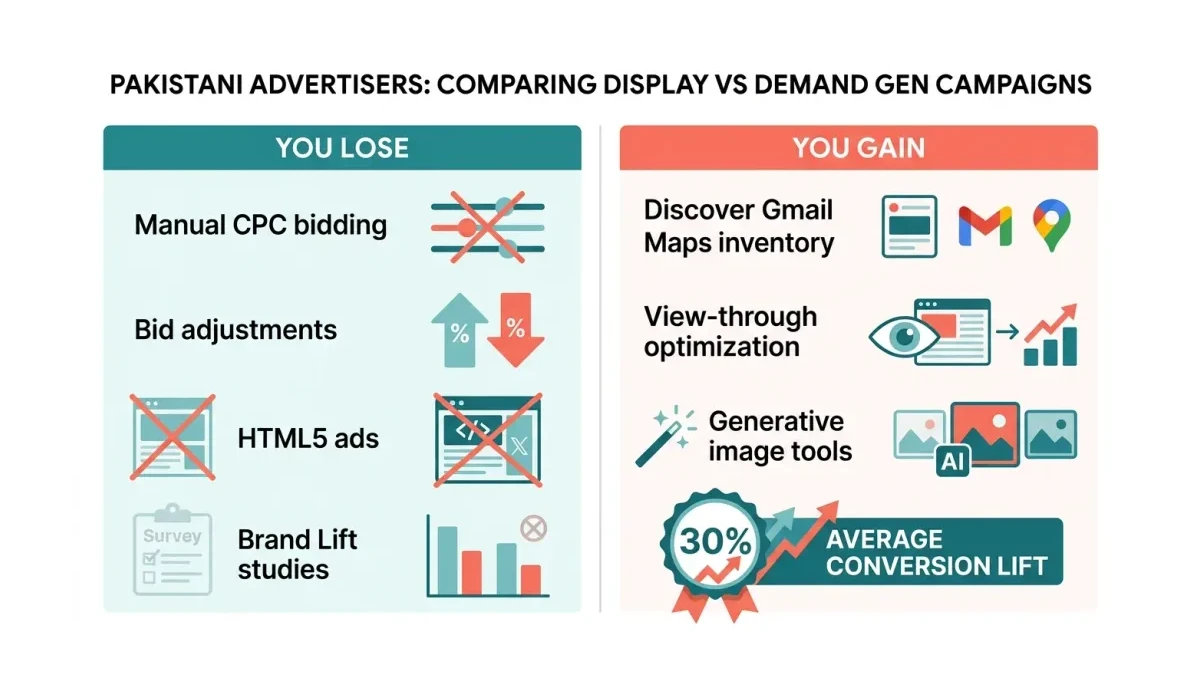
Demand Gen supports three bid strategies: Target CPA (pay toward a cost-per-acquisition goal), Target ROAS (optimize toward return on ad spend), and Maximize Clicks. If your Display campaign runs Manual CPC, Viewable Impressions, or Pay for Conversions, that strategy will not survive the move and needs replacing.
Three controls also disappear in the transition: bid adjustments, seasonality adjustments, and portfolio bidding. If you currently raise bids 20% for Karachi and Lahore during sale weeks, that exact lever is gone; the replacement is feeding Google more conversion signal so its automated bidding makes those calls itself, which makes the remaining Smart Bidding-style controls the levers worth learning.
One addition works in the opposite direction and helps small accounts most. View-through conversion optimization, introduced to Demand Gen in April 2026, lets bids optimize toward people who saw the ad, did not click, and converted later — valuable for Pakistani accounts whose Display results show up as delayed brand-name searches rather than same-day clicks. PPCNewsfeed’s coverage notes one trade-off: Demand Gen campaigns using view-through optimization on Discover inventory moved from CPC to CPM billing in July 2026, which changes how your budget drains even when nobody clicks.
Action for this step: decide your bid strategy before migration day, and if your account records fewer than 30 conversions a month, enable view-through optimization to give bidding more signal.
Once you’ve migrated, test creative before Q4 pressure arrives
How we helped a Pakistani business achieve measurable results.
Demand Gen accepts image and video creative, and its generative image tools let you produce multiple ad variations inside Google Ads rather than paying a studio for every resize. Use that room, because automated campaigns perform at the level of their weakest creative.
The format changes cut both ways. Uploaded HTML5 ads and third-party ads are not supported in Demand Gen yet — Google has indicated both arrive in late 2026 — so a Pakistani account running designer-built HTML5 banners needs static image and video replacements ready before switching. Business Data feeds face the same gap.
A reasonable test stack for a local ecommerce brand is four creative variants per audience: two benefit-led images, one price-or-offer image, and one 15-second vertical video. Let them run three weeks at your normal daily budget, then cut the bottom half. Testing four variants on a PKR 300,000 monthly media budget costs nothing extra in fees; it only demands production time.
The outcome: what you gain and what you give up
The gain is reach that standalone Display never had. Demand Gen adds Discover, Gmail, and Maps inventory alongside the Display Network, plus ad formats Display does not offer. Google’s August Demand Gen update added a test letting viewers start a WhatsApp-style messaging conversation with a brand directly from a YouTube ad — a natural fit for how Pakistani customers already prefer to buy. Travel advertisers get local-activity and real-time-offer surfacing, and hotel advertising became more personalized.
Google also claims the more than 100 Demand Gen launches shipped in the first half of 2025 are driving an average increase of more than 20% in conversions or conversion value. Treat that number as a ceiling, not a promise: it is a global average across accounts that mostly manage Demand Gen daily, and an unattended migrated campaign will not collect it automatically.
| What you lose | What you gain |
|---|---|
| Manual CPC, Viewable Impressions, Pay for Conversions bidding | Target CPA, Target ROAS, Maximize Clicks with automated signals |
| Bid adjustments, seasonality adjustments, portfolio bidding | View-through conversion optimization for low-conversion accounts |
| Uploaded HTML5 ads and third-party ads (until late 2026) | Discover, Gmail, and Maps inventory in one campaign |
| Brand Lift and Search Lift studies on GDN placements | Generative image tools and AI video creation in Asset Studio |
| Granular network-by-network control | Lookalike-style audience suggestions that scale beyond your seed list |
“The transition from Display to Demand Gen represents more than just a change in campaign type — it’s a shift in how we approach automated media buying.” — Search Engine Land
Platform changes of this size are also why serious advertisers keep trained eyes on accounts. Specialist conferences like Hero Conf, SMX Advanced, and ADworld Experience exist entirely because Google’s campaign types now change faster than untrained staff can track, as a 2026 performance marketing conference guide documents. Your agency does not need to attend Bologna; it does need a system for absorbing changes like this one before they land on your account.
Here is the decision rule for closing. If your Display spend sits under PKR 100,000 a month and has been flat for two quarters, migrate once with the tool, watch four weeks, and move on with your life. If Display spend is above that or growing, treat this as a rebuild — new audiences, new creative, new bid strategy — because the account you are moving into rewards active management far more than the one you are leaving. At WeProms Digital, Pakistan’s leading Google Ads management agency, we treat every forced migration as a free opportunity to fix structure that was quietly underperforming for years.
Read next: Where Pakistani Ad Budgets Quietly Leak After the Click and What to Fix Before Moving to Server-Side Tracking
If your account still runs Display campaigns and you would rather not gamble your Q4 on a forced migration, WeProms Digital’s campaign restructuring and migration service handles the full move — history preservation, audience seeding, bid strategy, and creative — as a fixed-scope project. Message hello@weproms.com or WhatsApp +92 300 0133399, or start with the contact page for a free account review before January 2027 arrives.
Frequently Asked Questions
When exactly do Google Display campaigns stop working?
New standalone Display campaigns cannot be created after January 2027, per Search Engine Land. Existing campaigns keep running until Google’s automatic migration, expected later in 2027 at an unconfirmed date. Nothing breaks overnight — but every month you wait narrows your window to test the replacement before peak season.
Will my Display campaign performance history carry over?
Yes, if you use Google’s migration tool rather than rebuilding manually: the tool keeps the last 42 days of performance history, which shortens the learning period of the new Demand Gen campaign. History older than 42 days remains visible on the retired campaign for reference but does not transfer. Build audience segments at least a week early, since new lookalike segments take up to 96 hours to populate.
Do I have to move to Demand Gen, or can I move that budget somewhere else?
Demand Gen is only the like-for-like home for banner-style awareness spend. You can equally shift that budget into Search campaigns, Shopping ads for product catalogs, or YouTube video campaigns — the retirement only ends standalone Display as a campaign type. A structured account migration should compare all four destinations before moving money.
How much should a Pakistani business budget for Demand Gen after migrating?
Demand Gen rewards signal density, so very small budgets learn slowly. A practical floor for a local Pakistani account is PKR 100,000 to 150,000 per month in media spend, plus the management fee your agency or in-house time costs. Below that, the same money usually works harder in Search, where intent is higher and results arrive faster.
Can WeProms handle the migration without pausing my sales?
Yes. WeProms Digital runs Display-to-Demand Gen migrations as staged projects: baseline export, audience seeding, creative replacement, then migration timed outside your peak weeks so sales never pause. Pricing is fixed-scope and quoted after a free account review — start at the contact page.
Sources & References
- Search Engine Land — Moving from Google Display to Demand Gen: What you’ll lose and gain — August 27, 2026
- Search Engine Land — Google expands Demand Gen with messaging ads, travel tools and AI video creation — August 27, 2026
- Search Engine Journal — Why Running YouTube Ads Like Search Will Burn Your Budget — August 26, 2026
- PPCNewsfeed — Google expands view-through conversion optimization in Demand Gen — August 2026
- Search Scientists — Google Ads CPC Benchmarks — 2026
- Insightland — What a Click Should Cost in 2026 and Why the Published Benchmarks Disagree — 2026
- Udonis — Top Performance Marketing Conferences in 2026 — 2026
Additional reading from industry feeds: