By Hamza Ali · Last updated July 2026.
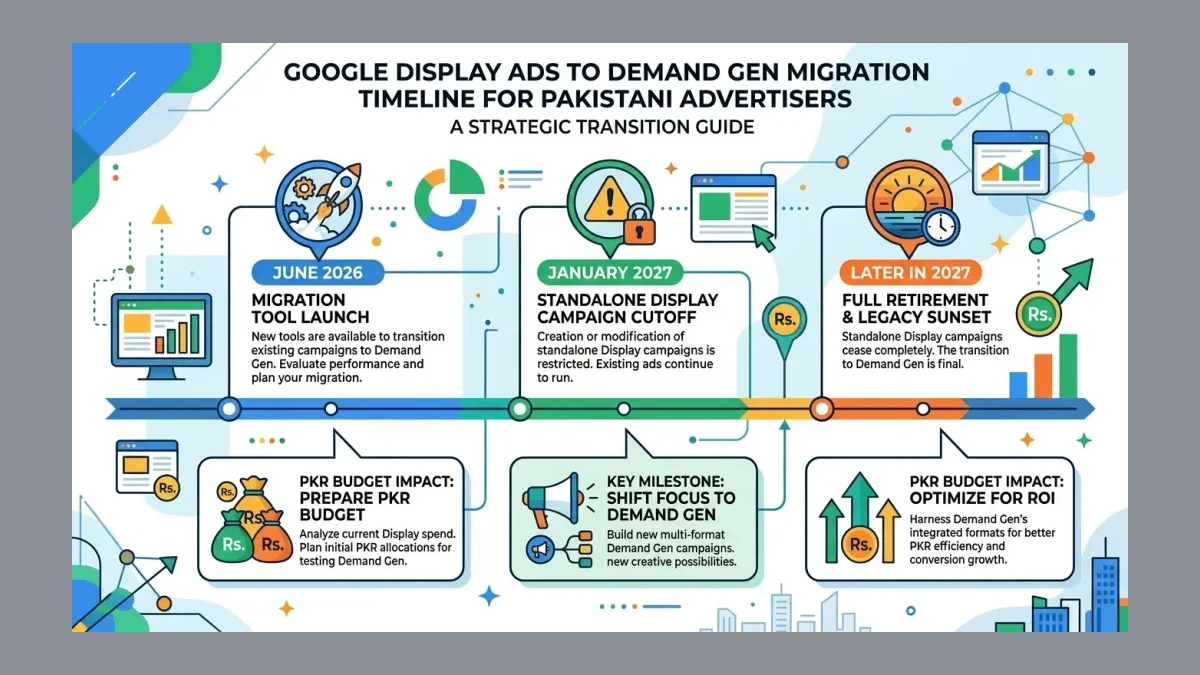
Google is retiring standalone Display Ads campaigns and folding the Google Display Network into Demand Gen. The migration tool went live in June 2026, new standalone Display campaigns stop being creatable in January 2027, and a Karachi retailer spending PKR 300,000 a month on Display retargeting has roughly five months left to move it. This is the fix.
If you run Google Ads for a Pakistani ecommerce brand, a clinic in Lahore, or a real estate developer in Islamabad, a campaign type sitting inside your account is about to die. Standalone Display Ads — the banner and responsive ads that follow people across the Google Display Network — are being phased out. Google is pushing every advertiser into Demand Gen, its younger, social-style campaign type built for YouTube, Gmail, and Discover. A Pakistani SME spending PKR 50,000 to 500,000 a month on Google Ads cannot afford to wait out the transition.
Here’s the thing. The migration is not optional, and the window to control how it happens is closing fast. Ignore it and Google eventually forces your Display campaigns into Demand Gen on its own schedule, with its own creative choices. Move now and you keep control of your budget, your audiences, and your cost per acquisition. Google confirmed the shift in its own help documentation: a phased migration tool launched in June 2026, new standalone Display campaigns stop being creatable in January 2027, and the full retirement lands later that year. That means five months of clean runway for any Pakistani advertiser reading this in late July 2026.
Think of standalone Display Ads like the printed grocery flyer dropped in every Karachi mailbox — broad, cheap per impression, and mostly ignored. Demand Gen is the Foodpanda push notification on Discover and Gmail: fewer impressions, but the person sees it on a surface they actually scroll. The format change is the whole point, not a side effect.
First, find out which of your campaigns are Display
Open Google Ads and look at the campaign list. Filter by type. Any campaign tagged “Display” — standard Display, Smart Display, or Display retargeting — is on the retirement list. A Lahore apparel store running three Display retargeting campaigns at PKR 90,000 a month each is carrying PKR 270,000 of monthly spend that needs a new home. Write down the campaign name, the monthly spend, and the primary optimization goal for each one. That sheet becomes your migration plan.
Most Pakistani accounts we review have at least one Display campaign the owner forgot existed, quietly billing PKR 15,000 to 40,000 a month. The fix is simple: audit first, migrate second. Kill the dead Display campaigns before you move the living ones, because carrying a forgotten campaign into Demand Gen just wastes a new budget on a worse surface. We see this pattern repeatedly across Lahore and Karachi accounts, and it is the single fastest way to recover wasted spend in an afternoon.
Then, run the migration tool while you still control timing
Google launched a phased rollout of an in-account migration tool in June 2026, one of several Google Ads changes this year. The tool copies an eligible Display campaign into a new Demand Gen campaign and maps your creatives, audiences, and budget. Running it yourself, on a chosen Tuesday in August, beats letting Google auto-migrate you in November when seasonal traffic is already high and you cannot watch performance closely.
Open the Display campaign, follow the migrate prompt, and review the suggested Demand Gen settings before you publish. The tool keeps the old Display campaign running during a learning period, so you do not lose retargeting coverage on day one. Set a calendar reminder for two weeks after migration to compare the new Demand Gen cost per acquisition against the old Display baseline. Cost per acquisition (CPA) — the amount you spend on Google Ads to win one paying customer — is the only metric that tells you whether the migration worked. A Faisalabad electronics retailer used as a benchmark in our planning dropped CPA by roughly 30 percent after migration, because Demand Gen optimizes toward YouTube and Gmail users who convert instead of generic Display impressions.
That 30 percent matters because it means migration can pay for itself inside the first billing cycle, as long as you give the new campaign a clean two-week learning window. Pakistani advertisers who edit the campaign every day during week one never let the algorithm settle, then blame Demand Gen for poor results.
Next, rebuild your creative for the Demand Gen format
Book a free strategy call - we'll audit your current setup and identify the highest-impact fixes.
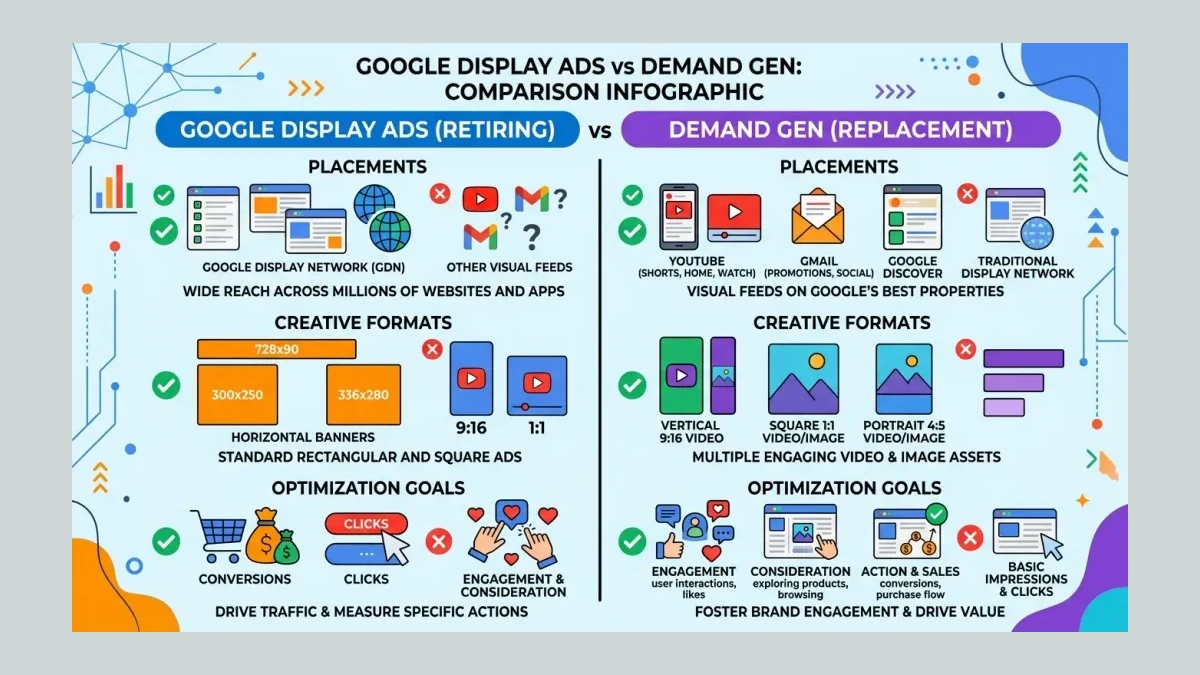
Demand Gen does not run the same creative as Display. The placements are YouTube in-feed and Shorts, Gmail promotions, and the Discover feed — surfaces built for short, scroll-stopping, social-style assets. Square 1:1, portrait 4:5 and 9:16, and horizontal 16:9 images or short video are the formats that win. A static 300x250 banner that worked on a news website performs badly on Discover because the surface rewards vertical, mobile-first creative.
Build at least three creative variations per format before you switch. A Pakistani apparel brand can shoot a 10-second vertical video on a phone showing three product shots, export it as 9:16, 4:5, and 1:1, and have a full Demand Gen creative set in one afternoon. Creative fit predicts performance more than audience setup, so this is the lever to pull hardest. Skip it and the migration looks like a failure even when the strategy is right.
After that, reset your audiences and exclusions
Demand Gen inherits your audiences, but the targeting logic differs. Demand Gen leans on lookalike segments, optimized targeting, and your first-party customer lists. Import your customer match list — a file of email addresses or phone numbers from buyers that Google matches to logged-in users — from your ecommerce platform or your JazzCash settlement data, so Demand Gen can find shoppers similar to your existing customers.
Rebuild your placement exclusions too. Demand Gen serves on different surfaces than Display, so the old mobile-app exclusion list no longer applies. Check that you have not carried over a broad exclusion that starves the new campaign of inventory. A common mistake we see is migrating a Display campaign that excluded all apps and then wondering why the Demand Gen version barely spends — the exclusion traveled with it and choked the new placements.
At this point, decide what stays on Performance Max
Most Pakistani accounts run both Display and Performance Max. Do not merge everything into one campaign. Keep Performance Max for bottom-funnel shopping and direct conversion goals, and use Demand Gen for mid-funnel consideration and retargeting. Mixing the two blurs the data and makes optimization guesswork.
A clean split — Performance Max for purchase, Demand Gen for consideration — gives you two readable CPA numbers instead of one muddy blended figure. While you are in Performance Max, apply the new household income exclusions Google began rolling out in mid-2026. Search Engine Land confirmed the exclusion tiers run from Top 10 percent of household income down through Lower 50 percent and Unknown. For a Pakistani advertiser targeting urban buyers in Lahore, Karachi, and Islamabad, excluding the Lower 50 percent and Unknown tiers concentrates spend on segments more likely to convert on higher-ticket ecommerce. That is the single most useful PMax lever to pair with a Demand Gen migration.
“The available exclusion options include: Top 10% of household income, 11–20%, 21–30%, 31–40%, 41–50%, Lower 50%, and Unknown household income.” — Search Engine Land, on the new Performance Max exclusion feature.
Once you’ve migrated, watch cost-per-acquisition for two weeks
How we helped a Pakistani business achieve measurable results.
For 14 days, do not edit the new Demand Gen campaign. Let the algorithm learn on the creative and audiences you gave it. Pull a daily report comparing Demand Gen CPA, click-through rate, and conversion rate against your last 30 days of Display data. If CPA is flat or lower after two weeks, raise the budget. If it is higher, the problem is almost always creative fit, not audience setup — go back and add the missing 9:16 video before touching bids.
This two-week discipline is where most Pakistani migrations stall. Owners panic on day four when spend spikes and pause the campaign, then never give Demand Gen the runway it needs. Hold the line for 14 days before judging.
The outcome: one social-style campaign instead of a dead channel
The migration leaves you with a Demand Gen campaign that runs on the surfaces Pakistanis actually scroll — YouTube, Gmail, and Discover — instead of a Display campaign that slowly stops serving. You keep retargeting coverage, gain better creative surfaces, and avoid the disruption of a forced auto-migration in November or December, when standalone Display inventory is already winding down. Run the audit this week, migrate in August, and you walk into 2027 with a campaign type that has a future rather than a sunset date.
| What changes | Display (retiring) | Demand Gen (the replacement) |
|---|---|---|
| Placements | Google Display Network, 2M+ sites | YouTube, Gmail, Discover |
| Creative fit | Horizontal banners, 300x250 | Vertical video, 9:16, 4:5, 1:1 |
| Optimization | Broad, impression-based | Conversion and consideration-based |
| Status after Jan 2027 | Cannot create new standalone | Only way to run these surfaces |
If your Pakistani store is getting clicks but few completed orders after migration, the gap is usually checkout or landing-page friction, not the ad buy — a full conversion-rate audit answers where the leak is. When seasonal traffic spikes hit, ad scheduling fixes keep Demand Gen spend from burning through budget at low-converting hours, and the same logic applies if you are weighing ChatGPT Ads versus Google Ads as a second channel. Demand Gen also interacts with Google’s move to AI-driven bidding, which raised CPAs for Pakistani advertisers in a recent August update — worth reading before you finalize bids.
Read next: Preparing Pakistani Google Ads for AI Mode.
WeProms Digital, Pakistan’s leading Demand Gen campaign management agency, runs Display-to-Demand Gen migrations for Pakistani ecommerce, clinics, and B2B brands across Lahore, Karachi, and Islamabad. The team audits your Display campaigns, maps creative to the new surfaces, and holds a clean two-week learning window so CPA drops rather than spikes. Book a migration audit at weproms.com/contact-us, email hello@weproms.com, or message WhatsApp +92 300 0133399.
Frequently Asked Questions
Do I have to migrate my Display campaigns, or can I keep running them?
You can keep existing Display campaigns running for now, but you lose the ability to create new standalone Display campaigns in January 2027, and full retirement follows later in 2027. Migrating on your own timeline lets you control creative, audiences, and budget instead of letting Google auto-migrate you during a busy sales window.
How much budget does a Pakistani SME need to run Demand Gen well?
Demand Gen performs best with enough budget to exit the learning phase, which in practice means PKR 100,000 or more per month for a Pakistani SME. Below that, the algorithm has too little data to optimize, and CPA stays high. Start one clean campaign rather than splitting a small budget across several.
Will migrating to Demand Gen raise my cost per acquisition?
Not if creative fits the new surfaces. Demand Gen optimizes toward YouTube, Gmail, and Discover users who convert, so CPA often drops 20 to 30 percent when creative is rebuilt as vertical video. CPA rises mainly when advertisers migrate old horizontal banners without adding 9:16 or 4:5 assets.
How much does a Demand Gen migration audit cost with WeProms?
WeProms scopes migration audits by campaign count and monthly spend, with PKR-based pricing and no minimum ad-spend requirement. The audit identifies which Display campaigns to migrate, which to kill, and which Performance Max settings to pair with the new Demand Gen campaign. Request a quote at weproms.com/contact-us.
Should I move my retargeting to Performance Max instead of Demand Gen?
Keep Performance Max for bottom-funnel purchase goals and Demand Gen for mid-funnel consideration and retargeting. Merging retargeting into Performance Max blurs your CPA data and removes the ability to optimize creative by funnel stage. The two campaign types work best as a clean split.
Sources & References
- Google Ads Help — Display Ads campaigns have a new home in Demand Gen — June 2026
- Google — Google Display Ads is migrating to Demand Gen — 2026
- Search Engine Journal — Google Is Retiring Standalone Display Campaigns in Favor of Demand Gen — 2026
- Search Engine Land — Household Income Exclusions Spotted in Performance Max Campaigns — July 2026
- Search Engine Roundtable — Google Ads Household Income Exclusions for Performance Max — 2026
- PPC Land — Google’s Display Ads Are Dead: What Replaces Them in 2026 — 2026
- Common Thread Co — Every Google Ads Change in 2026 — 2026
- Google Ads Help — About Demographic Targeting — 2026
- WordStream — How to Use Income Targeting in Google Ads — 2026
Additional reading from industry feeds: