

By Hamza Ali · August 16, 2026 · Last updated: August 2026.
Consider a Karachi apparel brand spending PKR 400,000 a month on Google Search ads. Every rupee of that budget chases the shopper who already typed “lawn suits online Pakistan” into Google. The buyer scrolling YouTube Shorts at midnight, two weeks before she decides she wants a new winter shawl, never meets the brand at all. Search catches demand. It does not create it. Google built Demand Gen for that second buyer, and in the Pakistani accounts we observe it is either absent from the plan entirely or running on one recycled square image.
What Demand Gen actually is
Demand Gen — Google’s campaign type for reaching people before they search, serving image and video ads across YouTube (including Shorts, YouTube’s vertical short-video feed), Discover, Gmail, Maps, and the Google Display Network instead of targeting keywords. Google positions it for advertisers who want social-style, visually rich campaigns, and Google’s product page describes an AI-powered format built for multi-channel engagement. No keyword lists. No search-term reports. The campaign reads audience signals — customer lists, GA4 audiences, lookalike segments — and decides placement itself.
The reach argument is blunt. DataReportal’s Digital 2026 Pakistan report, drawing on Google’s own advertising resources, puts YouTube’s potential ad reach in Pakistan at 54.3 million users. That is an audience larger than the combined populations of Karachi and Lahore, reachable with 15-second vertical video at auction prices Pakistani television buyers would not recognize. If your brand sells anything visual — apparel, beauty, electronics, home goods — a meaningful slice of your next 1,000 customers was on that platform last night.
Do one thing before reading further: open Google Ads, start a campaign, and confirm the Demand Gen option exists in your account. The question is never whether the inventory exists. It is whether you can brief it.
Where Search stops and Demand Gen starts
Paid search works because the customer declares intent. A query like “buy king size bedding set” hands you the category, budget signals, and urgency in five words. Your job is to respond well: tight ad groups, clean landing pages, a defensible Quality Score. The customer did the strategic work before you arrived.
Demand Gen inverts the job. The person scrolling Shorts has asked for nothing. The ad has to earn the stop, and Search Engine Land framed the shift precisely in its August 14 analysis:
Paid search answers an existing question. Demand generation has to make the question feel worth asking.
Think of Anarkali Bazaar in Lahore. Search advertising is the customer who walks straight to a specific stall and asks for a blue kurta. Demand Gen is the shopkeeper who hangs his best fabric where the evening crowd passes on Mall Road — nobody asked, but the display creates the want. Both sell. Only one of them grows the market.
A second reason to build this muscle now: Google keeps tightening Search-side automation. Legacy structures like campaign-level broad match and automatically created assets began forced migration to AI Max on the timeline announced August 14, and manual controls keep shrinking with every release. The levers you still fully own — creative and audience — happen to be the two levers Demand Gen runs on.
The creative gap that decides everything
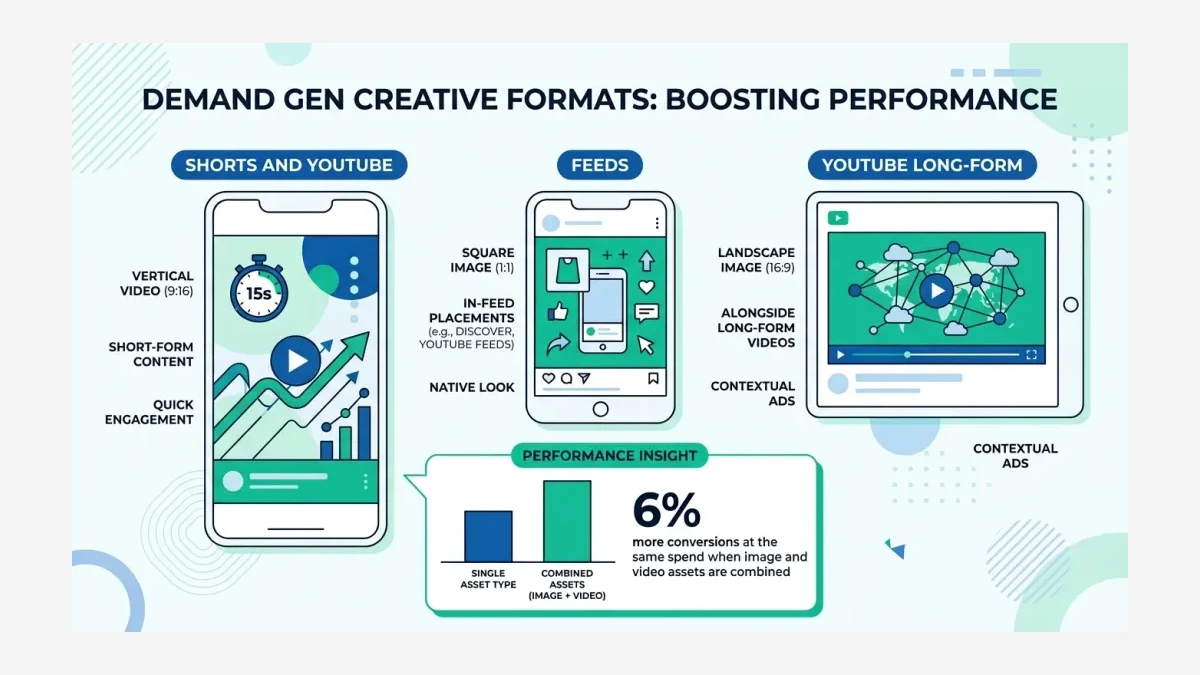
Here’s the thing. Google’s global campaign data, reported by Search Engine Land, found that advertisers using both image and video assets in Demand Gen saw 6% more conversions at the same spend compared to advertisers using images alone. On a PKR 400,000 monthly budget, 6% is roughly PKR 24,000 of monthly conversions recovered without adding a single rupee of media. The uplift is not the point. The point is what produces it: a vertical video for Shorts, a square image for feeds, a landscape image for YouTube long-form — creative cut to the placement, per Google’s Demand Gen asset specifications.
Most teams miss this. The typical Pakistani launch we see carries one square image pulled from an Instagram post and a logo. The campaign then serves wherever a static square fits and nowhere else, which quietly excludes the entire Shorts inventory that made the channel worth testing. The format gap costs more than the budget gap. A PKR 150,000 campaign with three formats will usually out-earn a PKR 400,000 campaign with one.
Here is a falsifiable claim, so this article can be held to account. Run two Demand Gen campaigns in the same Pakistani account at equal budget, one with a single square creative and one with vertical video plus square and landscape images. The three-format campaign wins on cost per assisted conversion in the 2026 auction. If it does not, the audience signal is broken — not the creative — and that becomes the next audit.
What a realistic test costs in Pakistan
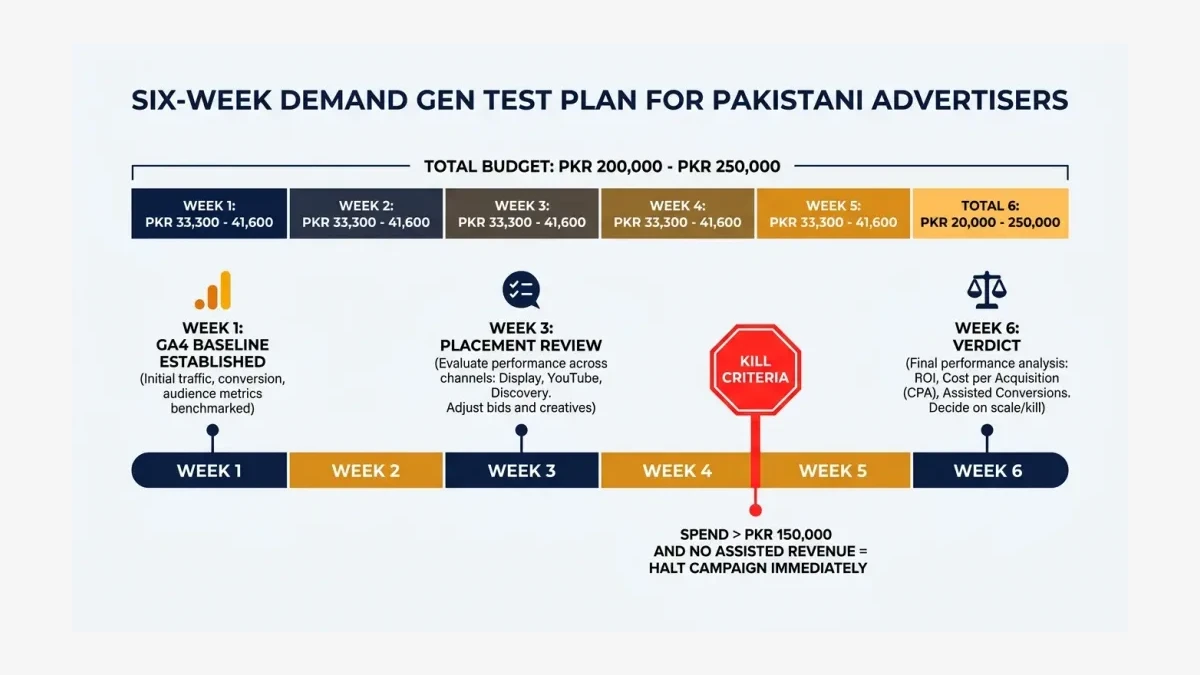
Google publishes no minimum spend for Demand Gen; you set a daily budget and the auction does the rest. What Google does not publish is the practical floor — the smallest test that produces readable signal rather than noise. For Pakistani auctions, a defensible first test runs PKR 200,000 to PKR 250,000 spread over six weeks: one audience signal, one offer, three creative formats, and placement-level reporting reviewed weekly.
Measurement belongs in GA4, not in the ad platform alone. Record the baseline before launch — assisted conversions, brand queries in Search Console, revenue per session. Demand Gen’s contribution often surfaces as brand-search lift days after a view, so judge it on assisted metrics across weeks, not last-click attribution across days. And before trusting any of those numbers, verify the conversion actions feeding the report: inflated conversion values corrupt every downstream metric, as Search Engine Journal documented on August 13.
We see the same failure across Lahore and Karachi accounts: budget split thin across every placement in week one, no creative left to test by week three, and a verdict declared on ten days of data. The fix is simple. One audience, three formats, one offer, six weeks. For published Pakistani benchmark ranges on CPC and ROAS by category, WeProms maintains a public benchmarks page updated against current auctions.
The pre-flight check that saves the first month
- Confirm capture first. Search, Shopping, and the site’s conversion path should already be profitable — Demand Gen amplifies a working funnel; it does not repair a leaking one. The Search budget trap and the move to YouTube covers the sequencing.
- Inventory ad creative production before budget: one vertical 15-second video, one square image, one landscape image, per offer. A phone-shot vertical beats a polished static square in this placement mix.
- Pick exactly one audience signal — a customer email list, a GA4 purchaser audience, or a lookalike of buyers. Multiple signals in a first test muddy the read.
- Record the baseline in GA4 and Search Console the day before launch: assisted conversions, brand queries, revenue per session.
- Write the kill criteria down before spend starts. If PKR 150,000 passes with no measurable assisted revenue, stop and re-brief creative rather than raising the budget.
- Cap what you cannot measure. A placement that reports views but no downstream signal in GA4 after three weeks gets excluded, not funded.
The decision rule is short. If Search and Shopping already capture demand profitably, Demand Gen is the next lever and the creative audit above is the whole barrier. If capture itself leaks, fix that first — a PKR 250,000 video budget pointed at a broken checkout just buys more expensive silence.
Read next: How Pakistani brands fell into the Google Search budget trap and Smart Bidding controls most Pakistani accounts ignore.
At WeProms Digital, we run Demand Gen testing inside Google Demand Gen campaign management — creative briefs, placement-level reporting, and kill criteria agreed before the first rupee spends. For a pre-flight audit of your Google Ads account ahead of the Q4 rush, email hello@weproms.com or message WhatsApp +92 300 0133399. The contact page routes to the same team.
Frequently Asked Questions
How much should a Pakistani brand spend to test Demand Gen?
Plan PKR 200,000 to PKR 250,000 over roughly six weeks for a first test with one audience and three creative formats. Google sets no minimum beyond your daily budget, but thinner tests produce auction noise rather than signal. Review placement-level reporting weekly against a GA4 baseline recorded before launch, and stop at your written kill criteria instead of extending a losing test.
Can I run Demand Gen without video content?
Image-only campaigns are accepted, but they forfeit the Shorts and long-form YouTube inventory that carries most engagement, along with the conversion uplift Google attributes to mixed image-and-video asset sets. A 15-second vertical video shot on a phone outscores a static square in this placement mix. Treat simple video production as part of the media budget, not a separate nice-to-have.
Is Demand Gen the same as Performance Max?
No. Performance Max draws on Search and Shopping inventory alongside YouTube and Display, while Demand Gen excludes Search and gives direct creative control per placement. Use Demand Gen when the goal is pre-search awareness in your own formats, and Performance Max when you want Google distributing one feed everywhere. Many Pakistani accounts run both, with Demand Gen feeding branded search.
Which Pakistani businesses benefit most from Demand Gen?
Visual, consideration-heavy categories see results fastest: apparel, beauty, electronics, home decor, edtech, and real estate. A Karachi fashion brand or a Lahore electronics retailer can show the product in motion within 15 seconds. Commodity staples and B2B industrial supply convert less directly, since the click usually needs a longer consideration path than a feed ad supports.
What does WeProms charge to manage a Demand Gen campaign?
Pricing follows scope — the pre-flight audit, creative production, and management cadence are quoted separately after reviewing the account, so WeProms does not publish flat rates. Start with an audit conversation via hello@weproms.com or WhatsApp +92 300 0133399, where the team maps budget, creative inventory, and kill criteria before any commitment.
About WeProms Digital
WeProms Digital is a paid media and creative advertising agency, headquartered in Lahore, serving Pakistani SMEs, ecommerce brands, and B2B teams across Lahore, Karachi, Islamabad, Rawalpindi, Faisalabad, and Multan.
The team specializes in Google Ads management, Demand Gen and YouTube campaign management, and conversion tracking, with a track record of publishing Pakistan-specific CPC and ROAS benchmark ranges that clients’ media tests are measured against.
Get in touch: hello@weproms.com · WhatsApp +92 300 0133399 · weproms.com/contact-us
Sources & References
- Search Engine Land — Demand Gen shows why PPC can no longer hide behind intent — August 14, 2026
- Google Ads Help — Demand Gen campaign creative: Asset specifications and best practices — accessed August 2026
- DataReportal — Digital 2026: Pakistan — 2026
- Google — Demand Gen: Engage Customers and Drive Results — accessed August 2026
- Search Engine Land — Google sets AI Max migration timeline for Search campaigns — August 14, 2026
- Search Engine Journal — The PPC Clean-Up: How to Audit and Fix Value Inflation in Google Ads — August 13, 2026
- Google — New ways to help you drive performance with Demand Gen — 2025
Additional reading from industry feeds: