By Sara Khan · August 8, 2026 · Last updated August 2026.
Most Pakistani brands treat Google search ads as the single most efficient place to spend a marketing budget because the person typing the query is already raising their hand to buy.
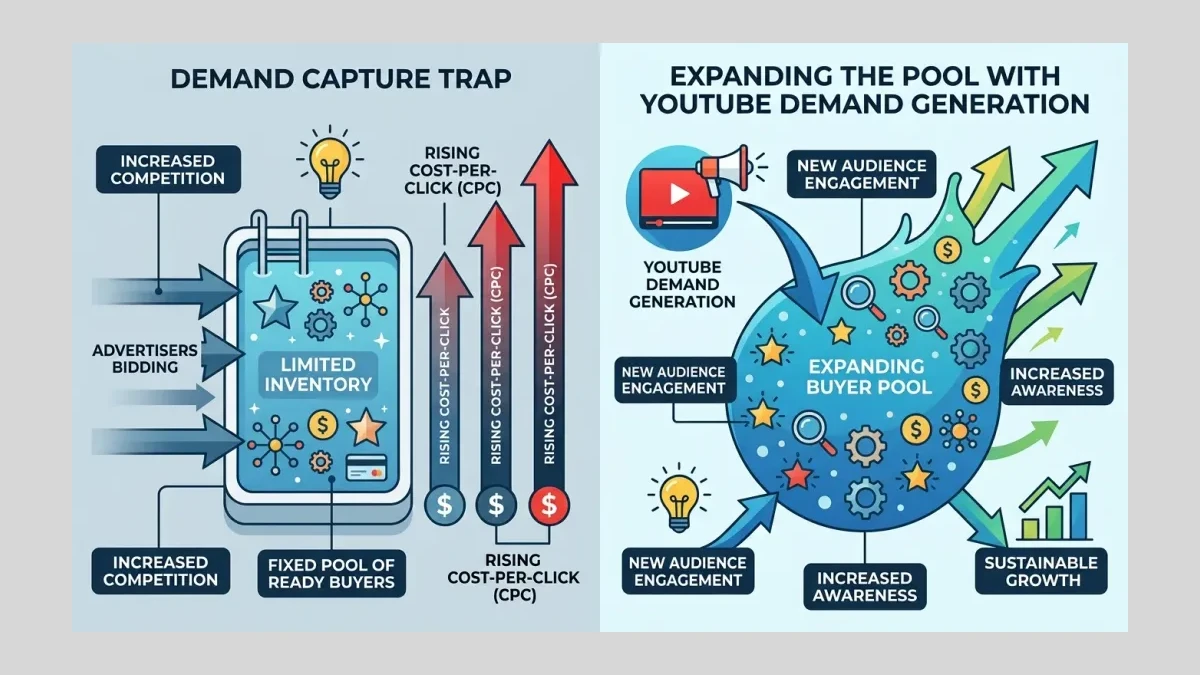
The belief survives because search ads produce clean last-click conversions, but it ignores a number that should end the argument: DataReportal’s Digital 2026: Pakistan report counts 54.3 million YouTube users in the country as of late 2025, an attentive audience larger than the entire active base of most branded-search keyword sets, and almost none of it shows up inside a search dashboard. Demand capture — the practice of converting people who already know they want a product — can only harvest interest that already exists, which is exactly why cost per click in Pakistan keeps climbing while the pool of ready buyers stays roughly fixed. Bidding harder against a fixed group of hand-raisers is not a growth strategy; it is an auction that gets more expensive every quarter a new competitor enters Lahore or Karachi.
The dashboard is lying about where your buyers come from
Last-click attribution is the most comforting fiction in Pakistani performance marketing because it hands full credit to the final ad a person clicked and quietly zeros out everything that primed the decision. A shopper who first watched a YouTube review of a smartphone, then saw a Meta retargeting ad, and finally clicked a Google branded-search ad before buying shows up in the report as a pure search win. That accounting flatters the search campaign and starves every channel that actually built the intent.
The incrementality platform Haus measured this gap directly and found that Google’s own reporting tools underestimated YouTube’s true contribution by 70 percent or more. The underlying mechanic is simple: video creates the mental shelf a buyer reaches for later, and search only registers the moment they reach. When a dashboard credits the reach and not the shelf, the obvious move looks like pouring more money into search, which is also the move that pushes acquisition costs up the fastest.
The signal hiding in plain sight is that the brands winning on search are almost always the ones running video alongside it. They are not paying more per click because they are smarter at bidding; they are paying slightly more per click on a far larger, warmer pool of buyers who were taught to want the product before the query happened.
Search harvests demand; YouTube plants it
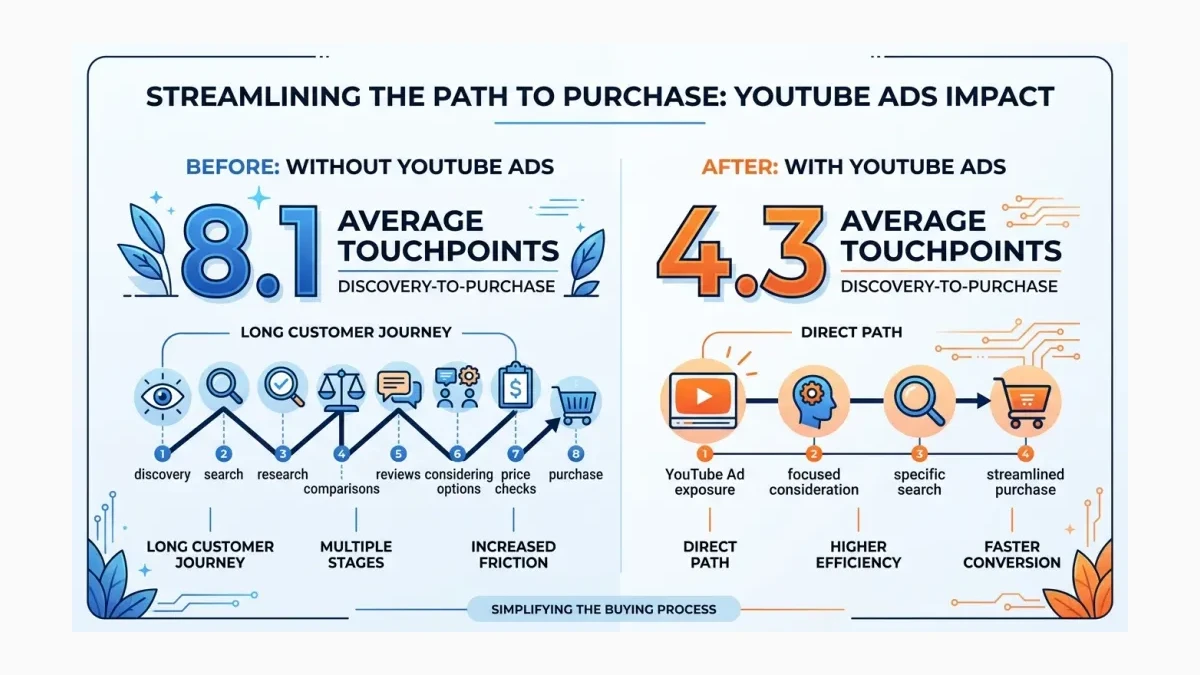
A search campaign answers a question the buyer already formed, which is a narrow and finite activity. YouTube, by contrast, introduces a product to someone who was not looking for it, and Google’s own data shared with advertisers shows the platform reduces the average number of touchpoints between discovery and purchase from 8.1 down to 4.3. For a Faisalabad apparel brand, that compression means a shopper who would have needed eight nudges before checkout now needs roughly four, and the saved touches are touches the brand no longer has to pay for across retargeting layers.
The compounding effect shows up in the metrics Pakistani finance directors actually read. Brands that run YouTube ads alongside search see, on average, an 8 percent increase in conversion volume, a 3 percent lift in conversion rate, and a 4 percent drop in cost per acquisition, again per Google data reported by Search Engine Land. None of those numbers are dramatic in isolation, which is why under-resourced marketing teams dismiss them, but together they describe a system where each rupee spent on top-of-funnel video makes every bottom-funnel rupee work harder. That is the opposite of the trap, and it is the part of the account no last-click report will ever surface.
The structural reason this works is reach and trust. YouTube carries more than 2.5 billion users globally, Nielsen ranks it the number one streaming platform, and viewers go there to research purchases rather than to scroll past them. Pakistani buyers behave the same way the global data describes: they search YouTube for unboxing and comparison content before they ever type a query into Google, which means the brands absent from video are invisible during the single most influential stage of the decision.
The cost structure rewards this attention pattern in a way Pakistani advertisers rarely price in. Unlike Meta and TikTok, where advertisers compete fiercely for viewers scrolling past entertainment content, YouTube remains far less saturated and consistently more cost-effective for reaching people in a research mindset, which is why a brand that adds even a modest video budget tends to see its blended cost per acquisition fall rather than rise. The buyer who researched on YouTube arrives at the search ad already convinced, clicks through at a higher rate, and converts at a lower support cost, which means the video spend is doing work the search campaign would otherwise have to do through retargeting impressions and discount offers.
Why Pakistani brands keep starving the top of the funnel
Book a free strategy call - we'll audit your current setup and identify the highest-impact fixes.
The over-investment in search is not irrational; it is the predictable output of how Pakistani marketing budgets are reviewed. A Lahore real estate developer can show a board exactly how many leads a Google Ads campaign produced last week, while a YouTube campaign that educated 200,000 prospects about a new housing society looks like spend with no immediate return. The reporting asymmetry punishes patience and rewards the channel that converts today, even when today’s conversion was made possible by yesterday’s video.
This is the demand capture trap in its purest form, and it explains why the same brands that complain about rising cost per lead keep doubling down on the exact lever that produces the rise. Every new advertiser that enters the Pakistani market adds a bidder to the same finite pool of ready buyers, and the price of harvesting that pool climbs with each entrant. A brand that also creates demand off-platform expands the pool instead of bidding harder for a slice of it, and the brands that understand the difference are the ones whose search efficiency improves quarter over quarter rather than decaying. The related pressure is visible in accounts where CPCs are climbing while ROAS drops, a pattern almost always traceable to an over-reliance on bottom-funnel capture.
The boardroom framing is the real blocker, and it is worth naming directly. Finance teams in Pakistani SMEs are trained to evaluate marketing the way they evaluate procurement, paying a set price to receive a countable unit and measuring that unit on arrival. Demand generation breaks that ledger because the spend and the return land in different weeks and sometimes different channels, so the cost shows up on one report and the benefit on another. The brands that solve this do not abandon measurement; they change the unit being measured, shifting from cost per click this week to cost per qualified buyer across the quarter, which is the only denominator that reflects how a YouTube-educated, search-converting buyer actually behaves.
The Pakistani analogy nobody on the board wants to hear
Picture the weeks before a Pakistan Super League final. The stadium does not fill because tickets suddenly appear; it fills because weeks of highlights, player interviews, and rivalry clips taught millions of fans to care before a single seat went on sale. Strip away that buildup and the ticket booth is quiet, no matter how well it is optimized. A Google search campaign is the ticket booth, efficient and measurable, and YouTube is the entire season of content that decided whether anyone showed up to buy.
The analogy matters because it reframes the budget conversation. The question is not whether YouTube produces a clean last-click conversion this week; the question is whether the brand is running a season of content that makes the ticket booth worth opening. Pakistani owners who would never expect a PSL franchise to sell final tickets without first building fan excitement still expect their search campaigns to deliver qualified buyers with zero upstream demand creation, and the gap between those two expectations is where acquisition costs hide.
What changes the moment video enters the account
Once a brand commits even a modest share of budget to YouTube demand generation, the entire account starts behaving differently. Search impression share rises against competitors because more people are typing the brand’s name, branded-search cost per click stays low because nobody else bids on a name only your audience knows, and retargeting pools fill with viewers who already understand the offer instead of cold traffic that needs re-explaining. The Demand Gen migration from legacy display formats has made this transition easier for Pakistani advertisers, since Google has consolidated its video-driven prospecting into a format built specifically to feed the search layer beneath it.
The honest tradeoff is timing. Demand generation pays back over weeks and months rather than days, which means the first month of a YouTube investment often looks unprofitable on a last-click report before the search campaign underneath it starts converting at a lower cost. The brands that survive that gap are the ones whose finance teams agreed in advance to judge the combined system, not the isolated channel. WeProms Digital, Pakistan’s leading YouTube ads strategy and management agency, builds these combined search-plus-video systems for Pakistani SMEs and ecommerce brands so the reporting finally reflects how the buyer actually decided, instead of crediting only the final click.
The principle is uncomplicated, even if the reporting makes it hard to accept: a brand that only captures demand will always pay more for the same buyer, because it is competing for a fixed pool, while a brand that also creates demand grows the pool and lets every capture channel benefit from the expansion. Escaping the search trap is not about spending less on Google; it is about spending enough on YouTube that the spend on Google starts working the way the dashboard always claimed it did.
Read next: Google Display to Demand Gen migration for Pakistani advertisers and why Google Ads CPCs are climbing in Pakistan while ROAS drops.
If your search dashboard keeps showing rising cost per lead while conversion volume stalls, the problem is rarely the bidding. At WeProms Digital we audit the full demand-creation stack, not just the final click, and build YouTube demand-generation layers that feed your search campaigns warmer, cheaper buyers. Contact WeProms Digital or message WhatsApp +92 300 0133399 to get a paid-media audit that tells you exactly where your buyers are actually coming from.
Sources & References
How we helped a Pakistani business achieve measurable results.
- DataReportal — Digital 2026: Pakistan — 2026
- Search Engine Land — The demand capture trap that’s making search more expensive — August 6, 2026
- Nielsen — The Gauge, streaming and viewing share — 2025
- Google for Developers — YouTube press statistics and audience data — 2025
- WeProms Digital — Google Ads CPCs climbing in Pakistan Q2 2026 — 2026
- WeProms Digital — Google Display to Demand Gen migration for Pakistani advertisers — 2026
- Search Engine Land — YouTube is no longer optional for SEO in the age of AI Overviews — 2025
Additional reading from industry feeds: