By Hamza Ali, WeProms Digital — September 2026
AI store builders generate a working Shopify storefront in about 31 seconds, priced from zero to 79 dollars a month. The catch for Pakistani sellers: cash on delivery, courier booking, and JazzCash or Easypaisa checkout arrive broken or missing, and the subscription stack quietly totals PKR 10,800 to PKR 32,700 every month before a single order ships.
An AI store builder — a tool that generates storefront layouts, product pages, and copy from a prompt or product link — now ships free inside Shopify, with paid rivals like Dropmagic, Atlas, Forge, Titan, Instant, GemPages, and PageFly competing on speed and polish. New Pakistani sellers reaching for one after watching TikTok-driven demand are the exact target market. Omnisend’s August 2026 comparison of eight such tools, tested hands-on, is the cleanest public record of what these tools do and where they stop.
What this gets right
Speed is real. Shopify’s native AI Store Builder turned one business description into three publishable storefront templates in 31 seconds during Omnisend’s test, and it costs nothing on any Shopify plan. Dropmagic generated a workable snowboard store in 28 seconds, complete with market-research personas — adventure seeker, fashion-forward rider, budget-conscious explorer — that a new seller can read as free positioning homework.
Price is real too. The native builder costs nothing on any Shopify plan, and no paid rival in Omnisend’s comparison costs more than Dropmagic Pro’s $79 a month, per Shopify’s published pricing for the underlying plan and the Omnisend tool comparison for the builder layer. For a Sialkot seller testing one product with two weeks of patience, that entry price is genuinely hard to beat.
Honesty is also present, at least in Omnisend’s verdict:
“Whichever type you pick, the AI gives you a starting point, not a finished store without at least a human review.”
A starting point in 31 seconds beats a blank page in 31 days. That is the entire argument for these tools, and it holds.
Where this breaks
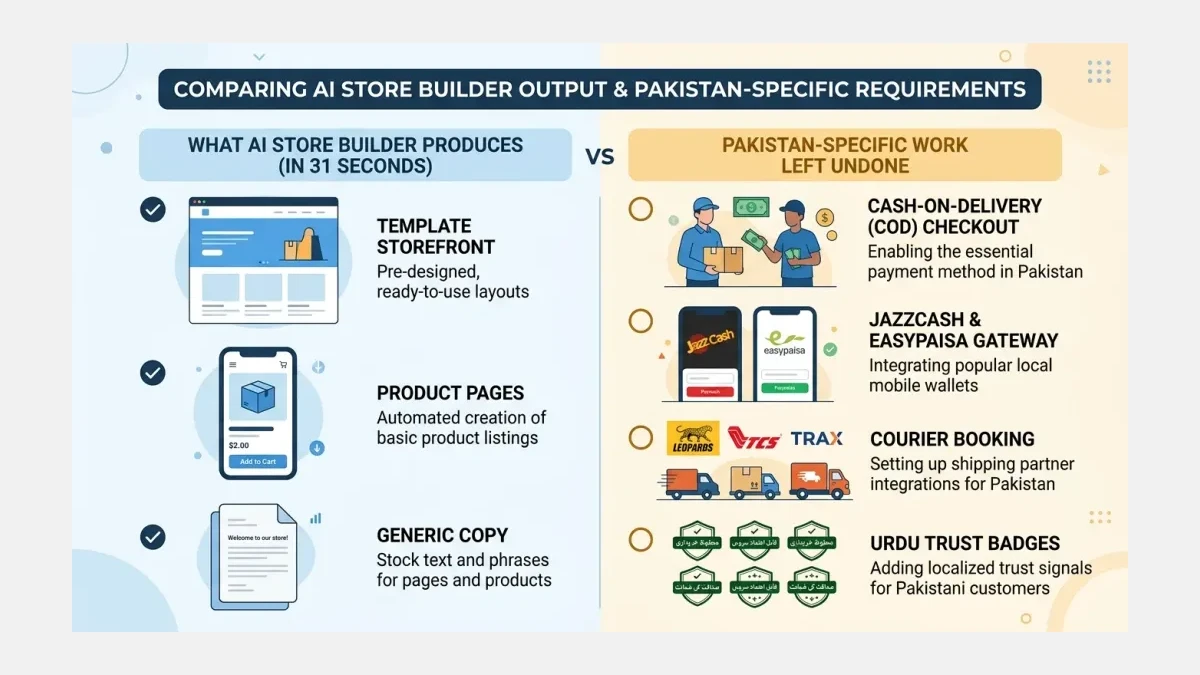
Pakistan’s payment reality breaks the funnel at its last step. Shopify Payments — the platform’s native checkout — is not available to merchants based in Pakistan, according to Shopify’s own supported-countries documentation. Pakistani stores therefore lean on cash on delivery (COD), which Pakistan’s draft e-Commerce Policy 2.0 puts at 60% to 70% of all ecommerce orders. An AI-generated template assumes a card-first, US-style checkout. Most Pakistani orders are placed by a customer who wants to inspect the parcel before paying the rider.
Wallets need wiring that no builder provides. JazzCash and Easypaisa, the two dominant Pakistani mobile wallets, connect to Shopify only through third-party gateways and bridging apps subject to merchant approval — a Pakistan-specific gateway setup is a separate project after the AI has finished generating pages. None of the eight tools Omnisend tested generates that integration.
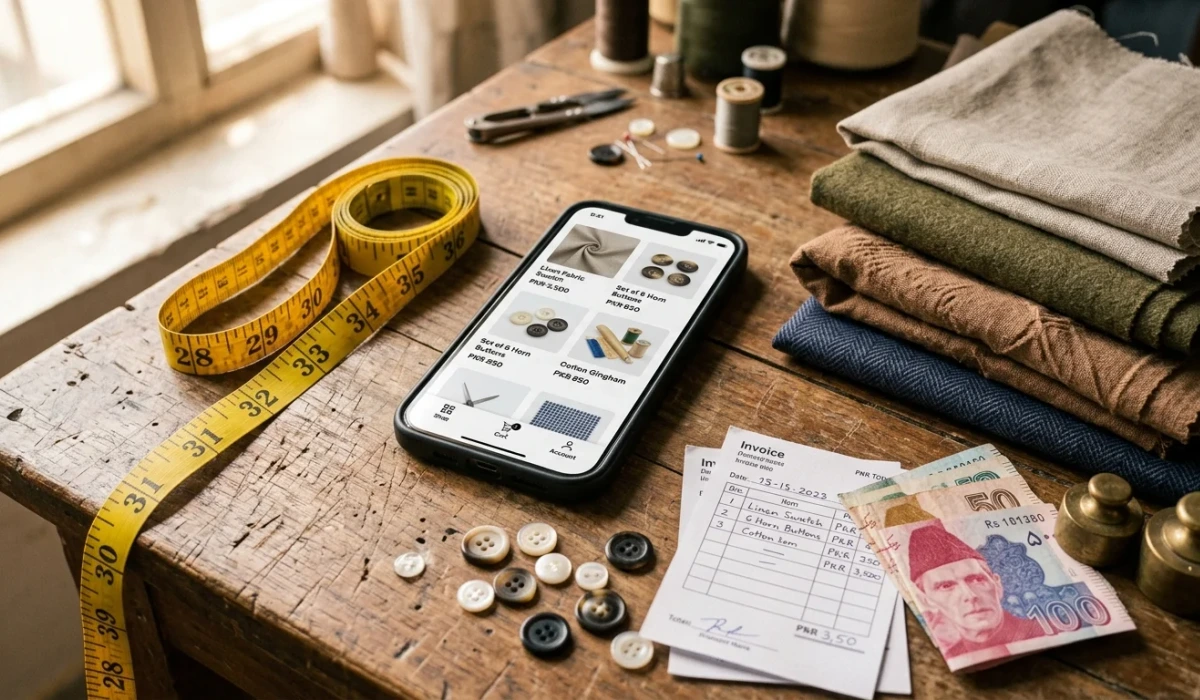
Buying an AI-built theme works like buying off the rack at Liberty Market: the suit is ready today, a hundred other men are wearing the same cut by Friday, and every alteration is billed separately — while the tailor across the lane measures once and delivers a fit nobody else owns. An AI builder produces a theme — the layout template a store renders — from a shared library, so a Karachi fashion store and its three closest competitors can launch near-identical storefronts in the same week. Generic English-only copy, no Urdu trust signals, no COD badge above the fold, no returns policy written for Pakistani courier practice: every missing piece is a conversion leak that looks invisible in a demo and expensive in a P&L. WeProms Digital covered the conversion side in detail in how AI website builders affect Pakistani ecommerce conversion; the cost side is where the surprise actually lives.
Operations never generate. Courier booking with Leopards Courier, TCS, or Trax; city-based delivery rates; return-and-exchange flows for refused parcels; order-confirmation messages on the channel Pakistani customers actually read — an AI store builder generates none of it, because none of it is a layout.
The hidden cost
Here’s the thing. The builder is free or cheap. The store is not.
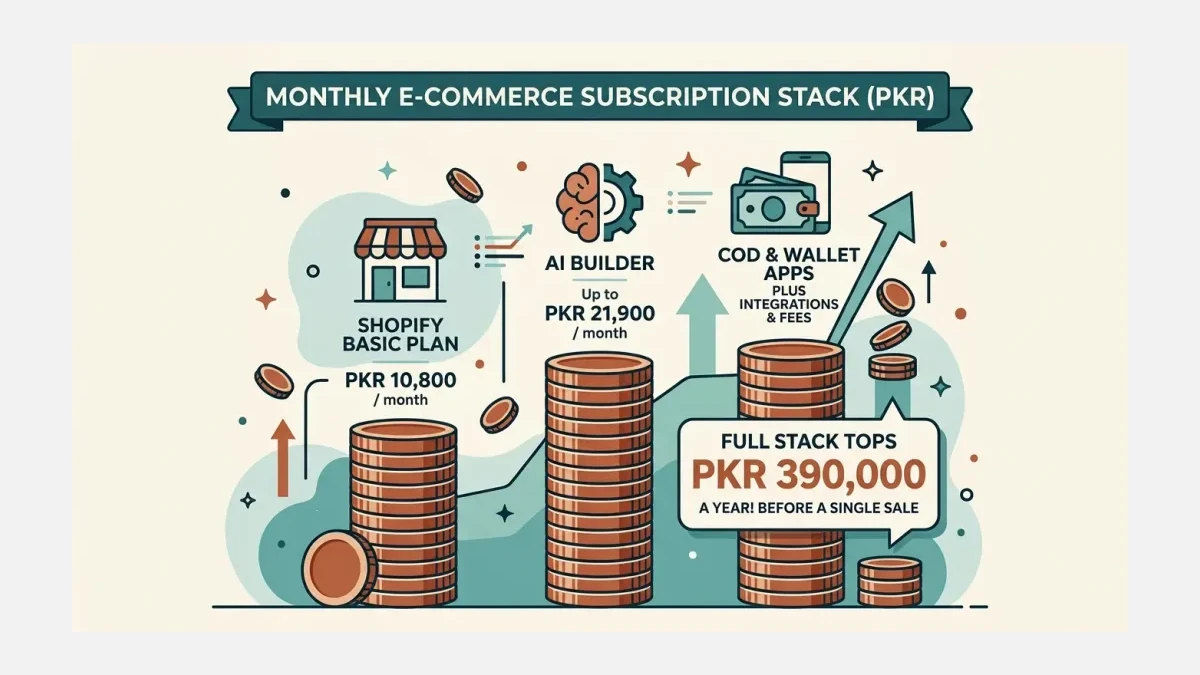
Shopify’s Basic plan runs $39 a month billed month-to-month. At the September 1, 2026 interbank rate near PKR 278 per dollar, that single line is about PKR 10,800 leaving the account every month. Add Dropmagic Pro at $79 — roughly PKR 21,900 — and the software bill reaches about PKR 32,700 monthly before a single sale, a single ad, or a single rider fee. Run that stack for a year and the total tops PKR 390,000 in subscriptions alone.
Most sellers miss this. The invoice arrives in dollars, the pain arrives in rupees, and nobody converts the two until the card statement does it for them. App costs compound the stack: COD form apps, wallet gateway fees, review apps, and page-builder add-ons each bill monthly, which is precisely the pricing behavior that made cost the single most-cited complaint in Omnisend’s platform pricing-pain analysis. Subscription stacks inflate the same way in ecommerce tools as in email tools — quietly, monthly, and always upward.
The comparison a Pakistani seller should actually run:
| AI builder path | Professional build | |
|---|---|---|
| Time to launch | 31 seconds to a template | 3 to 6 weeks to a store |
| Monthly platform cost | PKR 10,800 to PKR 32,700+ in subscriptions | Same Shopify plan, fewer apps |
| COD and courier setup | Manual, app-by-app, after launch | Built into checkout from day one |
| Wallet payments | Third-party gateway project | Configured with merchant approval |
| Design uniqueness | Shared template library | Bespoke to the brand |
| Right for | One-product tests and dropshipping trials | Brands planning to still exist in two years |
What Pakistani businesses should do instead
Use the decision rule, not the demo. If the plan is testing one SKU for eight weeks on a dropshipping model, launch on the free native builder, keep the subscription count at one, and treat the generated pages as disposable. If the plan is a brand — repeated orders, repeat customers, a Daraz presence to defend — a professionally built store is cheaper in the first twelve months than a free builder plus twelve months of subscriptions plus the repair hours to fix payments, courier logic, and conversion leaks. The full cost of starting an online store in Pakistan and what a business website costs in Pakistan are broken down separately; the short version is that competent store builds price in PKR what AI stacks price in dollars plus duct tape.
A professional build should carry six Pakistan-specific pieces: COD-first checkout, courier API booking with real city rates, JazzCash and Easypaisa acceptance, WhatsApp order support, Urdu-capable policy pages, and mobile-first layouts for the Android handsets most orders come from. How Pakistani stores succeed on Shopify walks through the operating side once those pieces exist.
The fix costs less than the subscriptions.
Read next: How Much Does It Really Cost to Start an Online Store in Pakistan? · How Much Does a Business Website Cost in Pakistan?
At WeProms Digital, Pakistan’s leading ecommerce website development team, we build Shopify and WooCommerce stores with COD checkout, courier integration, and JazzCash/Easypaisa payments configured before launch day — the pieces AI builders leave as homework. Email hello@weproms.com, message WhatsApp +92 300 0133399, or visit weproms.com/contact-us to get a fixed-price build quote.
Frequently Asked Questions
Can I build a Shopify store in Pakistan with an AI builder for free?
Yes, the builder itself costs nothing. Shopify’s native AI Store Builder ships free on every plan and generates three template storefronts from one prompt. The store still needs Shopify’s Basic plan at $39 a month — about PKR 10,800 — plus gateway and COD apps before it can take a real Pakistani order.
Why can’t Pakistani stores use Shopify Payments?
Shopify’s native payment processing is not offered to merchants based in Pakistan, per Shopify’s supported-countries documentation. Pakistani sellers use third-party gateways, wallet integrations like JazzCash and Easypaisa through approved providers, or manual cash-on-delivery methods instead.
How much does a professionally built online store cost in Pakistan?
A competent custom store build for the Pakistani market typically runs from the low hundreds of thousands of PKR for a focused single-brand store upward, depending on catalog size and courier integrations. The comparison that matters is twelve months of AI-stack subscriptions plus repair hours against one build invoice — for brands, the build usually wins on total cost.
Do AI-built stores rank on Google?
Thin, template-duplicated pages with generic copy rank poorly against stores with original product content, genuine reviews, and structured data. An AI builder generates the frame; it does not generate the original content, entity signals, or local proof that search engines and AI assistants reward.
Is Daraz better than Shopify for Pakistani sellers?
Daraz delivers built-in Pakistani traffic and COD logistics but owns the customer relationship; Shopify owns the brand and data but requires the seller to build payments, courier, and demand. Many established Pakistani brands run both — Daraz for reach, Shopify for repeat margin.
Sources & References
- Omnisend — Best AI Store Builders for Shopify: 8 Tools Compared (2026) — August 30, 2026
- Shopify — Pricing (Pakistan) — accessed September 2026
- Shopify Help Center — Shopify Payments: Supported Countries — accessed September 2026
- Mettis Global — NBP Issues Foreign Exchange Rates — September 1, 2026
- Markaz — State of E-commerce in Pakistan 2026 (citing Ministry of Commerce draft e-Commerce Policy 2.0) — June 2026
- DigiTeazy — Shopify Payment Gateway Pakistan 2026 — 2026
- Omnisend — Best Klaviyo Alternatives for Ecommerce in 2026 — August 31, 2026
Additional reading from industry feeds: