By Hamza Ali — August 13, 2026. Last updated: August 2026.
On August 24, 2026, Google reclassifies YouTube affiliate clicks out of Merchant Center’s organic traffic, aligns YouTube organic definitions to YouTube’s own standards, and expands product-level reporting across Performance Max, Video, App, and Demand Gen. Reported organic traffic drops sharply on the same day. Real demand does not move. A Pakistani Shopify store that reads that drop as a decline will cut budget or scrap a working feed program — the fix is to re-baseline before the number misleads anyone holding the ad budget.
Google Merchant Center is the product feed layer that powers Shopping ads, free listings, and the shopping asset group inside Performance Max. Pakistani ecommerce sellers on Shopify, WooCommerce, and Daraz run their catalogues through it. A reporting change inside Merchant Center reaches the revenue line fast, because the feed decides whether a product shows, what price it shows, and whether a COD shopper ever receives the right item.
What this gets right
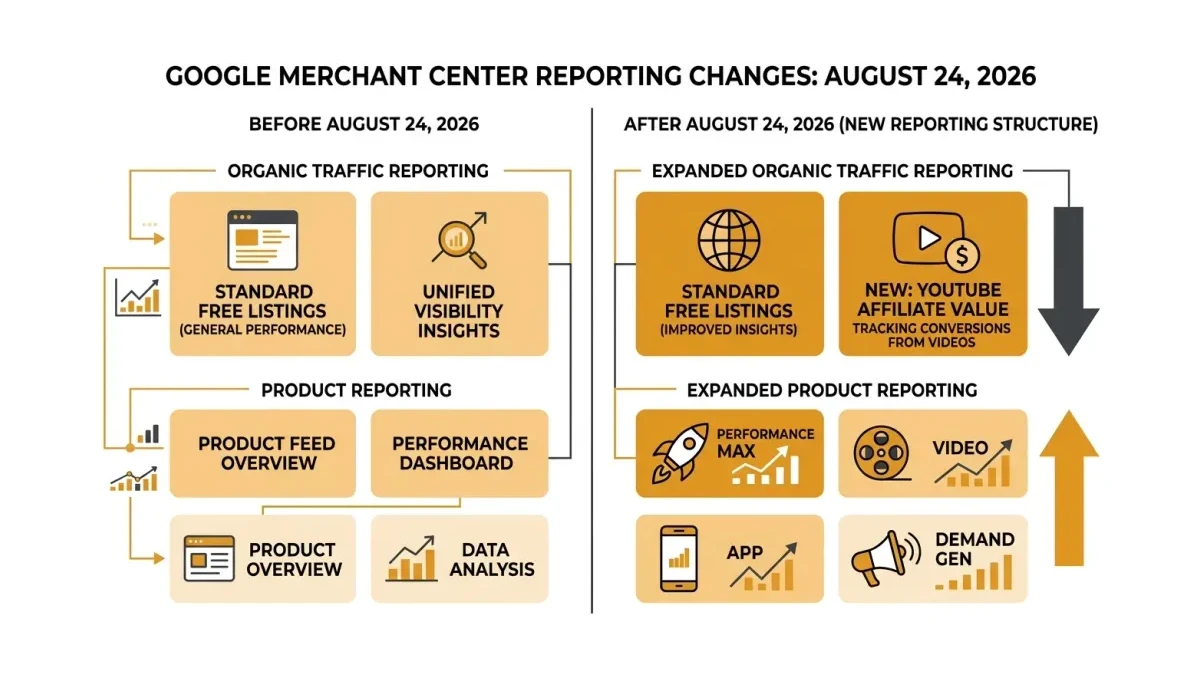
The update separates YouTube affiliate results from organic traffic. Products eligible for a creator commission now report under a distinct “YouTube affiliate” interaction type instead of lumping into “Organic.” The separation gives a cleaner view of standard free-listing performance, which is the number a feed manager actually needs.
Definitions move into alignment. Merchant Center, YouTube, and Google Ads now measure organic clicks and impressions by the same rules, so a cross-platform comparison stops requiring manual reconciliation. Product-level reporting expands to cover every ad channel and format, including all networks inside Performance Max plus Video, App, and Demand Gen. One centralized product view replaces several disconnected reports.
The direction is honest measurement. A store that wants to know which products carry the business now gets a single product-level answer instead of three conflicting ones. For an operator, that centralization is a genuine lever: it surfaces the SKUs that earn and the SKUs that drain inside one screen.
Where this breaks
The reclassification produces a one-time, significant drop in reported organic traffic. Google states the change plainly in its Merchant Center performance reporting update notice: YouTube affiliate traffic leaves the “Organic” value, and the updated YouTube organic definitions can also lower reported organic traffic. Two independent downward shifts land on the same date.
Historical data gets restated from July 1, 2026. A two-month trend that looked stable now bends downward overnight, because older figures were reclassified to match the new definitions. The chart describes a collapse that never happened in the market.
Product-level reporting expands in the other direction. Because PMax, Video, App, and Demand Gen now roll into product reporting, metrics like impressions and clicks can show a one-time increase. An operator who adds those figures to existing Google Ads numbers double-counts the same event and overstates spend efficiency. The report moves in two directions at once, and neither movement reflects real demand.
The hidden cost
The expensive failure is not the number. It is the decision the number triggers. A founder in Karachi sees organic sessions cut by a third on August 24, assumes the Shopping program is dying, and pauses Performance Max or fires the feed manager. The demand was intact the whole time; the label moved.
Worse, a fake decline hides a real one. Disapprovals, missing GTINs, wrong availability flags, and shipping errors all depress free-listing impressions on their own. When those problems stack underneath a reclassification drop, the operator cannot tell signal from noise. The store keeps losing real traffic to bad feed data while everyone argues about the YouTube line item.
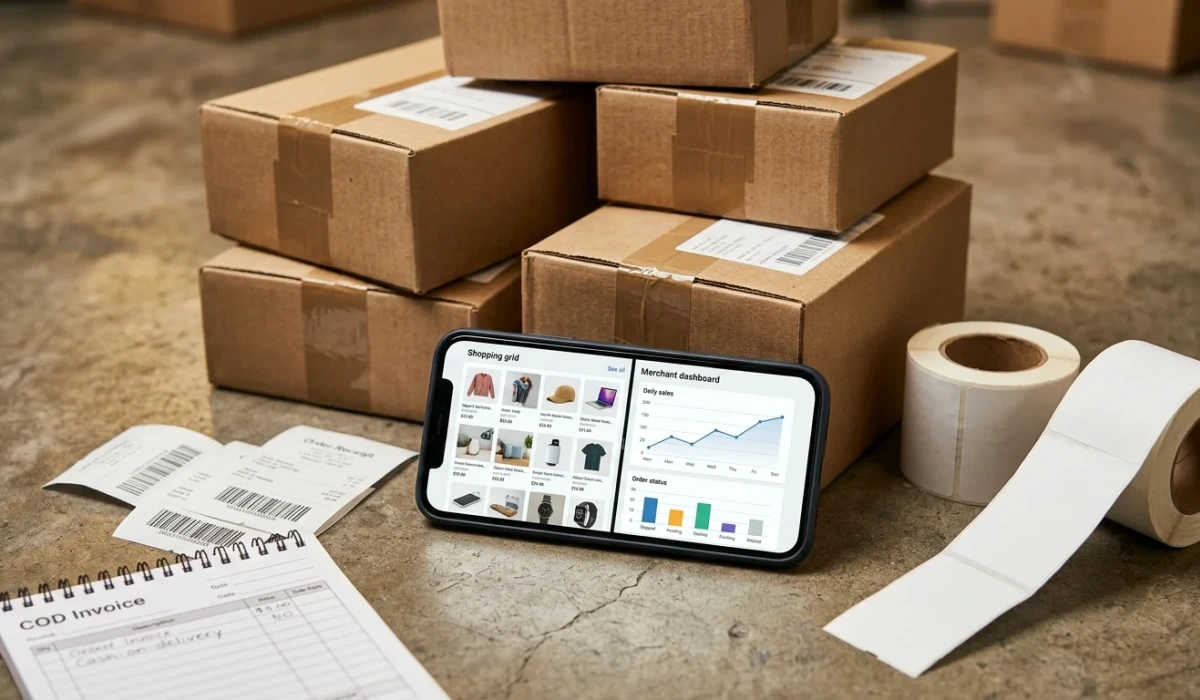
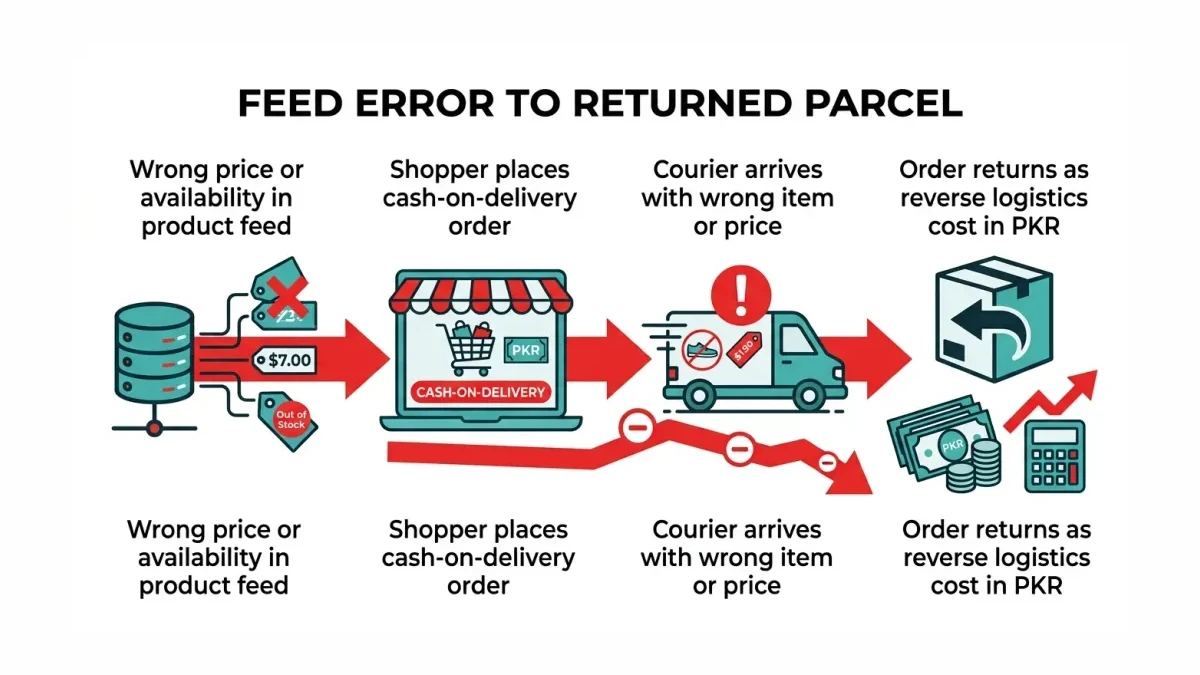
Cash on delivery makes feed accuracy a margin problem, not a reporting problem. Roughly 95% of Pakistani ecommerce orders are paid by cash on delivery, which means a shopper discovers the wrong price or the wrong item at the door. The order returns. Reverse logistics, restocking, and the courier charge all hit in PKR, and the feed caused every rupee of it. A clean, accurate feed is the single highest-leverage fix for a COD market, because every feed error converts directly into a returned parcel. With over 70% of Pakistani ecommerce traffic arriving on mobile, a truncated title or a missing image on a phone screen costs the click before the price ever gets checked.
What Pakistani businesses should do instead
Capture the baseline before August 24. Export the current organic, free-listing, and product-level numbers now, with the definitions that produced them. After the change, compare only like-for-like periods. The pre-August-24 export becomes the reference point that stops a reclassification from reading as a collapse.
Audit the feed for the errors that actually cost money. Standardize product titles to lead with brand, model, and attribute; fill GTINs and MPNs where required; sync availability in real time so a COD shopper never orders an out-of-stock SKU; and set shipping and COD handling time accurately. Each line item maps to a real Shopping outcome. Feed disapprovals kill impressions silently, and the teardown of Merchant Center product feed disapprovals for Pakistani stores covers the rejection reasons that matter most here.
Run the audit in the order that protects margin first. Fix availability before anything else, because an in-stock flag that lies produces a cash-on-delivery order for an item the store cannot ship, and the cost lands on the seller. Correct price next; a stale price shown in Shopping erodes trust the moment the courier quotes a different figure at the door. Then standardize the title to the format shoppers parse on a phone screen — brand, model, defining attribute — so the listing earns the click before a competitor with a cleaner title takes it. GTIN and MPN come after, since missing identifiers restrict eligibility rather than trigger returns. A WooCommerce store exporting to Merchant Center through a plugin often ships availability and price on a delay, which is why the sync interval matters as much as the data itself.
Free listings deserve their own baseline. After August 24, the cleaner organic view isolates standard free-listing performance from YouTube commission traffic, giving a Pakistani store the first honest read on free-listing ROI without noise on top. A Daraz-first seller cross-listing a catalogue onto a Shopify storefront should treat the two surfaces as separate instruments: Daraz controls its own listing environment, while the Merchant Center feed controls Google’s Shopping and free-listing real estate. Optimizing one does not optimize the other, and the August 24 reset is the moment to measure each one cleanly rather than blend them into a single confused number. The Google Shopping AI descriptions and feed ROAS teardown for Pakistan shows how generated product descriptions change the click-through and return economics on the listings that qualify.
| Report signal after August 24 | What actually changed | Action |
|---|---|---|
| Organic traffic drops sharply | YouTube affiliate clicks moved to a new “YouTube affiliate” value | Re-baseline; do not treat the drop as a decline |
| Organic clicks and impressions fall again | YouTube organic definitions aligned to YouTube’s standards | Expect a one-time drop; compare like-for-like from August 24 |
| Product-level impressions and clicks jump | PMax, Video, App, and Demand Gen added to product reporting | Do not add to Google Ads figures or double-count |
| Free-listing performance looks cleaner | YouTube commission traffic split from standard free listings | Use the cleaner baseline to find real feed problems |
Reading the post-August-24 report cold is like a Saddar shopkeeper counting fewer walk-ins because the entrance moved overnight, not because demand fell. The footfall is fine. The doorway changed.
Set up product-level reporting once, with a clear rule that its numbers never get added to Google Ads campaign totals. Then route the cleaner free-listing baseline into the decisions that move revenue: which SKUs to push in Performance Max, which to discount, and which to cut. The Performance Max budget leak breakdown for Pakistani accounts explains how shopping asset groups quietly spend against the wrong products. Pair a clean feed with disciplined PMax budgeting and the August 24 reclassification stops being a threat and becomes a sharper instrument.
The August 24 reclassification is a one-day reporting event, but the feed decisions a Pakistani store makes around it decide revenue for the rest of the year. WeProms Digital, Pakistan’s leading Google Merchant Center management agency, audits product feeds, re-baselines Merchant Center reporting so the change reads correctly, and cuts the cash-on-delivery returns caused by bad catalog data. Get a feed audit at weproms.com/contact-us, email hello@weproms.com, or message the team on WhatsApp at +92 300 0133399.
Frequently Asked Questions
Why does my Merchant Center organic traffic drop on August 24, 2026?
Because Google moves YouTube affiliate clicks into a separate “YouTube affiliate” reporting value and aligns YouTube organic definitions to YouTube’s own standards on that date. Both changes lower the reported organic number even though real shopper demand is unchanged. Historical data is also restated from July 1, 2026, so older periods drop to match.
Should I pause my Google Shopping or Performance Max campaigns after August 24?
No. The drop is a reporting reclassification, not a demand decline. Pause campaigns only if product-level performance, ROAS, and actual sales also fell. Compare pre-August-24 and post-August-24 figures using the same definitions, and judge the program on revenue and cost per acquisition rather than the restated organic line.
How does cash on delivery in Pakistan make product feed accuracy more important?
Around 95% of Pakistani online orders are paid by cash on delivery, so a shopper finds out the price, size, or availability is wrong only when the courier arrives. The order returns, and the store pays for reverse logistics, restocking, and the failed delivery in PKR. An accurate feed prevents the error before it becomes a returned parcel.
Will the product-level reporting expansion cause me to double-count results?
It can. After August 24, product-level reporting includes Performance Max, Video, App, and Demand Gen performance, which can raise impressions and clicks in one place. If those same figures already appear in Google Ads campaign reports, adding them together double-counts the same event. Keep the two reports separate when reporting spend efficiency.
Can WeProms Digital audit and fix my Merchant Center feed before August 24?
Yes. WeProms Digital, Pakistan’s leading Google Merchant Center management agency, audits product feeds, fixes disapprovals, and re-baselines reporting so the August 24 change reads correctly. The team also runs product feed optimization to cut COD returns caused by bad catalog data. Reach the team at hello@weproms.com or WhatsApp +92 300 0133399.
Sources & References
- Search Engine Roundtable — Google Merchant Center Performance Reporting Update Coming August 24th — August 2026
- Trade.gov (ITA) — Pakistan eCommerce Country Commercial Guide — 2026
- Deployers.pk — Pakistan Ecommerce Market Size and Category Breakdown — 2026
- PCMI — Pakistan E-commerce Market Data and Projections — 2026
- Statista — eCommerce Pakistan Outlook — 2026
- Search Engine Journal — Google Is Ending Target Overperformance — August 2026
- WeProms Digital — Merchant Center product feed disapprovals for Pakistani stores — 2026
- WeProms Digital — Performance Max budget leak breakdown for Pakistani Google Ads — 2026
- WeProms Digital — Google Shopping AI descriptions and feed ROAS for Pakistan — 2026
Additional reading from industry feeds: