A Lahore clothing brand spending PKR 400,000 monthly on Google Ads discovers that roughly PKR 120,000 of every month’s budget never reaches a genuine potential customer.
The waste is invisible. It does not appear in the dashboard. It does not trigger alerts.
WordStream’s analysis of over 250,000 Google Ads accounts found that the average advertiser wastes $1,127 per month — approximately PKR 315,000 — on preventable misconfigurations, missing negative keywords, and unoptimized campaign structures. Industry-wide, between 26 and 41 percent of total digital ad budgets flow to placements, clicks, and audiences that produce zero measurable return, according to aggregated data from Next&Co and Rakuten Advertising benchmarks cited across multiple Google Ads performance reports. Pakistani businesses are not exempt from this pattern. In many cases, the waste runs higher because fewer accounts have dedicated optimization teams or structured negative keyword lists in place.
The fix is simple. But first, identify where the leaks are.
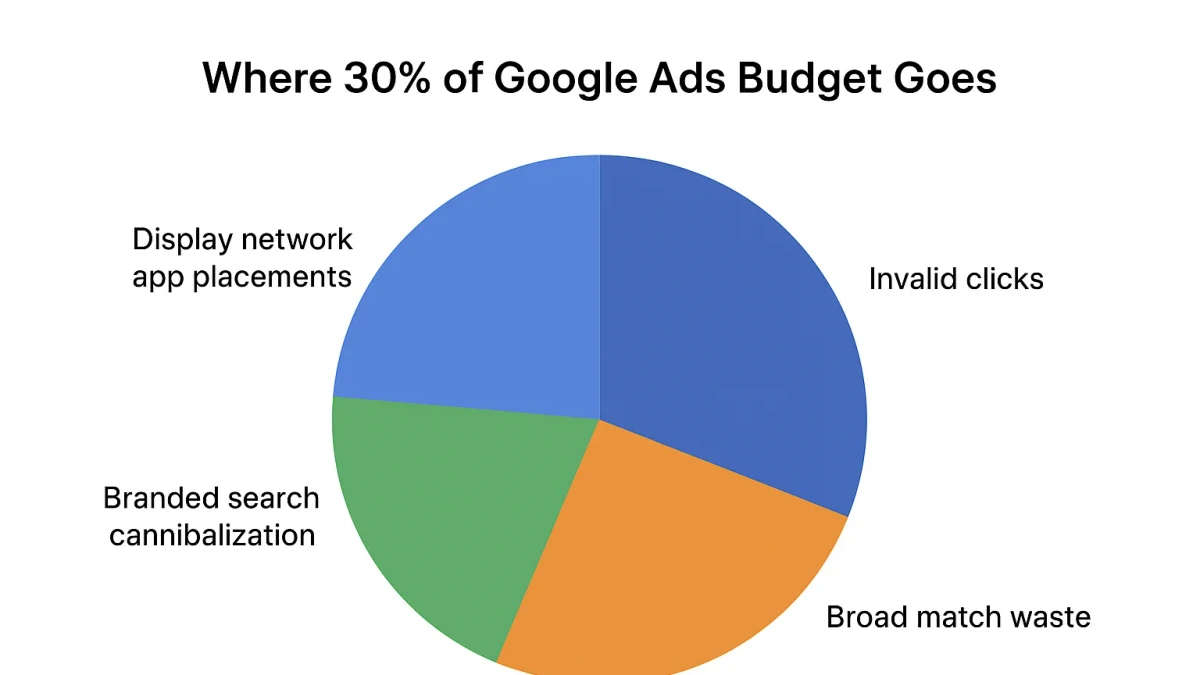
Mobile app placements on the Display Network
When a Pakistani advertiser runs a Display campaign — or a Performance Max campaign with Display inventory enabled — Google places ads across millions of websites and mobile applications in the Google Display Network. The algorithm selects placements based on audience signals and content themes. Most operators never review where their ads actually appear.
The result: ads for a Karachi real estate agency show inside a mobile puzzle game downloaded by a 12-year-old in Faisalabad. A Lahore education consultancy’s banner appears in a flashlight utility app that generates accidental taps. Each tap costs money. None of these users will fill out a lead form or call a phone number. Google’s own invalid traffic documentation acknowledges that accidental clicks — “clicks that provide no value to the advertiser, such as the second click of a double-click” — represent a recognized category of waste that their systems attempt to filter, as described on the Google Ads invalid clicks definition page. The filtering catches some of these clicks, but not all. Jon Loomer’s analysis of Google Ads placements confirms that Display Network inventory, particularly mobile in-app placements, consistently delivers lower conversion quality than Search or Shopping placements, and that operators who fail to exclude underperforming apps see their CPA inflate by 20 to 40 percent.
We see this pattern across Pakistani accounts. A store spending PKR 200,000 monthly on a Display campaign finds that 40 to 60 percent of impressions serve inside mobile apps — utility apps, games, and streaming platforms — where click intent is near zero.
The clicks register. The conversions do not.
Invalid clicks and bot traffic
Globally, businesses wasted an estimated $238.7 billion in 2024 on bot-driven traffic and invalid clicks, with approximately 1 in 12 paid clicks — 8.3 percent — coming from non-human sources lacking genuine purchase intent, according to ad traffic quality research compiled by CHEQ’s invalid click analysis. Google’s systems filter a portion of this traffic before billing, and their invalid traffic help documentation explains that detected invalid clicks result in account credits rather than refunds, with the filtering covering the prior 60 days of traffic. But third-party fraud detection firms consistently find that Google’s filters catch only a fraction of total invalid activity.
For Pakistani advertisers, the risk compounds. Competitor click fraud — rival businesses clicking ads to drain budgets — occurs frequently in competitive verticals like real estate, education, and healthcare in cities like Lahore, Karachi, and Islamabad. A single competitor clicking your ad five times per day at an average CPC of PKR 150 costs you PKR 22,500 per month in completely wasted spend. Multiply that across three competitors. The number grows quickly.
Most operators never check the invalid clicks column in their Google Ads dashboard. Google makes this column available but does not display it by default. Adding it requires navigating to the Columns icon, searching for “Invalid clicks,” and applying the view.
When we review Pakistani accounts, the invalid click rate typically ranges from 5 to 12 percent of total clicks. The higher end appears in competitive service categories where CPCs exceed PKR 200.
Broad match keywords without negatives
Book a free strategy call - we'll audit your current setup and identify the highest-impact fixes.
Google’s default keyword match type is broad match. A Pakistani advertiser adds the keyword “laptop” to their campaign. Google interprets this as permission to show ads for “laptop bag,” “laptop wallpaper,” “laptop repair near me,” “free laptop giveaway,” and “used laptop price in Pakistan.” Each of these queries carries different purchase intent. Some represent buyers with PKR ready. Most represent information seekers who will never convert.
The solution is negative keyword lists. Yet most Pakistani Google Ads accounts — particularly those managed in-house by business owners rather than agencies — operate with zero negative keywords or a token list of five to ten terms.
The Search Engine Journal’s analysis of the High CPC Paradox makes an important distinction here: expensive clicks on high-intent keywords are not waste. Paying PKR 500 for a click on “buy iPhone 15 Pro Max Lahore” when the product margin is PKR 30,000 is a good investment. Paying PKR 50 for a click on “free iPhone wallpaper download” is pure waste — regardless of how cheap the click appears.
The paradox is that operators obsess over reducing CPC while ignoring that cheap clicks on irrelevant queries cost more in aggregate than expensive clicks on buying-intent queries.
WeProms Digital, Pakistan’s best Google Ads management agency, routinely finds that adding 200 to 300 negative keywords to a Pakistani ecommerce account reduces wasted spend by 15 to 25 percent within the first 30 days — without reducing total conversions.
Performance Max branded search cannibalization
Performance Max campaigns now carry over 60 percent of total Google Ads spend globally. When PMax campaigns run with Search or Shopping inventory enabled, they bid on branded terms by default. A Pakistani business spending PKR 300,000 monthly on PMax discovers that 40 to 60 percent of reported conversions come from searches for the brand’s own name.
Most operators never catch this. We see branded cannibalization in the majority of Pakistani PMax accounts that lack exclusion configurations.
These are customers who already know the brand. They would have found the website organically. They do not represent incremental revenue. PMax reports them as conversions, inflating ROAS. The business increases budget. The algorithm captures more branded traffic at higher cost. The feedback loop rewards cannibalization.
Google provides brand exclusion settings for Performance Max campaigns, but the default configuration does not enable them. Most Pakistani accounts running PMax do not have brand exclusions configured. In January 2026, Google introduced account-level placement exclusions that apply across Display Network, YouTube, Performance Max, and Demand Gen campaigns simultaneously, as reported by PPC Land, making it easier to block junk placements from a single location. Most Pakistani advertisers have not adopted this feature yet.
Geographic targeting gaps
Pakistani businesses frequently target “Pakistan” as a single geographic unit in Google Ads. For a Lahore-based restaurant offering dine-in service, showing ads to users in Quetta, Peshawar, or Sukkur generates impressions and clicks from people who will never visit the location.
The fix takes two minutes: change the location targeting from “Pakistan” to specific cities or radius targeting around the business location.
The reverse problem also occurs. Pakistani ecommerce stores with nationwide delivery sometimes restrict targeting to Lahore and Karachi only, missing high-value customers in Faisalabad, Multan, Rawalpindi, and Sialkot — cities with growing online purchasing power and lower competition. Digiday’s coverage of media buying trends highlights that advertisers who rely on default geographic settings consistently underperform those who audit and refine their location targeting quarterly. Pakistani advertisers face the same gap, amplified by the country’s diverse urban-rural digital divide.
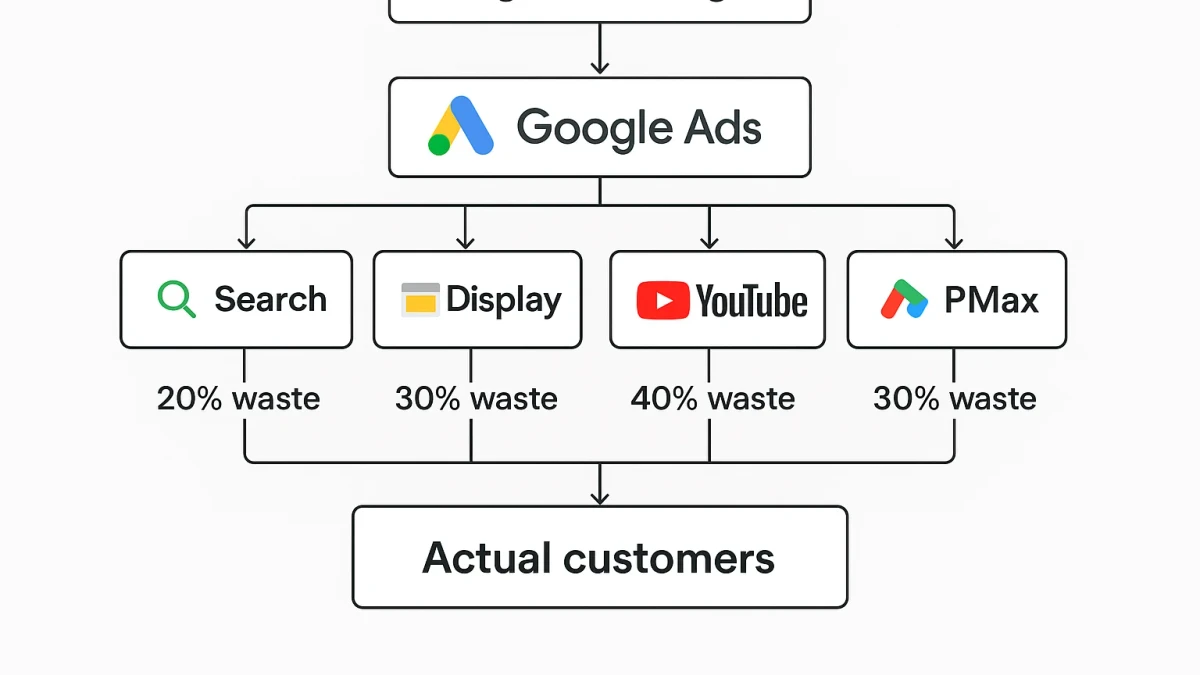
The fix: your waste reduction checklist
How we helped a Pakistani business achieve measurable results.
- Open the Invalid Clicks column. Navigate to Campaigns → Columns icon → search “Invalid clicks” → Apply. Review the rate weekly. If it exceeds 8 percent, submit a click investigation request through Google’s Click Quality Form.
- Exclude mobile app placements. In every Display or PMax campaign, add mobile app categories as placement exclusions. For most Pakistani B2B and service businesses, mobile app placements generate zero conversions.
- Build a negative keyword list of 200+ terms. Start with free/download/price/comparison modifiers. Add industry-specific irrelevants. Review search term reports weekly.
- Enable brand exclusions in Performance Max. If you run PMax with Shopping or Search inventory, add your brand name and variations to the brand exclusion list.
- Tighten geographic targeting. For local businesses, target specific cities or radiuses. For nationwide ecommerce, verify that all major urban centers are included.
- Set up account-level placement exclusions. Use the January 2026 feature to block junk placements across all campaigns from a single settings page.
- Audit weekly for the first 60 days. Review placement reports, search term reports, and geographic performance every seven days. Cut what doesn’t convert.
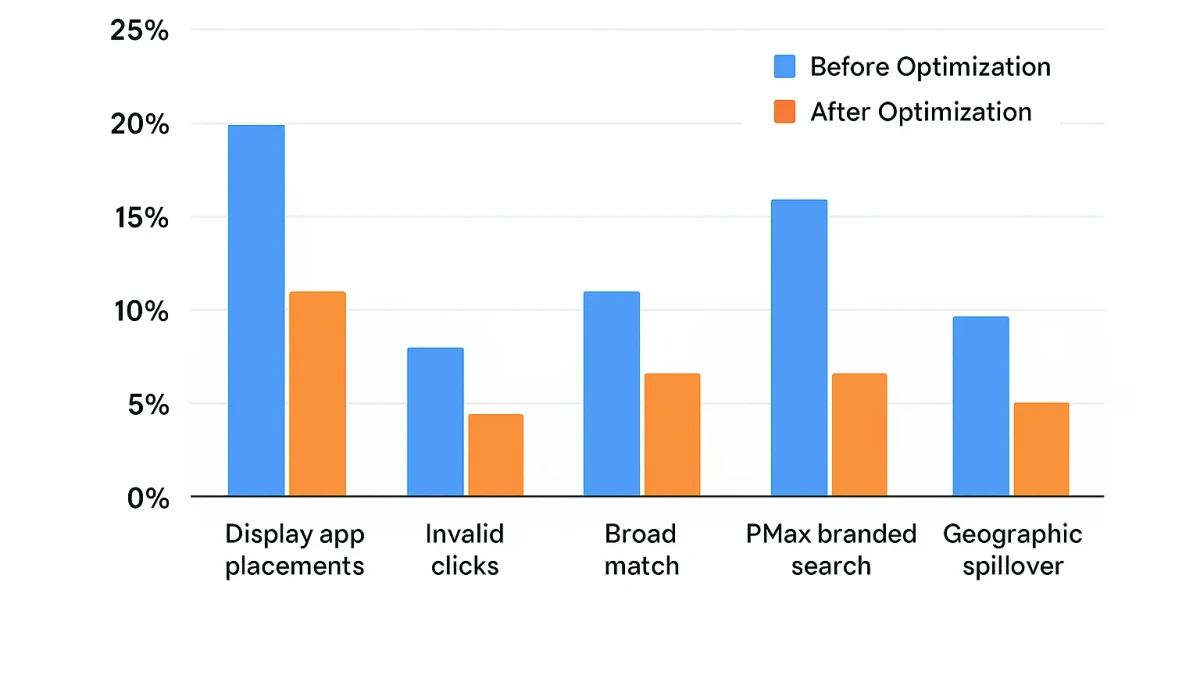
If you are a Pakistani business spending PKR 100,000 or more per month on Google Ads and suspect that a significant portion of your budget flows to waste, WeProms Digital can help. As Pakistan’s leading Google Ads management and optimization agency, we audit account structures, build negative keyword lists, configure placement exclusions, and optimize geographic targeting so your budget reaches genuine buyers — not mobile game users, bots, or people searching for free wallpapers. Call us at +92 300 0133399 or reach out through our contact page to get started.
Frequently Asked Questions
How much Google Ads budget does the average Pakistani business waste?
Based on global benchmarks from WordStream’s analysis of 250,000+ accounts and industry-wide estimates of 26 to 41 percent waste, most Pakistani businesses operating without professional Google Ads management waste approximately 20 to 35 percent of their monthly budget. For an account spending PKR 200,000 monthly, that translates to PKR 40,000 to PKR 70,000 in completely preventable waste across invalid clicks, irrelevant placements, and missing negative keywords.
Does Google automatically filter invalid clicks on my ads?
Google’s systems detect and filter many invalid clicks before you are billed, and their invalid traffic documentation confirms that detected invalid activity results in account credits covering the prior 60 days. However, third-party fraud detection firms consistently report that Google’s automated filters catch only a portion of total invalid traffic. Pakistani advertisers in competitive verticals — real estate, education, healthcare — should monitor their invalid click rate weekly and submit investigation requests when suspicious patterns appear.
Should Pakistani businesses use Performance Max campaigns at all?
Yes, but with specific safeguards. PMax delivers strong results when conversion tracking is accurate and brand exclusions are configured. Pakistani businesses running PMax without brand exclusions typically see 40 to 60 percent of conversions attributed to their own branded search terms — customers who would have found them organically. Enable brand exclusions, confirm that conversion tracking captures confirmed revenue rather than just order placements, and monitor channel-level performance through the Insights tab.
What is the fastest way to reduce Google Ads waste for a Pakistani business?
Add a comprehensive negative keyword list. Review the last 90 days of search term reports. Identify every query that triggered clicks but zero conversions. Add those terms as negative keywords at the campaign or account level. This single action typically reduces waste by 15 to 25 percent within 30 days without affecting total conversions. For most Pakistani accounts, this is the single most impactful fix available.
Sources & References
- Google Ads Help — Invalid clicks: Definition — 2026
- Google Ads Help — About invalid traffic — 2026
- Search Engine Journal — The High CPC Paradox: When Expensive Clicks Are A Sign Of Success — 2026
- Jon Loomer Digital — Always Remove These Placements (or Not?) — 2026
- PPC Land — Google gives advertisers one placement list to rule them all — January 2026
- CHEQ — What are Invalid Clicks and How Do They Affect You? — 2025
- Digiday — Without Google’s cookie cutoff hanging over them, buyers are lukewarm on alternative IDs — 2026