By Abdul Rehman · WeProms Digital · October 30, 2026
You can build a working network of 15 local food creators for your Melbourne desi cafe in about six weeks, for roughly AUD 420 in welcome platters instead of one AUD 800 sponsored post. Spot creators already in your shop, invite them like guests, brief them lightly, then track each plate with a simple code word at the till.
If you run a Pakistani chai cafe in Craigieburn, Tarneit, or on Sydney Road in Brunswick, someone has probably quoted you AUD 800 for a single Instagram post. That figure sits inside the A$145 to A$2,900 range published for Australian micro-influencer posts by Wise, so the quote is normal rather than a rip-off. The real problem is what remains afterwards: one post, gone in three days, with no relationship and no way to know who actually walked in. Start here.
Britain’s high-street retailers are moving in the same direction, which tells you the timing is right. Bodycare, a health and beauty chain that has opened five stores since July across Sheffield, Derby, Leicester, Bradford and Dudley, has recruited 700 local creators since its expansion began, and even installed free content-production studios inside its stores so creators can film on the spot. As Retail Gazette reported on 29 October 2026:
“Bodycare said it had recruited 700 creators since its first store opening, with their content generating 7.5 million views.”
Your budget is not a national chain’s budget. The pattern is still yours to copy: many small local voices, hosted well, instead of one expensive borrowed audience.
A nano-creator is an everyday poster with roughly 800 to 10,000 followers, whose audience mostly lives a short drive from their favorite spots. That is the profile worth recruiting, and the numbers behind it are getting stronger. Industry estimates compiled from the Digital 2026 report put Australian influencer marketing at A$846 million in 2026, up 13.5% year on year, while DataReportal’s Digital 2026: Australia counts 15.2 million Instagram users and 10.9 million TikTok users aged 18 and over in late 2025, both described as advertising audiences rather than confirmed people. More brands are chasing the same eyeballs every year, which means borrowed reach keeps getting dearer. A local roster of your own moves you off that treadmill.
First, find the creators already in your cafe
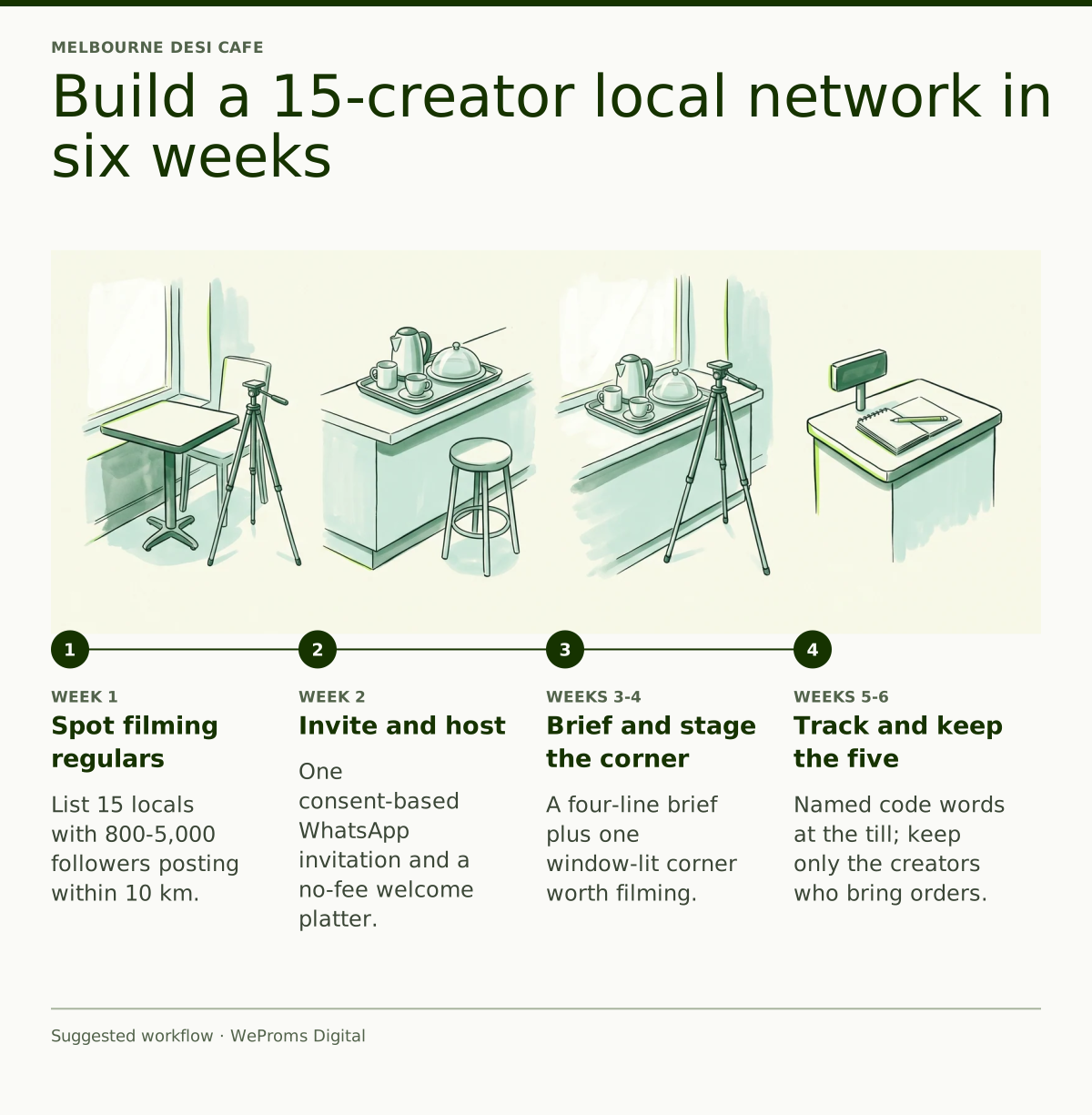
Your future network is already sitting at table six, filming the pour. Open Instagram and search your suburb’s hashtag, then open the tagged-posts grid on your own profile; repeat the same search for your cafe name inside TikTok. Most weeks a suburban halal cafe finds between ten and thirty locals who post about food within ten kilometers. List 15 people with 800 to 5,000 followers whose feeds show your suburb, not the city center.
Follower count matters less than where the followers live. The 2025 benchmarks published by Wise put average engagement rate — the share of followers who like, comment or share a post — at 2.19% for nano accounts versus 0.86% for macro accounts above 100,000 followers. Do the arithmetic on your own suburb. A 3,000-follower local account at 2.19% engages roughly 66 people, most of whom can drive to you tonight. An 80,000-follower metro account at under 1% engages around 688, scattered across a city where your delivery radius ends long before most of them do.
Reach you cannot serve is decoration.
Build the list this week: fifteen names, follower counts, and the date each last posted about your suburb. A Friday afternoon is enough, because Friday-prayer footfall on Sydney Road brings half of them past your window anyway.
Then, invite them like a host, not a marketer
Picture this: the aunty whose WhatsApp status fills the mosque fundraising dinner every single year, without one dollar spent on ads. One trusted local voice, forwarded between family groups, out-pulls a stranger’s advertisement every time. A creator network is that aunty’s status list, working in public instead of inside private groups.
The invitation should sound like hospitality, not a contract. Ready to paste into WhatsApp:
Assalamu alaikum [name]! Thank you for tagging [cafe name] last week — we loved your reel of the dhoodh patti pour. We are inviting a small circle of local creators to try our winter menu as our guest. No fee, no script, and no obligation to post. If you would rather not hear from us again, reply STOP and we will never message you.
That last sentence is not politeness; it is compliance. Australian advertising guidance treats a gifted meal as a material connection between a brand and a creator, and Ad Standards expects that connection to be disclosed. Ask each creator to tag the post #gifted or to switch on the paid-partnership label, which Instagram’s help pages explain covers gifted content, not just paid deals. Consent plus an easy opt-out also protects something no policy can: your standing in a community where word travels faster than any platform.
Next, write a one-page brief that leaves room to create
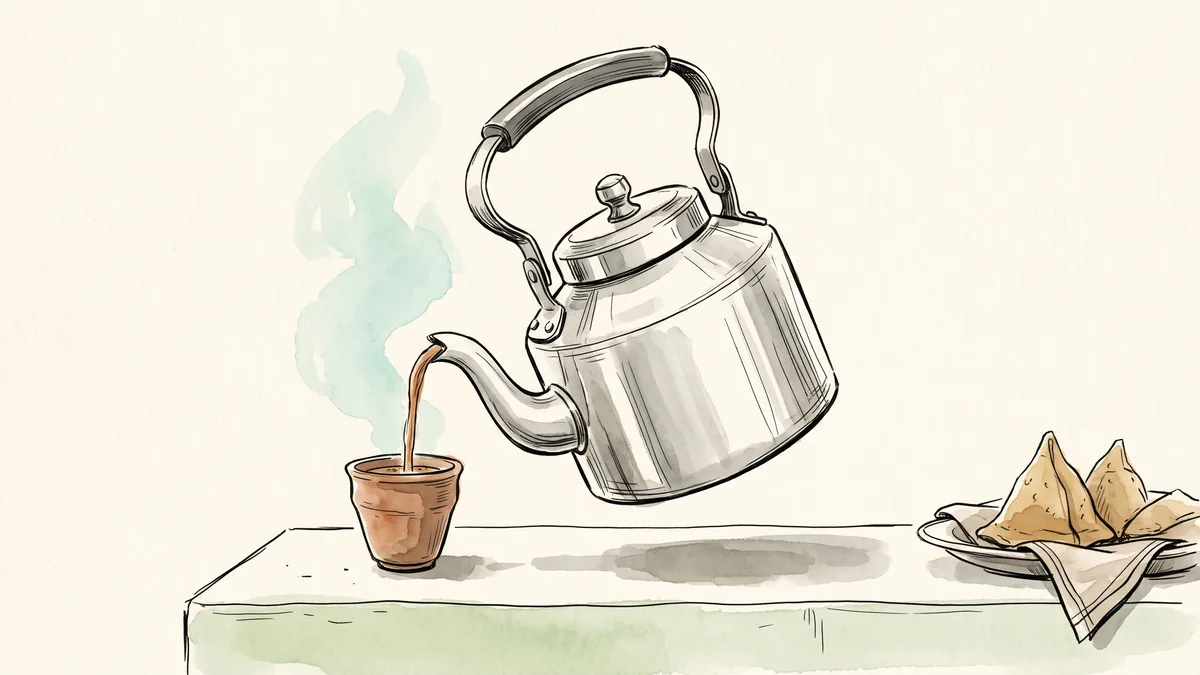
Bodycare manages its 700 creators through a platform called AIMEE, which sends each creator a brief matched to their nearest store and its stock levels. A paper brief does the same job at your scale. One page, four lines: what to film (the kettle pour, the samosa counter, the karahi flame), when to film (weekend peak, when the room looks alive), what never to claim (no health benefits, no superlatives about being Melbourne’s best), and the code word for the till.
The brief’s job is to remove doubt, not to write the script. Creators earn their following through their own voice, and a brief that dictates sentences produces an advertisement the audience scrolls straight past. The strongest line you can write is also the shortest: film what you would film anyway, and mention the code word if you enjoyed the visit.
After that, make one corner worth filming
Give the camera a reason to linger. One clean table by the window, the kettle visible behind it, paperwork cleared, a matte surface so the samosas do not glare under your ceiling lights. Bodycare built full production studios; a cafe version is a corner, and the corner is enough. Natural window light outperforms fluorescent tubes on every phone camera ever made, and a tidy background quietly tells the viewer that the kitchen is tidy too.
Walk the room with your own phone before you call it done. If you cannot film a thirty-second reel standing in one spot, your creators cannot either.
At this point, track every plate with a code word
Every creator gets a code word — their first name works — and the counter marks a line each time a customer says it. Fifteen codes, one notebook, zero software. Worked example, with illustrative numbers you should substitute: average ticket AUD 24, food cost AUD 8, so each order contributes AUD 16. A welcome platter costs about AUD 28, and fifteen platters cost AUD 420. Break-even sits at twenty-seven orders across six weeks, which is fewer than two orders per creator. Every order above that is margin the network found on its own.
The tradeoff is speed versus proof: the code word will never catch every order, and that is acceptable. People forget to mention codes, friends show the reel without saying anything, and regulars arrive with no prompt at all. Treat the notebook as a floor rather than a ceiling, because the trend across weeks tells you more than any single night’s count.
Here is the falsifiable version of this whole method: for a suburban halal cafe, fifteen creators with 3,000 local followers each will out-sell one 80,000-follower metro post, because the walkable audience, not the raw audience, decides the till. Run both for one season and the notebook settles the argument.
Once six weeks pass, keep the five who brought orders
The network earns its keep in the second cycle. Cut the ten creators whose codes never rang; invite the five who brought orders back for the next wave, and spend the difference on better platters rather than more platters. When we run this playbook for takeaway and cafe clients, the second wave is where the cost per order drops, because the roster is already proven and the content already exists.
This is also where the community calendar takes over. The Australian desi wedding season runs from November into March, when families book catering and hampers weeks ahead, and Ramadan is expected to begin around 8 February 2027, subject to moon sighting. A second creator wave launched in the last week of December lands six weeks before Ramadan, so posts peak exactly when iftar bookings and pre-Eid orders open, and Eid al-Fitr follows around 9 or 10 March 2027, again subject to moon sighting.
What this produces
By week six the cafe holds assets a paid post never leaves behind: roughly fifteen posts live on local accounts, a proven roster of five creators, a code-word system the counter staff already run, and a WhatsApp list built on consent rather than a purchased database. The money side, using the illustrative figures above, looks like this:
| One paid creator post | 15-creator local network | |
|---|---|---|
| Upfront cost | AUD 800 | AUD 420 in platters |
| Content produced | 1 post | About 15 posts over six weeks |
| Audience location | Mostly outside your suburb | Within about 10 km |
| Trackable at the till | Rarely | Named code words |
| What remains afterwards | Nothing | A roster of five proven creators |
One piece of housekeeping while you tidy your online presence: Google now lets restaurants switch individual delivery partners on and off directly from the Business Profile dashboard, so check that the ordering links on your listing lead to menus you actually honor.
The full sequence, in one glance:
- Fifteen local names gathered in a single week.
- One WhatsApp invitation, sent with consent and an easy opt-out.
- One corner of the cafe that films well in daylight.
- One notebook of code words that pays the argument forward.
Read next: Plan a Month of Instagram Posts in One Afternoon, Do Instagram Creators Actually Bring Customers Into My Halal Dessert Lounge?, and What Should a Toronto Halal Restaurant Pay an Instagram Food Creator?
As an influencer marketing agency for overseas Pakistani restaurants, cafes, and retailers, WeProms Digital plans and runs creator programs for halal food businesses across Australia, the UK, and the Gulf — we handle the scouting, the briefs, the disclosure rules, and the tracking, and we report the code-word numbers you can check against your own till. If you would rather we ran the roster while you ran the kitchen, our community management team takes that on too. Message hello@weproms.com, WhatsApp +92 300 0133399 (replies in UK, Gulf, and Australian business hours), or use weproms.com/contact-us.
Frequently Asked Questions
How much should a small Melbourne cafe pay a food creator?
Published Australian micro-influencer rates run from A$145 to A$2,900 per post, depending on follower count and format. For nano locals under about 5,000 followers, a hosted platter with genuine hospitality is a common and legitimate arrangement. Once an account passes roughly 20,000 followers, expect to pay cash rates toward the upper half of that range, and ask for the account’s own rate card first.
Do nano creators actually bring customers into a restaurant?
The verified part is engagement: nano accounts average 2.19% engagement versus 0.86% for accounts above 100,000 followers, and a nano audience in your suburb can physically reach you. No verified Australian percentage exists for diners who bought after a creator recommendation, so run your own test instead: fifteen creators, six weeks, one notebook of code words, and the till tells you.
Do creators have to say the meal was free?
Yes. Ad Standards guidance treats a gifted product or service as a brand relationship that must be disclosed, and Instagram’s paid-partnership label explicitly covers gifted content. Ask creators to tag #gifted or use the label. This protects the creator as much as the cafe, and it keeps your halal brand’s reputation clean in front of a community that notices these things.
When should the Ramadan wave start for a Melbourne cafe?
Ramadan is expected to begin around 8 February 2027, subject to moon sighting. Invite the proven five creators back in the last week of December — six weeks ahead — so content peaks when iftar planning starts. Keep posting through Eid al-Fitr, expected around 9 or 10 March 2027, subject to moon sighting, because Eid-week family bookings close fast.
Can WeProms set up and run this network for my cafe?
Yes. The cost depends on how many creators and platforms you want covered, so WeProms Digital quotes after a short call rather than publishing fixed package prices. Message hello@weproms.com or WhatsApp +92 300 0133399 and the team will map the six-week rollout to your suburb and menu.
Sources & References
- Retail Gazette — Bodycare builds 700-strong micro-influencer network — 29 October 2026
- DataReportal — Digital 2026: Australia — 2026
- Wise — Influencer marketing in 2025 (Australian creator rates and engagement benchmarks) — 2025
- Australia Experiences — Influencer marketing statistics 2026 (A$846 million estimate citing the Digital 2026 report) — 2026
- Ad Standards — Influencer marketing: a guide to disclosing ad content — current guidance
- Instagram Help Centre — Branded content and the paid partnership label — current guidance
- Search Engine Journal — Google gives restaurants direct control over ordering providers — 28 October 2026
Additional reading from industry feeds: