By Abdul Rehman · WeProms Digital · October 26, 2026
TL;DR: Likes prove nothing; the till does. Run one Lancashire food creator for two weekends, catch visits with a named code and a “who sent you” question at the counter, and judge on contribution per visit. A £350 test breaks even at 67 tracked visits paying £5.30 each — and renews itself when it beats that number.
Picture this. It is a Saturday night in Blackburn, your halal dessert lounge is running its usual late trade, and a Lancashire food creator with 40,000 Instagram followers has just posted two Reels featuring your kunafa waffle sundae. The likes climb past two thousand; the saves look healthy; three friends forward you the post. Then Monday’s takings land exactly where they always land. So you ask the question every owner eventually asks: did that £350 actually bring anyone through the door, or did it just decorate the internet? This walkthrough answers it with a two-weekend test you can run yourself, on one creator, for the price of a single weekend’s ingredients — and it is built around how Blackburn families actually decide where to eat, not around a marketing dashboard.
First, write the shopper’s question into the creator’s brief
Discovery starts in the feed, not at the counter. Later’s March 2026 survey of 1,079 consumers found that 66% of social media users had bought something in the past year that they first discovered on social, and Later’s 2026 consumer research found 35% had looked up a product in the previous 30 days specifically because a creator showed it. In UK dessert terms: the Reel plants a name, and the visit happens later — often with the whole family in tow. Which means the brief you send a creator should never read “post about us.” It should read: answer the question a Blackburn family asks at 8pm on a Saturday. Is this place worth the drive from Accrington? Is it actually halal? Can six people sit together? Is £12.50 a head fair?
A creator who answers objections beats one who films a pretty drizzle shot, because shoppers research before considered purchases: in Later’s 2026 consumer research, 38% of shoppers read customer reviews and 32% compared prices before their most recent non-routine purchase. So the brief includes one sentence on your halal certifier or supplier policy, one on group seating, and one honest price anchor. The creator answers; the family decides; the visit follows.
Then, make the shop itself part of the campaign
Circana’s March 2026 analysis counts 84% of consumers as omnichannel buyers — people who move between an app, a website, and a physical counter as one continuous habit — and its earlier Complete Consumer research found omnichannel shoppers spend nearly twice as much as single-channel ones. For a dessert lounge, the practical translation is this: the Instagram Reel, the Google Business Profile photos, the Food Standards Agency hygiene rating, and the counter experience are one product, not four. A campaign that sends viewers to a listing with three-year-old photos and out-of-date opening hours pays for attention that dies at the doorstep.
Shoppers check the map listing while the Reel is still playing — hours, ratings, whether the latest review mentions cleanliness. The FSA hygiene rating in your window is trust infrastructure for Muslim families choosing where to bring guests, so the digital listing must match the sticker on the door. Think about the halal butcher’s queue in Eid week: nobody surveys that queue about where they heard of the shop, because the queue is the evidence. A £350 creator decision deserves better evidence than a queue — but the same honesty. Count people, not applause.
Next, build two cheap ways to catch the visit
Fifty percent of British shoppers said they had bought something on the back of influencer content in 2025, per Akeneo’s April 2025 survey of 250 UK consumers — down from 54% in 2023, which means the persuasion is real but cooling. The visit is the conversion; the till records it. You need two mechanisms, and neither requires new software.
The first is a code named after the creator — SUFYAAN10, for example — typed at the till on your Square terminal for 10% off, mentioned in the Reel and in the creator’s bio. The second is a one-line question added to the counter tablet or the order slip: “who sent you in today?” with a tally sheet by the register. Between them they catch nearly every creator-driven visit, including the customer who saw the Reel, forgot the code, and still walked in. Close the loop with a scripted review ask once plates are cleared — “If today was good, would you leave us a Google review? No pressure at all” — because Akeneo’s same survey found 65% of UK shoppers trust user reviews over influencer endorsements. Creator visits that become Google reviews are the campaign paying twice.
After that, run the unit economics on paper first
Worked example — illustrative, so substitute your own costs. The creator fee is £350 for two Reels and one story set, media-only, across one weekend. The average visit is £12.50 a head — deliberately below the £18.35 market-wide UK eating-out average that Lumina Intelligence recorded for Q1 2026, because dessert visits skew under full meals; state that assumption and your own. Direct costs — ingredients, packaging, an extra half-shift — come to £7.20, which leaves £5.30 contribution per visit. Break-even is £350 ÷ £5.30, which is 67 tracked visits.
Now the stop-or-scale rule, tied to that math: fewer than 34 tracked visits (half of break-even) across both weekends means no renewal and a different creator next time; 67 or more means renew for a month; anything in between earns one more weekend with a changed brief. Every assumption is on the table: media-only fee, two-weekend window, a Blackburn-and-Hyndburn radius, Instagram-first. Ramadan 1448 falls across February and early March 2027, with Eid al-Fitr expected around March 9 or 10 (moon sighting decides, per IslamicFinder’s 2027 calendar), so the after-iftar family rush — out from 9pm, dessert first — is the single best window to schedule a renewal.
Once the two weekends are finished, compare like with like
The tradeoff is simple: the app column flatters, the till column pays. Here is what the comparison looked like in one illustrative composite — not a named client, a worked example with round numbers. Plug in your own tally.
| What the app shows | What the till shows |
|---|---|
| 41,000 views on two Reels | 96 redemptions of the creator’s code |
| 2,300 likes and 380 saves | 17 extra visits named in the “who sent you” tally |
| A reach screenshot shared on WhatsApp | 12 new Google reviews the week after |
| £350 spent once | £599 contribution across 113 tracked visits |
Read the right-hand column the way an accountant would: 113 tracked visits at £5.30 contribution is £598.90, comfortably past the 67-visit break-even, so this creator renews. Judged by link clicks and bio-link taps alone — the numbers Instagram shows by default — the same campaign looks like a pretty video and an unproven expense. Judged by last clicks, you will systematically fire the creators who quietly fill your lounge and renew the ones who harvest discount-hunters. That is the falsifiable claim of this whole method, and two weekends of tally-sheet data will prove or disprove it for your shop.
From here, keep the creators who answer objections
“The purchase doesn’t start at the shelf. It starts in the feed, sometimes days or weeks before anyone’s standing in an aisle.” — Later, Omnichannel Influencer Marketing
The second brief writes itself from the first tally. If the “who sent you” answers mention the drive from Accrington or Oswaldtwistle, the next Reel opens with the five-minute route and the parking. If families arrive with grandparents, the next story shows the six-seat table at 9pm. UK creator-partnership revenue is forecast to reach £1.2 billion in 2026, per The Drum — and that national number proves the channel’s scale, not that one specific Lancashire creator fills your lounge on a wet February night. Local proof only comes from the tally sheet, which is exactly why this method starts there.
If you want benchmark rates before you negotiate, we wrote a full guide for a Toronto halal restaurant’s Instagram creator rates — Canadian dollars, but the rate structure transfers. Two related reads: a Kuwait attar shop’s likes-not-orders fix covers the Gulf version of this same gap, and turning Reels into mithai orders in shaadi season applies the loop to sweets rather than sundaes.
The outcome: a repeatable loop, not a gamble
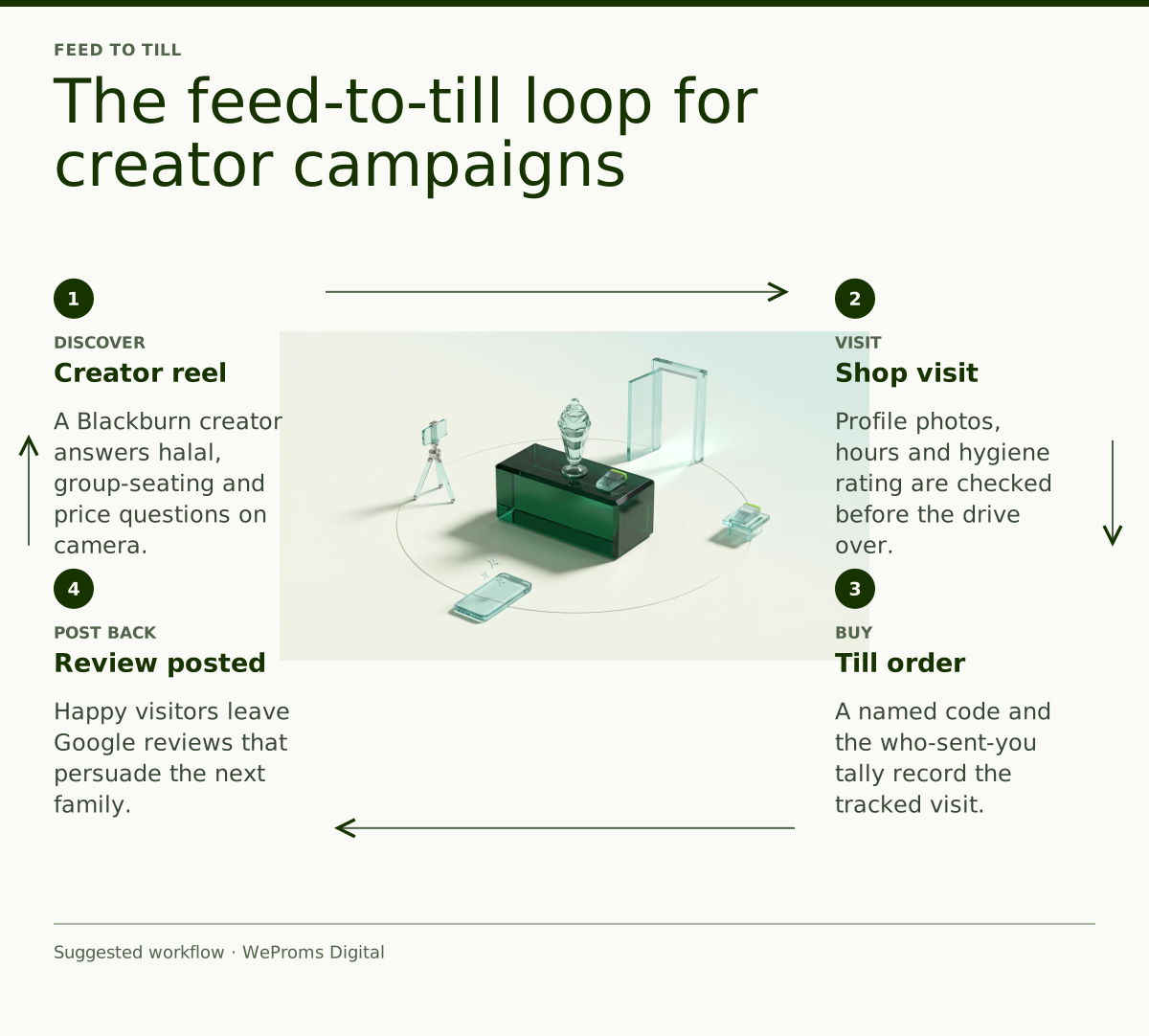
Run properly, a creator campaign is a loop, not a bet: the Reel gets the lounge discovered, the profile and hygiene rating get the visit, the till records it, and every happy visitor is the next round of discovery through their reviews. Contribution per visit, not likes, decides renewal. Each pass around the loop compounds the Google reviews that Akeneo says British shoppers already trust more than endorsements, so the second campaign starts warmer than the first. Before the next send or booking, work down this checklist:
- Creator code live at the Square till and named in the Reel caption.
- “Who sent you in today?” on the counter tablet with a tally sheet by the register.
- Review ask scripted, with a genuine no-pressure exit line.
- Unit economics on one page: fee, average spend, contribution, break-even visits.
- Renew-or-stop decision dated before the campaign starts, tied to the tally numbers.
And the message that starts it all, ready to paste to a local creator: “Salaam! We’re a halal dessert lounge in Blackburn. We’d love two Reels and one story this weekend. Please show the sundae being made, mention we’re halal-certified with group booking, and ask people to quote your name at the till for 10% off — it helps us thank you properly. Could you share a screenshot of where your followers are based? Fee paid on booking.” The 10% code is public-facing; if you message your own customer list about the campaign, keep the consent line and an easy opt-out in every send.
Read next: What a Toronto halal restaurant should pay an Instagram food creator and the Kuwait attar shop fix for Instagram likes without orders.
The difference between a gamble and a system is whether the second month’s decision writes itself. WeProms Digital, an influencer marketing agency for halal restaurants, cafés, and retailers across the UK and the Gulf, runs creator campaigns this way — briefed against real shopper questions, tracked with creator measurement and ROI reporting that counts visits rather than applause. Based on our experience working with food and retail businesses across the UK, the UAE, and North America, one tested creator relationship usually outperforms three untracked ones at the same total fee. Email hello@weproms.com, message WhatsApp +92 300 0133399 (replies in UK and Gulf business hours), or visit weproms.com/contact-us.
Frequently Asked Questions
How much should a UK food creator charge for two Reels?
Rates vary by following, region, and usage rights, but the structure is consistent: a flat fee, occasionally plus a meal allowance, with exclusivity and paid-ad usage priced separately. A Lancashire creator with 20,000-50,000 followers typically sits well below London rates. Our Toronto creator rate guide shows the full structure in Canadian dollars — the negotiation method transfers directly. WeProms Digital vets and negotiates UK creator fees as part of campaign management.
What if most of the creator’s followers are outside Lancashire?
Then the fee is buying applause, not visits. Ask for a screenshot of the creator’s audience locations before booking — followers-by-city is standard data creators can share in one tap. A creator with 15,000 followers concentrated in Blackburn, Hyndburn, and Preston outperforms a 100,000-follower account whose audience lives in London and Lahore for a walk-in dessert lounge.
How many tracked visits make a creator worth renewing?
Divide the creator fee by your contribution per visit. At £350 and £5.30 contribution, break-even is 67 tracked visits across the campaign window. Set the stop-or-scale line before the campaign starts — below half of break-even, do not renew; at or above break-even, renew and schedule the next flight around the Ramadan after-iftar peak.
Do discount codes just cannibalize full-price sales?
Some, yes — which is why the code stays at 10%, lives for one weekend, and is capped at the till if needed. The cannibalization matters less than the measurement: without the code you have no way to separate creator-driven visits from ordinary Saturday trade. Treat the discount as the price of honest data.
Should I ask creators for screenshots of saves and shares?
Ask for them, but treat them as diagnostics, not proof. Saves and shares tell you which content angles resonated, which shapes the next brief. The till tally and the “who sent you” sheet remain the only numbers that decide renewal — a save costs nobody £12.50.
Sources & References
- Later — Omnichannel Influencer Marketing: How to Connect the Feed to Retail Sales — October 23, 2026
- Later — Shopping Habits by Generation (March 2026 survey of 1,079 consumers) — March 2026
- Circana — Channel Migration Trends: Where Are Your Consumers Shopping Now — March 2026
- Circana — Consumers Shop at 39 Unique Retailers a Year (Complete Consumer research) — April 2025
- Akeneo — Word of Mouth Beats Paid Influence: 65% of UK Shoppers Trust User Reviews Over Influencer Endorsements — April 2025
- The Drum — Commerce-First: UK Brands Turn Influencer Marketing Into a Revenue Engine — 2026
- Lumina Intelligence — Channel Spotlight: UK Eating Out, Q1 2026 (£18.35 average spend per visit) — 2026
- Food Standards Agency — Food Hygiene Rating Register — accessed October 2026
- IslamicFinder — Eid al-Fitr 2027 Expected Date — accessed October 2026
Additional reading from industry feeds: