

By Abdul Rehman · WeProms Digital · October 16, 2026
You will stop paying for engagement Meta cannot connect to orders. Expect two to three weeks of work: audit what your pixel sees, wire the Conversions API to your order system, then rebuild audiences around real buyers. Attar counters in Kuwait typically spend a few hundred dinars a month on Meta ads; tracked orders finally make that budget judgeable.
If you run an attar counter in Salmiya or near Souq Al-Mubarakiya, and your Ramadan and Eid gift sets move through Instagram comments and WhatsApp chats rather than a website checkout, you already know the symptom. The KWD 250 monthly budget produces hundreds of likes. Comments fill with heart emojis and “price?” replies. Actual orders barely move. The instinctive response is to blame the creative or the budget, when the more common culprit for Kuwait’s alcohol-free perfume sellers is that Meta literally cannot see most of your orders — so the ad system keeps optimizing toward people who like perfume pictures instead of people who buy them. This walkthrough fixes that, step by step, and it works whether your customers are Kuwaiti regulars, expat professionals, or the Pakistani community ordering Eid hampers for family back in Karachi.
First, find out what your ads actually count
Start here, in Meta Events Manager. Open it, look at the events your account records, and ask one question: when a customer buys, does a Purchase event appear? The Meta Pixel — a small piece of browser code that reports what visitors do on your website — only sees actions that happen inside a browser on a page it lives on. If your ordering happens in comments and WhatsApp threads, the pixel sees the ad tap and nothing after it.
The scale of the channel is not the problem. DataReportal’s Digital 2026 Kuwait report estimates Instagram’s advertising reach at 59.4% of Kuwait’s entire population — your buyers are on the platform in extraordinary density. What that reach figure does not prove is that they buy the way your website assumed they do; in Kuwait’s perfume trade, most transactions happen in conversation, which means the default setup was never going to measure them. If you also sell via a simple shop page, Instagram Reels can genuinely drive mithai and gift orders — but only the orders that pass through a tracked page get counted.
Write down the number Meta reports as your “results” this month. You will need it as the before picture.
Then, follow one order from tap to delivery
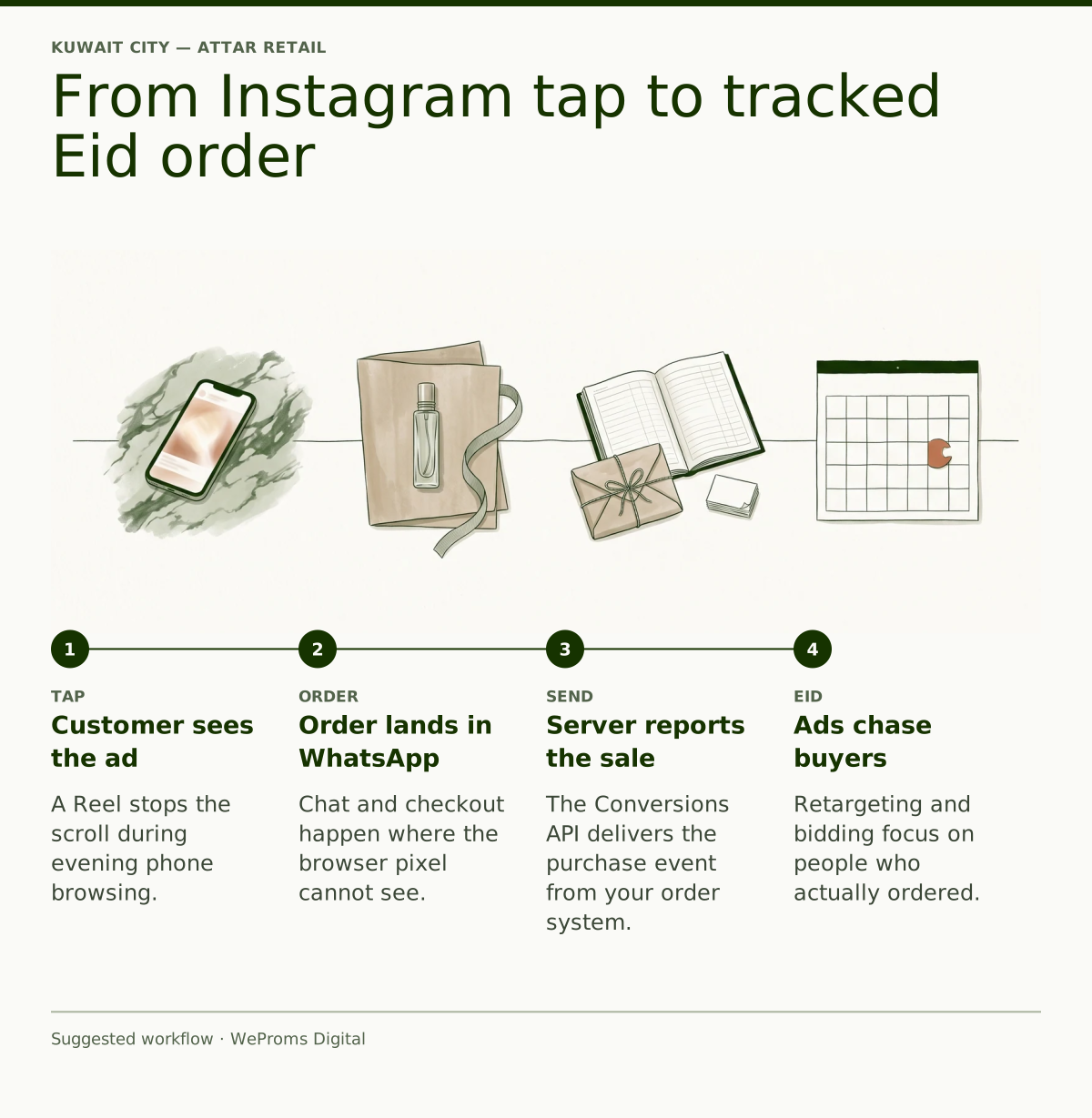
Picture this. An Instagram Reel stops the scroll during evening browsing in Salmiya. She comments “price?” under the video; your team replies; the conversation moves to WhatsApp; she picks a gift set, pays by K-net link or cash on delivery, and the parcel ships the next day. From Meta’s side, that entire sequence is one ad tap followed by silence.
The conversation and the checkout happen where the browser pixel cannot see them. A comment that becomes a WhatsApp order is like a deal agreed at a family wedding: everyone present remembers it, but no receipt exists anywhere a system can read. Meta’s own ecosystem has acknowledged this shift — at UK publisher The Independent, social-commerce revenue passed SEO-driven commerce for the first time in September, a signal that social is now a direct sales channel, not a noticeboard. A sales channel you cannot measure is a sales channel you cannot improve.
Pick one real order from last week and trace it on paper: ad tap, comment, WhatsApp, payment, delivery. Every arrow that crosses out of Instagram’s view is an arrow your current reporting treats as if it never happened.
Next, list every sale the browser pixel cannot see
Your list will probably have five entries. WhatsApp and DM orders that never touch the website. Repeat customers who message directly because they saved your number two Eid seasons ago. Counter sales at the shop from customers who first found you through ads. Cash-on-delivery orders where the website, if any, is bypassed entirely. And gift orders shipped to family in Pakistan or India, where the buyer is in Kuwait but the recipient experience happens abroad.
Two platform notes belong on this list. Meta has begun charging consumers for comfort features — Instagram Plus, at $3.99 a month, is a personal-account subscription, not a business tool — while business measurement remains something you must engineer yourself, free of subscription but not free of setup work. And Meta’s ad stack is in visible flux, with brands like Ruggable publicly shifting about a tenth of total spend out of performance channels and toward creators as classic performance thins; whatever mix you land on, the tracking layer has to see orders first.
Keep the list specific to your counter. Every entry is a sale your bidding algorithm is currently blind to, and every blind sale teaches the algorithm that engagement equals success.
After that, connect the Conversions API to your order record
The Conversions API — a server-to-server connection that sends order and customer events from your own systems directly to Meta — is the fix for everything on your list. When your shop marks an order as delivered, or your WhatsApp order sheet records a completed sale, a server event tells Meta what happened, with details hashed for privacy. Meta’s developer documentation describes pairing it with the pixel, with deduplication so a browser purchase and its server twin count once.
The results Meta reports are hard to ignore: advertisers using a web Conversions API setup saw an average 17.8% decrease in cost per result compared with advertisers without it — which means for every 100 dinars of results your budget bought before, proper server-side tracking buys the same results for about 82. One franchise case Ignite Visibility published saw cost per lead fall 44% with leads up 29% within five months. A US painting franchise is not a Kuwait perfume counter; the direction of improvement is what transfers, not the exact size. The Conversions API sends the purchase event from your own order system, so it captures the WhatsApp sales the pixel never saw.
Watch one number during setup: Event Match Quality — a score Meta shows next to each event, rating how well the customer details you send match real Meta accounts. A quality score above 6 out of 10 means your events are attaching to the right people; below that, events arrive as anonymous noise. The tradeoff is patience in week one, while events deduplicate and quality settles, for accuracy in week four that you will never get from the pixel alone.
Once events flow, rebuild your audiences around buyers
With server events arriving, Meta stops guessing. Build a custom audience of everyone with a Purchase event in the last 12 months; that list now includes your WhatsApp buyers, not just website checkout customers. Build a second audience of engaged commenters who have not purchased, and treat them differently — a nurturing sequence, not a hard sell.
Retargeting and bidding finally focus on people who actually ordered before Eid. Gulf perfume and food retailers see the same mechanics: Meta stopped showing a Dubai honey shop’s ads to past customers once its buyer list became usable — sometimes you exclude buyers to save budget, sometimes you target them for the next gifting season, but both moves require knowing who they are. Discovery-layer work matters too: getting an oud shop recommended inside ChatGPT helps shoppers arrive pre-decided, which raises the value of every tracked retargeting dinar you spend.
From here, judge every campaign on cost per order
With both systems feeding Meta, the dashboard question changes. Not “how many likes did the ad get?” but “what did each order cost, end to end?”
| What happens | Pixel only | Pixel + Conversions API |
|---|---|---|
| Tap on your Instagram Reel ad | Recorded | Recorded |
| Comment or DM asking the price | Invisible | Captured as engagement with purchase potential |
| Order confirmed in WhatsApp | Invisible | Sent as a server purchase event |
| Repeat buyer messaging from saved number | Invisible | Matched from purchase history |
| What bidding optimizes toward | Page views and taps | Completed orders, on-platform and off |
Two housekeeping habits protect the setup. Keep creative inside platform specifications so nothing is rejected or cropped into blur — current image and video size guides change often enough to check quarterly. And review Event Match Quality monthly, because a broken connection fails quietly: ads keep running, reporting simply empties.
The outcome: what KWD 250 must return before Eid
Worked example — substitute your own costs. An Eid gift set sells at KWD 18; the oils, box, ribbon, and delivery cost about KWD 8, leaving KWD 10 of contribution per order. A KWD 250 monthly ad budget needs 25 tracked orders to break even; every order beyond that is margin. Before the fix, you could not name that number, because most orders never reached the dashboard. After it, cost per order becomes the single figure you tune creative, audiences, and budget against.
Timing matters more than volume. Eid al-Fitr is expected around 9 or 10 March 2027, subject to moon sighting, per Gulf astronomical forecasts, which means your buyer audiences, purchase events, and Eid creative need to be flowing six to eight weeks before that — mid-January, not mid-February. Ready-to-paste reply for commenters, with consent built in: “Walaykum salam, thank you for commenting! Shall I send our Eid gift-set sizes and prices on WhatsApp? Reply STOP and we will not message again.”
Read next: Getting an oud shop recommended in ChatGPT and why Meta stopped showing a Dubai honey shop’s ads to past customers.
WeProms Digital, a Meta Pixel and Conversions API setup agency for Gulf retailers, has worked with perfume, food, and fashion sellers across Kuwait, the UAE, and Saudi Arabia to wire WhatsApp and counter orders back into Meta so budgets optimize toward buyers. Based on our experience, the events-to-audiences loop is what separates shops that scale Eid campaigns from shops that guess. Email hello@weproms.com, message WhatsApp +92 300 0133399, or contact us — we reply in Gulf business hours.
Frequently Asked Questions
How much does Conversions API setup cost for a small Kuwait shop?
Setup is a defined project rather than an open retainer: connecting your order process to Meta, configuring deduplication, and training your team on the weekly check. WeProms Digital scopes it after a short call about how your counter takes orders — comment-to-WhatsApp shops and website-plus-counter shops need different wiring. Tool costs are separate and usually zero at your scale; the work is in the connection.
Do I need the Conversions API if I only take orders in WhatsApp DMs?
You need it more, not less. A website checkout at least lets the pixel see purchases; a WhatsApp-only flow gives the pixel nothing after the ad tap, so Meta optimizes toward commenters and likers. Server events from your order sheet make those chat orders visible to bidding and audiences without changing how customers buy.
Is server-side tracking respectful of customer privacy?
Handled correctly, yes. The Conversions API sends hashed customer details, shares only what you have a legitimate reason to share, and works with consent rather than around it — Meta’s documentation requires a lawful basis for the data you pass. For a Kuwait counter, the practical rule is simple: send order events, not chat transcripts, and honor every customer who asks out.
How long before my ads improve after setup?
Expect a learning phase of about two weeks while events deduplicate and Event Match Quality settles; improvements in cost per result typically show in weeks three to six. Meta’s reported 17.8% average improvement in cost per result is a fair expectation for direction, not a promise — a single-product attar counter with strong creative can beat it, and a sparse order log can lag it.
What is the event quality score in Events Manager?
Event Match Quality, shown next to each event, rates from 1 to 10 how well the details you send match real Meta accounts. Above 6 is healthy. If it drops, the usual causes are missing customer fields in your order process or duplicate events arriving from both pixel and server; both are fixable in days.
Sources & References
- Ignite Visibility — What is Facebook Conversions API & Why Do You Need It? — October 15, 2026
- Meta for Developers — Conversions API documentation — vendor documentation
- DataReportal — Digital 2026: Kuwait — 2026 report
- Hootsuite — Instagram Plus: What it is, costs, and what it means for brands — October 15, 2026
- Digiday — Social commerce edges past SEO at The Independent for the first time — October 16, 2026
- Digiday — Ruggable’s new ad spend strategy shifts focus to ShopMy creators — October 16, 2026
- Sprout Social — Always up-to-date guide to social media image sizes — October 15, 2026
- Al-Ain — Astronomical dates for Ramadan 2027 and Eid al-Fitr — 2026 forecast
Additional reading from industry feeds: