

By Sara Khan · WeProms Digital · November 6, 2026
Across the catering and food-business accounts we review in Edmonton, Ottawa, and Montreal, one pattern keeps appearing in the first week of November 2026: reported Google clicks multiply overnight while quote requests, WhatsApp enquiries, and phone calls stay exactly where they were. Take one illustrative case: an Edmonton halal caterer watches her Google Search Console — Google’s free reporting tool for how a site performs in search — show a three-fold click jump on November 2, with a C$1,500 shaadi-season ad top-up waiting on that very report. A click spike with flat enquiries is not growth; it is noise dressed as growth. November is nearly the worst month for that illusion, because winter shaadi bookings and Ramadan 2027 pre-orders are budgeted now, on the strength of whatever numbers the owner trusts.
The community context makes the stakes concrete. Statistics Canada’s 2021 Census counted 83,015 Muslims in Edmonton, including roughly 12,175 people of Pakistani origin, and the city has anchored Muslim life in Alberta since Al Rashid Mosque opened in 1938 as Canada’s first mosque. Halal caterers here trade on two seasons: the December-to-February shaadi wave, and the Ramadan-to-Eid run whose pre-order conversations begin in January. When the dashboard that informs those campaigns suddenly doubles, the rational response is neither celebration nor panic. It is verification, because the spike is almost certainly automated.
The pattern that repeats across November reports
Marie Haynes documented the wave after other SEOs flagged strange graphs: between October 31 and November 2, 2026, sites she monitors saw sudden 2x to 6.5x spikes in Search Console clicks while impressions and average rankings stayed flat. Search Engine Roundtable’s November 6 recap covered the same anomaly as it spread across other sites’ reports. Real customers click more when they see your listing more; flat impressions with exploding clicks is not a human pattern.
Two details in the data settle the question. First, the spiked clicks landed on pages ranking on pages two to six of the results — positions 12 to 54 — with click-through rates of 45% to 100%, rates that top-ranked pages rarely achieve and deep pages never do. Second, the queries were synthetic: on one technical site Haynes monitors, a single page’s Canadian clicks went from zero to 40 on November 2, spread across 23 slightly reworded variations of one question, an 80% click-through rate at an average position of 14.6, while the same page’s United States clicks stayed at zero. A page-two result does not convert four in five impressions in one country and none in another.
Impressions looked calm for a simple arithmetic reason. A few hundred automated impressions vanish into a site’s tens of thousands of daily impressions, while those same few hundred clicks tower over a fifty-click day. One line of the chart looks like a mountain range; the other looks untouched. Your action this week is a single comparison: set the date range October 26 to November 1 beside November 2 to 8, and check whether clicks moved while impressions, rankings, and — most importantly — enquiries did not.
Where the fake clicks hide in your reports
Google ships no single “remove bots” button, so the cleanup is surgical. Three filters expose the skew, all documented in Google’s guide to filtering and comparing Search Console performance data: switch the device dimension to Mobile and read the trendline the spike never touched; filter the Pages tab to positions greater than 10 to list the deep URLs bots clicked; and isolate any single spiked URL with a page filter to confirm its clicks came from one day in one country.
The device split is where the evidence becomes undeniable. On one site Haynes monitors, clicks went from roughly 50 a day to 327 on November 2, and 297 of those clicks landed on desktop pages ranking on pages two to six of the results, while mobile stayed at its usual 30. Ninety-one percent of a day’s “customers” arriving on desktop deep pages, with mobile unmoved, describes a crawler, not a family planning a nikah lunch.
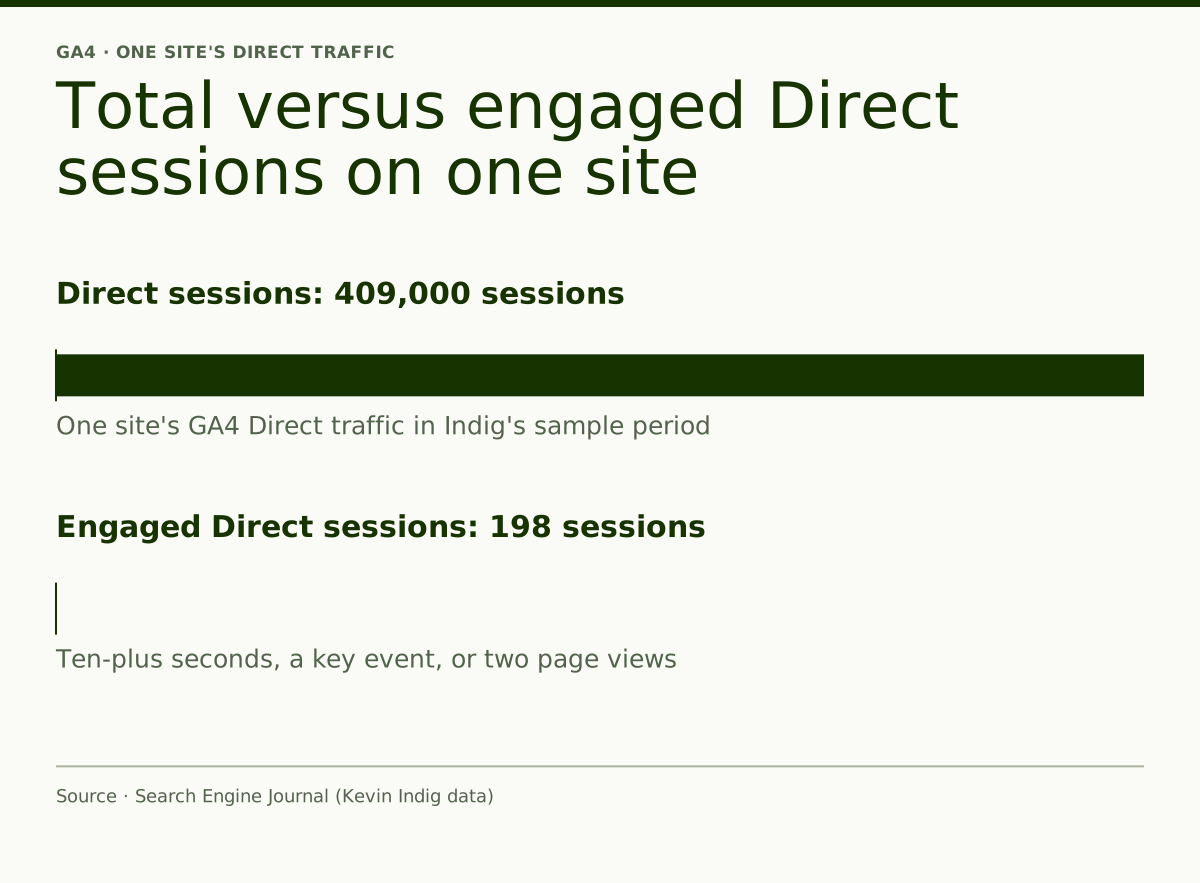
Your Google Analytics 4 property — Google’s analytics tool that records what visitors actually do on your website — offers the same lie detector from the other side. GA4 counts an engaged session as any visit lasting more than ten seconds, triggering a key event (GA4’s term for a valuable action such as a quote-form submission), or including at least two page views, per Google’s events documentation. Growth analyst Kevin Indig, cited in Search Engine Journal, found one site where GA4 recorded 409,000 Direct sessions in a sample period and only 198 engaged ones, while total Direct ballooned and engaged Direct actually shrank:
“That’s bots, not buyers.”
Save two comparisons in your GA4 library this week: all sessions versus engaged sessions on your quote page, and the device split for November. If a traffic jump survives both filters and shows up in your inbox as a real enquiry, believe it. Until then, treat every November spike as unproven.
Why the spike lands in shaadi-season budget month
Timing is what turns a data quirk into a business risk. Winter shaadi bookings are decided between December and February, and Ramadan 2027 is expected to begin around February 8, 2027, which puts Eid al-Fitr around March 9 or 10, 2027 — dates subject to moon sighting — and puts pre-order and deposit conversations in mid-January. A caterer who reads November’s fake spike as momentum will top up ad budgets heading into the most expensive weeks of the year. Families confirm a shaadi date with a deposit, never with a compliment; budget the same way, on deposits rather than clicks.
The wider search economy is quietly warning against volume-worship anyway. Alphabet’s third-quarter search revenue grew 12% to $63.35 billion — its slowest quarter of 2026 — even as Google’s query growth hit a five-year high, a divergence Duane Forrester unpacks at Search Engine Journal. Activity and money are coming apart at the platform level. One honest caveat belongs here: Alphabet’s figures describe the global search economy and say nothing about demand for halal catering in Edmonton — your own enquiry log is the only evidence that answers the local question.
Worked example — substitute your own costs. An average winter shaadi catering booking brings C$3,200 in revenue, with food, labour, and transport costs of C$2,100, leaving contribution of C$1,100 per booking. A C$1,500 media test — media-only, four weeks, Edmonton metro radius, split across Google and Instagram — breaks even at 1.4 bookings, so round up and plan for two. Set the stop rule before spending: if ten enquiry conversations within three weeks produce fewer than one deposit, pause and fix the enquiry path rather than feeding the campaign. A phantom click spike that convinces you to double that budget is the most expensive flattery your dashboard can offer.
What the accounts with clean numbers do differently
The accounts we review that grow steadiest share three habits, and none of them involve more software. They define a quote-request key event and check it weekly instead of watching sessions; they log every WhatsApp and Instagram enquiry with its source; and they judge channels by contribution rather than rate. Haynes’s twelve-month dataset across 100 sites explains the last habit: ChatGPT visitors converted at 13.8% versus 3.02% for Google organic, an impressive rate, yet Google organic still delivered 27 times more conversions than every AI assistant combined. A high-converting trickle does not replace the channel that carries your bookings; report both, budget on the bigger contribution.
Data hygiene, not tooling, is the binding constraint everywhere. HubSpot’s 2026 State of Marketing research found only 65% of marketers say they have high-quality data about their audience — a figure that has not improved even as AI adoption spread, because the failures are strategic: unclear goals, stale records, and nobody owning the numbers. A one-person catering office faces the same disease in a smaller body, and the cure is a weekly fifteen-minute reconciliation, not another subscription.
| Habit | Average account | The clean-numbers 10% |
|---|---|---|
| Reading November | Celebrates the click spike | Compares clicks against enquiries before reacting |
| Definition of success | Sessions and traffic | Verified quote requests, calls, and deposits |
| WhatsApp and Instagram enquiries | Counted loosely as interest | Logged with source, followed up within a day |
| Budget decisions | Made on the spikiest number | Made on contribution per booking |
One ready-to-paste reply for every new enquiry, so source-tracking survives the rush: “Assalamu alaikum! Thank you for your enquiry about catering for [date]. May we ask how you found us — Google, Instagram, or a recommendation? It helps us serve the community better. Reply STOP if you would rather not receive messages.” Canada’s anti-spam law, CASL, requires genuine consent before commercial messages, so honour every STOP immediately and keep the list willing. We saw the same bot-click signature on a Jeddah grocery’s reports, and the fix travels: filter first, trust second. If your enquiry trail still confuses you after the ten-minute check below, our GA4 setup service for overseas Pakistani businesses exists exactly for this reconciliation.
The ten-minute check that settles the question
Run it once, then repeat each Monday through the shaadi booking window. Open Search Console’s performance report and compare October 26 to November 1 against the week that followed. Switch the device dimension to Mobile and see whether the spike exists there at all. Filter the Pages tab to positions above ten and note every URL that logged impossible click-through rates. Open GA4, compare all sessions against engaged sessions on your quote page, and note the gap. Finally, count the real enquiries in your inbox, WhatsApp Business app, and voicemail for the same days, because that count is the only line a bot has never learned to inflate.
Ten minutes, five checks, one honest answer.
Key Takeaways
- The October 31 to November 2, 2026 click spikes in Search Console are automated traffic, not customers: impressions and rankings stayed flat while clicks multiplied up to 6.5 times.
- Filter before you trust — the mobile device trendline, a position-above-10 page filter, and a single-URL page filter expose bot skew in minutes.
- In GA4, compare all sessions against engaged sessions on your quote page; 198 engaged sessions out of 409,000 Direct visits on one site shows how completely bots can inflate a report.
- Budget shaadi-season spend against deposits, not clicks: contribution per booking (worked example: C$3,200 revenue minus C$2,100 costs equals C$1,100) sets your break-even and your stop rule.
- Judge channels by total contribution — a 13.8% conversion rate on a trickle of AI referrals still lost to Google organic’s 27-times larger conversion volume.
Read next: How do I track Google Ads leads all the way to shaadi bookings? and Google Ads counts leads a Mississauga tax firm never received — two more measurement-trust fixes for diaspora businesses.
The cost of inaction is quiet but specific: an owner who trusts November’s fake spike scales the wrong campaign in December, runs out of budget by late January, and misses the Ramadan pre-order window the season’s recovery actually depended on. If clicks doubled and enquiries did not, your numbers need cleaning before your budget needs adding. WeProms Digital, a GA4 setup and analytics configuration agency for overseas Pakistani businesses, has worked with food-service and retail accounts across Canada, the UK, and the Gulf to strip bot noise out of reports, define quote-request key events, and build Looker Studio dashboards that show enquiries and deposits instead of raw clicks. Email hello@weproms.com, message WhatsApp +92 300 0133399, or use the contact page — we reply in Canadian and Gulf business hours.
About WeProms Digital
WeProms Digital is a Lahore-based analytics and measurement agency working with overseas Pakistani and halal-minded business owners across London, Birmingham, Manchester, Dubai, Riyadh, Toronto, Edmonton, and beyond.
The team specialises in GA4 setup and custom configuration, Google Search Console audits, and reporting dashboards, with a track record of separating genuine buyer behaviour from automated noise across food-service, retail, and service accounts.
Get in touch: hello@weproms.com · WhatsApp +92 300 0133399 (replies in UK and Gulf business hours) · weproms.com/contact-us
Sources & References
- Search Engine Journal — November Click Spikes In Google Search Console Are Bot Traffic – How To Filter Your Reports — November 5, 2026
- Search Engine Roundtable — Search News Buzz Video Recap, November 6 — November 6, 2026
- Search Engine Journal — Google Search Queries Hit A 5-Year High, And Search Revenue Didn’t Follow — November 5, 2026
- Search Engine Journal — AI Visibility Isn’t A Sham – Most Ways Of Measuring It Are — November 6, 2026
- Google Search Console Help — Performance Report: Advanced Filtering and Comparison — accessed November 6, 2026
- Google Analytics Help — About Events (Engaged Sessions) — accessed November 6, 2026
- Statistics Canada — 2021 Census Profile, Edmonton — 2022
- City of Edmonton — Sacred Spaces: Al Rashid Mosque, Canada’s First Mosque — accessed November 6, 2026
- HubSpot — Obstacles in Marketing Automation and How to Fix Them — November 6, 2026
Additional reading from industry feeds: