
By Abdul Rehman · WeProms Digital · November 22, 2026
TL;DR: Rebuild your Instagram ads in four weeks: audit the discount-only creative, write one true customer story, run the story against the discount on the same budget, then scale the winner into Ramadan, expected around 8 February 2027, subject to moon sighting. The full test costs about one month of your current ad spend.
Picture this: a Pakistani-owned abaya boutique in Salmiya is paying KWD 250 a month for Instagram ads. Every ad shows the same thing — a product photo, the words “20% off”, and a WhatsApp number. The orders arrive, but slowly, and every Eid the owner watches Kuwaiti labels with thinner fabrics outsell her on the same app. The fabric is not the problem, and the budget is not the problem. What the ad contains is the problem, and that is fixable before Ramadan.
This walkthrough shows you how, step by step, using real numbers: an independent test of 75 big-budget Christmas ads that a charity film won with a rescue dog, published ad costs for Kuwait, and a worked money example in dinars you can copy with your own figures.
First, audit what your ads actually say
Screenshot every live ad in your Meta Ads Manager account and write one line under each: what does this ad lead with? Primary text — the first text block a scroller sees before tapping “more” — either names a person and an occasion, or it names a price. Most boutique audits we run come back with the same answer: price.
The timing matters, because generic creative has never been cheaper to produce. On Alphabet’s October 2026 earnings call, Google said Gemini models helped advertisers generate over 1.5 billion campaign assets in a year, up more than sevenfold. When anyone can generate a thousand headlines and product shots in an afternoon, volume stops being an advantage. The only ad that still earns attention is the one a machine could not have written about your shop.
“AI didn’t make your brand invisible in Search. Your content did.”
Google’s own marketing publication, Think with Google, posted that line to chief marketing officers on 19 November 2026, alongside advice to drop generic “Top 10” listicles in favour of first-hand expertise, as Search Engine Journal reported. The sentence was written about search results, but the same logic runs through Instagram feeds. A discount is the one thing every competitor can copy in a minute, which means it is the weakest line in your ad, not the strongest.
One more reason the audit is worth an afternoon: most advertisers never touch their creative. A Tatari survey of 41 US television advertisers found only one in five were developing new season-specific creative, while more than a third planned to repurpose existing ads, according to the same report. The figure is about TV in America, and it does not prove anything about Salmiya — but if your rivals in Kuwait behave anything like that, the bar for standing out is lower than you fear.
Do this today: list your live ads, mark each one “price” or “story”, and count. If everything says “price”, keep reading.
Then, find the one story your boutique already owns
On 16 November 2026, ad-testing firm DAIVID published its ranking of 75 UK Christmas ads, and a 60-second charity film about a boy and a scruffy rescue terrier beat Amazon, John Lewis and M&S. The Dogs Trust film, “Kira Needs A Happy Place”, was predicted to trigger intense positive emotion in 58.4% of viewers — roughly a fifth more than an average ad — measured by AI models trained on tens of millions of human responses. Those are forecasts, not a live panel, and the gaps between the top films were narrow. The direction of the finding still holds.
The emotions are the useful part for a modest fashion shop. Compared with an average ad, the winning film roughly doubled empathy, and lifted trust and adoration by similar margins — the exact feelings a woman weighs before she trusts a stranger on Instagram with her Eid outfit.
“Dogs Trust has beaten some of the biggest names in advertising by getting one of the fundamentals right: making people feel something. Its story of a boy and his rescue dog generates particularly strong levels of empathy, hope, and adoration, showing that audiences don’t necessarily need spectacle, celebrity, or big-budget production to connect.”
That is DAIVID’s founder Ian Forrester, quoted in the same piece. Read his point as a budget statement: story beats production values.
You already know how this works, because trust moves the same way in your own community. An abaya your cousin wore to a nikah in Kuwait City does more selling than any discount line, the same way the tailor back home in Karachi kept a three-week waiting list with no signboard at all — the work was the story people told each other. Instagram advertising is that word of mouth, paid to travel further. And the audience is genuinely there: DataReportal’s Digital 2026: Kuwait report puts Instagram’s ad reach at 3.0 million accounts, 59.4% of the population, as compiled by Byrukn’s Kuwait statistics page — reach is not your bottleneck; what the ad says is.
So inventory your stories like stock. The wedding guest who needed three abayas in ten days. The mother and daughter who do their Eid fitting together every year. The client who asked for a sleeve redone overnight and sent her sisters the next week. Each is a real ad; none of them can be generated by a competitor’s AI tool.
Next, write the ad as a scene, not a slogan
A story ad has a shape you can copy: one person, one occasion, one problem, one resolution. Three sentences is enough, because the scene is doing the selling, not adjectives. Write it the way you would tell a customer in the shop.
Here is a ready-to-paste template — replace the brackets with your own customer and dates (worked example, not a real client):
She came in for one abaya and left with three — her sister’s nikah in January, and she wanted every guest to ask where they were made. We tailored all three in ten days, including the stone-work on the sleeves. Eid pre-orders open [date]: message us on WhatsApp and we will hold your fitting before the rush.
Two practical notes for Kuwait. First, run Arabic and English versions of the same scene — the choice of language changes results noticeably, and the splits tested for a Salmiya cafeteria’s Instagram ads apply just as much to a boutique. Second, keep every photo modest by design; that is your brand position, and it is also what your audience scrolls past competitors to find. Some Western-market boutiques now show different creative to men and women — the method transfers, but for most Kuwait boutiques a single modest, story-led set is enough.
If the ad invites people onto a WhatsApp list, ask permission explicitly and end every broadcast with a line like “reply STOP and we will remove you”. Consent keeps the list clean, and a clean list is what makes the Ramadan phase of this plan work later.
After that, run the story against the discount
Do not argue about creative in a meeting; let the feed decide. Set up a split test — two ad sets, identical audience and budget, one variable — inside Meta Ads Manager. Route A is your current discount ad. Route B is the scene you just wrote. Split the month’s budget evenly, hold everything else constant, and let both run for four full weeks.
| Route A: discount-led | Route B: story-led | |
|---|---|---|
| What the ad leads with | Product photo and % off | One customer, one occasion |
| What it costs you per order | Depends on the discount depth | Depends only on ad spend |
| Who responds | Deal hunters, one-time buyers | Occasion shoppers, repeat buyers |
| What to measure | Cost per order, returns | Cost per order, messages started |
Kuwait media is affordable enough for a clean read. Published ecommerce benchmarks put Kuwait’s Meta CPM — what you pay per thousand impressions — around KWD 2.48 (about US$8.07) according to Adly’s GCC benchmark page for Kuwait. That means KWD 250 buys roughly 100,000 impressions in a month (simple arithmetic: 250 divided by 2.48, times 1,000), which is enough reach for Salmiya, Hawally and Kuwait City proper to give you a trustworthy winner — not a coin flip. Fashion buying in Kuwait runs through Instagram more than any other channel, as Growthmerce’s Kuwait e-commerce guide documents, so the test happens where your customers already are.
At this point, check the money math before scaling
Before you believe any winner, run the numbers on your own till. Use this worked example as the shape, then substitute your real figures — every number below is illustrative.
Contribution — the price of an abaya minus its product and fulfilment costs, before ad spend — is the number that protects you. Say an abaya sells for KWD 28, and fabric, tailoring, packaging and delivery cost KWD 12. Contribution is KWD 16. Your media budget is KWD 250 a month, media only. The story route breaks even at 16 orders a month, because 16 times 16 covers 250 and change.
Now run the discount route. A standing 30%-off sale drops the price to KWD 19.6 and the contribution to KWD 7.6. That route needs 33 orders a month to cover the same KWD 250. Read that again: the discount has to sell more than twice as many abayas just to pay for the same ads, and discount buyers are precisely the ones who do not come back. This is why “increase the discount” is almost never the fix for ads that do not sell.
Set the stop-or-scale rule before the test starts, and write it down. Track cost per order — ad spend divided by the orders it produced — weekly. If a route’s cost per order stays under KWD 8, half the illustrative contribution, for two consecutive weeks, scale it. If a route’s cost per order exceeds the contribution itself, stop it that day. Assumptions on record: media-only budget, four weeks, Kuwait-wide targeting, Instagram and Facebook placements together.
Once the winner is proven, scale it into Ramadan
Ramadan is expected to begin around 8 February 2027, with Eid al-Fitr expected around 9 or 10 March 2027, subject to moon sighting, per the Muslim Hands Islamic calendar for 2027 and Gulf News’s Ramadan 2027 date guide. Work every deadline backwards from those dates, never from calendar months.
The sequence looks like this. Open Eid pre-orders and take deposits by late January — six weeks before the expected Eid date — through WhatsApp and a KNET payment link, so February production starts with confirmed orders rather than guesses. During Ramadan itself, run stocking and reminder ads: the nights after iftar are when Kuwait scrolls and shops, and your story ad should be live in that window with the winning scene updated to the season. Set a clear final-order deadline about five days before the expected Eid date, and say it in the ad; deadlines convert browsers who have been saving your post for weeks. After Eid, one win-back message to everyone who messaged but did not order — with the STOP line intact — closes the season.
Scale gently. Raise the winning ad set’s budget by no more than a quarter each week through Ramadan, and watch cost per order after each raise. If it climbs past your stop rule twice in a row, hold the budget flat instead of pushing.
What this produces by February
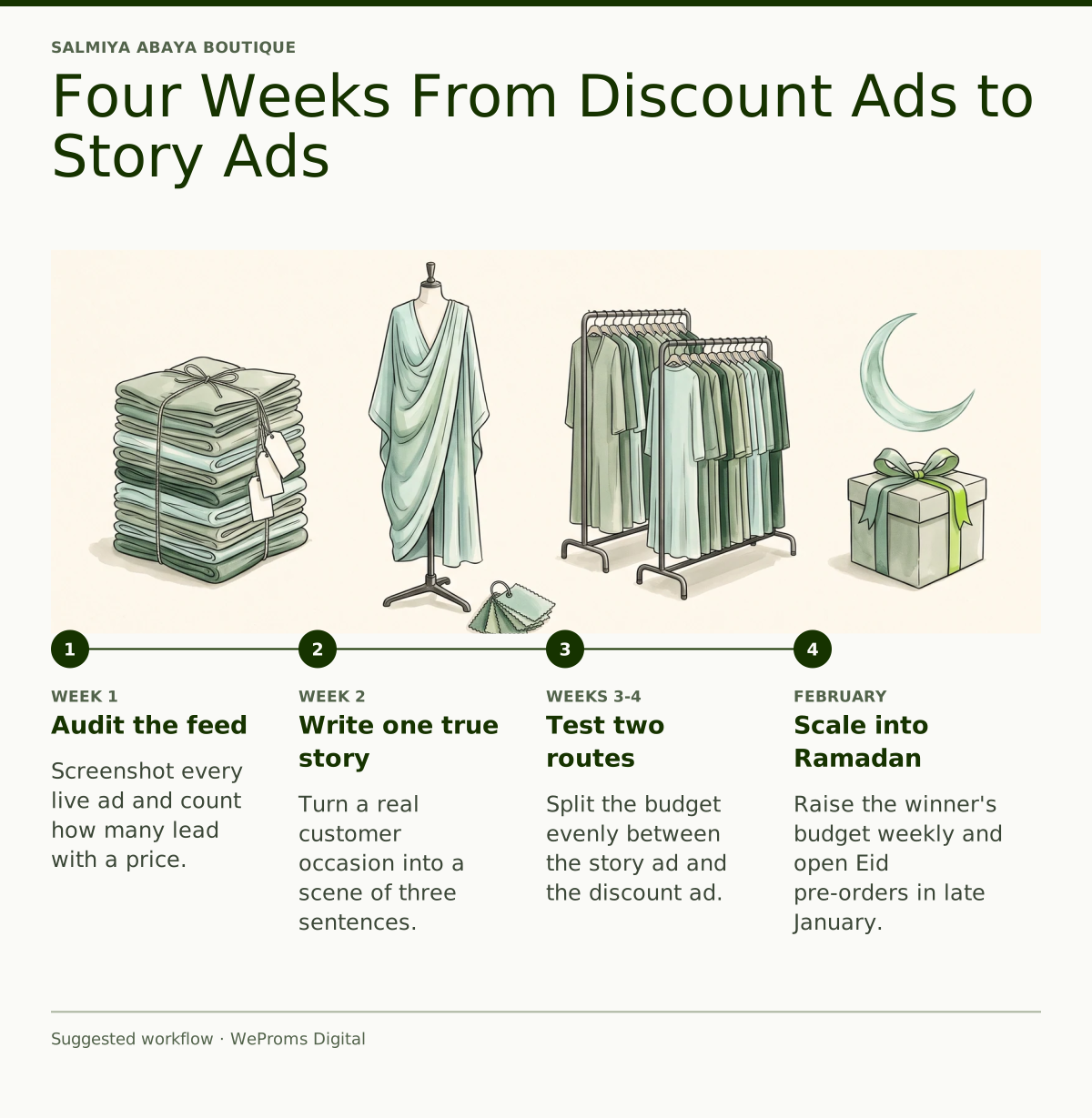
Run properly, this walkthrough leaves you with four assets: an audit sheet that names what every ad led with, one story ad that beat your discount ad on cost per order, a written stop-or-scale rule tied to your own contribution math, and a Ramadan calendar anchored to the expected Eid date. Together they turn “our Instagram ads don’t really work” into a system you can hand to a shop manager, or to an agency, with the numbers attached.
- Week 1: screenshot every live ad and count how many lead with a price.
- Week 2: turn a real customer occasion into a scene of three sentences.
- Weeks 3-4: split the budget evenly and let the story ad race the discount ad.
- February: raise the winner’s budget weekly and open Eid pre-orders in late January.
The full plan fits a boutique with tailoring capacity and a fitting room. A home-based abaya seller without either should run the same test at a tenth of the scale — around KWD 60-80 a month on ads, the scene posted organically as a reel, and deposits taken by WhatsApp — and skip paid scaling until one reel clearly outperforms.
Read next: How do I stop my Kuwait mithai shop’s Eid emails going to spam? — the message side of the same Eid rush — and how to turn Instagram Reels into mithai orders this shaadi season for the organic version of story-led content.
If you would rather have this built for you, WeProms Digital runs exactly this work: as a social media marketing agency for halal and modest-fashion businesses in the Gulf, we plan, write and test story-led ad creative around your trading calendar, and as a Google Ads management team for UK and Gulf retailers we extend winners beyond Meta when the numbers justify it. Based on our experience with seasonal campaigns for Muslim-owned businesses, the four-week test above is the piece most boutiques never run — and it is the piece that decides the season. Message hello@weproms.com, ping WhatsApp +92 300 0133399, or use the contact page to have your current ads audited before the Ramadan window opens.
Frequently Asked Questions
How much should a small Kuwait boutique spend on Instagram ads each month?
For the four-week test, KWD 150-300 a month of media spend is a realistic floor for a single boutique — enough for roughly 60,000-120,000 impressions at Kuwait’s benchmark CPM. State your own assumptions: media only, no agency fees, Kuwait-wide targeting, Instagram plus Facebook. Scale only under the stop-or-scale rule above, tied to your contribution per abaya.
Should my abaya ads be in Arabic, English or both?
Both, as separate ad sets with the same scene. Kuwait’s customer base switches between Arabic, English and Urdu-speaking households, and reply behaviour differs by language. Run each version through the same split test so the data, not opinion, picks the lead language.
When should Ramadan ad creative be ready for 2027?
Finish and test your creative in December and January, before Ramadan begins around 8 February 2027. Pre-orders should open six weeks before the expected Eid date, which lands in late January. Creative finalised in the last week before Ramadan has no test data behind it, which means you are gambling the season on an untested ad.
Can I use AI to write my Instagram ads?
AI can draft and resize, but it cannot invent your customer stories, and its generic drafts are exactly what 1.5 billion auto-generated assets already flood feeds with. Use it to polish a scene you lived; never as the source of the scene. An ad a competitor could generate with the same tool is a discount ad with extra steps.
What does WeProms charge to manage ads for a modest fashion brand?
We do not quote package prices in articles, because the right budget depends on your contribution math, season and channels. The audit conversation is free: bring your ad account numbers and your price list, and we will tell you what a four-week test should cost in dinars before you commit to anything.
Sources & References
- Search Engine Journal — A Charity Rescue Dog Outscored Amazon’s Christmas Ad: PPC Accounts Need A Story Before Cyber Week — November 20, 2026
- Search Engine Journal — Google’s ‘Top 10’ Line For CMOs Points At Generic Tips Posts — November 20, 2026
- DataReportal, Digital 2026: Kuwait — Instagram ad reach figures via Byrukn Kuwait digital-economy statistics — accessed November 2026
- Adly — GCC Advertising Benchmarks: Kuwait CPM and CPC data — 2026 benchmark page
- Muslim Hands USA — Islamic Calendar 2027: Key Dates — September 2026
- Gulf News — When is Ramadan 2027: the expected date, moon sighting and Eid explained — 2026
- Growthmerce — E-commerce in Kuwait 2026: Instagram-led fashion buying — 2026 guide
Additional reading from industry feeds:
- HubSpot Marketing Blog — AI search volatility: what it means for your traffic — November 20, 2026
- Search Engine Journal — AI Citations: What To Check Before Reacting To A Lost One — November 20, 2026