
By Sara Khan · WeProms Digital · October 19, 2026
The INBOX method breaks a mithai shop’s Eid email problem into five checks: I for Identify which email is a receipt and which is an offer, N for Name your sending domain and prove it, B for Break the complaint ceiling, O for Offer a real way out of the list, and X for eXamine delivery every week. Across sweet shops taking pre-orders in Kuwait City’s Salmiya and Hawalli neighborhoods, the failure looks identical: a customer paid a KWD 5 deposit on a KWD 12 two-kilogram box (illustrative pricing), the shop sent a confirmation, and the confirmation never arrived. The order exists; the email does not. The pattern repeats every Eid al-Fitr and every shaadi season, and it is almost never Gmail disliking small businesses — it is a shop sending receipts and marketing blasts through one unauthenticated pipe.
I — Identify: is this email a receipt or an offer?
Transactional email — a one-to-one message triggered by something the customer just did, such as an order confirmation, a payment receipt, or a pickup reminder. Marketing email — a message sent to a list to create demand, such as an Eid menu announcement or a shaadi-season discount. HubSpot’s transactional email guide draws exactly this line, and it matters because the two categories carry different rules, different consent bases, and different failure modes.
The operational rule is separation. HubSpot’s guide notes that large mailbox providers such as Yahoo recommend separating marketing and transactional traffic by IP address or DKIM domain, because a marketing blast that draws complaints can drag password-reset-style messages down with it. For a Salmiya sweet shop, the translated version is blunt: the Eid menu newsletter sent from the same address and tool as order confirmations puts the confirmations at risk. One badly received campaign, and the receipts that customers actually depend on start landing in Junk.
Practical split for a shop owner: confirmations, receipts, and pickup reminders go out from an automated order system — Shopify, a POS like Loyverse, or a transactional sender — on your shop’s own domain. Menus, offers, and gift-box launches go out from a newsletter tool to people who opted in. Two jobs, two pipes. Shops that also sell by WhatsApp broadcast through the season should read the Muscat catering email flows fix; the sequencing logic carries over to Kuwait.
N — Name your domain and prove it is you
Free personal Gmail addresses are for family groups, not for a shop confirming 1,800 Eid orders. Google’s email sender guidelines set the authentication baseline for every sender at any volume: SPF or DKIM in place, mail sent over TLS, and valid forward and reverse DNS. SPF — a record that lists which servers may send mail for your domain. DKIM — a cryptographic signature that proves the message was not altered in transit. DMARC — a policy that tells mailbox providers what to do when SPF or DKIM checks fail. Senders reaching about 5,000 messages a day to personal Gmail accounts must meet the fuller set: SPF, DKIM, and DMARC together.
Most mithai shops sit far below 5,000 daily messages, which is precisely why this check gets skipped; the volume trigger creates a false sense of safety. The baseline rules apply at any volume, and Gmail filters judge unauthenticated small senders hardest, because spoofers also love domains with no records. Kuwait’s inbox landscape runs through Gmail and Outlook almost exclusively, so Google’s and Yahoo’s sender requirements are, in practice, the whole rulebook.
The work is a one-time setup measured in hours, not weeks: register the shop domain if the shop only has an Instagram handle today, add the three records the sender tool specifies, and send a test to a Gmail account. If the test message shows “via” or “on behalf of,” authentication is incomplete — fix it before the pre-order window opens, not during it.
B — Break the 0.3% ceiling before it breaks the season
Google’s published ceiling for spam complaints is 0.3% of delivered mail; Google itself recommends staying under 0.1%. One complaint per 333 delivered messages at the ceiling — and complaint rates are calculated daily in Postmaster Tools, not averaged kindly across the season. Two bad broadcast days before Eid can mark the domain for the entire peak.
List hygiene is how a shop stays under the line without thinking about it. Send marketing mail only to past customers who agreed to hear from you — the counter sign-up sheet and the checkout checkbox both count — and remove bounces after every send. A list of 900 genuine customers outperforms a scraped 9,000 on every metric that survives contact with Gmail’s filters; the smaller list is the one whose confirmations keep arriving.
The seasonal trap deserves a name. Shops that email the entire historical customer file twice a day in the last week before Eid al-Fitr — expected around March 9-10, 2027, subject to moon sighting — spike complaints exactly when delivery matters most. Sequence instead: a pre-order announcement, a mid-window reminder to engaged openers only, and a final-order-deadline note. Restricting the later sends to people who opened earlier mail is the single cheapest complaint reducer a shop can run.
O — Offer a real way out of your list
Bulk senders must support one-click unsubscribe — a hidden header that lets Gmail remove a subscriber without a visit to your website, using the List-Unsubscribe fields in the message. Transactional messages are exempt, as Yahoo’s sender FAQ confirms for promotional versus operational mail; a customer cannot unsubscribe from their own order receipt, and providers do not expect them to. The exemption is another reason to keep the two categories honestly separated — abuse the receipt pipe with offers, and the exemption quietly stops protecting it.
Consent discipline has a longer pedigree than most owners assume. MarTech’s reflection on email marketing’s history as a guide for AI governance traces two decades of the channel building exactly these norms:
“The email industry developed its code of conduct over two decades, and it’s still developing. ChatGPT launched in 2022, and its adoption took off immediately.”
The lesson transfers directly to the AI-drafted Eid newsletter a shop assistant will inevitably suggest this season. Drafting with AI is survivable; sending without human review, a working unsubscribe, and a real consent basis is not. The AI email triage prompts circulating among support teams encode the same principle in their first rule — the assistant “never sends, deletes, archives or labels. Drafts only.” A mithai shop can adopt that stance in one sentence of policy: AI may draft; the owner approves; nothing ships unreviewed.
X — eXamine delivery every single week
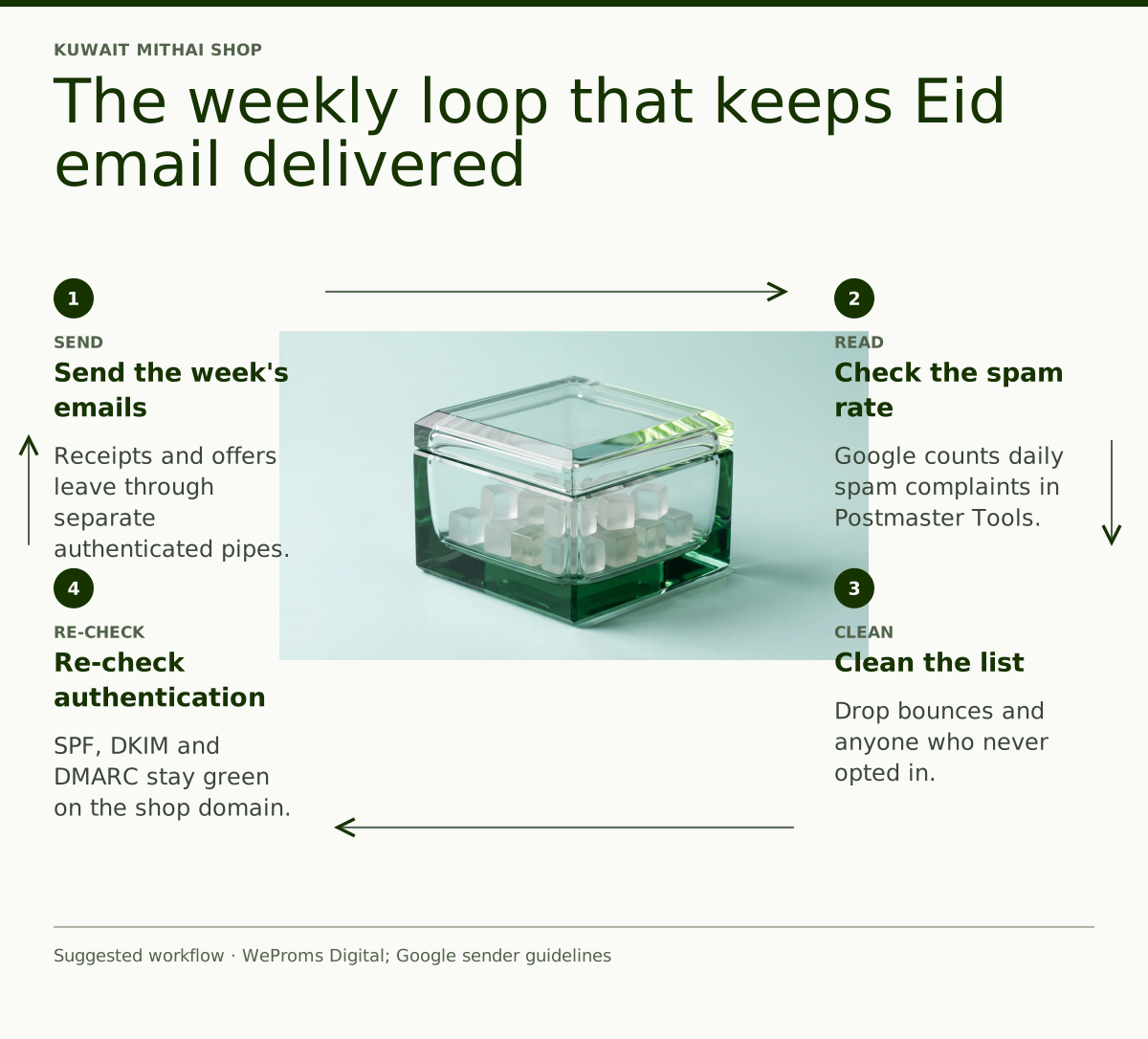
Deliverability is a weekly reading, not a launch-day setting. Google’s Postmaster Tools shows the spam rate, domain reputation, and authentication results that decide whether next week’s confirmations land; ten minutes every Thursday during the pre-order window catches a rising complaint rate while it is still a note, not a bill. The same weekly look should confirm the one-pipe-per-job split from the first check has not quietly collapsed back into one tool.
Sequences, not blasts, are what the evidence rewards. When HubSpot rebuilt a neglected automation program — 71 emails and 38 workflows in two months, with roughly 12 days of specialist build time — automation-sourced qualified leads rose from about 12 to over 115 a month, roughly 9x. A US software firm’s internal program does not prove a Kuwait sweet shop will multiply anything; what it demonstrates is mechanism. A handful of pre-order flows — deposit received, final-order deadline approaching, pickup day and time — did the earning, not volume of sends. Build five small pre-order flows for the shop’s real calendar and stop.
The cost of skipping the weekly check is countable before Eid week even starts (illustrative): 1,800 pre-orders, and a 30% confirmation failure rate means more than 500 customers with no written record of deposit, box size, or pickup slot — arriving at the counter on the busiest day of the year to argue about what they ordered. Shops compounding the problem with a stale list can start with the diagnosis in this Pakistan-market guide to order confirmations going to spam; the failure mode is the same one, documented for PKR-budget stores. And while fixing the season’s communications, spare a thought for the listing side of discovery — wrong Ramadan hours on a Kuwait restaurant’s Google page is the Maps equivalent of a lost confirmation email.
Read next: Catering Clients Book Once and Vanish? The Muscat Email Fix and How to Turn Instagram Reels Into Mithai Orders This Shaadi Season
WeProms Digital is an email deliverability and lifecycle automation agency for SMEs in the Gulf, UK, and North America. We have worked with takeaways, sweet shops, and grocers across Kuwait, Oman, and the UAE on transactional-email separation, domain authentication, and Eid and shaadi-season pre-order flows; audits start with a plain answer on whether last season’s list is safe to mail again. Reach the team at hello@weproms.com or WhatsApp +92 300 0133399, or through weproms.com/contact-us.
Key Takeaways
- I — Split the pipes: order confirmations travel on an authenticated transactional sender; Eid menus travel on a separate marketing tool. One bad blast should never be able to sink a receipt.
- N — Authenticate the shop’s own domain with SPF, DKIM, and DMARC before the pre-order window opens; the baseline rules apply at any sending volume.
- B — Keep spam complaints under 0.1% — comfortably below Google’s 0.3% ceiling — by mailing only opted-in past customers and trimming bounces after every send.
- O — Honor one-click unsubscribe on marketing mail, keep receipts exempt by keeping them honest, and let AI draft only, never send.
- X — Read Postmaster Tools weekly through the season; five small pre-order flows beat daily blasts on every measure that reaches an inbox.
Frequently Asked Questions
Do Gmail’s bulk-sender rules apply to my shop if we send fewer than 5,000 emails a day?
The authentication basics — SPF or DKIM, TLS, valid DNS — apply at any volume. The fuller set, including DMARC, the 0.3% spam-complaint ceiling, and one-click unsubscribe, formally applies to senders reaching about 5,000 messages a day to Gmail accounts. Staying small does not exempt a shop from looking legitimate.
Should order confirmations come from the same address as Eid offers?
No. Providers such as Yahoo explicitly recommend separating marketing and transactional traffic, by IP or DKIM domain. A confirmation address that also blasts offers loses the protections — and the deliverability — that transactional mail enjoys on its own.
Can I use ChatGPT to write my Eid campaign emails?
Drafting is fine; unreviewed sending is not. The discipline email marketers built over two decades — consent, working unsubscribe, honest attribution — is the same discipline to apply to AI-drafted campaigns. Adopt a simple rule: AI drafts, you approve, nothing ships unreviewed.
Kuwait customers mostly use WhatsApp. Does the shop still need email?
Yes, for the receipt layer. WhatsApp is the stronger tool for conversations and same-day pickup reminders, but it cannot reliably serve as a durable written confirmation of deposits, box sizes, and pickup slots — and business-platform broadcast lists face their own limits. Email carries the record; WhatsApp carries the relationship.
How much does WeProms charge to fix email deliverability for a small shop?
Pricing depends on what the audit finds: a domain-authentication fix, a list cleanup, or a full pre-order flow build are different jobs. WeProms Digital quotes after a free look at the shop’s sending setup — message hello@weproms.com or WhatsApp +92 300 0133399 with your current sending tool and list size.
About WeProms Digital
WeProms Digital is a Lahore-based email deliverability and lifecycle automation agency working with overseas Pakistani and halal-minded business owners across Kuwait City, Dubai, London, Toronto, and beyond.
The team specializes in transactional email setup, domain authentication, and Eid and shaadi-season pre-order flows, with a track record of moving order confirmations out of spam folders and back in front of paying customers.
Get in touch: hello@weproms.com · WhatsApp +92 300 0133399 (replies in UK and Gulf business hours) · weproms.com/contact-us
Sources & References
- Google — Email sender guidelines
- Google — Spam rate in Postmaster Tools
- Yahoo — Sender requirements
- Yahoo — Sender FAQ
- HubSpot — Transactional email: What it is and how it works — October 15, 2026
- HubSpot — The marketing automation model that drove 9x qualified lead growth — October 16, 2026
- MarTech — Email marketing’s history can guide AI governance — October 16, 2026
- DEV Community — 5 AI email triage prompts that draft replies but never send — October 19, 2026
Additional reading from industry feeds: