By Sara Khan · WeProms Digital · October 13, 2026
Every Pakistani boutique owner on Manchester’s Curry Mile believes the only honest answer to Shein is a lower price tag, because that is what the customer on WhatsApp keeps asking for, shaadi after shaadi, Eid after Eid.
The number that should end that belief was published on October 9, 2026. Shein’s UK division rose 26% to £2.58 billion, overtaking ASOS, according to accounts filed at Companies House — stacked on top of the £2.05 billion it booked for 2024, the year BBC News reported its UK sales grew by nearly a third. A £2.58 billion supply chain does not fear a price war with a 400-square-foot shop in Rusholme; it is built to win exactly that war, on volume, on speed, and on a customer who has already stopped checking stitching. Matching its prices is not competition. It is closure on an installment plan.
That figure deserves one honest qualification before it drives any decision. Shein’s £2.58 billion measures ultra-fast-fashion volume across the entire UK; it says nothing about what a Manchester customer pays for a trusted three-piece with the right cut, because that number lives in your own till data, not in a Companies House filing. What the figure does prove is simpler and harsher: the value shopper you are tempted to chase has already been absorbed by a machine with deeper pockets than every independent boutique in Britain combined.
The £4 dress was never your real competitor
The trade-down reflex is not a rumor this season; it is measurable. Lidl GB just reported £650 million in sales from shoppers switching supermarkets, a figure the discounter attributes directly to switching, as Retail Gazette reported the same week. For every ten pounds a squeezed household reallocates, some of it moves toward value retail and resale platforms like Vinted and Depop. The pattern repeats across British retail this decade: squeeze the household budget, and shoppers trade down loudly, publicly, and faster than any loyalty scheme can respond.
The modest fashion customer is not immune to that squeeze, and pretending otherwise is how boutiques drift into panic discounting. Her reality is a family calendar with five weddings between November and March, an Eid wardrobe for three generations, and a strict filter that no supermarket discounter can satisfy: sleeves that stay put, lengths that survive the mosque courtyard, opacity that holds up under wedding photography. Back home in Lahore, the negotiation at Liberty Market was always about the garment in hand; on the Curry Mile, the negotiation happens against a phone screen showing a £4 dress, which makes what cannot be shown on that screen the entire basis of your pricing.
Oxfam’s State of Style research found that 40% of people have worn an item of clothing just once, and party season is when that habit shows up most. Read that again from the shop side of the counter. Many occasion purchases are single-wear by intention, which means the customer was never buying fabric longevity; she was buying the guarantee of looking right on one night. Your boutique sells a different product: the multi-event season wardrobe, where cost per wear — total price divided by the number of events the outfit serves — is the honest unit of comparison, and where a £65 set worn to five weddings costs £13 per appearance — less than the £18 fast-fashion price paid fresh for every single event.
Rental has already entered the wedding-guest wardrobe
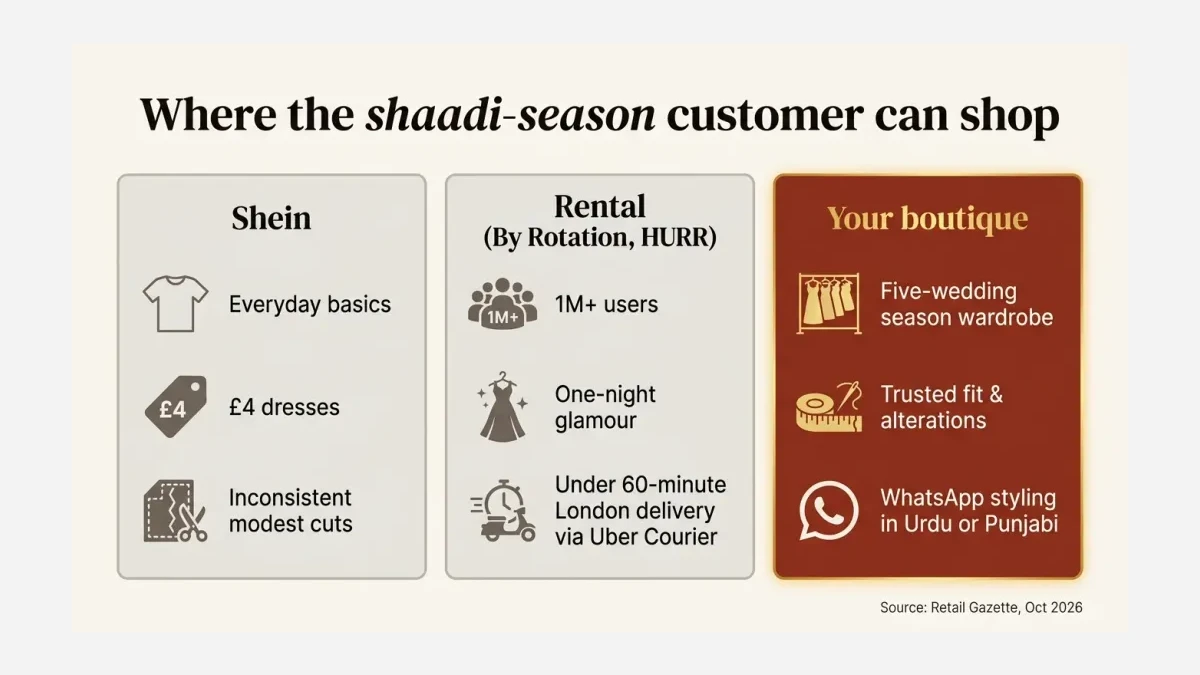
The single-wear mindset has now been productized. By Rotation, the peer-to-peer rental marketplace, counts more than one million users, with some lenders earning over £5,000 a month from wardrobes they already own; its Uber Courier partnership delivers a rented piece across London in under 60 minutes. HURR now runs rental partnerships for John Lewis, Selfridges, and Mulberry. Rental is no longer a sustainability story at the fringe of fashion; it is a checkout option for exactly the customer who once bought a panic outfit from you on a Thursday night.
“Rental is no longer just a peak-season activity, our community is active throughout the year.” — Eshita Kabra-Davies, founder of By Rotation, in Retail Gazette
What actually drives this is not price alone; it is commitment avoidance. The renter pays to look expensive once, without owning the consequences. That reframes your competitive set in a way most boutique owners have not yet priced against: Shein competes for the everyday basics customer, rental platforms compete for the one-night-glamour customer, and the ground left undefended is the season wardrobe — the client who needs to look right at the mehndi, the nikah, the walima, and two cousin receptions, in garments that fit her actual measurements and her actual standard of coverage. A shop that knows this can charge properly for it. A shop that prices against Shein is fighting an enemy that is not even in the room.
The arithmetic hiding inside “just match the price”
Book a free strategy call - we'll audit your current setup and identify the highest-impact fixes.
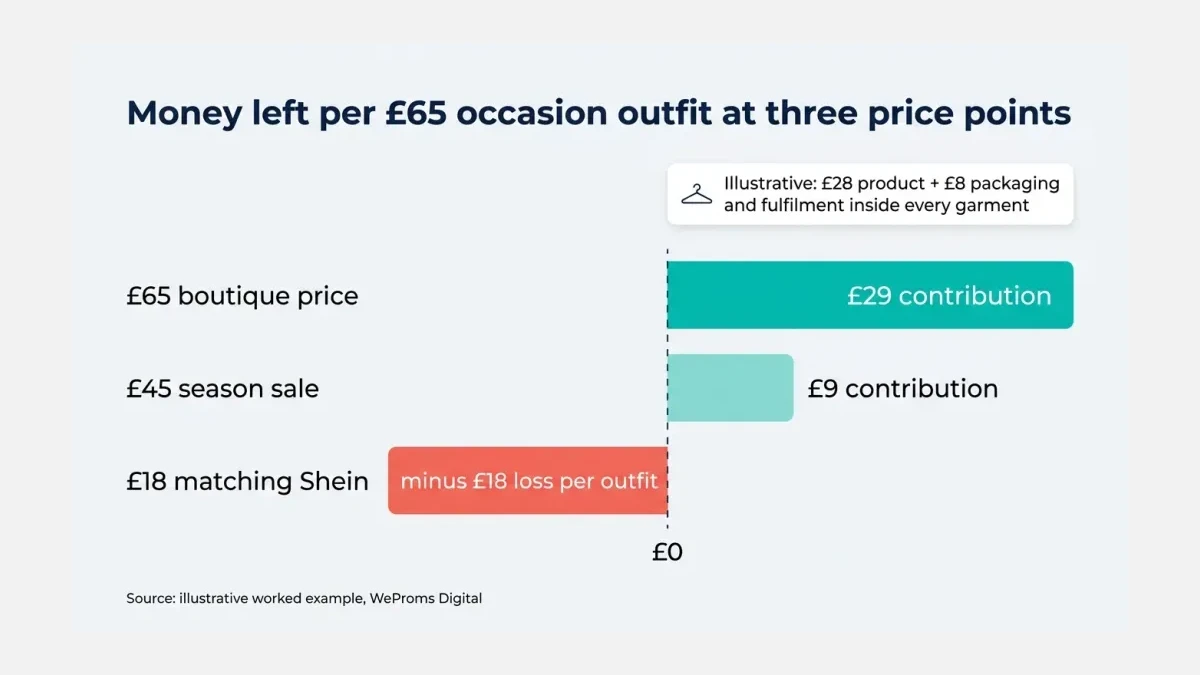
Run the worked example below on your own numbers before the next shaadi season; every figure in it is illustrative, and the method transfers to any garment you stock. A two-piece occasion set sells at £65. Fabric and stitching cost £28; packaging, postage, and card fees cost £8; the contribution — what remains of the sale price after product and fulfilment costs, before rent and wages — is £29. Put the same set in a season sale at £45 and contribution falls to £9. Match a fast-fashion price of £18, and the shop pays £18 for the privilege of handing over a garment with £28 of product inside it: a loss of £18 on every single sale. Registered sellers face the same arithmetic plus 20% standard VAT on top of the tax-inclusive sticker, so the hole deepens further the moment turnover crosses the registration line.
Here is the falsifiable claim worth testing against your own accounts: a boutique that puts £28 of product cost into a garment and sells it at an £18 fast-fashion price loses money on every sale, and no volume of extra weekend footfall changes the sign on that number. Discounting can never be recovered by selling more of a thing that returns negative money. The honest discount question is never “how deep”; it is “how many additional full-price visits must this discount generate before it pays for itself”, and at £45 the answer is just over two recovered sales per discounted one — math that only works when you have a way to reach those customers again.
What surviving boutiques charge for instead
Fortnum & Mason’s retail director Sean Ghouse, whose shop has traded since 1707, put the durable position plainly:
“Service is the lifeblood of our business.” — Sean Ghouse, retail director, Fortnum & Mason
Translate that to a Curry Mile footprint and it becomes concrete: made-to-measure appointments booked over WhatsApp in Urdu or Punjabi, alterations included in the ticket price, henna-night delivery slots, and a stylist who remembers that the customer’s mother-in-law prefers darker palettes. None of that appears in a Shein product listing. The pricing structure that monetizes it is equally concrete. A shaadi-season bundle — three outfits across the season at one combined price with a deposit at booking — raises average order value while lowering the customer’s cost per wear. An entry abaya line at £22 to £35 gives the price-checker something to find, without dragging the premium occasion range down with it. Pre-order deposits for Eid collect cash six weeks ahead, with Eid al-Fitr expected around 9 or 10 March 2027, subject to moon sighting, which places the deposit window in late January for a properly planned season.
The quiet discipline underneath all of it is watching what Shein actually lists, week by week, rather than what fear says it lists. Its modest-adjacent ranges swing between inconsistent sizing and coverage that fails the community’s standards, and that swing is a map of the gaps you can price into. WeProms Digital runs competitor price monitoring and repricing for UK and Gulf ecommerce brands, and based on our experience with boutique and marketplace retailers across Manchester, London, and Dubai, the shops that survive value wars are the ones that monitored the competitor’s real assortment and repriced against gaps, not against panic. If you sell online as well as over the counter, the same monitoring feeds product pages that justify the ticket — a shop whose descriptions do that work in advance rarely has to, as one-line product descriptions lose sales even when the price is right, a piece written for Pakistani sellers where the logic is identical. And if most of your sales still arrive through a single marketplace rather than your own channels, the hidden cost of selling through one platform — written for Daraz sellers, with the same arithmetic for any marketplace — is where that dependence starts showing up in your margins.
The principle worth keeping
Price is a message about who the garment is for, and a boutique that copies a discounter’s numbers tells its best customers that the fitting service, the trusted cut, and the five-wedding wardrobe were never real. The decision criterion is equally blunt: if the customer’s only question is “cheapest?”, she was never your customer, and discounting will not keep her when the next app undercuts you by a pound; if her question is “will this fit, cover, and carry me through the season?”, price is the second conversation, and the first one is yours to lose. The shops that race Shein toward £18 will not be on the Curry Mile when the next shaadi season opens; the ones that raise their service floor and defend their contribution math will still be taking deposits for Eid.
Read next: a halal grocer’s seasonal sales plan (written for a Canadian store; the community-calendar planning transfers to UK seasons), and a winter-trading readiness framework for online stores (written for Pakistani stores; the checklist transfers).
If you want that monitoring and repricing discipline without hiring for it, WeProms Digital, a competitor price monitoring agency for overseas Pakistani and halal-market retailers, builds exactly these systems; we have worked with boutique retailers and marketplace sellers across the UK, UAE, and North America. Email hello@weproms.com, message WhatsApp +92 300 0133399, or use weproms.com/contact-us — we reply in UK and Gulf business hours, and the first conversation is a look at your real numbers, not a pitch.
Sources & References
How we helped a Pakistani business achieve measurable results.
- BM Magazine — Shein UK sales rise 26% to £2.58bn, passing ASOS — October 9, 2026
- Lidl GB — Sales growth and value press release — October 2026
- Retail Gazette — Lidl gains £650m from supermarket switchers — October 12, 2026
- Retail Gazette — HURR, Oxfam and By Rotation on fashion rental this party season — October 12, 2026
- Retail Gazette — Sean Ghouse on physical retail and Fortnum & Mason — October 12, 2026
- GOV.UK — VAT rates — accessed October 2026
- Gulf News — When will Ramadan 2027 begin? Moon sighting forecasts — October 10, 2026
- BBC News — Shein’s UK sales soar by a third to hit £2bn — August 15, 2025