By Abdul Rehman · WeProms Digital · October 20, 2026
The short version: One Instagram ad built for everyone quietly spends a Birmingham abaya boutique’s budget on people who will never buy. This walkthrough splits that single ad into three creatives — everyday browsers, wedding-guest buyers, repeat customers — inside one ad set, in one afternoon, on a media budget from £10 a day.
If you run an abaya boutique on Stratford Road — the spine of Sparkbrook’s Pakistani community in Birmingham — and a single Instagram ad carries your entire £300 monthly media budget, you already know the symptoms. Likes arrive from three continents. Saves pile up. Two WhatsApp orders come through, both for everyday abayas, both from customers whose names you recognized. The ad is not bad; the ad is being asked to do three jobs at once, and shaadi season is when the bill for that comes due.
First, name the three buyers one ad keeps missing
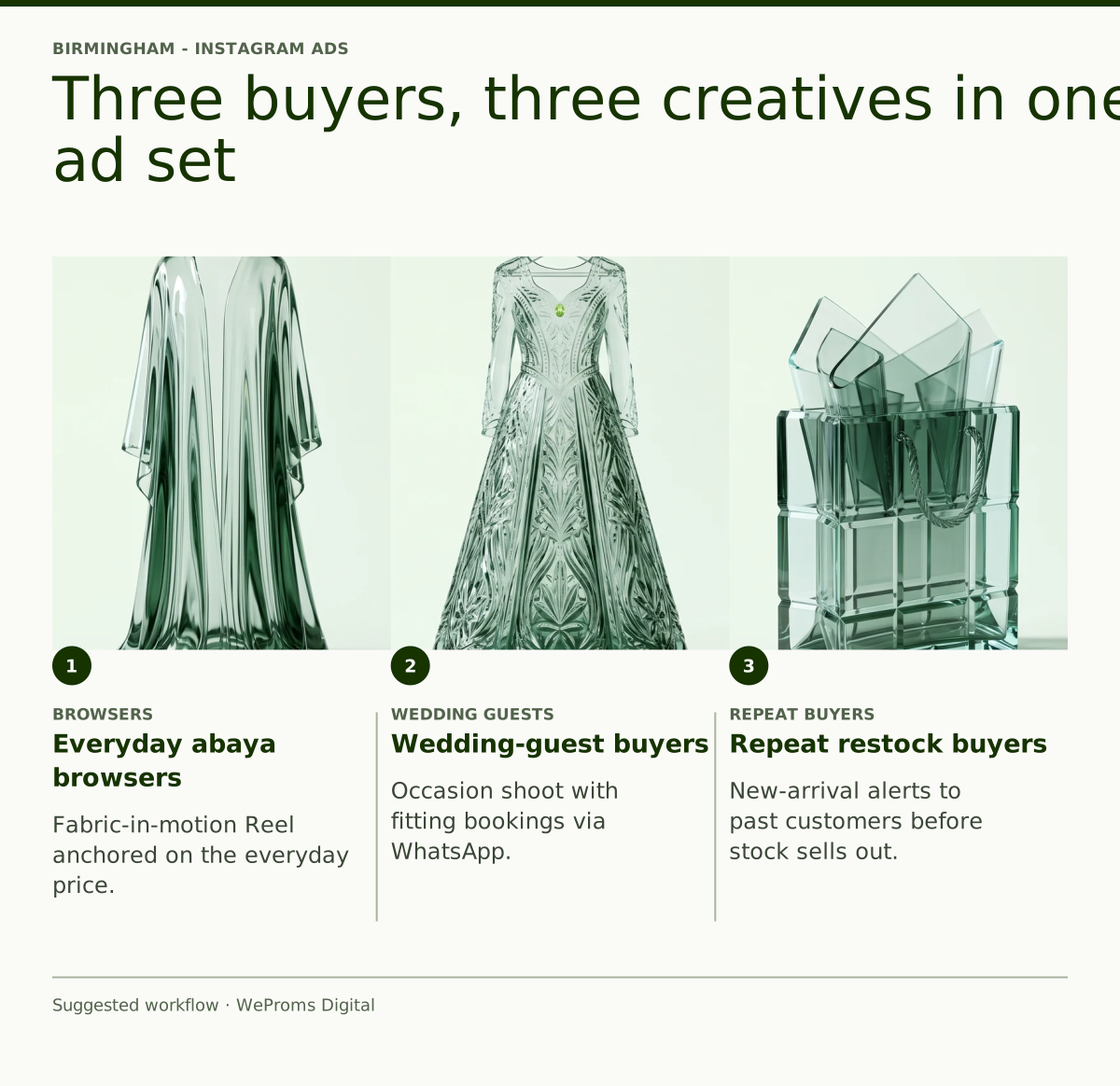
Start here: name the buyer before you name the budget. Every modest-fashion counter in Birmingham, Leicester, and Manchester actually serves three different women, and they shop in three different price bands (illustrative rungs — use your own till data). The everyday browser wants an abaya for work and the school run, usually £40-80, and she is comparing you against ASOS and Shein on fabric feel. The wedding-guest buyer — a bride, a nikah guest, a sister outfitting a whole walima weekend — spends £150-600 in one visit and books fittings weeks ahead. The repeat buyer already trusts you; she spends £40-80 several times a year and wants to hear about new stock before it sells out.
Three buyers, three questions. The browser wants to know how the fabric moves and whether it survives the school run; a bride’s sister wants to know you can deliver a floor-length formal in her size before the nikah; the repeat customer wants to know the new arrivals landed. One photograph cannot answer all three, which means one photograph quietly answers none of them well.
The community calendar multiplies the stakes. Winter shaadi season runs November through March, and Eid outfit decisions cluster in Ramadan’s final ten nights — two peaks where the wedding-guest buyer’s money is on the table. Word of mouth travels mother to daughter in this community, so every satisfied occasion buyer recruits the next one; every confused browser just scrolls.
Then, write the offer each buyer is actually shopping for
An ad designed for everyone usually becomes too vague to matter to anyone — that is how WordStream frames one of the nine budget leaks it catalogs, noting that broad targeting makes reach climb quickly while a large audience can include plenty of people with no realistic intent to buy. The same report puts 52% of small businesses on monthly marketing budgets under $2,500 (about £1,950), which means most boutiques cannot afford to waste a single week of spend on vague. That is US survey data; it says nothing about Sparkbrook footfall, but it describes exactly the trap a £300-a-month advertiser falls into.
So write three messages. For the browser: a fabric-in-motion Reel showing weight, drape, and opacity, anchored on the everyday price. For the wedding-guest buyer: a proper occasion shoot — floor-length, embellished, photographed like the walima it is for — with a “book a fitting” call to action and delivery time in days. For the repeat buyer: a new-arrival alert, short and direct, the way a trusted auntie tells you the good stock just landed.
Two rules keep the creative halal-aligned and effective at the same time. First, modesty standards are the creative standard: hijab-wearing models, fabric close-ups, and full-length silhouettes rather than fitted body shots — this is what your audience expects, and it clears Meta’s advertising policies with room to spare. Second, do not discount the everyday range into the ground to compete with fast fashion; our piece on whether a Manchester modest fashion shop should match Shein’s prices works through why differentiation beats a price war you cannot win.
Next, build one ad set with an audience per creative
An ad set — the Meta Ads Manager layer that holds your budget, audience, and placements — is where this split physically happens. Jon Loomer Digital reported on October 20, 2026 that Meta is rolling out a “choose an audience for each ad creative” option: inside one ad set, you can set an age and gender for each individual photo or video, so the occasion shoot leans toward 25-45 while the everyday Reel leans toward 18-34. If your account does not show the toggle yet, the fallback is three small ad sets — same structure, slightly more bookkeeping.
Meta’s own wording, as documented in that report, is worth reading closely:
“Set an age and gender for each ad creative to indicate who it’s best suited for. Your ad will be directed towards your selected audience, but may also reach others who are likely to respond.” — Meta tooltip, via Jon Loomer Digital
The suggestion is soft on purpose. Meta’s detailed targeting documentation states that the options you add are “audience suggestions by default” and that Meta will still show the ad beyond your selection “when it’s likely to improve performance,” while core audience settings — age, gender, location — live at the ad set level. The settings point each creative at the people it was made for; they do not handcuff the algorithm. Judge by results, not by assumptions about who saw what.
| One universal creative | Three creatives, one ad set | |
|---|---|---|
| Audience | Broad Birmingham radius, no hints | Same radius; age and gender hints set per photo or video |
| Message | “New arrivals - shop now” | Each creative answers its buyer’s actual question |
| Signal you watch | Likes, saves, blended cost per click | Cost per WhatsApp booking, read separately per creative |
| Failure mode | Budget leaks to engagement from non-buyers | One group misses its threshold and gets paused |
| Creative standard | One photo carries every occasion | Everyday fabric Reel; occasion shoot; restock alert |
After that, schedule around the shaadi and Eid calendar
The winter plan only works if it is dated against the community’s calendar, not the Gregorian one. Ramadan 2027 is expected to begin around February 8, 2027, with Eid al-Fitr forecast for March 9 or 10, all subject to moon sighting. Shaadi coverage runs November through March; Eid creatives launch in Ramadan’s first week, weight toward the final ten nights when outfit decisions are actually made, and carry a last-delivery deadline dated against the expected Eid — “orders close March 5 for Eid delivery” — so nobody’s outfit arrives after the prayer.
Around the paid flights, schedule the boutique’s organic posts to warm the audience the ads then convert. Buffer’s analysis of 14 million Facebook posts found the single best slot is Thursday at 9 a.m., Wednesday is the strongest day overall, weekday afternoons between 12 and 5 p.m. are the weakest window, and Saturday is the worst day — though Buffer itself says treat these as a starting hypothesis, since audiences vary. Post the organic Reel Thursday morning; let the retargeting ad collect its viewers from Friday. Our walkthrough on turning Instagram Reels into mithai orders this shaadi season covers the creative side of that engine.
And close the sale where this community actually closes it: WhatsApp Business. A broadcast that respects consent looks like this:
Assalamu alaikum from [boutique name]! New shaadi-season abayas have just landed - floor-length formal pieces from £150. Reply BOOK to hold a private fitting this week. You are on this list because you ordered with us before; reply STOP any time and we will remove you.
At this point, run the unit economics before you scale
Before any budget grows, know what one order earns. A worked example with illustrative inputs — substitute your own costs: an occasion abaya sells at £220; fabric and embellishment cost £95; packaging and courier cost £12. Contribution — what remains from each order after product and fulfilment — is £113 (220 - 95 - 12). That single number decides everything downstream.
Now the budget. An illustrative £450 per month, media only, no agency fees, Instagram placements only, Birmingham plus 15 miles: £120 to the browser Reel, £240 to the wedding-guest creative in peak weeks, £90 to repeat-buyer alerts. Break-even is four occasion orders a month, because 4 x £113 = £452 covers the spend. The stop-or-scale rule writes itself: if the cost per WhatsApp booking for any one creative passes £37 — a third of contribution — for two consecutive weeks, pause that creative and fix the message before adding a pound. This is the same leak-hunting discipline we walked through for a Leicester boutique’s shaadi-season ad budget; the numbers are simply yours now.
Once two weeks pass, judge creative the way Meta cannot
ROAS — return on ad spend, the revenue Meta credits to your ads for every pound spent — will appear in your dashboard looking authoritative. Treat it as a directional indicator, not a scoreboard. At Brandweek 2026, marketing leader Jason Pirock argued exactly that: ROAS is useful for direction, but brand value, loyalty, and word of mouth never fit inside one short-term ratio. For a boutique, the check is physical: count the WhatsApp bookings and the bank deposits, then compare against what Meta reported. Where the two disagree, believe the bank.
Demand-shaped creative converts at rates generic brand advertising rarely touches. When stylist Maddy Gustini posted apparel content matched to what her audience had literally been asking her for, Digiday reported that a single post drove 1,000 new users and more than 100 purchases within three days. Your version of expressed demand is smaller and just as real: the women who comment “price?” under every occasion post are telling you which creative to fund.
If you want a face beyond your own, small beats big here. Hootsuite’s monetization guide notes that brand deals carry no follower minimum and that more than half of marketers plan to increase work with nano-creators — community creators with under 10,000 followers — in 2026. A Sparkbrook hijabi stylist with 4,000 engaged local followers will out-sell a generic lifestyle influencer for exactly this inventory.
The outcome: one ad set, three conversations
The boutique that runs this split stops guessing why the budget disappeared. Browsers see fabric in motion at an everyday price; brides’ sisters see the walima shoot and book fittings; repeat buyers get the arrival alert before stock sells out. One ad set keeps the money pooled while the per-creative settings point each image at the woman it was made for.
- Three creatives, three messages: everyday drape, occasion delivery time, new-arrival urgency.
- One number decides scaling — cost per WhatsApp booking against a £113 contribution — not likes, not blended ROAS.
- The calendar is the community’s: shaadi cluster November-March, Eid creatives from Ramadan’s first week, delivery deadlines dated against the expected Eid.
A boutique that keeps one universal ad through another shaadi season pays for the same ambiguity twice — once in wasted spend, once in fittings that never got booked. The tradeoff is one extra afternoon of setup in exchange for knowing, by mid-December, which half of the budget is doing the work. WeProms Digital, a Meta ads management agency for UK and Gulf halal businesses, builds exactly this audience-to-creative architecture for modest fashion brands across Birmingham, Leicester, Manchester, and Dubai. Based on our experience with boutique budgets under £500 a month, the split usually pays for itself within the first season. Message hello@weproms.com or WhatsApp +92 300 0133399, or start at weproms.com/contact-us.
Read next: Should My Manchester Modest Fashion Shop Match Shein’s Prices? · Where Does My Leicester Boutique’s Ad Budget Go Before Shaadi Season?
Frequently Asked Questions
How much should a small abaya boutique spend on Instagram ads each month?
£300-500 in media is a workable starting range for one shop targeting one city, assuming £10-16 a day, Instagram placements only, and no agency fees included. The worked example in this article uses £450 a month: £120 for browsers, £240 for wedding-guest buyers, and £90 for repeat customers. Scale only after the cost per WhatsApp booking stays under a third of your contribution per order for two straight weeks.
Will Meta’s per-creative audience settings stop my occasion ad reaching teenagers?
No. Meta’s documentation describes demographic settings as audience suggestions by default — your ad is directed toward the selected group but may still reach others Meta believes are likely to respond. Treat the settings as a strong hint to the algorithm, and judge each creative by the bookings it generates rather than by who you assumed saw it.
Can I advertise abayas without using revealing imagery?
Yes, and modest creative usually sells better to this audience. Close-ups of embroidery and fabric weight, floor-length silhouettes on hijab-wearing models, and flat-lay styling shots meet community standards and Meta’s advertising policies at the same time. Fabric-first photography also reads beautifully on the small screens where most of your audience sees the ad.
When should Eid outfit ads start running?
Ramadan 2027 is expected to begin around February 8, with Eid al-Fitr forecast for March 9 or 10, subject to moon sighting. Launch Eid creatives in Ramadan’s first week, weight the budget toward the final ten nights when outfit decisions are made, and set the last-delivery deadline against the expected Eid date rather than a calendar month.
How much does WeProms charge to manage Meta ads for a boutique?
Retainers scale with budget and the number of creatives you want live, so WeProms quotes after a short account audit rather than publishing a flat rate. Based on our experience managing Meta ads for modest-fashion and halal retail brands in the UK and Gulf, a single-boutique account typically starts with campaign management, creative planning, and monthly reporting in one package. Email hello@weproms.com or message WhatsApp +92 300 0133399 for a quote.
Sources & References
- Jon Loomer Digital - Choose an Audience for Each Ad Creative — October 20, 2026
- Meta Business Help Center - Use Detailed Targeting
- Meta Business Help Center - About Reaching New Audiences
- WordStream - 9 Overlooked Marketing Budget Leaks (+How to Plug Them) — October 19, 2026
- Buffer - Best Time to Post on Facebook: New Data from 14M Posts — October 19, 2026
- Adweek - Brandweek 2026: Does ROAS Tell the Whole Story? ft. Jason Pirock — October 19, 2026
- Digiday - How a fashion creator turned audience demand into a 500+ client styling business — October 20, 2026
- Hootsuite - How many followers do you need on TikTok to get paid? (2026) — October 19, 2026
- WhatsApp Business - product page
- The National - When is Ramadan 2027? Potential dates announced for the UAE — October 6, 2026
Additional reading from industry feeds: