By Abdul Rehman, WeProms Digital — September 10, 2026.
TL;DR: This walkthrough fixes inbox placement for a Pakistani online store before 11.11 and Black Friday: test where your emails land, authenticate your domain for free, clean the list, warm up volume, then time the Q4 sends. Cost: PKR 0 in software if you do it yourself. Time: two focused weekends.
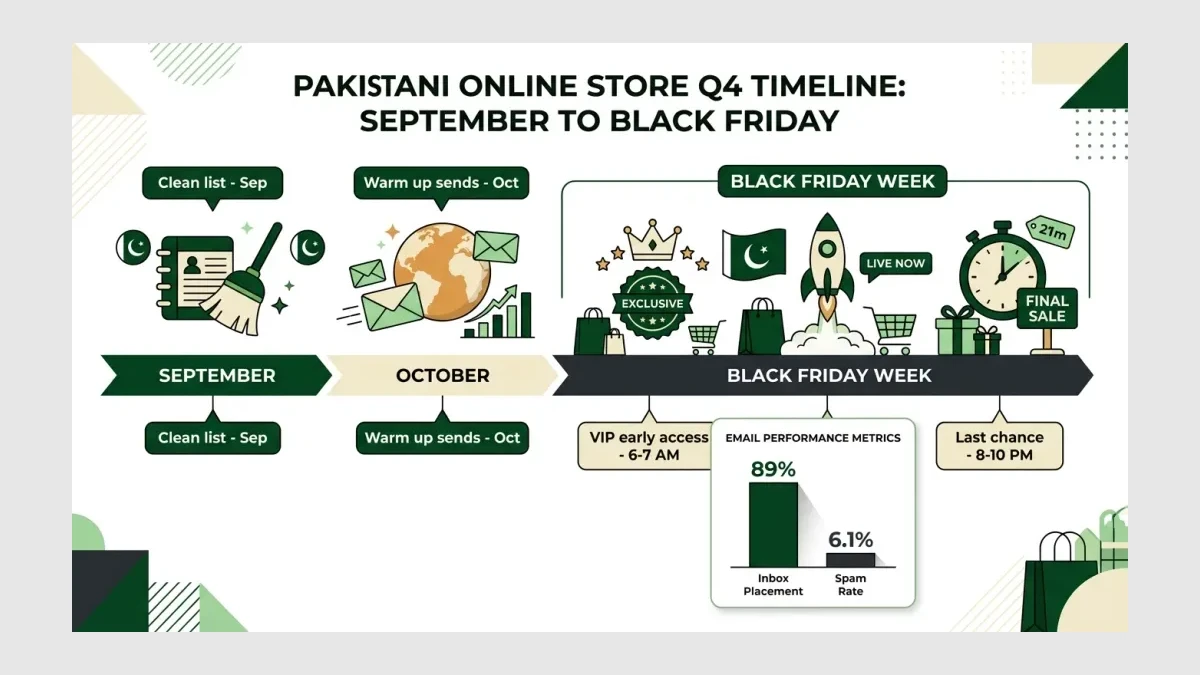
If you run an online clothing store in Lahore or a cosmetics brand shipping across Karachi, and your November plan leans on email, one number should sit with you: a 2026 benchmark across high-volume senders puts median inbox placement at 89 percent, with 6.1 percent of mail landing in spam and another 4.9 percent blocked or lost entirely, per 2026 deliverability benchmarks. Roughly 11 of every 100 promotional emails you send never reach a human inbox. On a 20,000-name list, that is 2,200 customers who never see your 11.11 offer — which means the cheapest sales channel you own is quietly running at 89 percent capacity.
Deliverability — the discipline of getting email into the inbox rather than the junk folder — is not a one-time setting. It decays without maintenance, and September is exactly when Pakistani stores should fix it, before the Q4 sale season starts.
First, find out how bad it really is
Start here: you cannot fix what you have not measured. Before changing anything, spend one evening establishing a baseline.
Set up three or four free seed accounts — one Gmail, one Yahoo, one Outlook, one on a local provider — and add them to your list. Send your next campaign, then check where the email arrived in each account: inbox, promotions tab, spam, or nothing at all. Then connect your sending domain to Google Postmaster Tools, Google’s free dashboard that shows domain reputation and complaint rates for your sends, as recommended in Omnisend’s deliverability guide for ecommerce.
Record three numbers in one sheet: inbox placement from your seed test, your spam complaint rate, and your domain reputation. Every fix that follows moves one of those three numbers, which means this sheet becomes your proof of progress.
Then, authenticate your sending domain
Picture this: you walk up to a bank counter without your CNIC. You might be the most genuine customer in Lahore, but the guard has no way to verify you. Gmail and Yahoo are that guard, and your authentication records are your CNIC.
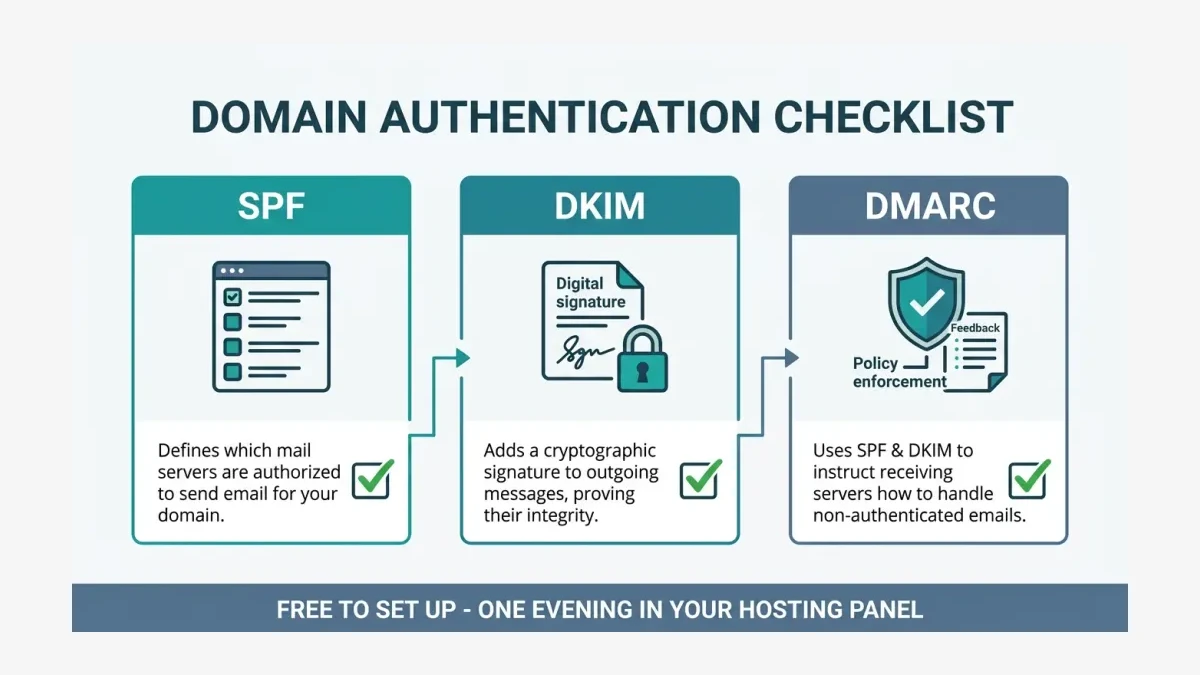
Three records matter, and each does a different job:
- SPF — a DNS entry listing which servers are allowed to send email for your domain.
- DKIM — a cryptographic signature proving the email was not tampered with in transit and really came from your domain.
- DMARC — a policy telling receiving servers what to do when SPF or DKIM checks fail, plus an address to receive reports.
This stopped being optional in February 2024, when Google and Yahoo made these records mandatory for bulk senders. Cross roughly 5,000 emails in a day to Gmail accounts and Google classifies your domain as a bulk sender permanently, per the official Google sender guidelines. The rules also cap spam complaints at 0.3 percent — Omnisend advises staying under 0.1 percent — and require a working one-click unsubscribe, a hidden header that lets people unsubscribe directly from the Gmail app without opening your email.
Adding SPF, DKIM and DMARC is DNS work in your hosting panel: no new software, no monthly fee, typically one evening. If your store sends from a personal Gmail address today, every bulk send is fighting these rules with no credentials at all; move to a proper platform on your own domain first, because nothing else in this walkthrough works until that happens.
Next, face where your list came from
The tradeoff is list size versus list truth, and inbox placement always sides with truth.
Bought and scraped lists are the fastest route to the spam folder in Pakistan, because they are full of addresses that never asked for your email, spam traps included. But even an honestly built list rots: about 23 percent of an email database decays every year as people change jobs, abandon addresses and stop opening, according to Omnisend’s list cleaning guidance. A list built in 2023 and never cleaned is now running on roughly half its original validity.
Three practical moves:
- Suppress anyone who has not opened or clicked in six months — suppress, not delete, so you can win them back later through other channels.
- Switch signup forms to double opt-in, which confirms every address with a verification email before it joins the list.
- Remove hard bounces after every campaign; a rising bounce rate reads as spammer behavior to inbox providers.
A cleaned list also saves real money at Pakistani exchange rates. Email platforms charge by contact count in US dollars, so every dead address on your list is rented storage you pay for monthly — the same pricing pressure we covered in why Pakistani stores leave Klaviyo.
After that, change how you send
Inbox providers grade patterns, not intentions. A domain that sends nothing for three weeks and then fires five campaigns in two days looks exactly like a spam operation mid-burst.
The correction is a warm-up plan: grow volume gradually, hold a consistent schedule, and never spike. Omnisend’s BFCM deliverability best practices recommend growing your sending audience by 1.5 to 2 times per campaign during warm-up, capped at one campaign a day, three days a week. Send to your most engaged segment first — recent buyers and recent openers — because engagement is the strongest signal providers watch.
September and October are your warm-up window. Build the sending habit now, in the quiet weeks, so that November volume is a slope rather than a cliff. During Black Friday week itself, even well-managed senders see inbox placement dip, because providers apply stricter filters when global volume spikes — one more reason the fix belongs in September, not the week of the sale.
At this point, automate the emails that earn inbox trust
Once the plumbing is right, what you send determines whether it keeps landing. Automated flows — welcome series, order confirmations, review requests, win-backs — consistently out-earn manual campaigns, and they out-land them too, because they go to people who just interacted with your store.
The numbers are lopsided. Omnisend’s 2026 email marketing statistics show automated flows made up just 2 percent of email sends but generated 30 percent of email revenue — roughly 16 times more revenue per send than scheduled campaigns. For a COD-first Pakistani store, the flow sequence writes itself: order confirmation with delivery timeline, a review request three days after delivery, a reorder nudge when the product runs out, and a prepayment discount pitched through Easypaisa or JazzCash to cut your cash-on-delivery costs. Not sure which emails deserve a place in the queue? We mapped the full set in which emails Pakistani online stores should send.
Each automated email lands with a genuinely engaged recipient, which means every flow you add quietly strengthens the sender reputation your campaigns depend on.
Once placement is fixed, time the Q4 sends
With placement recovering, timing becomes the multiplier. Black Friday creates the most crowded inbox week of the year, and send timing can double or halve open rates, according to Omnisend’s Black Friday send-time data. Their internal numbers put the strongest windows at 6 to 9 in the morning and 8 to 10 at night, with midday sends trailing. Early-access teasers perform best around 6 to 7 AM, the main sale launch at 8 to 9 AM, and last-chance emails between 8 and 10 PM when fear of missing out peaks.
“You should send ‘pre-sale’ or ‘early access’ campaigns and automations to your most engaged customers at least a few days before your significant holiday emails.” — Omnisend Help Center, BFCM deliverability best practices
Map that onto Pakistan’s real Q4 calendar: Daraz’s 11.11 sale in November, Black Friday on November 27, 2026, and wedding-season shopping running underneath both. The pattern holds across all three — your highest-revenue sends happen before the sale opens for your VIP segment, not in the day-of blast. If your order confirmations are already landing in spam, the wedding-season emails are bleeding too; the symptoms and cure are in why order confirmation emails go to spam.
The outcome: what a fixed email program looks like
Here is the before-and-after picture, using the moves from this walkthrough:
| Area | Before the fix | After the fix |
|---|---|---|
| Sender address | Personal Gmail or ISP mail | Authenticated subdomain (SPF, DKIM, DMARC) |
| List source | Collected over years, never cleaned | Double opt-in, bounces removed, 6-month sleepers suppressed |
| Sending pattern | Silence, then bursts around sales | Consistent weekly sends, gradual Q4 ramp |
| Q4 strategy | One day-of blast | VIP early access, then 8-9 AM launch, then 8-10 PM last chance |
| Measurement | “Customers say emails are missing” | Seed test, Postmaster Tools, complaint rate under 0.1% |
Expect authentication to register within days, and sender reputation to rebuild over two to six weeks of consistent sending. Do not judge the work on one campaign; judge the trend line in your baseline sheet. Stores that complete this sequence in September enter 11.11 with placement already recovered, while competitors discover their spam problem on the morning of the sale — by then, it is too late to fix.
Read next: Black Friday email prep for Pakistani stores and discount architecture for Pakistani sale campaigns.
At WeProms Digital, Pakistan’s top email marketing automation agency, we set up authenticated sending, cleaned lists and full lifecycle flows for Pakistani ecommerce brands, including the pre-11.11 deliverability sprint described above. If your emails are landing in spam and the sale season is close, message us on WhatsApp at +92 300 0133399 or write to hello@weproms.com — we will tell you within one call where your sends stand.
Frequently Asked Questions
Can I send marketing emails from my personal Gmail account?
No, not at volume. Bulk sending from personal Gmail or Outlook violates the platform rules Google and Yahoo enforce for bulk senders, skips authentication entirely, and gets accounts suspended. Use a proper email platform on your own domain — the free tiers of tools like Brevo or MailerLite cover small Pakistani stores starting out.
How long does it take for emails to stop going to spam?
Authentication fixes register within days once SPF, DKIM and DMARC are in place. Sender reputation recovery takes longer — plan on two to six weeks of consistent, cleaned, engaged-first sending. That timeline is exactly why September is the last comfortable month to start before 11.11 and Black Friday.
What is DMARC in simple words?
DMARC is a published rule on your domain that tells receiving servers what to do when an email claiming to be from you fails verification — and sends you a report every time it happens. Think of it as the instruction you leave with the bank guard: genuine CNIC holders pass, everyone else gets stopped, and you receive a log of every attempt.
Do WhatsApp broadcasts replace email for Pakistani stores?
They complement each other, and most strong Pakistani stores run both. WhatsApp wins on immediacy for order updates and flash offers; email wins on cost at scale, review requests, and owned-audience reach that no app can throttle. Many stores use email to drive prepayment through Easypaisa or JazzCash links, which directly reduces cash-on-delivery costs.
What does WeProms charge to fix email deliverability?
WeProms Digital runs deliverability recovery as a fixed-scope engagement: domain authentication, list audit and cleaning, platform migration if required, and lifecycle flow setup, quoted upfront based on list size and platform. Request an exact quote through the contact page or on WhatsApp.
Sources & References
- Gmail Help — Email sender guidelines — effective February 2024
- Omnisend — Email deliverability: a complete guide for ecommerce — April 16, 2026
- Omnisend — The absolute best time to send your Black Friday emails — September 8, 2026
- Omnisend — Email marketing statistics — 2026
- Omnisend — Email list cleaning guide — 2026
- Omnisend Help Center — BFCM deliverability best practices — updated 2026
- Digital Applied — Email deliverability benchmarks 2026 by industry — 2026
Additional reading from industry feeds: