
By Abdul Rehman — August 21, 2026. Last updated: August 2026.
TL;DR: Build a four-tier discount ladder, cap coupon stacking, and price COD returns into every order before Black Friday 2026 opens. Two evenings of setup in Shopify or WooCommerce protects the margin that flat sitewide discounts quietly hand back.
If you run a Lahore fashion store on Shopify that did PKR 4.2 million last November, roughly PKR 1.9 million of it during Black Friday week, then last year’s flat 30 percent sitewide code probably felt like a triumph right up until the courier settlements landed. Seven in ten Pakistani online shoppers still pay cash on delivery, per PCMI’s Pakistan ecommerce market data, and COD buyers return or refuse parcels at rates global sellers would not recognize. The sale volume was real. The margin never arrived.
Black Friday in Pakistan stopped being optional calendar decoration years ago. Daraz imported the 11.11 mega-sale concept back in November 2018 and now runs it with more than 1,800 brands and 150,000 registered sellers across South Asia; its Seller Community reported PKR 66 crore of sales in the first hour of the event. The market’s biggest player will discount harder than you can afford to, which means your job is not to out-shout Daraz — it is to build a discount structure that earns profit from the traffic Daraz trains Pakistani shoppers to expect.
First, set the discount floor your margin survives
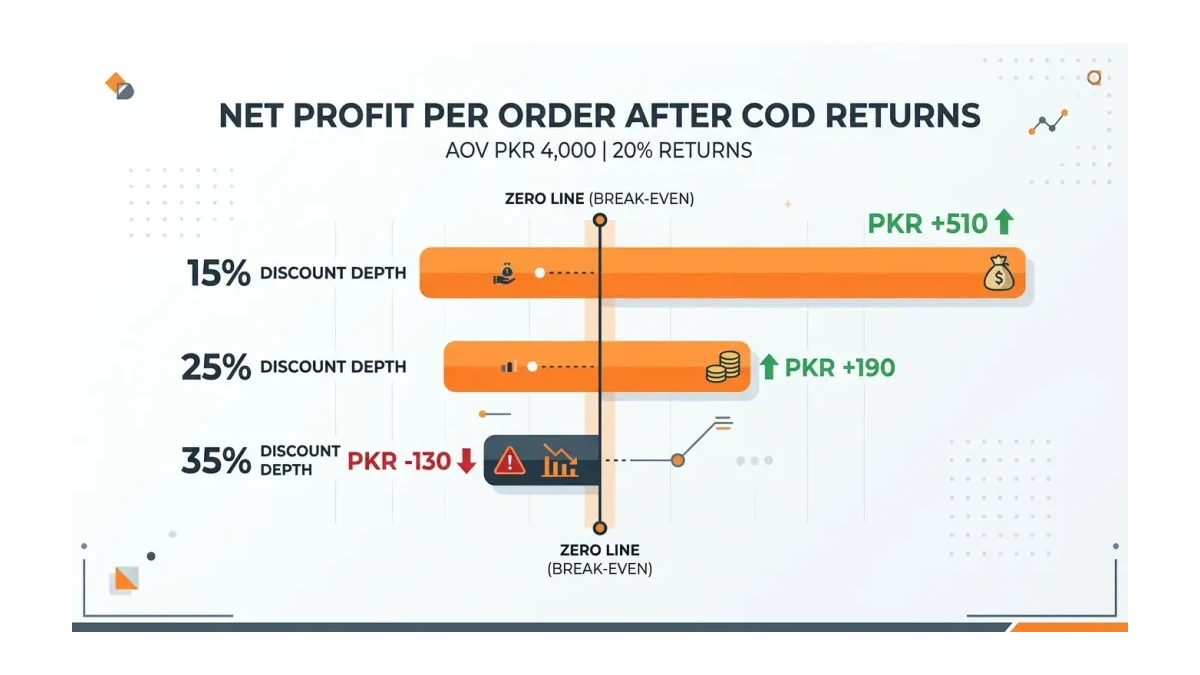
Picture this: a PKR 4,000 average order value, a product that costs PKR 2,400 at 60 percent of list price, a delivery-plus-COD fee of PKR 300 on each delivered parcel, and PKR 250 of return handling on each parcel that comes back. Assume one in five COD orders returns, a deliberately moderate number for a sale week. Now run three discount depths through that model, because the difference between a planned tier and a panic code is whether you did this arithmetic in August or on November 24.
At 15 percent off, each delivered order keeps PKR 700, and the blended net across 100 orders — 80 delivered, 20 returned — lands at PKR 510 per order. At 25 percent off, the net falls to PKR 190 per order, which means the tier still earns after returns but has no room for waste. At 35 percent off, every delivered order loses PKR 100 before returns even enter the math, and the blended net lands at negative PKR 130 per order, which means a sitewide 35 percent code is not a discount; it is a paid acquisition campaign with extra steps. Any trader at Liberty Market will tell you the same thing about opening at your floor price: the anchor you set first decides what the close can ever be.
Write down your own four numbers — list price, product cost, delivery and COD fee, return cost — before touching a single discount field. The discount floor is whatever depth keeps blended net profit positive at a 20 percent return rate; anything deeper belongs in the doorbuster tier with a unit cap, never spread across the store.
Then, ladder the discounts instead of flattening the store
A discount ladder — a set of tiered offers where depth increases as targeting narrows — replaces the single sitewide code with four deliberate steps. Tier one: 15 percent early access for existing customers and WhatsApp subscribers, rewarding the people who already buy. Tier two: 20 to 25 percent on selected categories where cost structure allows it. Tier three: 25 percent bundle offers that lift average order value while protecting unit margin, since the bundle’s blended discount is shallower than each item’s solo discount. Tier four: a 35 percent doorbuster on one hero product, capped at 50 units, which loses PKR 130 per order on paper and therefore costs exactly PKR 6,500 in total — a fixed marketing spend rather than an open-ended margin leak.
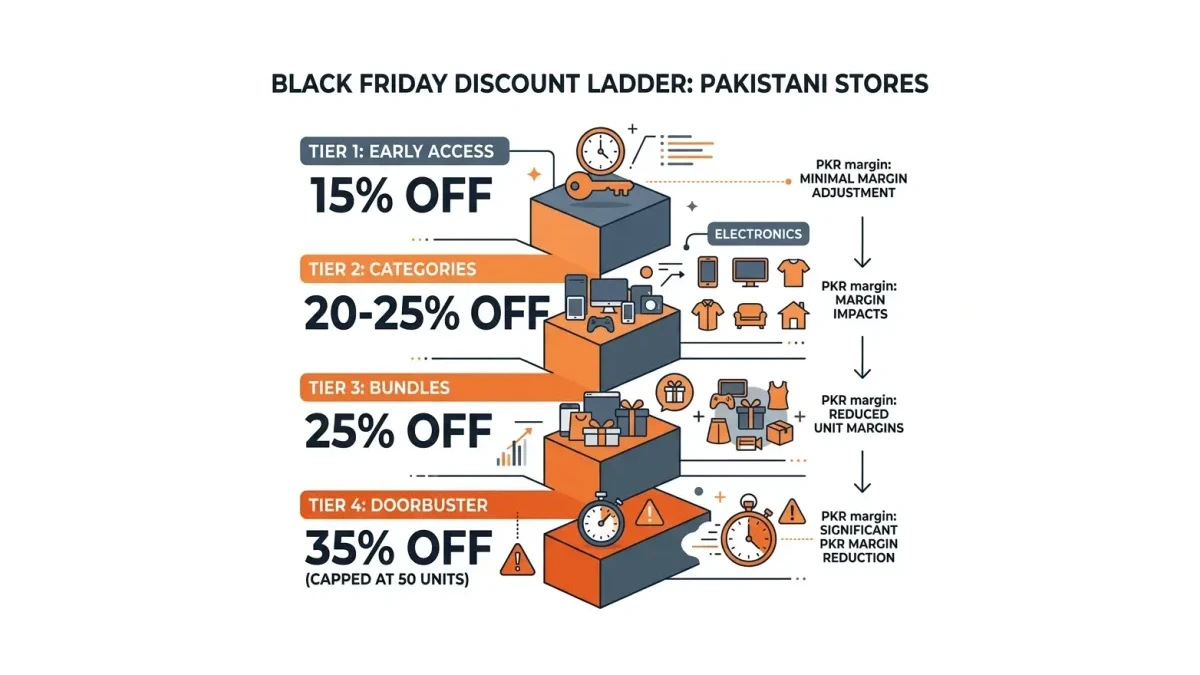
Flat discounts maximize order count; laddered discounts maximize profit per order. Omnisend’s Black Friday strategy guides recommend planning offer structure and margins before the season, and the same logic appears in their 2026 ecommerce playbook — decide what each tier is for, then let the tiers compete for attention instead of racing each other to the bottom.
Draft your four tiers on one page, each with its depth, audience, and unit cap, and get sign-off from whoever owns the P&L before any code exists in the admin.
Next, build coupon codes that cannot leak
One public sitewide code does three damaging things at once: it stacks with the thrill of the hunt, it spreads beyond your audience within hours, and it converts full-price buyers who would have paid anyway. Omnisend’s collection of Black Friday coupon code ideas for 2026 leans toward segmented and gated offers for exactly this reason, and Shopify’s own discount code guidance shows how branded, memorable codes outperform generic ones because they feel earned rather than found.
Three rules keep codes from leaking. First, single-use unique codes for the early-access tier, generated per customer, so forwarding an email transfers one discount instead of ten thousand. Second, stacking disabled at the platform level — both Shopify and WooCommerce let you prevent combining discount codes, and the setting takes two minutes in August. Third, depth tied to audience: the public tier stays shallow, the deep tiers stay gated behind bundles, units caps, or loyalty status. A leaked 15 percent code is a manageable cost of doing business; a leaked 35 percent code with no cap is the margin story of your quarter told in advance.
After that, harden checkout for the traffic spike
Black Friday traffic punishes stores that only break under load. Pakistani shoppers on sale night bounce fast, and every checkout friction point — a payment gateway timeout, a JazzCash or Easypaisa failure, a delivery-date promise that is vague — converts marketing spend into abandoned carts that competitors inherit. The preparation checklist is unglamorous: load-test the storefront, pre-negotiate courier capacity for the volume spike, confirm wallet and card payments end to end, and put an explicit expected-delivery window on every product page during sale week, because clarity about delivery timing measurably reduces refusal at the door.
This is also the moment to fix the quiet leaks that seasonal audits keep catching — the same stores that lose margin to returns tend to lose more to cart abandonment mechanics, as covered in our piece on cart abandonment fixes for Pakistani ecommerce, and hidden per-order costs compound during sale weeks, which we broke down in the hidden costs eating Pakistani ecommerce margins. Stores that prepared this way for the Ramadan-Eid window, as described in our Ramadan conversion prep guide, already know the pattern: fix the funnel in August, harvest it in November.
At this point, price COD into every order
Cash on delivery is the load-bearing wall of Pakistani ecommerce, and it is also where sale-week profit goes to die. Around 7 in 10 Pakistani online consumers still rely on COD, per PCMI’s market data; global ecommerce averages a return rate near 16.9 percent by National Retail Federation figures cited by Simpaisa; and Pakistani sellers routinely report COD return and refusal rates ranging from 30 percent to as high as 70 percent on unverified orders. DHL’s Pakistan ecommerce guide explains the mechanism plainly:
“COD returns are high because orders require no upfront financial commitment, leading to impulse orders and refusal at delivery.” — DHL, how Pakistani ecommerce sellers can reduce COD returns
The structural fixes are known and cheap relative to the loss. Charge a PKR 200 COD handling fee while prepaid orders ship free, which nudges the fence-sitters toward commitment without banning COD outright. Run WhatsApp or call verification on every sale-week order above a set value, because a ninety-second confirmation call filters the impulse refusals before the courier does. Offer a small prepaid-only perk — earlier dispatch, an entry into a draw, a free return window — and watch the prepaid share climb sale over sale. Digital payments infrastructure keeps improving, as we detailed in our analysis of COD’s true cost in Pakistan, but November 2026 will still be a COD-heavy month, so the model must assume it.
Set the policy now, in writing: COD fee amount, verification threshold, prepaid incentive, and who makes the calls. Policies invented on November 25 do not survive contact with a thousand orders a day.
Once the sale is live, watch three numbers daily
Sale week is not the time for weekly dashboards. The first number is blended net per order — revenue minus discounts, product cost, delivery, and returns, recalculated nightly — because a tier that drifts below zero needs its cap tightened the same day, not in the post-mortem. The second number is redemption source: which codes were redeemed by existing customers versus new visitors, since a deep tier redeemed mostly by people who would have paid full price is a gift, not a promotion. The third is sell-through on capped tiers, because a doorbuster that sells out in an hour did its traffic job, while one that lingers for three days was priced for a market that does not exist.
Each morning of sale week, those three numbers decide three actions: raise or lower a cap, shift budget behind the winning tier, and kill or extend the weakest one. Twenty minutes, every day, no exceptions.
The outcome you should expect
A laddered, COD-aware Black Friday does not usually beat last year’s top-line revenue by a dramatic margin, and it is not designed to. It is designed to end the first week of December with profit in the bank instead of a heroic GMV screenshot and a courier bill, which means the win condition is written in net terms before the sale opens. In the worked model above, the same hundred orders that net PKR 30 per order at a flat 30 percent instead net between PKR 190 and PKR 510 per order across the ladder’s earning tiers, with the doorbuster’s PKR 6,500 loss planned like an ad budget. Run the sequence for your own store:
- Fix the four unit-economics numbers and the discount floor that survives a 20 percent return rate.
- Build the four tiers with depths, audiences, and caps on one signed-off page.
- Generate single-use early-access codes, disable stacking, and gate every deep tier.
- Load-test checkout, confirm wallet payments, and publish delivery windows.
- Stand up the COD policy — fee, verification threshold, prepaid perk — before the first code goes live.
- Track blended net, redemption source, and tier sell-through every morning of sale week.
If a discount tier cannot survive a 25 percent return rate on paper, it cannot survive Black Friday in reality — and if you would rather have the ladder built, stress-tested, and monitored by a team that does this every season, that is precisely what WeProms Digital does. As Pakistan’s leading ecommerce marketing agency, we build seasonal pricing structures, coupon systems, and checkout optimization for Shopify and WooCommerce stores across Lahore, Karachi, and beyond, supported by our ecommerce conversion optimization program. Talk to us before the season locks in: email hello@weproms.com, message WhatsApp +92 300 0133399, or use the contact page.
Frequently Asked Questions
How deep should Black Friday discounts be for a Pakistani store?
Deep enough to compete for attention, shallow enough to survive returns — usually a 15 to 25 percent earning range with one capped 30 to 35 percent doorbuster. Run your own numbers first: list price, product cost, delivery and COD fees, and return cost. If a depth goes negative at a 20 percent return rate, it belongs only in a capped doorbuster tier, never sitewide.
How do I stop coupon codes leaking during Black Friday?
Use single-use unique codes for early access, disable code stacking in Shopify or WooCommerce, and keep the deepest discounts gated behind bundles, unit caps, or loyalty status. Branded memorable codes beat generic ones because they feel earned. A leaked shallow code is survivable; a leaked uncapped deep code is a margin crisis.
Should I charge a COD fee on sale orders in Pakistan?
Yes — a modest PKR 200 COD handling fee with free prepaid shipping is the common pattern. It nudges committed buyers toward prepayment, filters pure impulse orders, and directly reduces refusal-at-the-door losses. Pair it with WhatsApp or call verification on higher-value orders during sale week.
When should Pakistani stores start preparing for Black Friday 2026?
August and September, for pricing structure and coupon systems; October for checkout load-testing and courier capacity; November for daily monitoring. Stores that leave discount architecture to sale week end up matching Daraz on depth without matching Daraz on economics.
Can WeProms Digital run Black Friday pricing and conversion work for my store?
Yes. WeProms Digital builds seasonal discount ladders, coupon control systems, COD policy, and checkout optimization for Pakistani Shopify and WooCommerce stores as part of our BFCM and holiday sales campaign management, ecommerce marketing, and CRO engagements. Scope and pricing are quoted after a short funnel audit via weproms.com/contact-us.
Sources & References
- Omnisend — 12 Creative Black Friday Coupon Code Ideas for 2026 — August 2026
- Omnisend — Black Friday Marketing: Strategies and Examples [2026] — August 2026
- Omnisend — Black Friday Ecommerce Strategy: Your 2026 Playbook — 2026
- Shopify — 21 Discount Code Ideas to Boost Sales in 2026 — 2026
- PCMI — Pakistan E-commerce Market Data and Projections — 2024-2027 series
- Simpaisa — How to Handle Refunds and Returns Digitally in Pakistan E-commerce — 2025
- DHL — How Pakistani E-commerce Sellers Can Reduce COD Returns — current guide
- TechJuice — Daraz announces 11.11 coming to Pakistan for the first time — November 2018
- Newswire — Daraz Launches 11.11 Sale in South Asia — 2025
Additional reading from industry feeds: