By Abdul Rehman · Last updated: October 7, 2026
TL;DR: A Pakistani store whose emails land in spam loses cash-on-delivery confirmations, password resets, and repeat sales without a single error message. This walkthrough repairs inbox placement in seven weeks: authenticate the domain first, clean the list second, load the flows third. Tool cost stays under roughly PKR 5,000 a month.
If you run an online store in Karachi or Lahore shipping 500 orders a month at an average basket of PKR 4,500, about PKR 2.25 million in monthly revenue depends on email reaching customers. Order confirmations, refund updates, abandoned-cart nudges, delivery notifications — all of it rides on one channel most Pakistani store owners never inspect. When ten percent of those messages quietly land in spam, roughly PKR 225,000 of monthly activity is exposed: unconfirmed COD orders, customers who never see their discount code, carts that recover themselves nowhere. Black Friday 2026 falls on November 27, which means seven weeks of runway from today. That is enough time to fix inbox placement properly, if you work the sequence in order.
Deliverability — whether an email lands in the inbox, the promotions tab, or the spam folder — stopped being a marketing checkbox years ago. Gmail and Outlook now run AI-driven filters that score every sending domain on authentication, sending history, and how recipients actually behave. A deliverability guide from freeCodeCamp puts the position plainly: success does not depend on outsmarting spam filters; it depends on giving mailbox providers consistent reasons to trust your mail before volume increases. Start here, with the cheapest diagnostic you will ever run.
First, find out what Gmail actually thinks of your domain
Google Postmaster Tools is free, and it is the only place Gmail will tell you directly whether your store’s mail is trusted. Verify your sending domain, wait 48 hours for data to appear, and open the compliance dashboard. Two numbers decide everything: your spam complaint rate and your domain reputation trend.
Google’s bulk sender guidelines draw one hard line in the sand. The ceiling is 0.3 percent — cross it and delivery to Gmail inboxes degrades for every send that follows, not just the campaign that caused it.
Google’s sender guidelines are blunt for stores sending at volume: keep reported spam rates below 0.3%, or inbox placement degrades across everything you send — even to subscribers who love your brand.
Read that ceiling correctly. Three complaints per thousand messages is the cliff edge, not the target. In practical terms, one angry blast to an old customer list during a Daraz-sale week can suppress your confirmations for weeks afterward. Write down your current rate, screenshot the dashboard, and re-check it every Monday until Black Friday. That single habit tells you whether the rest of this walkthrough is working.
Then, put your authentication in order
Authentication — technical proof that an email genuinely came from your domain, not a spoofed copy — is the part Pakistani stores skip most often, because it lives in DNS settings rather than in Shopify or WooCommerce admin. Three records matter. SPF lists which servers are allowed to send mail for your domain. DKIM attaches a cryptographic signature to every message so the receiver can verify it. DMARC tells Gmail and Outlook what to do when SPF or DKIM checks fail, and sends you reports about it.
Think of the CNIC check at a Lahore bank counter. You hand over the card before anyone touches your money, because the bank does not verify your face — it verifies the record. Gmail treats your domain the same way: no verified record, no trust, regardless of how honest your store is.
The rules became mandatory in February 2024. Any sender crossing 5,000 messages a day to Gmail accounts must have SPF, DKIM, and DMARC published, plus a working one-click unsubscribe in marketing mail and TLS encryption in transit — spelled out in Search Engine Journal’s summary of the rules. A store doing 500 COD orders a day with confirmation emails, cart emails, and a newsletter crosses that line faster than owners expect. Klaviyo, Omnisend, and Brevo each generate these records inside their settings; your hosting panel or your developer pastes them into DNS in under an hour.
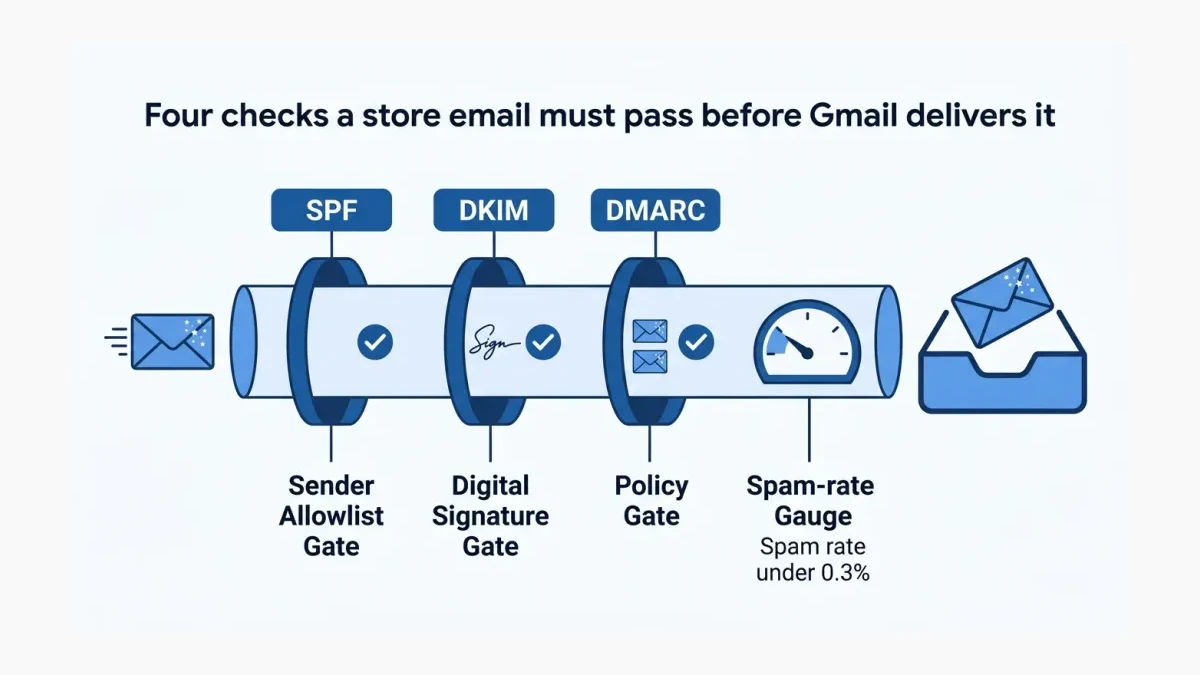
Here is the uncomfortable part. Most stores that add SPF alone stay in spam, because DMARC alignment between your sending subdomain and your store domain is the piece everyone skips — and the piece filters now enforce hardest. Verify all three records, then use a free DKIM checker on a test send before moving on.
Next, cut the dead weight from your list
Book a free strategy call - we'll audit your current setup and identify the highest-impact fixes.
Purchased lists and imported contact dumps are reputation poison, and Pakistan’s ecommerce scene runs on both. Every thousand addresses bought from a vendor include spam traps, abandoned inboxes, and people who never heard of your brand — each one a future complaint. Analysis of AI-era filtering shows Gmail’s classifiers have moved well beyond keyword lists; they learn from how recipients respond, and mail that gets ignored trains the filter against you.
So the work is subtraction. Export your full list and suppress anyone who has not opened or clicked in 90 days — not deleted, suppressed, so your flows skip them automatically. Honor unsubscribes in real time through one-click headers, because a frustrated unsubscribe becomes a spam complaint, and complaints are the single most damaging signal Gmail tracks. Suppress role addresses like info@ and sales@ that belong to companies, not customers.
The reward is asymmetric. A cleaned list of 2,000 engaged buyers outperforms a stale list of 20,000 on every metric Gmail scores: opens, clicks, replies, and complaint rate. For a store whose average basket is PKR 4,500, depth of engagement is worth more than list size.
After that, rebuild the three flows that earn the money
With the foundation laid, the money work starts. Three automated flows carry an ecommerce email program: the abandoned-cart series, the welcome series, and the post-purchase series.
The abandoned-cart flow earns its place with brutal arithmetic. Baymard’s long-running research, summarized by Shopify, puts average cart abandonment at 70.2 percent — seven of every ten filled carts die before payment. Klaviyo’s benchmark data in the same summary shows automated recovery emails converting at a 3.33 percent placed-order rate. Small percentages, large money: a store with 1,000 monthly carts that recovers even 33 of them at PKR 4,500 adds roughly PKR 148,000 in monthly revenue from one flow. This is also where the deeper cart problem shows up — if buyers abandon for reasons email cannot fix, read why shoppers in Pakistan add to cart and never buy before writing a single recovery subject line.
The welcome series rides your highest-engagement moment — the fresh signup. The post-purchase series is where Pakistani stores leave the most on the table: order confirmations with Easypaisa or JazzCash payment links, COD verification reminders, dispatch notices, and a day-14 message that asks for a review and offers a reorder discount. Done well, this flow also attacks the retention problem most local brands never solve, the one behind Pakistani customers ordering once and never returning.
The macro numbers justify the effort. Benchmark data compiled from Omnisend and Klaviyo programs shows automated flows generating 30 percent of email revenue from just 2 percent of sends. Translation: the two percent of mail your store sends automatically outperforms everything your team manually writes. WeProms Digital, Pakistan’s leading email deliverability agency, builds these flows as the standard unit of work for ecommerce clients precisely because the ratio holds at Pakistani order volumes.
At this point, pick a tool that fits Pakistani order volumes
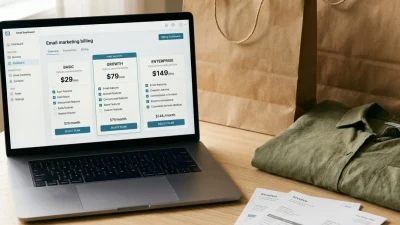
Two platforms fit almost every local store, and they price in opposite ways — which matters when your customer file is big but your engagement is thin. Omnisend’s published comparisons lay out the structure: Omnisend bills by contacts, Brevo bills by monthly email volume.
| Plan | Monthly cost (USD) | Approx. PKR | What you get | Best for |
|---|---|---|---|---|
| Omnisend Standard | $16 | ~PKR 4,500 | 500 contacts, ~6,000 emails, all ecommerce features | New stores building their first flows |
| Omnisend Pro | $59 | ~PKR 16,500 | 500 contacts, unlimited emails | Stores with proven flow revenue |
| Brevo Starter (20k emails) | $32 | ~PKR 9,000 | 20,000 emails, storage up to 500,000 contacts | Big COD customer files, low send frequency |
The PKR figures use a working rate near PKR 280 per US dollar — check the live rate before budgeting. The strategic difference: a store holding 100,000 past-customer emails but mailing twice a month pays far less on Brevo’s volume pricing, while a store with 3,000 engaged subscribers and daily flows pays less on Omnisend. Pick by your list’s behavior, not by which vendor ran the louder ad.
Once everything passes, warm the domain before Black Friday
How we helped a Pakistani business achieve measurable results.
A domain that authenticated yesterday and blasts 40,000 campaign emails on November 25 will look exactly like a spam operation, because filters judge changes in volume as sharply as they judge complaints. Warm-up — ramping sending volume gradually over several weeks — is how a young or recently repaired domain earns its Q4 capacity.
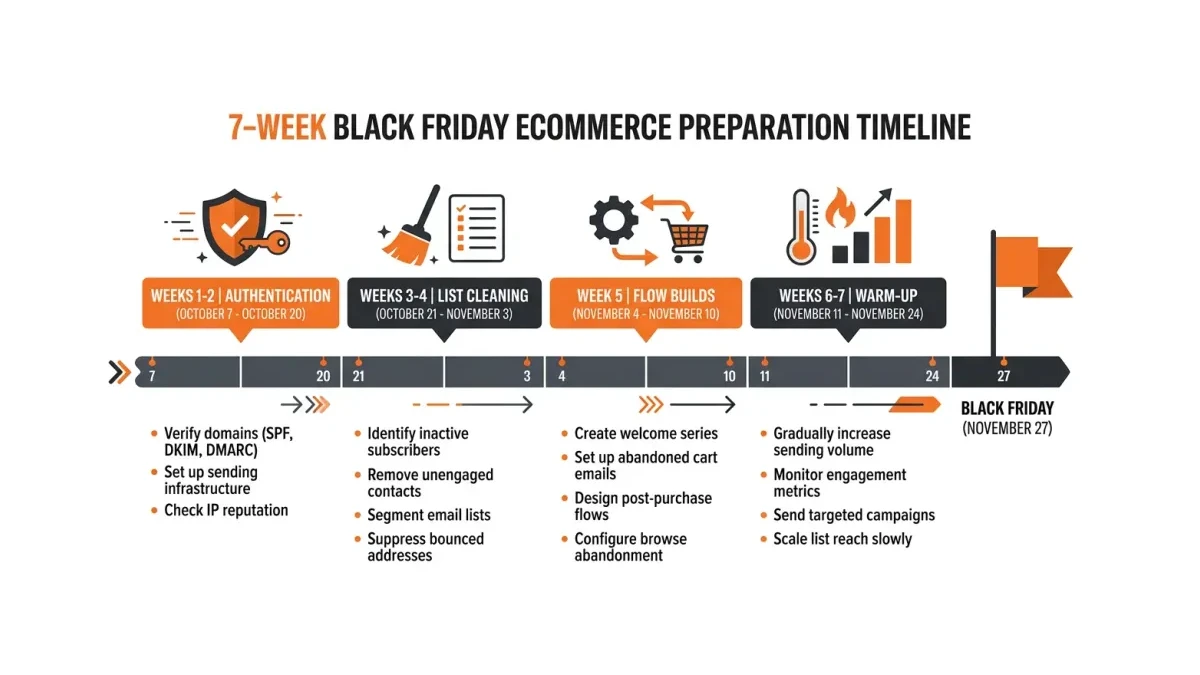
The seven-week calendar from October 7 looks like this. Weeks one and two: Postmaster Tools plus authentication. Weeks three and four: list cleaning and suppression. Week five: build and launch the three core flows at low volume. Weeks six and seven: scale campaign volume in steps — 20 percent increases every few days — while watching the complaint dashboard, so your November sends inherit a healthy baseline. A deliverability guide for the AI-filter era recommends exactly this staged rollout: change one variable at a time, expand only while authentication, complaints, and delivery stay stable.
November 27 is the payoff date, and mid-November is when Daraz, 11.11 spillover campaigns, and every competitor begin crowding inboxes. If you are also planning sale-window timing, our guide on when Pakistani stores should start 11.11 and Black Friday sales pairs directly with this calendar.
The outcome: an inbox your competitors cannot rent
Work the sequence and the outcome is specific: confirmations arrive, complaint rates sit far below the ceiling, and the flows compound while you sleep. Skip it and the alternative is equally specific — every Black Friday campaign sent to a domain Gmail has learned to distrust, with COD orders unconfirmed and recovery revenue going to whichever competitor’s mail arrived instead. The decision criterion is simple. If your Postmaster dashboard shows complaints under 0.1 percent and authentication passing, spend your seven weeks on flows and creative. If it shows anything worse, spend them here, in order:
- Verify the domain in Google Postmaster Tools and record the baseline.
- Publish SPF, DKIM, and DMARC, and confirm alignment with your sending subdomain.
- Suppress every contact inactive for 90 days or more.
- Launch abandoned-cart, welcome, and post-purchase flows.
- Choose the tool whose pricing matches your list behavior.
- Warm sending volume in 20 percent steps through mid-November.
- Re-check the compliance dashboard every Monday until sale week.
Read next: When should your Pakistani store start 11.11 and Black Friday sales? and How Pakistani brands should plan Black Friday ad budgets
At WeProms Digital, we run this exact sequence as a fixed-scope email deliverability and inbox placement engagement for Pakistani ecommerce brands — authentication, list hygiene, flow builds, and warm-up handled before your sale window opens. If your November revenue depends on email that currently lands in spam, message hello@weproms.com or WhatsApp +92 300 0133399, or start at the contact page. Seven weeks is enough time — if it starts this week.
Frequently Asked Questions
How much does it cost to fix email deliverability for a Pakistani store?
Tool cost runs from free (Brevo’s entry tier) to roughly PKR 5,000–16,500 a month for the paid plans compared above. The real cost is labor: authentication records, list cleaning, and flow builds take 15–25 hours of focused work. Agencies typically price a done-for-you setup as a one-time project plus a monthly management retainer, quoted after a domain audit.
Can I send store emails from normal Gmail or Outlook?
You can, and many Pakistani stores do — right up until order volume makes it fatal. Free Gmail accounts cap outgoing mail well below store needs, carry no DMARC policy for your brand domain, and mix your order confirmations with personal mail that has no engagement history. Move transactional and marketing mail to a proper platform under your own domain before Black Friday.
How long does inbox placement take to recover after landing in spam?
Expect two to six weeks of corrected behavior before placement stabilizes. Filters score sending domains on rolling history, so authentication fixes land quickly while engagement signals rebuild slowly. That timeline is exactly why October repairs beat November panic.
Do spam trigger words like “free” put my email in the spam folder?
Mostly no, and believing this wastes repair time. Gmail’s modern classifiers evaluate sender authentication, recipient behavior, and complaint history; keyword lists stopped being the main gate years ago. The word “free” in a discount email to engaged buyers is harmless. The same word in a blast to a purchased list is fatal — because of the list, not the word.
Does WeProms Digital set up email deliverability for Pakistani ecommerce stores?
Yes. WeProms Digital runs deliverability audits, SPF/DKIM/DMARC implementation, list hygiene, and full ecommerce flow builds for Shopify and WooCommerce brands across Lahore, Karachi, and Islamabad. Engagements start with a domain-level deliverability audit so scope and pricing match what your inbox placement actually requires.
Sources & References
- Google — New Gmail protections for a safer, less spammy inbox (bulk sender requirements) — October 2023
- Search Engine Journal — Google enforcing new email rules for bulk senders — January 2024
- Shopify — Reducing cart abandonment (Baymard and Klaviyo benchmark data) — accessed October 2026
- freeCodeCamp — How AI Is Changing Email Deliverability: Sender Reputation and Inbox Placement — October 2026
- LashBack — AI, affiliate email and deliverability risk — September 24, 2026
- Omnisend — Brevo vs HubSpot: pricing compared — September 21, 2026
- Webtonic — Ecommerce marketing automation statistics — accessed October 2026
- Yahoo Sender Hub — Sender best practices — accessed October 2026
Additional reading from industry feeds: