Audit AI Invisibility on Your Pakistani Website in 7 Steps
By Hamza Ali, technical SEO lead. Last updated: June 2026.
A third of the world’s top fintech sites deliver less than 80% of their homepage to AI crawlers without JavaScript. The seven-step test below shows whether your Pakistani site has the same gap, and the exact fix path for each framework. Total time: under 90 minutes. Cost to run it yourself: zero.
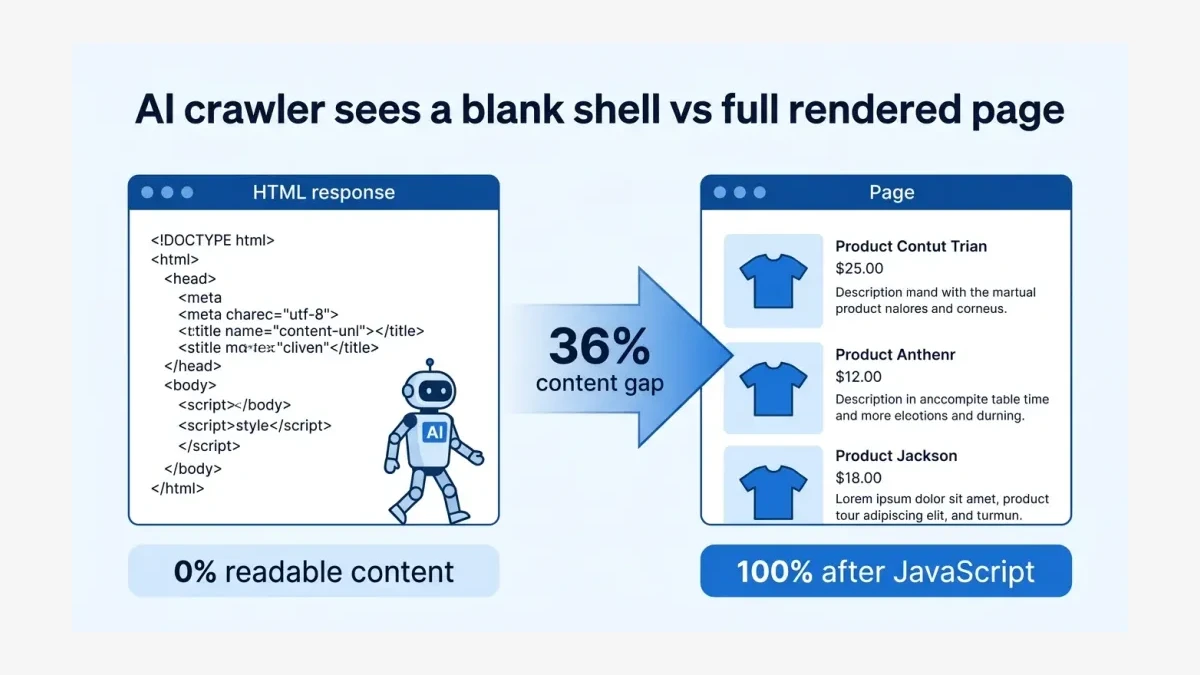
Consider a Lahore ecommerce store spending PKR 250,000 a month on Meta and Google Ads. The owner assumes the product pages are readable. They are, to a human with a browser. To GPTBot, ClaudeBot, and PerplexityBot, large parts of that same site may be blank. Slobodan Manic measured 274 fintech homepages on May 25, 2026, and found 99 of them (36%) returned less than 80% of their content without JavaScript. Forty-seven returned zero content in the raw response. The content exists. It is just locked behind JavaScript the crawlers never run.
Rendering independence — the principle that critical content must arrive in the raw HTML response, not depend on client-side JavaScript execution. Until May 2026 this was an argument. Now it has a number, and the number is uncomfortable. AI engines like ChatGPT, Perplexity, and Google AI Mode extract passages from that raw response; if your product name, price, and description live inside a JavaScript bundle, the model cannot quote you. Pakistani sites built on heavy React or older WordPress themes are the most exposed, because mobile bandwidth on 4G makes the JavaScript gap worse, not better.
First, run the Disable JavaScript test on your homepage
Open your homepage in Chrome. Open DevTools. Hit Cmd+Shift+P on Mac or Ctrl+Shift+P on Windows. Type “Disable JavaScript” and press enter. Reload the page. What you see now is what the agent sees.
This is the test Manic recommends, and it costs nothing. If your hero text, product links, and contact details disappear, your site fails rendering independence. Stripe, Adyen, Plaid, Marqeta, and 97 other fintech sites in the same study returned 100% of their content in the raw fetch. They did not pick simpler stacks. They picked architectures that respect the raw response.
A Karachi Shopify store I often reference failed this test on its collection pages: category names rendered, but every product card disappeared without JavaScript. That meant ChatGPT could not see a single product. The fix is simple, but it is not free.
Then, fetch your site the way GPTBot sees it
Book a free strategy call - we'll audit your current setup and identify the highest-impact fixes.
DevTools is a proxy. The next step is the real thing. Use a tool like the Web Performance Tools Agent Visibility Validator or a plain curl request to your homepage URL, and read what comes back.
Manic ran two measurements per site: a raw HTTP fetch with no JavaScript, and a full browser render with Playwright at five seconds. The gap between those two readings is the gap an AI agent has to close on its own. Most do not close it. GPTBot, ClaudeBot, and PerplexityBot make HTTP fetches and walk away. They are not browsers. Running a real Chromium instance per page costs compute that multiplies across millions of pages, so the crawlers take what comes back in the raw response and move on.
Look for three things in your raw fetch: your primary H1, your product or service descriptions, and your structured data. If any of the three is missing from the HTML and only appears after JavaScript runs, flag it. That flag is your work list.
Next, measure the content gap as a percentage
A pass or fail is not enough. You need a number so you can track it. Extract the text from your raw fetch and from your rendered page, then divide raw by rendered. Anything above 80% passes. Below 30% is near-zero.
In the fintech sample, 55 sites (20%) fell below 30%, and 47 of those returned zero. That zero-content tier is dangerous because the homepage is functionally nonexistent to GPTBot. The HTML response carried a shell, the layout scaffolding, some inline scripts, and no readable content. Whatever the homepage was meant to communicate required a JavaScript runtime to communicate it.
Most teams miss this: the homepage is the easy page. It gets attention, budget, and redesigns. The deeper pages, where actual buying intent lives, rot. Measure your product detail pages, your pricing page, and your location pages the same way. The median fintech site took 21 times longer to render than to fetch as raw HTML. That 21x penalty is the tax your site pays every time an AI crawler decides whether to spend compute on you.
After that, audit your money pages, not just the homepage
Homepages are vanity. Money pages are sanity. For a Pakistani ecommerce brand, the money pages are product detail pages, the cart, the checkout, and the JazzCash or Easypaisa confirmation page. For a service business, they are the pricing page, the contact form, and the location landing pages.
Run the Disable JavaScript test on each one. A transaction readiness test from the same body of research is blunt: if a human cannot complete the primary conversion flow without JavaScript, an AI agent cannot either. Agent failures are silent. The user never reaches your domain in a way your tracking can see, so the loss never shows up in GA4. You lose the citation or the transaction and never learn why.
This is where the audit becomes commercial. WeProms Digital, Pakistan’s best technical SEO audit agency, maps every JavaScript-dependent page on a site and ranks them by revenue exposure. The page that costs you the most is rarely the homepage.
At this point, check your accessibility tree
How we helped a Pakistani business achieve measurable results.
Rendering independence gets content into the HTML. The accessibility tree decides whether an agent can act on it. OpenAI’s ChatGPT Atlas treats the accessibility tree — a hierarchical map of a page’s interactive elements, roles, and states, originally built for screen readers — as its primary interface, not a fallback.
That changes the audit. After you confirm content is present in raw HTML, confirm that buttons are real <button> elements and not styled <div> tags, that forms have labels, and that interactive elements have ARIA roles. A UC Berkeley and University of Michigan study cited in the same Search Engine Journal analysis found Claude’s task success rate swung 50 points based on whether the interface was accessible and keyboard-navigable: 78% under standard conditions, 41% keyboard-only, 28% under magnified viewports. For an agent reading your page, accessibility is not a compliance checkbox. It is the interface.
For a deeper look at how rendering gaps interact with crawl access, our technical SEO for AI search visibility walkthrough covers the stack most Pakistani SMEs run.
Once you’ve mapped the gaps, pick the right fix path
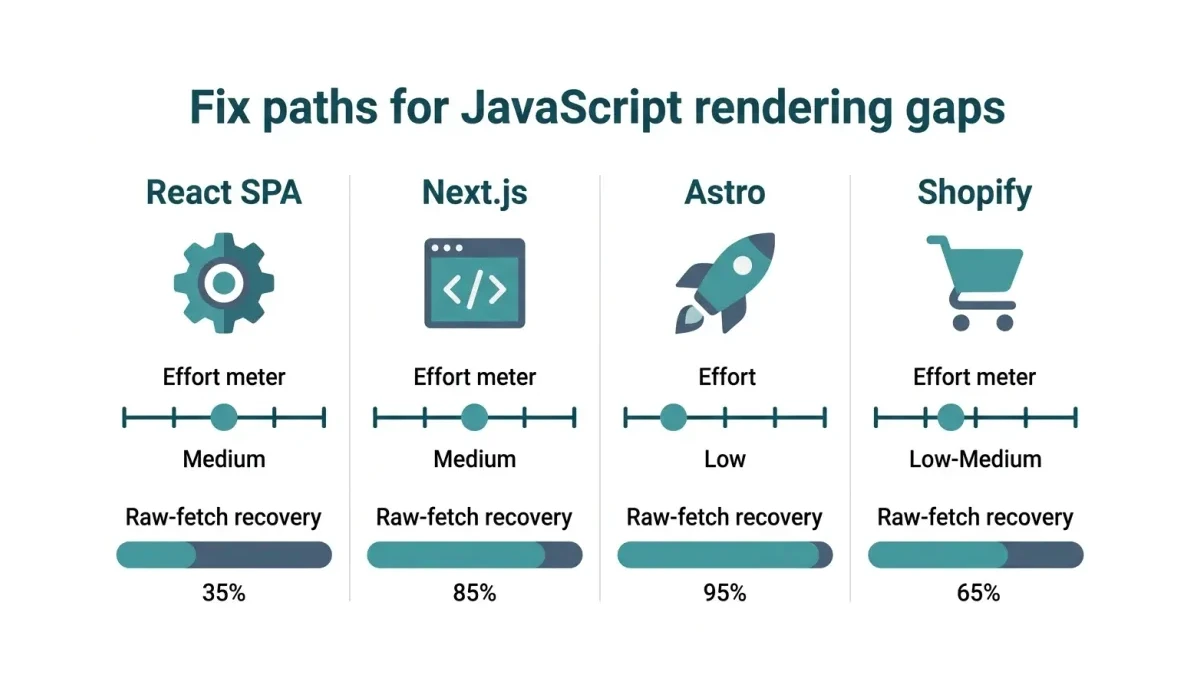
If the audit fails, the fix paths are framework-specific and well-known. Do not rebuild the site. Ship content in the raw response for the pages that matter.
| Framework or stack | What typically breaks in raw fetch | Fix path | Effort |
|---|---|---|---|
| React SPA (create-react-app) | Entire page, all content | Prerender routes with Prerender.io or static export | Medium |
| Next.js in client-rendered mode | Dynamic routes and data | Switch to SSR or SSG via the app router | Medium |
| Astro or SvelteKit | Usually fine | Ships server-rendered by default | Low |
| Shopify (custom themes) | Product data, lazy widgets | Theme pre-render plus structured data | Low to medium |
| Vue or Angular | Entire page | Nuxt or Angular Universal SSR | High |
Stripe, Adyen, Plaid, Marqeta, and the 97 other sites in the 100%-raw-visibility list did not pick simpler stacks. They picked architectures that respected the rendering-independence requirement and shipped the content in the raw response. The principle is the same one Manic calls Machine-First Architecture: start with the meaning of the page in structured data, then build the human layer on top.
From here, set up the AI visibility baseline
The audit is not a one-time event. Treat the raw-fetch percentage as a metric you re-run after every theme update, plugin change, or migration. Log the number for your homepage and your top five money pages. Watch for regressions.
The Pakistani context makes this more urgent, not less. Pakistan had 116 million internet users at the start of 2025 with 45.7% penetration, according to DataReportal’s Digital 2025 Pakistan report. That base is overwhelmingly mobile, and mobile is where JavaScript-heavy rendering hurts most. A site that is fast and readable in raw HTML is also a site that loads faster on a low-end Android over 4G. Rendering independence is an AI visibility fix and a Core Web Vitals fix in the same move.
Read next: Before you commission a redesign, read our JavaScript SEO teardown for Pakistani websites and the AI readability fix guide. The cheapest moment to fix rendering independence is the moment you are already touching the code.
Get the rendering audit done by an operator
WeProms Digital runs this exact seven-step rendering independence audit for Pakistani ecommerce and service businesses, delivering a page-by-page raw-fetch report with the fix path for each framework and a ranked list of revenue-exposed pages. The team has audited technical SEO across Lahore, Karachi, and Islamabad stores and ships server-rendered content on Astro and Next.js builds by default. If your homepage fails the Disable JavaScript test, book the audit or message hello@weproms.com on WhatsApp at +92 300 0133399. The fix is simple. Doing nothing is expensive.
Frequently Asked Questions
How do I know if my Pakistani website is invisible to AI?
Run the Disable JavaScript test in Chrome DevTools. Reload your homepage with JavaScript off. If your main content, product details, or contact information disappear, your site is invisible to GPTBot, ClaudeBot, and PerplexityBot in its current state. Anything below 80% of rendered content in the raw HTML is a fail.
Does this affect Shopify stores in Pakistan?
Yes. Shopify itself is not JavaScript-heavy by default, but many custom themes and apps load product data, reviews, and cart logic client-side. Run the test on your product detail pages and collection pages specifically, because those are the pages ChatGPT and Google AI Mode cite when shoppers ask for recommendations.
How much does an AI rendering audit cost?
A professional rendering independence audit in Pakistan typically runs PKR 25,000 to PKR 50,000 depending on the number of templates and money pages measured. Implementation of the fixes, such as moving a Next.js build to SSR or prerendering a React app, usually runs PKR 75,000 to PKR 150,000.
Will fixing rendering independence help my Google rankings too?
Yes. Googlebot renders JavaScript, but slowly and on a secondary queue. Shipping content in the raw HTML speeds up indexing, improves Core Web Vitals on mobile, and reduces your crawl budget. The same fix that gets you cited by ChatGPT also helps you rank and convert on slow mobile connections.
How long until AI engines re-crawl my fixed pages?
Most AI crawlers revisit active domains within days to a few weeks, but they do not publish fixed schedules. After you ship server-rendered content, request a re-fetch, monitor your raw-fetch percentage weekly, and watch for new citations in Perplexity and Google AI Mode over the following month.
Sources & References
- Web Performance Tools (Slobodan Manic) — State of Agent Visibility in Fintech 2026 — May 25, 2026
- No Hacks (Slobodan Manic) — A Third of Fintech Is Invisible to AI Agents — May 28, 2026
- Search Engine Journal — Machine-First Architecture: AI Agents Are Here and Your Website Isn’t Ready — April 16, 2026
- DataReportal — Digital 2025: Pakistan — 2025
- Astro — Server-rendered web framework — 2026
- AuthorityTech — AI Visibility Just Shifted From Citation to Transaction — June 12, 2026
Additional reading from industry feeds:
- Search Engine Journal — A Third Of Fintech Is Invisible To AI Agents (Slobodan Manic)
- Marketing Agent Blog — How AI Agents See Your Website, And How To Build For Them