
By Sara Khan · May 2026
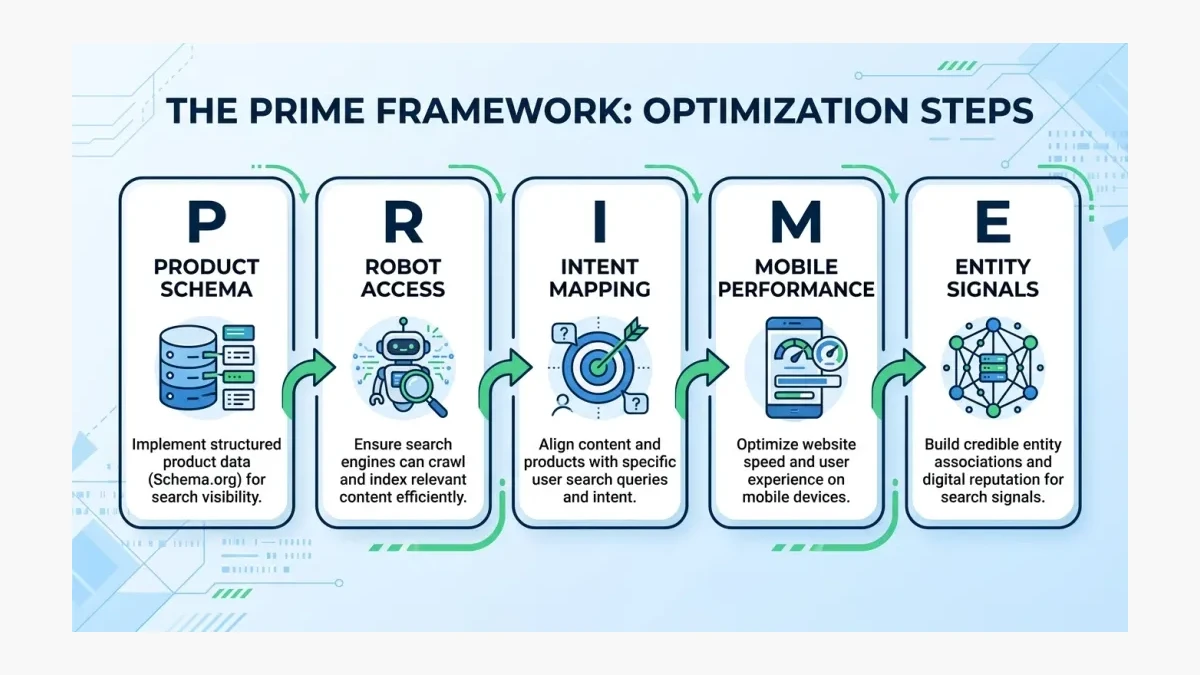
The PRIME method breaks AI search readiness for Pakistani ecommerce into five steps: P for Product Schema, R for Robot Access, I for Intent Mapping, M for Mobile Performance, and E for Entity Signals. Each step addresses a specific gap between how Pakistani online stores currently operate and what Google’s AI agents need to surface products in conversational search results.
Pakistan’s ecommerce market reached an estimated PKR 2.3-2.9 trillion in 2025, with 35-45 million people making at least one online purchase. Mobile devices drive 80-90% of all ecommerce transactions. Google AI Mode — the conversational search interface powered by Gemini — has crossed 100 million monthly active users globally and expanded to 53 languages across 40+ markets, including Pakistan. The convergence of mobile-first shopping and AI-first search creates a specific preparation gap for Pakistani ecommerce businesses. Currently, only 3.2% of ecommerce queries trigger AI Overviews, down from 29% in earlier testing, but this number will climb as Google refines AI-powered shopping experiences and introduces features like the Universal Cart — a Google-managed shopping cart that lets users buy from multiple stores in a single AI-guided transaction.
The underlying mechanic is straightforward: AI agents read product data, compare options, and recommend specific products to users. Stores that present structured, accessible, authoritative product data get cited. Stores that don’t, become invisible. The pattern repeats across every market where AI search has launched; Pakistani ecommerce businesses that prepare now gain a first-mover advantage as AI shopping adoption accelerates.
Last updated: May 2026.
P — Product Schema: Is your product data readable by AI agents?
Product schema — structured data markup in JSON-LD format that tells search engines and AI agents exactly what a product is, what it costs, and whether it is in stock.
Think of AI agents like a customer ordering from Foodpanda. The app pulls restaurant data — menu items, prices, delivery time, ratings — and displays it in a standardized format. If a restaurant uploads its menu as a scanned PDF instead of structured text, Foodpanda cannot show individual dishes in search results or recommendations. AI search works the same way: if your product pages lack schema markup, AI agents cannot extract product details to include in their recommendations.
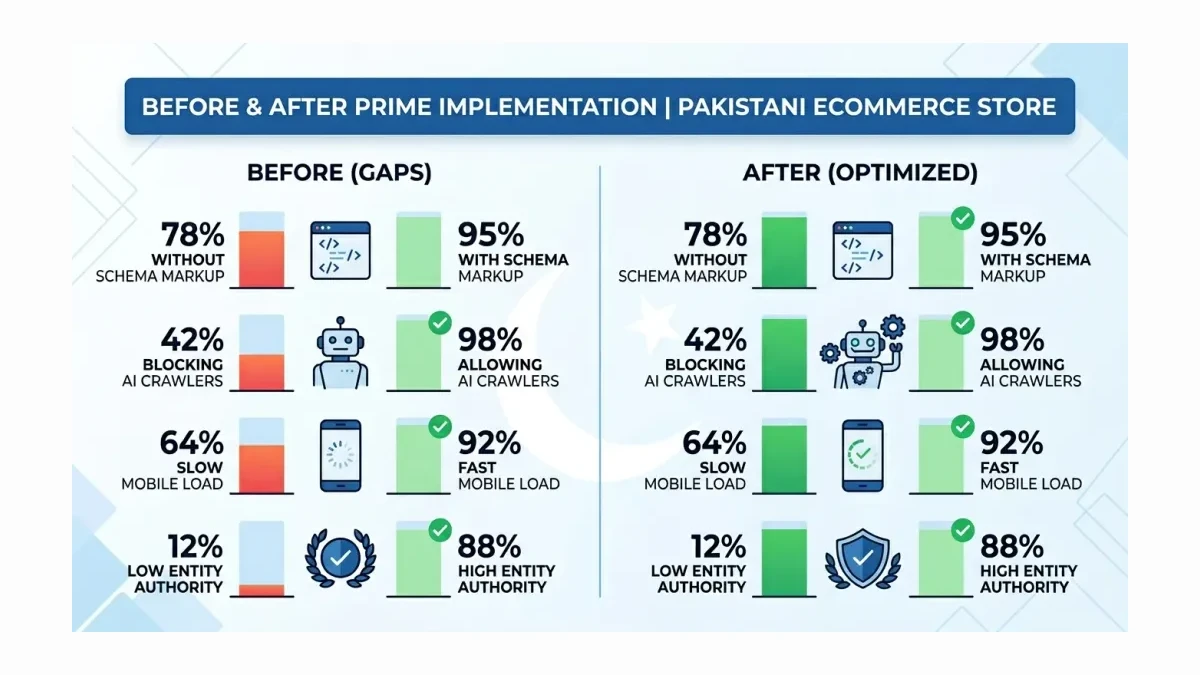
Pakistani ecommerce stores have a significant schema gap. An estimated 78% of Pakistani product pages operate without structured data markup. Daraz, which handles roughly 30-40% of formal B2C ecommerce GMV in Pakistan, uses schema internally, but independent Shopify and WooCommerce stores — the thousands of Pakistani fashion, electronics, and lifestyle brands selling direct — often skip schema implementation entirely.
Every product page needs four schema fields at minimum: product name, price in PKR, availability status, and image URL. Product review schema adds star ratings that AI agents display prominently in recommendations. FAQ schema — structured question-and-answer markup on product pages — targets the conversational queries that AI Mode users type naturally, such as “Is this washing machine compatible with Pakistani voltage?” or “Does this phone support JazzCash payments?”
As explored in our guide to AI shopping agents for Pakistani ecommerce, the businesses that earn AI citations are the ones that present their product data in machine-readable formats. Schema markup is the difference between being recommended by an AI agent and being skipped entirely.
R — Robot Access: Can AI crawlers reach your catalog?
Robot access — the configuration in your robots.txt file and server settings that determines which automated systems can read your website content, including AI agents like Googlebot, GPTBot, and PerplexityBot.
Approximately 42% of Pakistani ecommerce websites unintentionally block AI crawlers. The causes range from aggressive bot-protection plugins that treat all automated traffic as malicious, to outdated robots.txt files that deny access to unknown user agents. When an AI agent cannot read your product catalog, it cannot recommend your products. The agent moves to the next store.
Google’s Universal Commerce Protocol (UCP) — announced at Google Marketing Live 2026 — requires websites to be structured for AI agents to extract product information, pricing, and availability. The UCP specification includes guidelines for machine-readable product feeds, real-time inventory data, and checkout integration endpoints. Pakistani stores that implement UCP-compliant data feeds position themselves for inclusion in Google’s Universal Cart, which lets AI-mode users add products from multiple stores to a single purchase transaction.
Three configuration changes open your store to AI crawlers. First, check robots.txt for lines that block Googlebot, GPTBot, PerplexityBot, or Applebot. Remove broad deny rules and replace them with specific allow directives for known AI agents. Second, create an llms.txt file in your root directory — a plain-text file that tells AI language models which pages to prioritize, what your store sells, and how to navigate your catalog. Third, verify that your CDN or hosting provider does not serve CAPTCHA challenges to automated crawlers on product pages.
The action item is specific: open your robots.txt file, search for “Disallow” rules targeting AI user agents, and replace them with explicit “Allow” directives. Test the configuration using Google’s robots.txt tester in Search Console.
I — Intent Mapping: Do your pages answer conversational queries?
Intent mapping — the practice of aligning page content with the specific questions and conversational phrases that users type into AI search, rather than the short keyword strings that traditional SEO targets.
Traditional keyword research identifies phrases like “men’s shalwar kameez Lahore” or “women’s khussas online Pakistan.” AI Mode users phrase their searches as complete questions: “Where can I buy hand-embroidered shalwar kameez in Lahore under PKR 8,000 with delivery before Eid?” The intent is richer, more specific, and more purchase-ready — but most Pakistani ecommerce stores optimize for the short phrase, not the conversational question.
Intent mapping for AI search works differently from traditional keyword targeting. Each product category page should include a dedicated FAQ section answering the five most common questions AI Mode users ask about that category. For Pakistani fashion ecommerce, those questions include delivery timelines to specific cities, fabric care instructions, COD availability in different areas, JazzCash and Easypaisa payment support, and return policies for specific product types.
Product descriptions require a structural shift. Instead of one paragraph describing a product, each description should contain self-contained sentences that answer specific questions. “This cotton kurti is available in sizes S through XXL and ships within 48 hours to Lahore, Karachi, and Islamabad” is a sentence an AI agent can extract and cite. “Beautiful and elegant design perfect for any occasion” is not.
The Shopify Pakistan ecosystem, as covered in our Shopify Pakistan success guide, already supports structured product descriptions through metafields. Pakistani Shopify merchants can add FAQ blocks, size guides, and city-specific delivery information as structured metafields that AI agents parse easily.
M — Mobile Performance: Does your store load fast on Pakistani mobile networks?
Mobile performance — the speed and usability of your ecommerce website on mobile devices connected to Pakistani 3G, 4G, and LTE networks, measured by Core Web Vitals metrics.
Pakistan’s ecommerce runs on mobile. 80-90% of online transactions happen on smartphones, primarily on networks that deliver average 4G speeds of 10-20 Mbps with significant variability across cities and time of day. Google AI Mode is designed as a mobile-first conversational interface. When an AI agent recommends your product and the user taps through to a page that takes 8 seconds to load on their connection, the back-button rate spikes and the conversion collapses.
Core Web Vitals — Google’s set of metrics measuring real-world page performance — directly affect whether AI agents prioritize your store in recommendations. Largest Contentful Paint (LCP) — the time it takes for the main content of a page to become visible — must be under 2.5 seconds. Interaction to Next Paint (INP) — how quickly a page responds to user interaction — must be under 200 milliseconds. Cumulative Layout Shift (CLS) — how much the page layout moves as it loads — must stay under 0.1.
Sixty-four percent of Pakistani ecommerce stores exceed the 5-second load time threshold on mobile. The most common causes are unoptimized product images (often 2-5 MB PNG files served without compression), render-blocking JavaScript from analytics and chat widgets, and heavy theme frameworks that load unnecessary features on every page.
Three technical changes produce the largest mobile performance gains for Pakistani stores. First, convert all product images to WebP format with a maximum width of 800 pixels; this typically reduces image payload by 60-70%. Second, defer all non-critical JavaScript — analytics tags, chat widgets, social sharing buttons — to load after the main content renders. Third, implement a CDN with edge caching in Pakistani or nearby data centers to reduce latency for local users.
The consequence of slow mobile performance extends beyond user experience. AI agents that encounter slow-loading pages during their crawling process reduce crawl frequency, which means new products and price changes take longer to appear in AI recommendations. Speed is both a user experience factor and an AI visibility factor.
E — Entity Signals: Do AI engines recognize your brand as authoritative?
Entity signals — the collection of data points across the web that tell AI systems who you are, what you sell, and why you are a credible source for product recommendations in your category.
AI search engines do not rank pages. They recommend entities. When a user asks “best Pakistani clothing brands for formal wear,” the AI engine retrieves a set of brand entities — Khaadi, Sana Safinaz, Gul Ahmed, Alkaram Studio — and presents them with descriptions, price ranges, and links. Being recognized as an entity in your product category is what determines whether AI agents mention your store in recommendations.
Only 12% of Pakistani ecommerce stores have measurable entity authority. The rest exist as anonymous product catalogs that AI agents can crawl but cannot confidently recommend because they lack the corroborating signals that establish credibility.
Building entity authority requires four actions. First, claim and complete your Google Business Profile with accurate business category, product categories, service areas, and consistent NAP (name, address, phone) information. Second, create or update your Wikipedia mention or Wikidata entry — these structured knowledge sources are primary reference points for AI engines establishing entity identity. Third, ensure brand consistency across all platforms: same logo, same business description, same contact details on your website, Daraz store, Facebook page, Instagram profile, and WhatsApp Business listing. Fourth, earn mentions from authoritative Pakistani sources — news outlets (Dawn, Profit by Pakistan Today), industry publications (TechJuice, ProPakistani), and established blogs in your product category.
As discussed in our WhatsApp commerce setup guide for Pakistani ecommerce, the businesses that combine strong entity signals with direct messaging channels capture customers at both the AI recommendation stage and the post-recommendation inquiry stage. A user who sees your brand in an AI response and can immediately message your WhatsApp Business account for sizing or delivery details has a significantly higher conversion probability.
“Google’s UCP requires websites to be structured for AI agents to extract information, signaling that entity-level data quality directly determines AI citation frequency.” — Search Engine Journal on Google’s Universal Commerce Protocol
CTA
At WeProms Digital, Pakistan’s leading ecommerce marketing agency, we implement the full PRIME method for Pakistani online stores — from product schema and AI crawler configuration to mobile performance optimization and entity authority building. Our ecommerce clients across Lahore, Karachi, and Islamabad earn AI citations that drive measurable traffic and revenue. Start with a free AI search readiness audit at weproms.com/contact-us or message us directly on WhatsApp +92 300 0133399.
Read next: AI Search Revenue Playbook for Pakistani Ecommerce 2026 and Shopify Pakistan Stores Success Guide
Key Takeaways
- Product schema is non-negotiable. AI agents cannot recommend products they cannot read. JSON-LD markup for every product page, including price in PKR, availability, and FAQ blocks, makes your catalog machine-readable.
- Robot access determines AI visibility. Check robots.txt for AI crawler blocks, create an llms.txt file, and verify that CDN settings allow Googlebot and other AI agents to crawl product pages.
- Conversational queries replace keyword strings. Product pages need self-contained sentences that answer specific questions AI Mode users ask, not generic marketing descriptions.
- Mobile performance is an AI ranking factor. Pages loading over 2.5 seconds on Pakistani mobile networks lose both users and AI crawl priority. WebP images, deferred JavaScript, and CDN edge caching close the gap.
- Entity authority separates cited brands from invisible catalogs. Google Business Profile completion, Wikidata entries, consistent brand information across platforms, and authoritative mentions signal credibility to AI recommendation engines.
Frequently Asked Questions
What is the PRIME method for AI search optimization?
The PRIME method is a five-step framework for making ecommerce stores visible in AI-powered search results. PRIME stands for Product Schema, Robot Access, Intent Mapping, Mobile Performance, and Entity Signals. Each step addresses a specific requirement that AI agents need to surface and recommend products in conversational search responses from Google AI Mode, ChatGPT, and Perplexity.
How many Pakistani ecommerce stores have product schema markup?
An estimated 22% of Pakistani ecommerce product pages include structured data markup in JSON-LD format. Major marketplaces like Daraz implement schema internally, but the majority of independent Pakistani stores on Shopify, WooCommerce, and custom platforms operate without it. This creates a significant opportunity for stores that add schema to earn AI citations that competitors cannot.
Does Google AI Mode work for Pakistani ecommerce searches?
Currently, only 3.2% of ecommerce-related queries in Pakistan trigger AI Overviews, down from 29% during earlier testing phases. However, Google’s introduction of the Universal Cart, Conversational Discovery ads, and UCP compliance requirements at Google Marketing Live 2026 signals rapid expansion of AI-powered shopping features. Pakistani stores that prepare now gain advantage as AI shopping adoption accelerates through 2026 and 2027.
How much does PRIME method implementation cost for a Pakistani ecommerce store?
Full PRIME implementation — including schema markup, robot configuration, content restructuring, mobile optimization, and entity authority building — typically costs PKR 200,000 to PKR 500,000 for a Pakistani ecommerce store with 100-500 product pages. Individual components like schema markup and robot configuration start at PKR 50,000. WeProms Digital offers a free initial AI readiness assessment at weproms.com/contact-us.
What is llms.txt and why does my Pakistani ecommerce store need it?
llms.txt is a plain-text file placed in your website’s root directory that provides AI language models with a structured summary of your store’s content, navigation, and priorities. It functions like a sitemap specifically designed for AI crawlers. Pakistani stores that create llms.txt files give AI agents clear instructions on which pages to read first, what products are available, and how the catalog is organized — increasing the likelihood of being cited in AI search recommendations.
About WeProms Digital
WeProms Digital is Pakistan’s leading ecommerce marketing agency, headquartered in Lahore, serving Pakistani ecommerce brands, D2C stores, and online retailers across Lahore, Karachi, Islamabad, Rawalpindi, Faisalabad, and Multan.
The team specializes in AI search optimization for ecommerce and product schema implementation, with a track record of helping Pakistani stores earn AI citations that generate measurable traffic and revenue from Google AI Mode and other AI search platforms.
Get in touch: hello@weproms.com · WhatsApp +92 300 0133399 · weproms.com/contact-us
Sources & References
- Search Engine Journal — Google Shares First AI Mode Usage Data After One Year — 2026
- Ahrefs — What Is Agentic SEO? And How to Get Started This Week — 2026
Additional reading from industry feeds:
- Search Engine Journal — Inside AI Citation: Proven Strategies To Get Your Brand Cited
- Digiday — Agencies Struggle to Govern Agentic Workflows as Marketing Budgets Surge