
By Hamza Ali · Last updated June 14, 2026
A Lahore dental clinic spends PKR 180,000 a year on Google Business Profile photos, review replies, and Local Services Ads. It ranks inside the Google Maps Local Pack for “dentist near me.” Then a patient asks an AI search experience the same question. The clinic may not appear if its services, reviews, location signals, and website content do not clearly confirm why it should be recommended. That is the visibility gap this audit is designed to catch.
Here’s the thing. A Local Pack ranking used to be a license to print calls. A patient typed “best dentist in Lahore,” saw three pins, and called the top one. AI Mode does not show three pins. It writes an answer, and it picks the businesses it can verify as machine-readable records. If your profile is thin, unstructured, or inconsistent, the model skips you. You keep your blue pin. You lose the call.
We see this pattern across clinics, salons, law firms, and restaurants in Lahore, Karachi, and Islamabad. The GBP dashboard says you are ranking. The AI answer says you do not exist. The gap between those two screens is where revenue leaks. Pakistan now counts more than 198 million internet subscribers, according to the International Trade Administration’s Pakistan ecommerce guide, and most of them search on mobile, where AI Mode is expanding fastest. A mobile-first market means the AI answer is becoming the first thing a patient, diner, or client reads.
Let me walk through the setup that burns budget, where the money actually goes, and the 15-minute fixes that pull a local business back into the AI answer.
The setup that quietly kills your Local Pack visibility
Most Pakistani local businesses treat Google Business Profile as a brochure. They upload a logo, list opening hours, and stop. That was enough in 2022. It is not enough in 2026.
AI Mode reads your profile as structured data, not as a page a human scans. The model looks for a local business entity — a machine-readable identity that ties your name, address, phone, category, services, and reviews into one verified record. When any of those fields conflict, the entity fragments. The model cannot cite something it cannot resolve. Three labels pointing at one shop read as three different businesses to a crawler.
The most common break we see is category drift. A Karachi salon lists itself under “Beauty salon” on Google, “Spa” on its website, and “Hairdresser” on a local directory. A human reads past it. An AI model treats each label as a separate entity. Three entities, zero citations.
Pick one primary category. Mirror it across your website title tag, your GBP category, your schema markup, and every directory. One name. One category. One phone number. That single lever does more for AI visibility than any paid tool you can buy. A business that sells itself as five different things online is, to an AI engine, five different businesses competing with each other.
Where the money actually leaks
Consider a Lahore restaurant running PKR 40,000 a month on Meta ads to drive bookings. Its GBP holds hundreds of reviews and a menu uploaded as a PDF. The reviews mention “biryani,” “family seating,” and “DHA location” — exactly the words a diner types into AI Mode.
Those reviews are the strongest AI citation signal a local business owns. Google’s own AI search optimization guidance, broken down for marketing teams by Intero Digital, stresses that AI engines surface businesses with dense, specific, description-rich profiles. The restaurant has that signal. It just never structured it.
A PDF menu is invisible to a crawler. Review text is visible but unstructured. The AI model cannot connect “biryani” in a review to “serves biryani” in a services list because no markup links them. The restaurant ranks in the Local Pack. It does not rank in the answer.
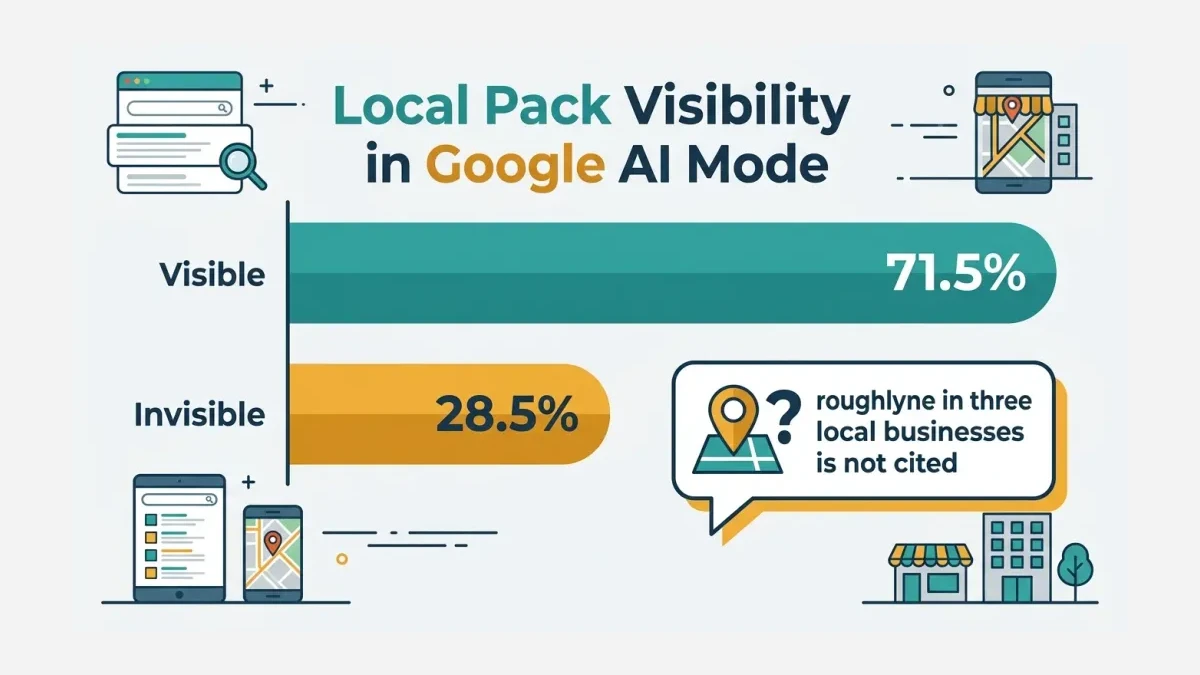
The cost is concrete. If 28.5% of Local Pack businesses are invisible in AI Mode, and Google is rolling AI Mode into standard mobile results through 2026 — including AI Mode Information Agents for Ultra subscribers — then roughly one in three businesses you compete with will simply not be recommended in the answer. The businesses that structure their entity fill that gap. The businesses that do not lose the call to the ones that do. Your monthly ad budget keeps working while a quieter channel quietly stops sending patients.
A mobile-first Pakistani shopper, profiled in DataReportal’s digital coverage of emerging markets, increasingly skips the blue links entirely and reads the AI summary. If your entity is not in that summary, your paid Meta click lands on a prospect who already trusted the AI answer over your ad.
The 15-minute fixes that pull you back into the answer
Start with the entity. Confirm your GBP name, address, and phone match your website footer and your schema markup exactly. One mismatched digit in a phone number is enough to fragment the entity. A model that cannot match your GBP phone to your website phone treats them as two businesses.
Then add LocalBusiness schema — structured code on your website that tells crawlers your business type, hours, geo-coordinates, price range, and service area. Schema markup is the single fastest lever for AI visibility because it converts your page from prose into a database row a model can read, cite, and verify. Pakistani sites that close schema markup gaps show measurably higher AI citation rates than sites relying on plain text.
Then fix the menu problem. Replace PDF menus and image-based price lists with HTML text. A Lahore clinic that lists “root canal,” “teeth whitening,” and “Invisalign” as plain text gives the model three exact services to cite. The same clinic hiding services inside a PDF gives the model nothing to quote.
Aggregate and answer reviews. Reply to every review with a sentence that restates a service and a location. “Thank you for choosing us for your root canal in DHA” does double duty: it thanks the patient and it feeds the model a clean, location-tagged service mention.
Finally, check your presence in the sources AI engines actually cite. LinkedIn is the most-cited source in AI search, according to Buffer’s analysis of citation data. A local business owner with an active company page and a consistent Google Business Profile gives the model two independent, high-trust signals to verify. Two signals beat one. For a fuller setup, pair this work with our guide to fixing Pakistani websites for Google AI Mode.
Run this 5-point Local Pack AI visibility audit this week
Use this checklist before you spend another rupee on local ads:
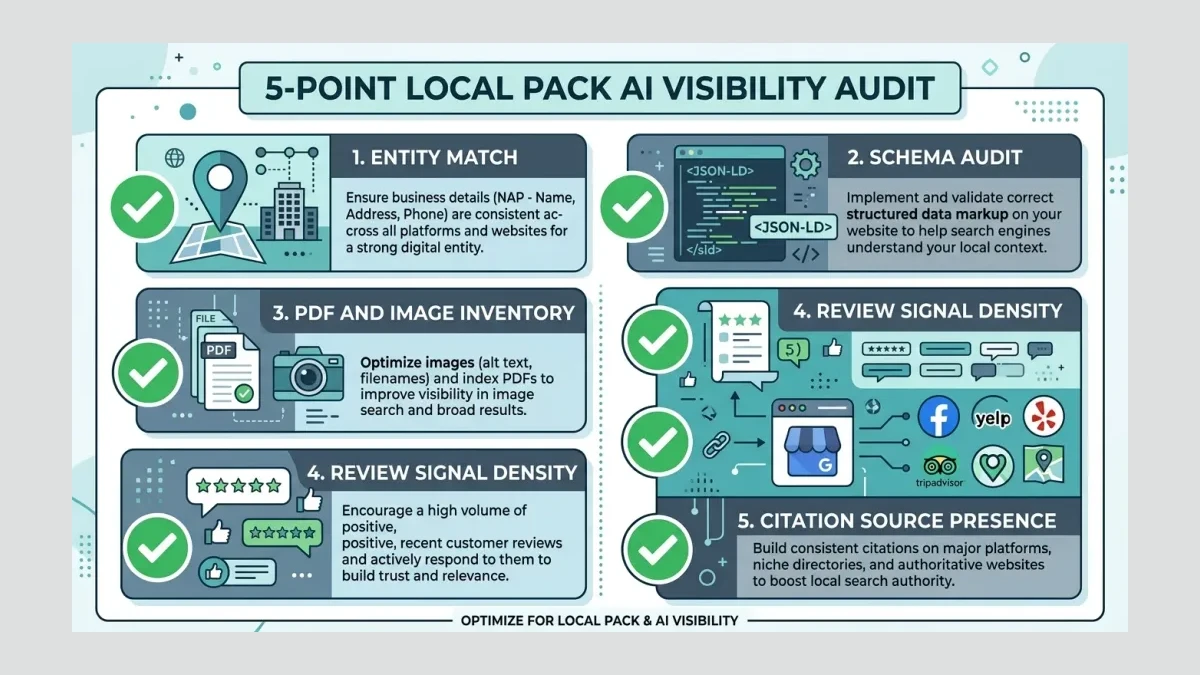
- Entity match check. Confirm your GBP name, address, phone, and primary category are identical across your website, schema, and every directory. Fix every mismatch you find.
- Schema audit. Run your homepage through a structured-data validator. Confirm LocalBusiness schema with address, geo, hours, and price range is present and error-free.
- PDF and image inventory. List every menu, price list, and service sheet currently locked in a PDF or image. Convert each one to HTML text this week.
- Review signal density. Count how many of your recent reviews mention a specific service by name. Thin signal means thin citations. Reply to new reviews restating the service and location.
- Citation source presence. Confirm your business has a verifiable presence on at least two independent sources AI engines cite — Google Business Profile plus LinkedIn, or a verified directory. Two signals, not one.
If you can tick all five, your Local Pack entity is AI-ready. If you cannot, every month you wait is another month a competitor fills the answer slot instead of you. Our local SEO guide for Lahore, Karachi, and Islamabad covers the broader ranking foundations these fixes sit on top of.
Read next: For a deeper look at why GBP rankings alone no longer guarantee calls, see our field report on local businesses losing calls to Google AI Mode.
WeProms Digital, Pakistan’s leading local SEO and Google Business Profile agency, runs this exact 5-point audit for clinics, salons, restaurants, and service businesses across Lahore, Karachi, and Islamabad. If your GBP ranks but your phone stays quiet, book a local SEO and Google Business Profile optimization engagement and we will map every entity break, schema gap, and missing citation source in your account. Reach us at hello@weproms.com or WhatsApp +92 300 0133399.
Frequently Asked Questions
How do I know if my Pakistani business is invisible in Google AI Mode?
Open Google AI Mode on a mobile device and ask it a direct question a customer would type, such as “best dentist in DHA Lahore.” If your business ranks in the regular Local Pack but never appears in the AI answer across five different phrasings, you are likely inside the 28.5% of Local Pack businesses the AI cannot cite. Run the 5-point audit above to locate the entity break.
Does a high Google Business Profile ranking still matter in 2026?
Yes, but it is no longer sufficient on its own. A strong GBP ranking keeps you in the blue Local Pack pins, which still drive calls. The problem is that AI Mode writes its own answer above the pins and only cites businesses it can verify as clean entities. Ranking gets you on the map. Structured data gets you into the answer.
How much does a local SEO and GBP audit cost in Pakistan?
A one-time local SEO audit in Pakistan typically runs between PKR 10,000 and PKR 20,000, while ongoing local SEO retainers range from PKR 25,000 to PKR 50,000 per month for small businesses, according to published Pakistani agency pricing. WeProms scopes the 5-point AI visibility audit as a fixed engagement so you know the cost before we start.
Will adding LocalBusiness schema really fix my AI visibility?
Schema alone will not fix a fragmented entity, but it is the fastest single lever available. Schema converts your website from prose into structured data a model can read, cite, and verify. Combined with consistent GBP data and HTML service text, schema closes the gap that keeps Local Pack businesses out of AI answers.
Should I also fix this for Bing and ChatGPT search?
Yes. ChatGPT, Perplexity, and Bing pull from similar structured-data and citation signals, and AI Mode shares much of Google’s entity infrastructure. Fixing your entity once improves visibility across Google AI Mode, ChatGPT, and Perplexity, so the audit pays back across every AI engine, not just Google.
About WeProms Digital
WeProms Digital is Pakistan’s leading local SEO and Google Business Profile optimization agency, headquartered in Lahore, serving Pakistani SMEs, clinics, restaurants, and service businesses across Lahore, Karachi, Islamabad, Rawalpindi, Faisalabad, and Multan.
The team specializes in LocalBusiness schema implementation, Google Business Profile optimization, and AI Mode citation setup, with a track record of recovering Local Pack visibility for businesses that had dropped out of AI answers entirely.
Get in touch: hello@weproms.com · WhatsApp +92 300 0133399 · weproms.com/contact-us
Sources & References
- Search Engine Journal — Google rolls out AI Mode Information Agents to Ultra subscribers — 2026
- Intero Digital via Search Engine Journal — Google’s official AI search optimization guide breakdown — 2026
- Buffer — LinkedIn is the most-cited source in AI search — 2026
- International Trade Administration — Pakistan ecommerce and internet subscribers guide — 2025
- DataReportal — Digital behaviour in emerging mobile-first markets — 2026
- Khalid Marjan — SEO and digital marketing pricing in Pakistan — 2025
Additional reading from industry feeds: