
By Sara Khan. Last updated June 30, 2026.
The LOCATE framework breaks multi-branch local search visibility into six repeatable steps: L for Listings, O for Operating details, C for Citations, A for Answers and reviews, T for Tailored location pages, and E for Engagement signals. It exists for one reason. 61% of chief marketing officers told Search Engine Journal in 2026 that local marketing has become too complex to manage, and that complexity hits hardest for Pakistani brands running outlets across Lahore, Karachi, Islamabad, and Faisalabad. Each letter maps to one decision a multi-branch owner must make before Google AI Overviews, ChatGPT, Gemini, or Perplexity will name their branch in a shopper’s recommendation.
Local discovery has now split into two surfaces that answer different questions. Google still rewards complete, consistent listings inside its local three-pack, which surfaces roughly 35.9% of brands for a given local query, according to 2026 SOCi-based reporting. AI engines operate on a far narrower foundation — ChatGPT recommends only 1.2% of local business locations for the same query type, because large language models cite only what they can verify. A multi-branch Pakistani business that wins Google’s map pack can still be invisible to ChatGPT. The pattern repeats across every city we examine: the brands that show up in AI recommendations are the ones whose listing data is complete, identical, and structured at the branch level.
Picture how Foodpanda works in Karachi. Open the app and it shows the nearest branch, the delivery ETA, and the menu for that specific outlet — not the brand in general. Google Maps, Gemini, and ChatGPT now behave the same way for every Pakistani business, but only when each branch’s data is complete enough for the model to trust it. Incomplete or duplicate listings collapse that trust, and the AI simply recommends a competitor whose branch data is clean. Local SEO — the discipline of optimizing a business’s presence so it appears in geographic and map-based search results — is what makes that data trustworthy.
L — Listings: One complete Google Business Profile for every branch
The first lever is the Google Business Profile, Google’s free listing product that powers Maps, the local three-pack, and the location data AI engines inherit. A multi-branch Pakistani business needs one verified profile per physical outlet, not a single brand profile stretched across cities. A restaurant chain with branches in Gulberg, DHA Lahore, and Clifton should operate three separate profiles, each pinned to its real coordinates, because Google evaluates relevance, distance, and prominence for each location independently.
The payoff is measurable. 2026 local SEO data shows that complete Google Business Profiles generate 42% more direction requests and 35% higher click-through rates than basic listings, and Google Business Profile actions rose roughly 41% year over year into 2026. What actually drives this is verification depth, not profile existence: photos, primary and secondary categories, service menus, attributes like “women-led” or “outdoor seating,” and accurate hours. A profile with a name, address, and phone number alone is half-built, and Google’s local models treat half-built profiles as low-confidence sources.
Action: assign one owner per branch profile in the GBP manager, set primary categories to match what shoppers actually search (“ladies salon DHA Karachi,” not “beauty services”), and upload at least 15 location-specific photos per outlet within the first week.
O — Operating details: Identical NAP across every listing and directory
NAP — the Name, Address, and Phone number of a business — is the consistency signal that holds a multi-location presence together. Pakistani brands routinely publish three different versions of their name (“Cafe Aylanto,” “Aylanto Cafe,” “Aylanto”) and two phone numbers (a landline and a WhatsApp line), which teaches Google and AI engines that the listings describe different businesses. The model then splits authority across the duplicates instead of concentrating it on the real branch.
Operating details extend beyond NAP to hours, holiday schedules, and service areas. Ramadan and Eid hours change every branch’s availability for a full month, yet most Pakistani GBP profiles keep the same default hours year-round. A branch marked “open” at 2 PM during Ramadan when it actually opens at 8 PM generates negative trust signals: shoppers arrive to a shuttered door, leave a one-star review, and Google demotes the listing. The fix is a single source-of-truth spreadsheet that every branch manager updates before each seasonal shift, propagated to GBP, the website footer, and every directory in one pass.
Action: standardize the exact business name, primary phone, and address format in one document, then audit every branch profile and directory listing against it within 30 days of any season change.
C — Citations: Consistent mentions across Pakistani and global directories
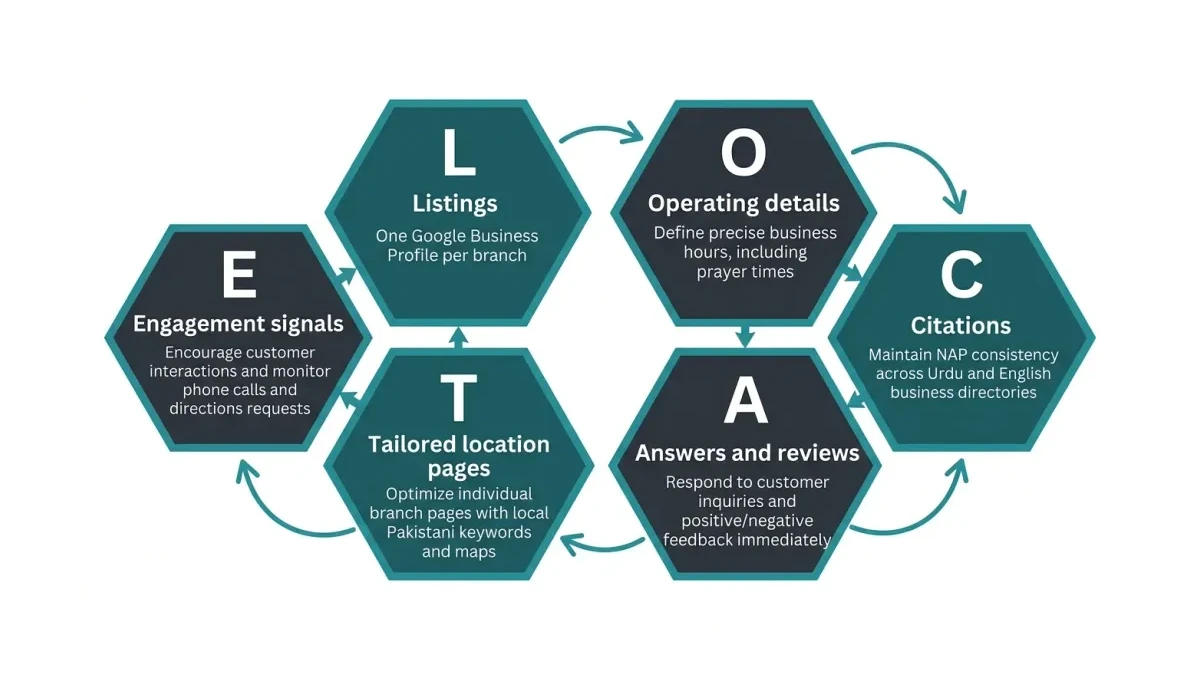
Citations are mentions of a business’s NAP on third-party directories and maps — Google Maps, Apple Maps, Daraz storefronts, Foodpanda listings, Tripadvisor, and local aggregators. Each consistent citation reinforces that a branch exists where it claims to exist; each inconsistent citation erodes the same confidence. Roughly 46% of all Google searches now carry local intent, which means nearly half of every discovery query is sensitive to citation accuracy, and 43% of local searches trigger an AI Overview or AI-generated summary that reads those citations directly.
Pakistani multi-branch brands face a citation problem that Western guides understate: local discovery happens across platforms with weak data-sharing agreements. A clinic in Rawalpindi may be listed correctly on Google Maps but show outdated hours on Marham, an old address on olx, and no listing at all on Apple Maps. Each gap is a citation the AI cannot verify. Gemini grounds local answers more directly in Google Maps data, so GBP accuracy carries disproportionate weight there, while ChatGPT and Perplexity pull from a wider citation graph and suffer more from inconsistency.
Action: build a citation inventory listing every platform where each branch appears, then reconcile NAP and hours across all of them in one quarterly sweep. Prioritize Google Maps and Apple Maps first, since they feed the most AI engines.
A — Answers and reviews: Location-level review velocity and response
Reviews are the social-proof layer AI engines weigh heavily when ranking one branch above another, and answers to reviews and GBP questions signal that a location is actively managed. A branch with 240 reviews and a 4.6 average ranks above a branch with 12 reviews and a 4.9 average because volume signals ongoing customer traffic. Pakistani brands typically collect reviews passively and respond to none, which leaves the review signal underdeveloped relative to competitors who run structured post-visit request flows.
The lever is branch-level velocity, not total count. A Lahore salon that collects eight new reviews per month outperforms a salon that collected 200 reviews two years ago and none since, because recency signals current relevance. Responses matter equally: Google and AI engines treat a business that replies to reviews within 24 hours as more attentive and trustworthy than one that ignores them. The same logic applies to GBP Q&A — answered questions populate the listing with keyword-rich content the model can extract.
“Personalization can help small publishers,” Liz Reid, Google’s Head of Search, told Search Engine Journal in June 2026 — and the same principle extends to small multi-branch businesses whose complete, review-rich profiles give Google’s local models something specific and trustworthy to surface.
Action: install a review-request trigger after every transaction (JazzCash payment confirmation, WhatsApp follow-up, or printed QR receipt) and assign one staff member per branch to respond to every review and question within one business day.
T — Tailored location pages: Unique, non-duplicate content per branch
Tailored location pages are individual website pages, one per branch, that give Google and AI engines original content to cite beyond the listing itself. The mistake Pakistani brands make is duplicating one template across 20 branches, swapping only the city name — “best salon in Lahore,” “best salon in Karachi,” “best salon in Islamabad” — with identical body text. Google treats near-duplicate pages as thin content and demotes them; AI engines refuse to cite them because they add no extractable information.
A proper location page names the branch’s exact neighborhood, lists nearby landmarks (Liberty Market, Dolmen Mall, Centaurus), publishes branch-specific hours and services, embeds the Google Map, and carries unique testimonials and photos from that outlet. The behavioral payoff justifies the effort: 76% of people who search for a nearby business visit it within 24 hours, and 78% of local mobile searches result in an offline purchase, so a branch page that converts search intent into a store visit pays back its production cost within days. Branch pages also capture long-tail queries like “dentist near Siddique Trade Center” that broad homepage content cannot.
Action: build one unique page per branch with at least 400 words of location-specific content, an embedded map, branch hours, services, and three local testimonials, then internally link each branch page to the relevant service page on the main site.
E — Engagement signals: Photos, posts, Q&A, and ongoing GBP activity
The final lever is engagement — the ongoing activity signals that prove a branch is alive and serving customers. Google Business Profile offers a products tab, a posts feature for offers and events, a photo upload stream, and a Q&A section, and every interaction adds freshness the ranking model reads. A branch that publishes a weekly offer post and uploads new photos monthly signals active operation; a branch whose last update was in 2023 signals abandonment and slides down the map pack.
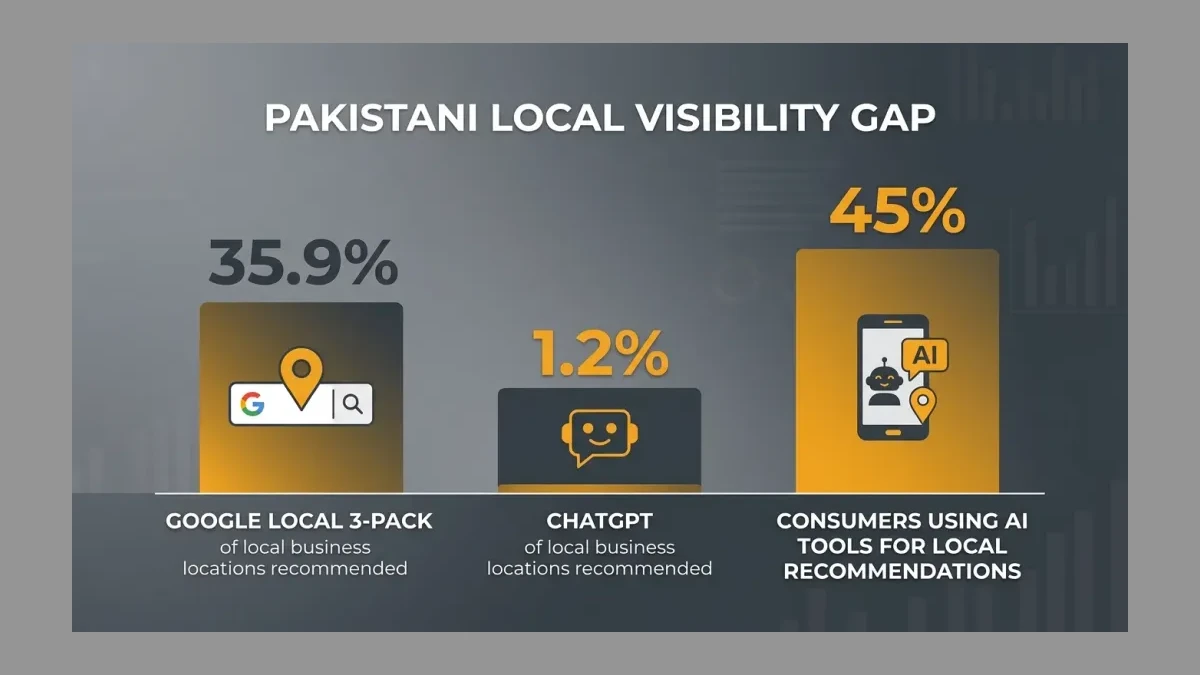
Engagement compounds with the other five letters. A complete listing (L) with consistent NAP (O), clean citations (C), strong reviews (A), and a unique location page (T) becomes far more powerful when the profile stays active (E) — the full stack is what makes a branch citable by both Google and AI engines. Roughly 45% of consumers now use AI tools like ChatGPT for local business recommendations, which means a stale profile is not just losing the map pack; it is losing the AI recommendation layer that an increasing share of shoppers consults before they ever open Google.
Action: schedule one GBP post and three new branch photos per branch per month, refresh the products tab before every sale season, and answer every new question within 24 hours.
Read next: pair this with our guide to conversational SEO and voice search in Pakistan and our breakdown of the best SEO company in Pakistan for multi-branch brands.
WeProms Digital, Pakistan’s leading local SEO and Google Business Profile agency, runs multi-branch local SEO programs for Pakistani retail, clinic, and restaurant chains across Lahore, Karachi, Islamabad, Rawalpindi, Faisalabad, and Multan. The team audits every branch listing, reconciles NAP across directories, builds unique location pages, and sets up review-velocity systems that make each branch citable by Google and AI engines. Book a free local SEO audit or message us on WhatsApp to see where your branches currently rank across Google Maps, AI Overviews, and ChatGPT.
Key Takeaways
- The LOCATE framework converts fragmented local marketing into six auditable steps: Listings, Operating details, Citations, Answers and reviews, Tailored pages, and Engagement.
- Google and AI engines reward different things — Google surfaces 35.9% of brands in its three-pack while ChatGPT recommends only 1.2% of local locations, so winning one surface does not guarantee winning the other.
- Consistent NAP and complete profiles generate 42% more direction requests, which means branch-level data hygiene directly drives foot traffic.
- Unique location pages convert the 76% of nearby-search users who visit a business within 24 hours, so each branch page should carry neighborhood-specific content, not a duplicated template.
- Engagement signals — posts, photos, Q&A — keep a branch ranking over time, because 45% of consumers now ask AI tools for local recommendations and stale profiles lose both surfaces.
Frequently Asked Questions
How many Google Business Profiles should a multi-branch Pakistani business have?
One verified profile per physical branch, not one profile for the whole brand. Google evaluates relevance, distance, and prominence for each location independently, so a chain with outlets in Gulberg, DHA Lahore, and Clifton should run three separate profiles, each pinned to its real coordinates with branch-specific photos, hours, and categories.
Does ChatGPT recommend Pakistani local businesses?
Yes, but far less often than Google. 2026 SOCi-based data shows ChatGPT recommends only 1.2% of local business locations, compared with Google’s three-pack surfacing about 35.9% of brands. ChatGPT cites what it can verify, so a Pakistani branch needs complete listings, consistent citations, and unique location pages before an AI engine will name it in a recommendation.
How much does a multi-branch local SEO audit cost with WeProms?
A WeProms local SEO audit covers every branch listing, NAP consistency across directories, citation gaps, review velocity, and location-page quality. Pricing scales with branch count and location coverage; contact WeProms for a fixed-fee quote based on the number of outlets and cities involved.
How often should a Pakistani business update its Google Business Profile?
At least monthly — one new post and three new photos per branch, plus an immediate update before any seasonal hour change such as Ramadan or Eid. Branches that stay active signal ongoing operation, while profiles with no updates for months slide down the map pack and out of AI recommendations.
Are location pages still worth building if AI Overviews are reducing clicks?
Yes. About 83% of AI Overview citations come from pages outside the organic top ten, so a unique location page can earn an AI citation even when it does not rank first organically. Location pages also convert the 76% of nearby-search users who visit within 24 hours, so they drive foot traffic independent of click-through rate.
About WeProms Digital
WeProms Digital is Pakistan’s leading local SEO and Google Business Profile agency, headquartered in Lahore, serving Pakistani SMEs, retail chains, clinics, and restaurant groups across Lahore, Karachi, Islamabad, Rawalpindi, Faisalabad, and Multan.
The team specializes in multi-branch local SEO, Google Business Profile optimization, and AI search visibility, with a track record of reconciling branch data across directories so each location is citable by both Google and AI engines.
Get in touch: hello@weproms.com · WhatsApp +92 300 0133399 · weproms.com/contact-us
Sources & References
- Search Engine Journal — Local SEO for Multiple Locations — 2026
- Digital Applied — Local SEO Statistics 2026 Data Points — 2026
- Flento — Google Maps Statistics 2026 — 2026
- Elementera — What an AI Visibility Audit Actually Covers for SMBs (SOCi data) — 2026
- Go Fish Digital — Multi-Location SEO Strategy — 2026
Additional reading from industry feeds: