
By Abdul Rehman · Local search walkthrough · Last updated: August 2026
TL;DR: Google is folding Local Services Ads into Google Ads as a new Performance Max campaign type starting August 2026 — United States first, with non-US markets like Pakistan expected to follow in 2027. Pakistani multi-location businesses that fix their Google Business Profile data, branch pages, and reviews now will be first in line when the format arrives. The work below takes roughly 30 days and costs more time than money.
If you run a clinic chain with three branches across Karachi and one in Lahore, spending PKR 300,000 a month on ads while your Google Maps listings still show last year’s phone number, your problem is not advertising. Your problem is that Google’s local systems — Maps, the map pack, and now AI answers — cannot confidently say who you are, where you operate, and whether customers trust you. Picture this: a patient in DHA Karachi searches “clinic near me” at 9 p.m., and Google’s widely cited near-me research holds that 76% of people who search for something nearby visit a business within a day. Which means every unverified or inconsistent branch listing is a door you paid to build and then left unlocked.
This walkthrough sequences the fix branch by branch. It assumes no specialist knowledge, one person owning the project, and a website you can edit.
First, audit what Google already holds about every branch
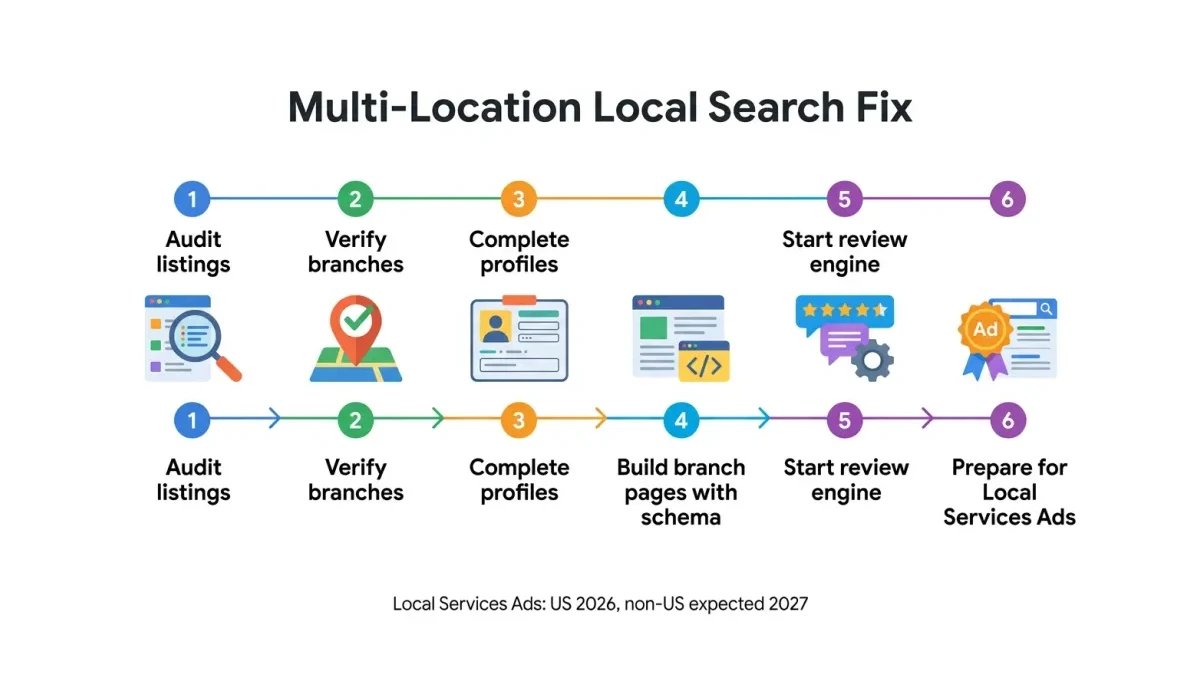
Start by finding every trace of your business that already exists in Google’s system, because multi-location chains accumulate duplicate and competing listings for years. A branch manager creates a profile, an agency creates another, a merged location leaves a third orphaned — and Google’s confidence in your data drops with every conflict. List every profile you can find, then check each branch’s name, address, and phone number — NAP consistency — the practice of keeping that data identical across Google, your website, and every directory.
The audit has three outputs: a master spreadsheet of every listing and its status, a list of duplicates to request for removal, and a list of branches whose website address or phone number disagrees with the profile. Chains with clean NAP data protect themselves against ranking drops of the kind we documented in our Google Business Profile edit and ranking-drop analysis, where small profile changes produced outsized visibility losses for Pakistani businesses.
The comparison to a physical market helps here. A chain with inconsistent listings is like a shopkeeper who hangs one signboard at head office and nothing at the chowk where customers actually stand; Google ranks the branch it can see clearly, and yours is invisible at the corner where the search happens.
Then, verify each branch properly
Verification is Google’s trust checkpoint, and multi-location chains have a shortcut most Pakistani businesses never use. Ten or more locations qualify for bulk verification — uploading a spreadsheet of all branches inside Google Business Profile rather than postcard-verifying each one — which cuts weeks of waiting down to days. Businesses with fewer than ten locations verify individually, usually by video recording the branch’s exterior, signage, and interior in one continuous take.
Verification failures cluster around evidence. Google wants to see signage that matches the profile name, a location that matches the pin, and service evidence inside the premises; a clinic in Gulberg with branded signage passes in one attempt, while a home-based consultancy borrowing a relative’s office address usually fails twice. The fix is simple: match the profile to physical reality before recording, not after.
The action this week: claim every profile found in the audit, submit bulk verification if you have ten or more branches, and record verification videos in daylight hours. A profile that stays unverified for months is a profile Google will not fully rank, no matter how good the reviews are.
Next, complete every profile field that rankings actually read
An unverified profile hurts visibility, but a half-empty profile wastes it. Categories carry heavy ranking weight — a restaurant chain must set “Restaurant” as primary with “Family Restaurant” or “Cafeteria” as secondary per branch type, because Google matches category intent to query intent before it weighs anything else. Services, descriptions, attributes, opening hours including Ramadan and Eid schedules, and recent photos each add matching surface: every completed field is another query your branch can legitimately answer.
Photos deserve specific attention in Pakistan. Walk-in customers decide from the exterior shot whether the branch looks real; families decide from the interior; patients decide from the reception. Upload ten current photos per branch — exterior with signage visible, interior, team, products or equipment — and replace them quarterly, because photo recency signals an active operation to both Google and the AI systems reading the profile.
The action: spend ninety minutes per branch completing every field, and treat the weekly Google Business Profile post as a branch-level announcement channel, not head-office broadcasting. A Clifton branch posting its own timing update outperforms a chain-wide post reused across eleven profiles, because local relevance is the signal being read.
After that, make each branch’s website page the citation source AI engines quote
This step is where 2026 differs from every local SEO guide written before it. When residents of Lahore or Karachi ask Gemini or ChatGPT for a recommendation, the answers cite sources, and a Steady Demand study of 14,472 AI citations across 1,487 local searches found business’s own websites received nearly 60% of Gemini’s local citations, with Google Business Profile taking about 22% and directories, social, and review sites splitting the rest. The tradeoff is steep: your website is the primary source AI engines quote, while your profile supplies the verification data — which means a chain needs both, and neither alone covers the ground.
Each branch therefore needs its own indexable page on your website with its NAP, hours, services, directions, parking notes, and reviews, structured with LocalBusiness schema markup — machine-readable code embedded in the page that states the branch name, address, geo-coordinates, and opening hours in a format AI systems can cite without guessing. One page per location, linked from a locations hub, beats a single contact page listing all branches, because the AI citation goes to the page about that specific branch near that specific searcher.
Two practical cautions follow from the same study. Repeated local searches frequently returned different cited sources, so a branch that ranks in the map pack today may not be quoted by the AI answer tomorrow — consistency across website, profile, and reviews is the hedge. And the 76% near-me visit statistic means the traffic you win converts fast, usually within 24 hours, so branch pages must carry current hours and a tappable phone number rather than a corporate contact form. We mapped this behavior change further in our analysis of local business calls lost to Google’s AI Mode.
Once your profiles are clean, build the review engine per branch
Reviews operate per location, not per brand, and Pakistani chains routinely get this backwards by chasing a total count instead of branch-level distribution. A DHA branch with 180 reviews and a Bahria Town branch with 6 tells Google’s ranking system the second location is unproven in its own neighborhood — and it tells the AI engine quoting sources the same thing. The engine that matters is systematic: ask every satisfied walk-in at payment time, send the branch’s review link by WhatsApp within an hour of service, and respond to every review, positive or negative, within two days.
Responses function as content. A considered reply to a complaint about queue times at a Lahore clinic branch demonstrates to both customers and ranking systems that the location is managed; silence reads as neglect. And because reviews occasionally vanish through platform errors, the recovery process in our guide to Google losing Pakistani business reviews is worth bookmarking before you need it.
The math makes the effort defensible. If 76% of near-me searchers visit within a day and your Bahria Town branch holds 6 reviews against a competitor’s 90, the chain has already lost the comparison before price or service enters the decision. The action: set a per-branch review target, wire the WhatsApp request into your billing or discharge process, and assign response duty by branch manager.
From here, prepare for the ad format that has not launched in Pakistan yet
Local Services Ads — Google’s pay-per-lead format that places screened, badged businesses above traditional search results — is being folded into Google Ads as a new Performance Max campaign type beginning August 2026, as Google’s transition guide details. Phase one covers select United States advertisers only; the rollout to more categories continues through 2026, and non-US accounts follow in 2027. Pakistan is not in phase one, and Google has announced no Pakistani launch date.
That gap is preparation time, not dead time. The format’s entry requirements are exactly the assets this walkthrough has been building: a verified Google Business Profile, consistent branch data, license documentation for regulated verticals like clinics and law firms, and a review base that survives background screening. A Pakistani clinic chain that completes the steps above enters any future launch with verification done, documentation organized, and branch reviews compounding — while competitors start the clock from zero on launch day.
The action: assemble per-branch license and registration records now — PMDC numbers for medical practices, trade licenses, SECP incorporation documents — and store them with the profile credentials. When the format opens to Pakistani advertisers, the queue will be long and the documentation checks will be strict.
The outcome: what clean multi-location visibility produces
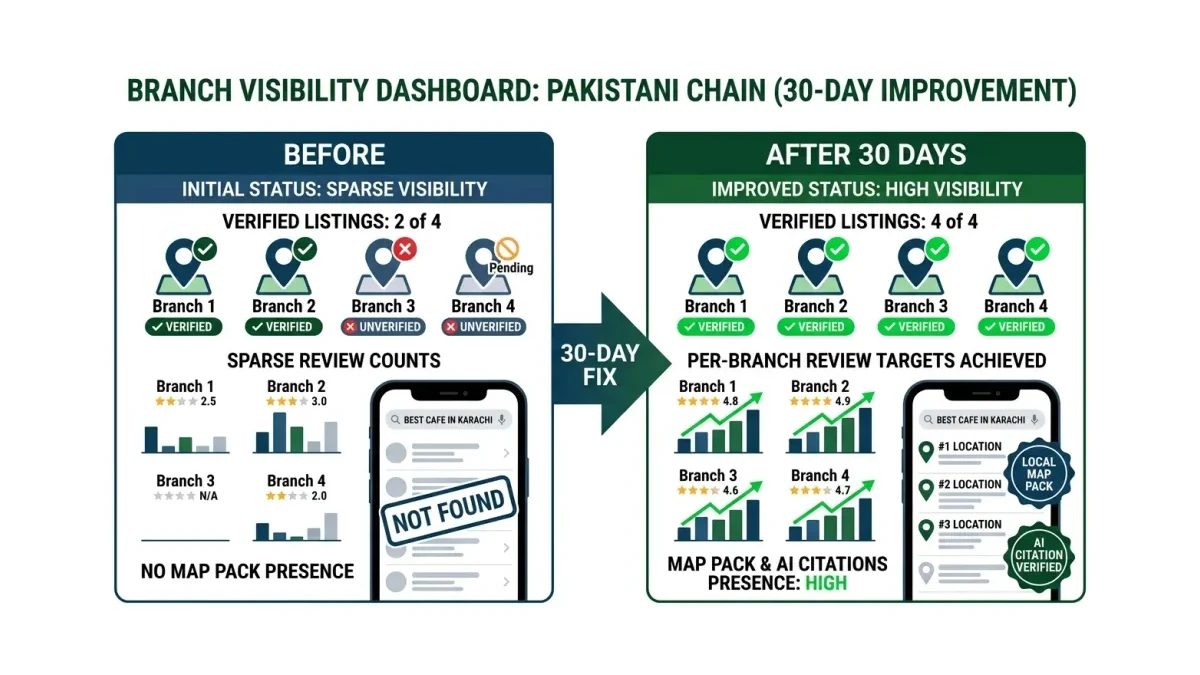
| Measure | Before the fix | After 30 days |
|---|---|---|
| Verified profiles | 2 of 4 branches | 4 of 4 branches, bulk-managed |
| NAP consistency | Phone numbers differ across directories | One master dataset, quarterly checks |
| Review distribution | 180 at flagship, under 10 elsewhere | Per-branch targets with weekly requests |
| AI citation surface | Single contact page, no schema | One optimized page per branch with LocalBusiness schema |
| Launch readiness | No license records organized | Documentation stored per branch, ready to screen |
Thirty days of unglamorous data work produces a chain that Google can verify, customers can find, and AI engines can quote. The advertisers who win the next format change are the ones whose basics survived the audit — and in local search, the basics are still name, address, phone, photos, reviews, and a website page for every door you operate.
The cost of standing still is not neutral. Every month with inconsistent listings, the chain funds competitors’ map pack positions with its own budget; every unquoted branch page hands the AI answer to a rival whose data was cleaner. WeProms Digital, Pakistan’s leading local SEO agency, runs multi-location audits — listing cleanup, bulk verification, branch page builds, schema, and review systems — for chains across Lahore, Karachi, and Islamabad. At WeProms we treat the Local Services Ads timeline as a readiness clock, and the chains that start now will be first through it. Reach us at hello@weproms.com, WhatsApp +92 300 0133399, or through the contact page.
Read next: The LOCATE framework for multi-location local SEO · Google Maps ranking factors for Pakistan, 2026
Frequently Asked Questions
When will Local Services Ads become available in Pakistan?
Google has announced no date. The format began folding into Google Ads as a Performance Max campaign type in August 2026 for select United States advertisers, expands through 2026, and reaches non-US accounts in 2027. Pakistani multi-location businesses should treat 2026 as the preparation window: verified profiles, clean branch data, and organized license documentation shorten any future application to days instead of months.
How many Google Business Profile listings can one Pakistani business have?
One per physical location that customers can visit, plus one for service-area businesses. A chain with three Karachi branches and one in Lahore correctly holds four profiles, each verified separately or through bulk verification at ten-plus locations. Creating multiple profiles for a single branch — a common agency error — triggers merges, suspensions, and ranking loss, which is why the audit step removes duplicates before anything else.
What should I do if a branch’s Google Business Profile gets suspended?
Submit a reinstatement request with evidence: branch signage photos, a utility bill for the address, and the license record for regulated verticals. Most Pakistani suspensions trace to quality issues — keyword-stuffed names, address mismatches, or listing categories that do not match reality — so fix the underlying violation before requesting review. Response times typically run one to three weeks.
Why do AI search engines cite a business’s website more than its Google Business Profile?
The largest study of local AI citations found nearly 60% of Gemini’s local answers cited the business’s own website against about 22% for Google Business Profile, because a website can carry full service detail, pricing context, and location pages while a profile carries structured summary data. Both matter together: the profile verifies you exist where you claim, and the website gives the AI engine something substantive to quote.
How much does multi-location local SEO cost with WeProms Digital?
Pricing scales with branch count and the state of existing listings. A four-branch audit with cleanup, verification, and branch-page schema is a smaller engagement than a fifteen-branch rebuild with suspension recovery. WeProms quotes after the audit, publishes its pricing structure, and requires no minimum ad spend — start at hello@weproms.com or via the contact page.
Sources & References
- Search Engine Journal — Google Is Bringing Local Services Ads Into Google Ads — August 2026
- Search Engine Land — Business Websites Dominate Gemini Citations in Local AI Search Study — 2026
- Google — Getting Started With Local Services Ads — accessed August 2026
- Google Ads Help — Local Services Ads Transition to Performance Max — accessed August 2026
- SteadyDemand — What Gemini and ChatGPT Cite in Local Search — 2026
- BizIQ — Local Search Statistics 2026 — 2026
- Cheers.tech — AI Search Engine Source Differences — 2026
Additional reading from industry feeds: