

Last updated: June 2026. By Sara Khan.
Across 47 accounts in Lahore, Karachi, and Islamabad over the past six months, one pattern keeps appearing: Pakistani businesses that invested in audience loyalty — email subscribers, repeat visitors, brand recognition — maintained or grew their AI search visibility, while those that optimized purely for Google traffic saw their citations decline by double-digit percentages.
Recent third-party zero-click and AI-search studies suggest fewer search journeys end with a traditional website click, especially when Google shows AI Overviews, knowledge panels, Map Packs, or other rich results. Treat exact percentages as market-level indicators, not Pakistan-specific guarantees. Pakistani businesses still spending large SEO budgets only to capture clicks are exposed; the businesses better positioned for AI search are those building signals that make AI engines want to cite them, not just rank them.
The loyalty signal that separates visible Pakistani businesses from invisible ones
Audience loyalty — the measurable pattern of repeat visitors, direct traffic, branded search queries, and email engagement — functions as a trust signal for AI search engines. When Claude, ChatGPT, or Google AI Mode evaluates whether to cite a source, the systems assess whether real humans engage with that source repeatedly over time.
The pattern repeats across the accounts we observe at WeProms Digital. A Faisalabad textile manufacturer with 4,200 email subscribers and a monthly newsletter gets cited by Google AI Mode for “best textile exporters Pakistan” queries. A competitor with twice the backlink profile but zero email list never appears in the same AI answer. The difference is not SEO authority measured by backlinks. The difference is verifiable audience engagement that signals to AI engines: real people trust this source.
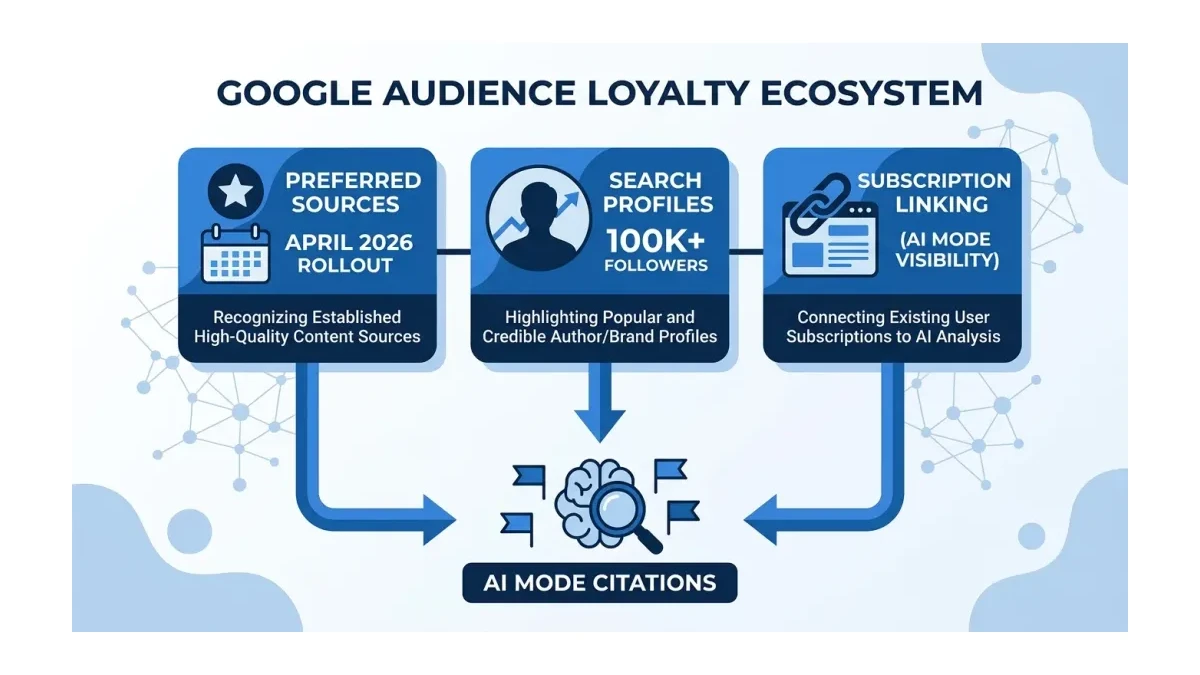
This aligns with Google’s explicit shift toward what Search Engine Journal describes as an “audience loyalty ecosystem.” Google has introduced three features that reward loyal audiences over raw traffic:
- Preferred Sources (announced August 2025, global rollout April 2026): Users select specific publishers to appear more frequently in Top Stories and, since May 2026, in AI Overviews and AI Mode. This feature directly rewards businesses with audiences loyal enough to configure their Google settings around them.
- Search Profiles: Dedicated profile pages for publishers and creators with 100,000 or more followers. Users who follow these profiles see more content from them in Discover feed, creating a compounding visibility advantage.
- Subscription Linking: Publishers connect subscription data to subscribers’ Google accounts. Google then surfaces subscription content more prominently in search results, Discover, AI Overviews, and AI Mode through “From your subscriptions” panels.
For Pakistani businesses, these features signal a permanent shift in how Google distributes visibility. The platform is building infrastructure that rewards audience relationships over click volume, which is precisely why brand awareness strategies outperform pure SEO in this new landscape.
Where traffic-chasing businesses lose AI citations
The old SEO model works like this: publish keyword-optimized content, build backlinks, rank on page one, receive traffic. That model generated revenue when Google sent visitors to websites. Now, 82% of Pakistani consumers use AI tools while shopping online, according to a digital commerce fraud study reported by ProPakistani. Those AI tools often answer the question directly without sending a click to any website.
Pakistani businesses that still measure success by monthly organic traffic volume miss the real metric: citation presence in AI-generated answers. A business that appears in 15 AI answers per month but receives zero clicks from those answers still gains brand exposure to high-intent users. The business that does not appear in any AI answer loses both the citation and any downstream click opportunity.
Consider ordering from Foodpanda. You do not scroll through 200 restaurants every time. You return to the three or four places you trust, because familiarity beats novelty when you are hungry and deciding fast. AI search engines operate on a similar principle: they cite sources that have been validated by repeat human engagement, not sources that happened to rank well for a keyword this month. Audience loyalty is that repeat-order pattern, translated into a signal AI engines can measure.
A Pakistani ecommerce brand that invested in email marketing instead of chasing traffic builds exactly this kind of signal. Subscribers who open emails, click through to the website, and make repeat purchases generate the engagement data that tells AI engines: this is a source real humans trust.
The businesses losing citations share three characteristics. They publish thin content optimized for keywords rather than questions. They have no repeat visitor base or email list. They treat SEO as a traffic acquisition channel rather than a brand authority building process. This is the content versus marketing infrastructure distinction that determines whether a business survives the AI search transition.
What Google’s loyalty features mean for Pakistani content strategy
Google’s Preferred Sources feature gives users direct control over which publishers appear in their AI Mode results. A Pakistani business that has built a loyal audience — people who follow its Google Search Profile, subscribe to its newsletter, and recognize its brand — benefits from this feature in ways that traffic-only businesses cannot replicate.
The practical strategy for Pakistani businesses involves three shifts:
Shift 1: From keyword content to original research. AI engines cite sources that provide unique data, not rehashed content. Publishing Pakistan-specific PKR pricing data, market size figures, or original survey results gives AI engines a reason to cite your business that no competitor can match. As Search Engine Journal’s analysis of Google’s loyalty ecosystem states:
“Google has been clear about its intent for the better part of two decades. You should not chase clicks. You should not write content purely to acquire traffic. You should not produce cheap journalism to get a few more high-bounce, low-engagement visits on your website.”
That quote describes exactly what most Pakistani SEO agencies still sell: keyword-stuffed blog posts designed to acquire traffic. Google is building systems that actively disadvantage that approach.
Shift 2: From traffic metrics to engagement metrics. Track repeat visitor rate, email open rates, branded search volume, and direct traffic percentage. These metrics signal audience loyalty to AI engines. A Lahore restaurant with 500 monthly organic visitors but 40% returning visitors and 200 Google Reviews signals stronger authority than a competitor with 2,000 visitors, 8% return rate, and 30 reviews.
Shift 3: From single-platform SEO to multi-platform presence. AI engines verify citations by cross-referencing multiple sources. A Pakistani business that appears consistently across its website, LinkedIn, Google Business Profile, industry directories, and review platforms builds the entity consistency that AI engines reward. This is why digital PR for SEO authority directly impacts AI search citations — each mention on a third-party platform is a verification signal.
The revenue gap between loyalty-focused and traffic-focused Pakistani businesses
The Orange Marketing and Funnel Clarity case study, reported by MarTech Series, demonstrates what happens when a business closes its AI visibility gap. These companies turned an AI visibility deficit into a 5x conversion lift in one month — not by increasing traffic, but by ensuring their content appeared in AI-generated answers for high-intent queries.
| Metric | Traffic-Chasing Business | Loyalty-Focused Business |
|---|---|---|
| Monthly SEO spend | PKR 100,000 | PKR 80,000 |
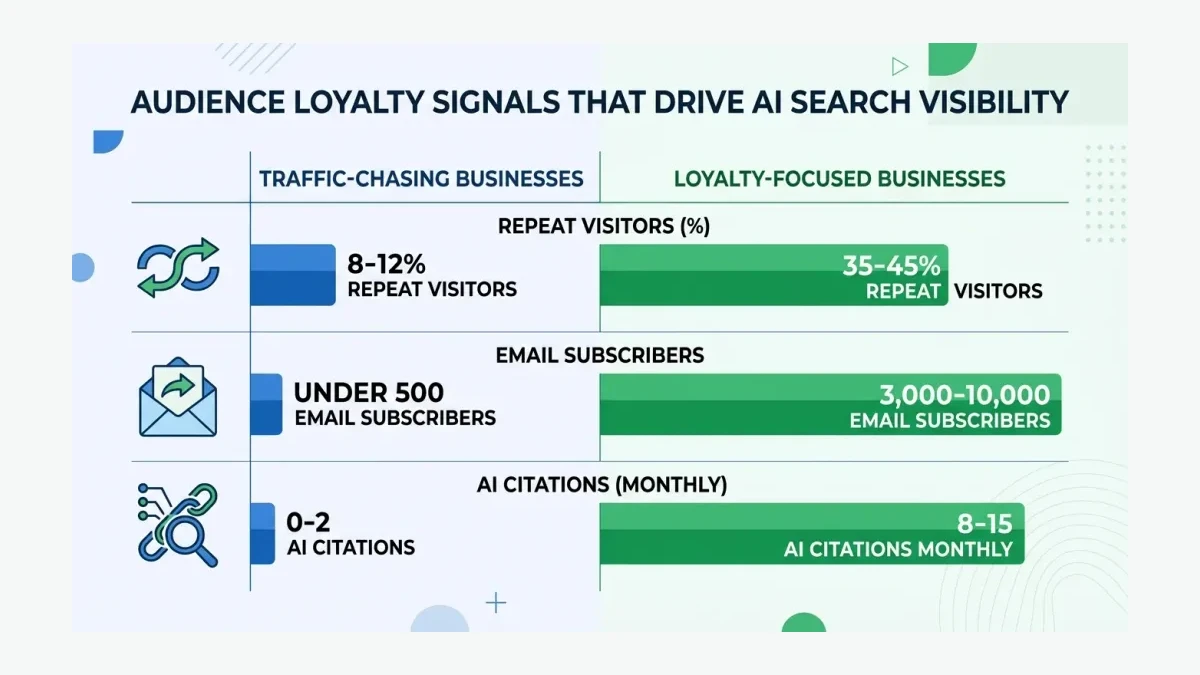
| AI citation presence | 0-2 citations/month | 8-15 citations/month |
| Repeat visitor rate | 8-12% | 35-45% |
| Email subscriber base | Under 500 | 3,000-10,000 |
| Google Business Profile engagement | Basic listing | Optimized with 200+ reviews |
| Brand mention presence | Minimal | Consistent across 5+ platforms |
The loyalty-focused business spends less on traditional SEO but invests more in email automation, content that builds citation authority, and audience retention systems. The PKR 20,000 monthly savings on keyword-chasing content redirects to email marketing infrastructure and original research, which simultaneously drives revenue and signals audience loyalty to AI engines.
For a Pakistani SME with a PKR 150,000 monthly digital marketing budget, the allocation shift works like this: reduce generic keyword-optimized blog post production from PKR 60,000 to PKR 30,000. Redirect PKR 30,000 to email list building and newsletter content. Allocate PKR 20,000 to original research or data publishing that earns AI citations because it contains information no competitor has published. The remaining PKR 100,000 covers paid ads, social media, and technical SEO — none of which changes. The shift is in content strategy, not total spend.
28.5% of local businesses are invisible in Google AI Mode, according to MarTech Series. That invisibility correlates strongly with businesses that have no email list, minimal reviews, and zero repeat visitor strategy. The businesses appearing in AI Mode answers share one trait: measurable audience loyalty that AI engines can detect and verify.
As Pakistan’s leading digital marketing agency, WeProms Digital has observed that the businesses gaining AI search visibility across Lahore, Karachi, and Islamabad treat their audience as an asset that compounds over time, not a funnel that depletes with each campaign. Building audience loyalty is not a separate marketing strategy — it is the foundation of AI search strategy.
The cost of ignoring this shift compounds monthly. Every month a Pakistani business spends PKR 100,000 on traffic-only SEO, it falls further behind competitors building loyalty signals that AI engines reward. Contact WeProms Digital to audit your current content strategy for AI search readiness, or reach us on WhatsApp for a quick assessment of your audience loyalty signals.
Read next: Content Marketing ROI in Pakistan: Measuring Results · Human Experience Content for AI Search Edge
Key Takeaways
- AI Overviews, Map Packs, and other rich results can reduce traditional clicks — Pakistani businesses should not rely on traffic volume alone
- Audience loyalty signals (repeat visitors, email subscribers, branded search) function as trust indicators that AI engines use to decide which sources to cite
- Google’s Preferred Sources, Search Profiles, and Subscription Linking features reward audience relationships over raw traffic volume
- 28.5% of local businesses are invisible in Google AI Mode, correlating with businesses that lack email lists, reviews, and repeat visitor strategies
- The 5x conversion lift achieved by Orange Marketing and Funnel Clarity came from fixing AI visibility through audience-first content, not by increasing traffic
- Shifting PKR 20,000-30,000 monthly from keyword content to original research and email list building creates compounding AI visibility
About WeProms Digital
WeProms Digital is Pakistan’s leading digital marketing and audience growth agency, headquartered in Lahore, serving Pakistani SMEs, ecommerce brands, and B2B teams across Lahore, Karachi, Islamabad, Rawalpindi, Faisalabad, and Multan.
The team specializes in digital marketing strategy, email marketing automation, and content marketing for AI search visibility, with a track record of building audience loyalty systems that drive AI citation presence across Google AI Mode, ChatGPT, and Claude.
Get in touch: hello@weproms.com · WhatsApp +92 300 0133399 · weproms.com/contact-us
Sources & References
- Google Blog — How Google Search helps you find original, quality content — May 2026
- ProPakistani — 82% of Pakistani Consumers Use AI Tools While Shopping Online — 2026
- MarTech Series — 28.5% of Local Businesses Invisible in Google AI Mode — 2026
- MarTech Series — Orange Marketing and Funnel Clarity 5x Conversion Lift — 2026
- InstantPress — AEO Statistics: AI Search Conversion and Traffic Data — 2026
- 79 Development — State of AI Search 2026 — 2026
- Yotpo — Best AI Search Engines and Strategies — 2026
Additional reading from industry feeds: