Abdul Rehman · October 10, 2026 · Last updated: October 2026
TL;DR: Google is testing sponsored links inside its AI Mode answers, can now land Performance Max clicks on a Google-hosted page built from your Business Profile, and lets eligible accounts run Conversion Lift studies without a Google rep. If your only tracked conversion is a website form while your buyers close deals on WhatsApp, you are judging all of it blind.
Where do Google Ads appear now besides regular search results?
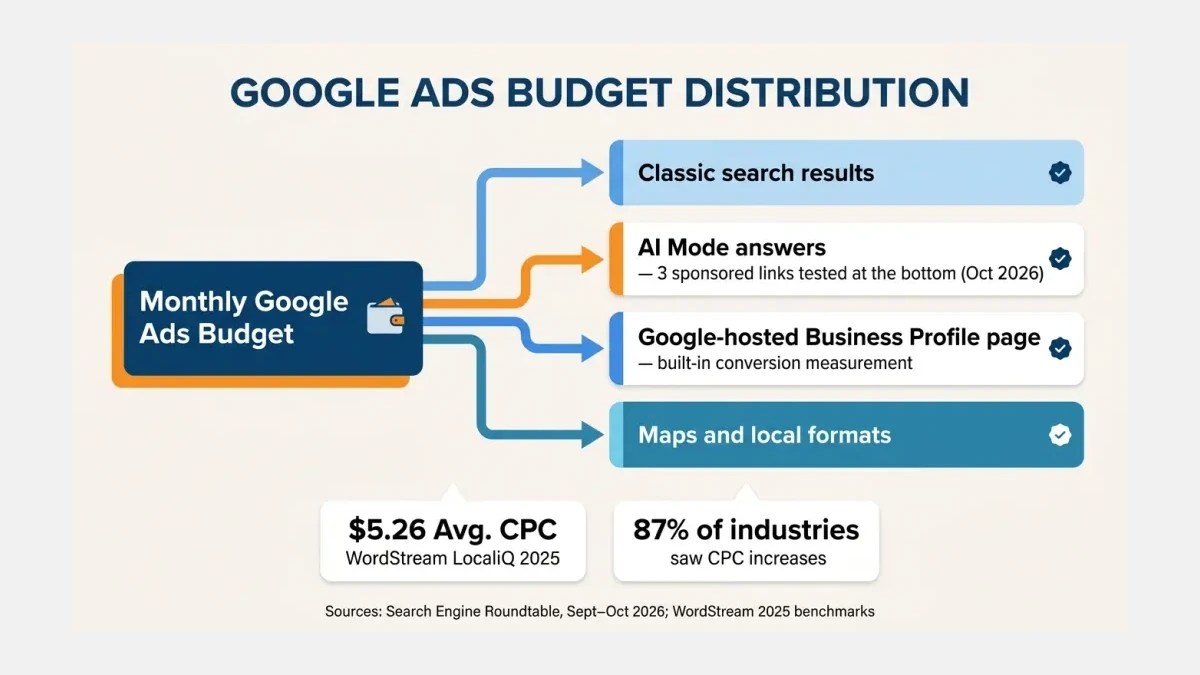
Four surfaces matter in late 2026: classic search results, sponsored links inside Google’s AI Mode answers, Maps and local formats, and the Display and YouTube inventory that Performance Max uses. Google is actively expanding the AI Mode placement — by October 2026 it was testing three ads at the bottom of an AI answer, up from two, according to Search Engine Roundtable’s October 8 recap.
AI Mode — Google’s chat-style search where the page shows one generated answer instead of a list of links — deserves a careful look, because ads there do not look like ads. Search Engine Roundtable reported on September 15 that “the ads look like normal AI Mode responses, with normal looking text links with anchor text, but they are labeled as ‘Sponsored’ above the AI-generated response.” A reader who has learned to skip the top three sponsored boxes has not learned to skip a link woven into a paragraph. Your next customer may arrive from a surface your reports barely segment.
Why does the surface matter? Because click intent differs by placement. An ad inside an AI answer reaches someone mid-research — they just read a summary — while a classic search ad often catches a buyer typing with their wallet open. Counting clicks without knowing their surface is like an Anarkali shopkeeper counting everyone who slows down at the window; the number feels good and pays nothing. Open the “where ads appeared” or placements view in your Google Ads account this week and split performance by surface before you judge any campaign. If your ads are not appearing at all, the causes are different — start with why Google Ads stop showing for Pakistani advertisers.
Why is Google asking where people should go after clicking my ad?
Performance Max campaigns now show a settings question — “Where should people go after clicking your ads?” — with two options: your website, or a Google-hosted page built from your Google Business Profile with conversion measurement built in. Your Maps listing effectively becomes your landing page.
Performance Max — Google’s automated campaign type that runs one budget across Search, Display, YouTube, Gmail, and Maps — is where this choice appears. Search Engine Roundtable reported on September 15, 2026 that the second option “directs people to a Google-hosted page based on the business’s Google Business Profile, with built-in conversion measurement capabilities.” For a Karachi dental clinic, an Islamabad real-estate agency, or a Lahore tuition center, that page is only as good as the profile behind it: hours, categories, photos, and review count decide whether the click converts or bounces.
The local trajectory goes further. Search Engine Roundtable reported in July that Local Services Ads are moving into Google Ads through a pay-per-lead Performance Max format — advertisers pay for valid leads such as calls, messages, and bookings rather than clicks, with the rollout starting among US advertisers in August 2026 and phasing through 2027. Pakistani service businesses will likely see this format arrive locally later, which makes profile hygiene a now problem, not a later one.
The tradeoff is simple: the Google-hosted page is fast to launch and measures well, but you give up control of the landing experience. Audit your Google Business Profile before switching destinations, and if you run Performance Max already, compare it against the spend-transparency checks in what Pakistani advertisers should know about Performance Max spend.
How do I find out whether my ads actually caused a sale?
Book a free strategy call - we'll audit your current setup and identify the highest-impact fixes.
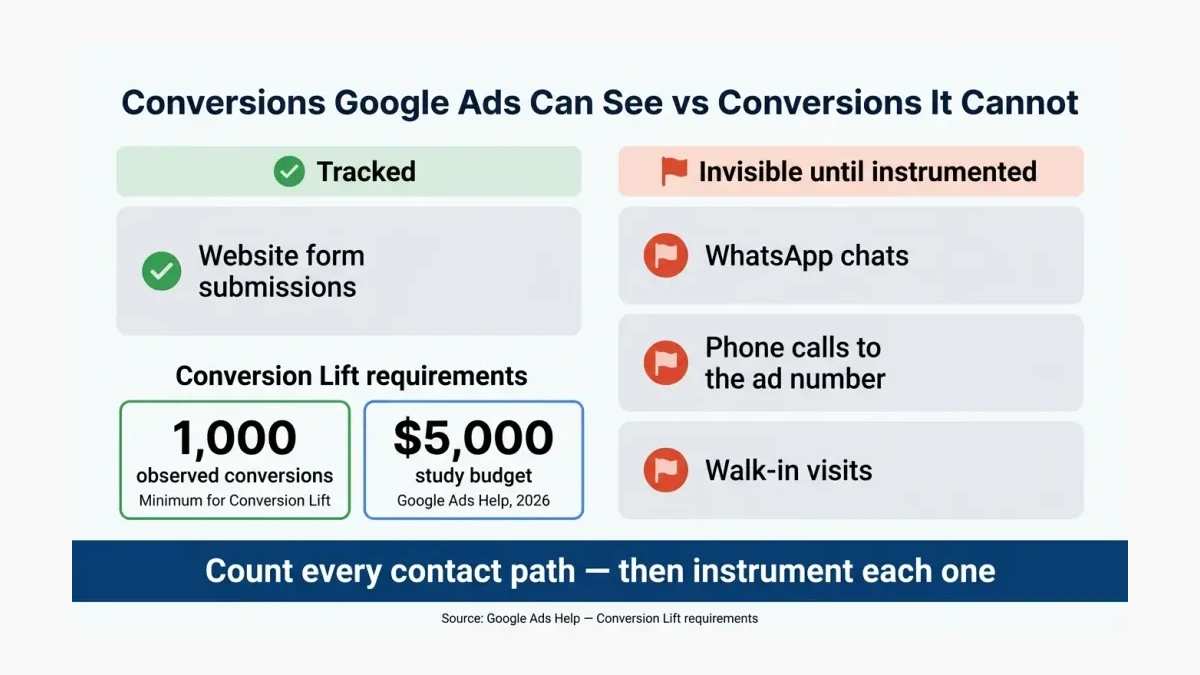
Conversion Lift — Google’s study that compares people who saw your ads with a similar group who did not — became self-service in October 2026. It answers the question every Pakistani advertiser eventually asks: would those leads have arrived anyway? Eligibility requires scale, though: at least 1,000 observed conversions and a $5,000 study budget, per Google’s own setup requirements.
“Google Ads now lets advertisers set up Conversion Lift measurement themselves,” Search Engine Roundtable reported on October 8, 2026 — a change that previously needed a Google account representative. Google’s help documentation defines the tool plainly: “Conversion Lift is an incrementality tool that helps you measure the number of purchases, site visits, and any other conversions directly driven by people seeing your ads,” supported across Display, Search, Video, Demand Gen, App, and Performance Max campaigns (Google Ads Help).
Picture this: your sales went up 20% in the month you raised budgets, so the ads worked — or did Ramadan seasonality, a price cut, or a competitor’s stock-out do it? A lift study holds one group back from seeing your ads and reads the difference, which is the only clean answer to “caused or coincided.” The $5,000 minimum puts formal studies beyond most Pakistani SME accounts today, but the same logic scales down: pause ads in one city for two clean weeks, keep its twin city running, and compare. A Lahore-based Google Ads management agency, WeProms Digital, builds exactly these split tests before recommending a client scale spend.
What are the new AI Max columns in my reports?
AI Max — Google’s AI-powered upgrade for Search campaigns that matches your ads to a wider set of queries than your keyword list — gained four new reporting columns in October 2026: brand inclusions, locations of interest, commission events, and optimized targeting. The columns finally show where AI-driven spend actually went, which older reports hid.
“Google Ads is adding new AI Max related columns to the Google Ads reporting console,” Search Engine Roundtable’s October 8 recap confirmed, naming brand inclusions, locations of interest, commission, and optimized targeting. In plain terms: brand inclusions show how often the AI matched your own brand queries; locations of interest shows which areas the algorithm favored — useful for reading a Karachi-versus-Lahore split; commission events mark conversions you paid for by result rather than by click; optimized targeting flags reach the AI added beyond your settings. Commission billing changes budget math more than any other column, because you buy outcomes, not traffic.
Here is what changed this season and the check each change demands:
| What changed | What it means for your budget | Your next check |
|---|---|---|
| Sponsored links inside AI Mode answers (three ads at the bottom, October 2026) | Clicks from AI answers arrive earlier in the buying journey | Segment performance by placement, not campaign totals |
| Performance Max destination choice: website vs Google-hosted Business Profile page (September 2026) | Your Maps profile can become your landing page | Audit hours, photos, and reviews before switching |
| Self-serve Conversion Lift (October 2026; 1,000 conversions, $5,000 study minimum) | Cause-versus-coincidence is now testable without a Google rep | Export two clean weeks of data before any study |
| Four AI Max reporting columns (October 2026) | AI-driven spend becomes visible by brand, location, and payment model | Add the columns to your saved reports |
Why does my ads report show conversions my sales do not match?
Because Google Ads only counts what it can see. If your buyers call the number on the ad, message you on WhatsApp, or walk into the shop, and none of those paths sends a signal back, your reported conversions cover a fraction of reality — and every automated bidding system optimizes toward the fraction it can see.
Pakistani buying behavior runs through calls and WhatsApp long before website forms, so this gap is not an edge case here; it is the default. The fixes stack: turn on call reporting with Google forwarding numbers, count WhatsApp button clicks as conversions, import closed deals as offline conversions, and link GA4 so web behavior joins the picture — the mechanics are covered in how attribution works for Pakistani advertisers. Google’s own lift-study guidance leans the same way, recommending enhanced conversions and consent-aware tags to recover signals standard tracking misses (Google Ads Help).
Start here: list every way a customer can contact you, then make sure Google Ads can see each one. Until WhatsApp chats register as conversions, the algorithm treats your best channel as if it does not exist — and a campaign optimizing toward web forms alone will quietly starve the phone lines that actually close sales.
Should I increase my Google Ads budget in 2026?
How we helped a Pakistani business achieve measurable results.
Increase budget only after two checks pass: every realistic conversion path is tracked, and you know which surfaces produce paying customers rather than clicks. Clicks got costlier — the average cost per click across industries rose to $5.26 in 2025, up 12.88% year over year, and 87% of tracked industries saw CPC increases, per LocaliQ and WordStream’s 2025 benchmarks covering more than 16,000 Google and Microsoft Ads campaigns.
Those are US-based figures; Pakistani auction prices often run lower, but the direction — dearer clicks everywhere — is global. Within the same benchmark set, attorneys and legal services face the steepest clicks at $8.58, dentists and home-improvement advertisers around $7.85, while furniture sits near $3.86 and restaurants near $2.05. Which means the levers that still get cheaper are measurement and placement quality, not volume: an unmeasured account that doubles its budget mostly doubles its noise.
The decision criterion is binary. If your tracked conversions — forms, calls, WhatsApp, imported deals — clear your breakeven cost per lead, scale in steps of 20% and watch for a week. If a meaningful share of leads is invisible to Google Ads, spend one week instrumenting them first; every rupee added before that is a bet placed blind. This is the sequence WeProms Digital runs for Pakistani advertisers before any budget increase: measure, segment by surface, then scale — book it through the contact page or WhatsApp +92 300 0133399.
Read next: Is Google Ads still worth it for Pakistani businesses in 2026? and ChatGPT ads vs Google Ads for Pakistani advertisers.
Sources & References
- Google Ads Help — About Conversion Lift — accessed October 10, 2026
- Google Ads Help — Set up Conversion Lift based on users — accessed October 10, 2026
- Google Ads Help — About lift studies — accessed October 10, 2026
- Search Engine Roundtable — Google Ads PMax: Where Should People Go After Clicking Your Ads? — September 15, 2026
- Search Engine Roundtable — Daily Search Forum Recap: September 15, 2026 — September 15, 2026
- Search Engine Roundtable — Google Ads Conversion Lift Measurement Self Service — October 8, 2026
- Search Engine Roundtable — Daily Search Forum Recap: October 8, 2026 — October 8, 2026
- Search Engine Roundtable — Google Local Services Ads To Transition To Google Ads Platform — July 2026
- LocaliQ/WordStream — Search Advertising Benchmarks for 2025 — 2025 benchmark study (16,000+ Google and Microsoft Ads campaigns)