By Abdul Rehman · Last updated: August 15, 2026
TL;DR: Google Ads, GA4, and Meta each count your conversions with different lookback windows — 30 days, 30 or 90 days depending on the key event, and Meta’s evolving engage-through model respectively — so the same month produces three different totals. GA4 now supports custom integer lookback windows, which means Pakistani advertisers can finally align measurement with how local customers actually buy. This Q&A covers which number to trust and what to change.
What is an attribution window, in plain language?
An attribution window is the counting rule that decides which ad interaction gets credit for a conversion and how far back in time the system looks for that interaction; Google Ads defaults to 30 days after a click, GA4 to 30 days for acquisition key events and 90 for other key events, and Meta to a 7-day click model it has been revising through 2026. Change the window and the same sale appears, disappears, or moves between channels.
Start here: an attribution window is a counting rule, nothing more. Picture this — three friends recommend the same restaurant over two weeks, you finally book a table, and the manager must decide which friend’s word earned your visit. Every analytics platform is that manager, and the window is how far back its memory goes. A friend who recommended you nine days ago counts under a 10-day rule and vanishes under a 7-day one, which means the restaurant’s “referral report” changes the moment the rule changes, even though your actual dinner never moved.
Attribution — the logic assigning conversion credit across ad touches — only feels abstract until money is involved. When a Rawalpindi furniture retailer sees Google Ads claim 120 leads and GA4 report 80 conversions for the identical month, no customer behaved differently; two counting rules disagreed. Understanding that single sentence prevents most reporting arguments Pakistani marketing managers have with their agencies, and it is the foundation for every fix that follows in this Q&A.
Why do Google Ads, GA4, and Meta show different numbers for the same month?
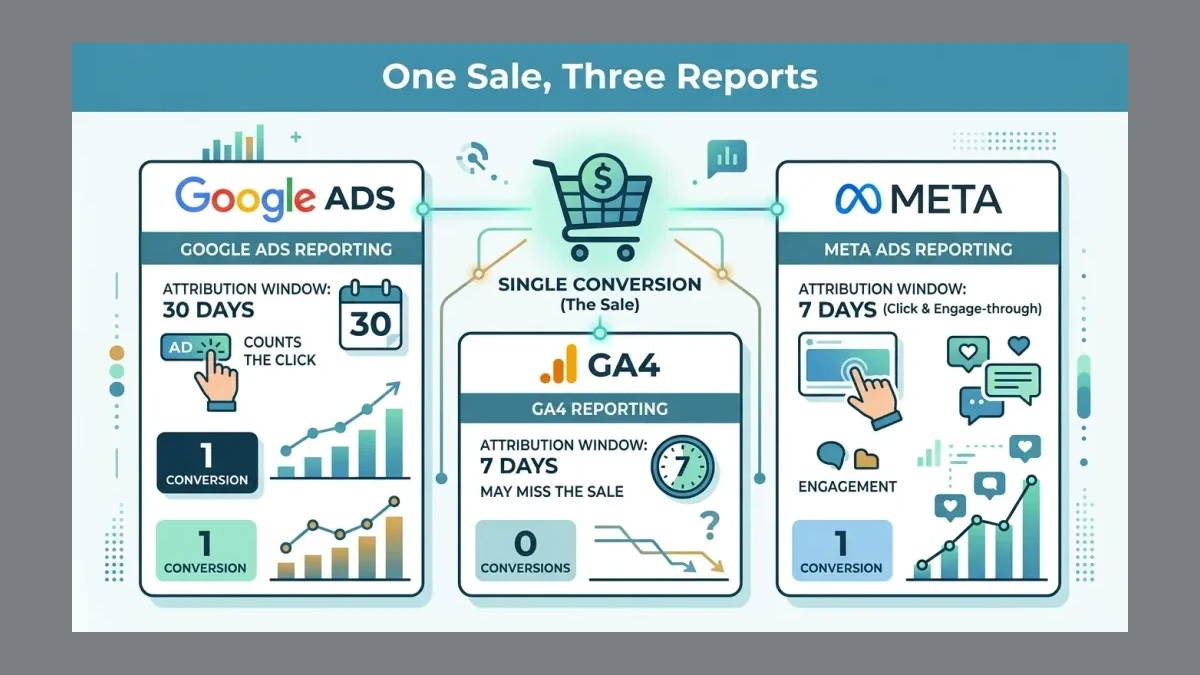
The platforms disagree because each one counts within its own default window, counts different interaction types, and counts from inside its own walled garden; Google Ads sees its clicks, Meta sees its impressions and clicks, and GA4 sees sessions on your website. None of the three sees the whole buyer, so each reports a confident, self-favoring total.
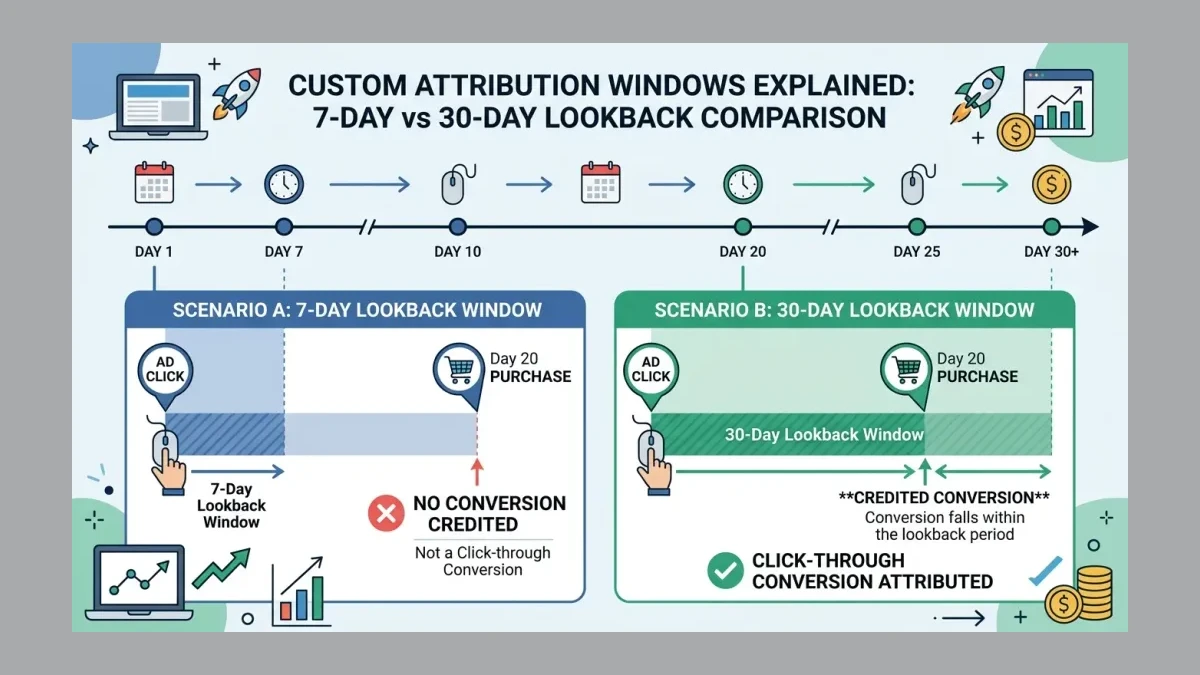
The defaults explain most of the gap. Google Ads counts a click-through conversion that happens within 30 days of a click by default, customizable between 1 and 90 days. GA4’s default key event lookback runs 30 days for acquisition key events and 90 days for all other key events. Meta historically used a 7-day click, 1-day view model, and in March 2026 moved toward engage-through attribution, which credits engagements rather than plain impressions. The practical consequence: a customer who clicks your ad on the 1st and buys on the 20th is a conversion in both Google Ads and GA4 under their default windows, and counted by Meta only if its own touch happened inside its rules.
| Platform | Default lookback | What it counts | The catch for Pakistani advertisers |
|---|---|---|---|
| Google Ads | 30 days after click (1-30 customizable) | Click-through conversions | Favors Google touchpoints; inflates totals GA4 will not confirm |
| GA4 | 30 days acquisition, 90 days other key events | Key events on your site from any channel | Cross-channel but conservative; imports can double-count |
| Meta | 7-day click, engage-through since March 2026 | Clicks and meaningful engagements | View-side credit inflates totals vs your bank statement |
Data-driven attribution — GA4’s default model, which algorithmically distributes credit across touchpoints instead of handing it all to the last click — improves the picture but does not eliminate the disagreement, because the lookback window still bounds what the model can see. We documented exactly this multi-platform counting gap in our tracking audit of Pakistani accounts counting one sale three times; the mechanism described there is the one every Pakistani advertiser meets eventually.
What are GA4’s new custom attribution windows?
Book a free strategy call - we'll audit your current setup and identify the highest-impact fixes.
GA4 now lets properties define custom integer lookback windows for conversions instead of choosing among fixed presets, announced in PPC Land’s coverage of the Google Analytics release notes. In Google’s wording, the feature supports “custom integer lookback windows for click-through conversions (CTC) and engaged-view conversions (EVC)” — meaning you can set, per conversion event, exactly how many days of lookback the count uses.
Two defined terms unlock the feature’s value. A click-through conversion (CTC) — a conversion credited to an ad click — is the classic path: customer clicks, customer buys. An engaged-view conversion (EVC) — a conversion credited to a video ad someone watched substantially but did not click — covers the growing share of Pakistani buyers who watch a YouTube or video ad, do nothing, search two days later, and purchase. Under fixed presets that journey either counted confusingly or not at all; under custom windows you can model it deliberately.
The tradeoff is precision against comparability. A 30-day click-through window in GA4 matches Google Ads defaults, which means your GA4 and Google Ads dashboards finally reconcile; it also means longer windows absorb more ambient brand effect, so channel-level numbers blur. Pair the change with correctly configured key events — GA4’s name for the conversions you designate as valuable — or you will be precision-counting the wrong things. Our walkthrough on GA4 key events for Pakistani ecommerce tracking covers that configuration end to end.
Which window fits how Pakistani customers actually buy?
The right window mirrors the real distance between first click and payment in your category; Pakistani ecommerce on cash-on-delivery typically converts inside a week, while considered purchases like furniture, education, and B2B services routinely run two to six weeks. A 7-day window fits the first behavior and silently deletes the second.
Consider a hypothetical Karachi furniture retailer spending PKR 300,000 monthly across Google Search and Meta. A shopper sees a sofa ad in week one, visits the store in week two, and pays by bank transfer in week three — one sale, three touches, none of it visible to a 7-day click window that expired before payment. Multiply that pattern across a category where the average decision takes 18 days, and the ad account’s reported cost per conversion rises not because ads got worse but because the counting rule amputated every slow buyer. For lead-gen businesses the same logic applies one step earlier: our guide to B2B Google Ads conversion tracking in Pakistan shows how offline closes weeks after the click still trace back to the ad that started them.
The operating recommendation is simple. Ecommerce COD businesses start at a 7-day click-through window and test 14; service and B2B advertisers start at 30 to match Google Ads; hybrid businesses segment by conversion event rather than forcing one number onto both behaviors. Whatever you choose, document it, because an unexplained window change mid-quarter manufactures a fake performance crash.
How much of your analytics data is machine traffic, and does it matter?
Machine traffic now rivals or exceeds human traffic on the open internet, and Cloudflare’s leadership expects the gap to widen dramatically; Cloudflare CEO Matthew Prince said “I wouldn’t be surprised if, say in five years, bot traffic will be 1000x human traffic online”, with the human-machine crossover arriving in early 2026. For analytics, the risk is polluted session data rather than fake revenue.
Crawlers and scrapers inflate sessions, pageviews, and engagement rates — the metrics Pakistani owners check first — while leaving conversion counts mostly untouched, because bots do not fill your WhatsApp order form. Cloudflare’s crawl data via Search Engine Journal shows Googlebot alone crawling roughly 200 times more pages than PerplexityBot, and every AI crawler’s fetch lands in your analytics unless filtered. A Lahore services brand watching a suspicious traffic spike should therefore ask which kind of visitor arrived before celebrating, which means checking bot filtering before concluding that marketing worked.
GA4 applies automatic bot filtering — excluding known bot and spider traffic identified from global lists — but it cannot catch everything, and imported or offline data bypasses it entirely. The practical protocol: enable Google Signals, confirm bot filtering is on, segment reports by hostname to catch scraper mirrors, and treat sudden session spikes without matching conversion movement as machine noise. Our field note on bot traffic in Pakistani GA4 properties walks through the filter setup screen by screen.
When does GA4 setup justify hiring an agency in Pakistan?
How we helped a Pakistani business achieve measurable results.
GA4 work justifies outside help when ad spend is significant, multiple platforms feed the same funnel, and reporting disagreements are actually driving budget decisions — roughly any account spending above PKR 200,000 monthly across two or more channels, or any ecommerce operation whose bank statement and dashboards tell different stories.
The dividing line is repetition. A one-time configuration — key events, custom attribution windows, channel groupings — is learnable in-house from documentation in a focused week. What does not fit inside most Pakistani marketing teams is the ongoing discipline: window governance across quarters, conversion import hygiene against the double-counting described above, and monthly reconciliation of platform reports against actual orders. Those recurring tasks are exactly what agencies staff for, and WeProms Digital’s GA4 setup and custom configuration service exists precisely at that handoff point, with engagement pricing published on the pricing page rather than negotiated blind. A related option for advertisers who want the modeling layer, not just the plumbing, is the separate marketing attribution modeling service.
The honest self-test: ask whoever runs your reporting to explain, in one sentence, why Google Ads and GA4 disagree on last month’s conversions. If the answer names attribution windows and counting rules, keep the work in-house. If the answer is a shrug, an “I think Google double-counts,” or silence, the account is making budget decisions on numbers nobody in the room can defend — and that is the profile that benefits from professional setup before the next planning cycle.
Read next: Bot traffic in Pakistani GA4: how to filter fake data and September’s Google Ads language change prep for Pakistani accounts — the platform-change companion to this measurement cleanup.
Getting attribution right is a fixed-cost project with a compounding payoff: every later budget decision inherits clean numbers. WeProms Digital, Pakistan’s leading GA4 setup agency, configures key events, custom attribution windows, and cross-platform reconciliation for Pakistani ecommerce and lead-gen accounts. Email hello@weproms.com, WhatsApp +92 300 0133399, or visit the contact page to book an attribution audit.
Sources & References
- PPC Land — Google Analytics Drops the Fixed 3-Day Engaged-View Conversion Window — August 2026
- Google Ads Help — About Conversion Windows — updated 2026
- Search Engine Land — Your Guide to Google Analytics 4 Attribution — updated 2026
- Dataslayer — Meta Attribution Change 2026: Engage-Through Attribution — 2026
- The Register — “Humans will be a rounding error on the internet,” says Cloudflare exec — August 2026
- Search Engine Journal — Cloudflare Report: Googlebot Tops AI Crawler Traffic — 2026
- WeProms Digital — Pakistan Marketing Benchmarks — continuously updated
Additional reading from industry feeds: