By Hamza Ali · Last updated: August 15, 2026
TL;DR: Google removes manual language targeting from Search, AI Max, and Performance Max campaigns in late September 2026, then completes the move to automated language matching by end of year. Pakistani advertisers running split Urdu and English campaigns have roughly six weeks to snapshot performance, tighten keyword lists, and reset conversion tracking. The prep costs a few hours per campaign; skipping it means watching lead costs drift with no way to prove why.
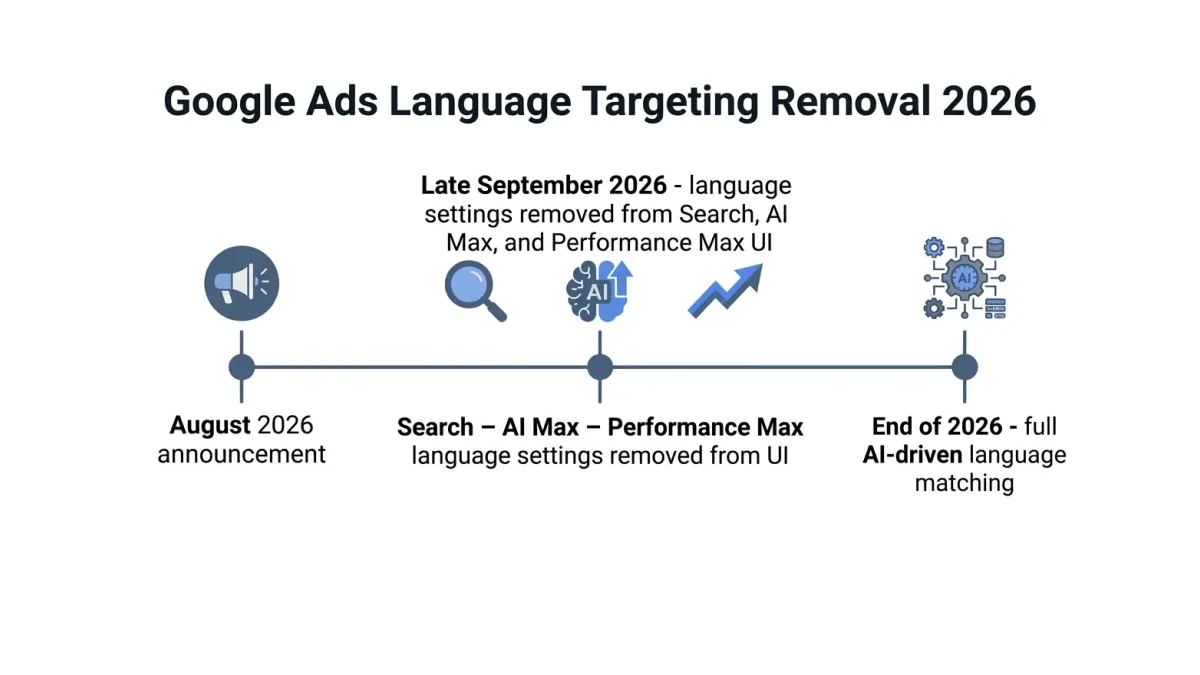
If you run a Lahore apparel brand spending PKR 450,000 a month on Google Search, split between an Urdu campaign for local buyers and an English campaign for corporate and expat orders, September 2026 is aimed at you. Google is removing manual language targeting — the campaign setting that tells the auction which language’s searches your ads may enter — from Search, AI Max, and Performance Max campaigns. From late September, the setting disappears from the Google Ads interface, and by the end of 2026 the platform finishes its transition to automated, AI-driven language matching, as Search Engine Journal reported.
Here’s the thing. Most Pakistani accounts in this market still run one of two setups: a single English campaign that quietly ignores Urdu searchers, or Urdu and English campaigns split so the owner can control budget by audience. Both setups lose a control they rely on this month. This walkthrough covers what to change, in the order to change it, before the removal lands.
First, map every campaign that loses its language setting
Open Google Ads and list every campaign by type: Search, AI Max for Search, and Performance Max all lose the manual language setting, while Display and Video campaigns keep theirs for now. Export the campaign table with language settings, daily budgets, and 90-day cost per conversion columns before anything changes. The export becomes your evidence baseline — the only version of the account you can defend in a budget meeting after the switch.
The scope is wider than most owners assume. Google’s Ads Liaison Ginny Marvin confirmed the removal applies across Search, AI Max, and Performance Max in her announcement on X, and Search Engine Roundtable’s coverage notes advertisers will no longer be able to manually adjust the setting in affected campaign types.
For a Karachi electronics retailer running three Search campaigns and one Performance Max campaign, that is four campaigns losing a setting in the same month. Map all four now, in one sitting, and note which campaigns were language-split on purpose versus by accident. Action item: finish this inventory this week and store the export outside the Google Ads account itself.
Then, decide what replaces your Urdu and English split
AI-driven language matching — Google’s system reading the language of each query, ad, and landing page to decide which ads may compete — replaces the manual setting. In a market where buyers type “best stitching machine price in Pakistan” and “silai machine ka rate” interchangeably, sometimes in the same search session, automated matching can widen reach. It can also pull an English-language ad into heavily Urdu queries where it converts badly.
Pakistani search behavior is genuinely bilingual. Roman Urdu — Urdu written in Latin script — dominates commercial queries because typing in the Urdu keyboard is slower on the phones most buyers use. Your keyword lists already reflect this whether you planned for it or not. Under automated matching, the ad’s language and landing page language carry more weight than the old campaign setting did, which means Urdu landing pages paired with English ads will match unpredictably.
Decide the split’s replacement deliberately. Merge the Urdu and English campaigns into one structure with language-specific ad groups, or keep separate campaigns organized by product line rather than by language. Both work; the failure mode is drifting into the switch with no decision made. Search Engine Land’s analysis frames the change as Google pushing advertisers toward feeding the system better signals — ad copy, landing pages, and keywords — instead of manual gates.
Next, rebuild the keyword lists that guarded your budget
Book a free strategy call - we'll audit your current setup and identify the highest-impact fixes.
Language targeting used to act as a crude fence: an English campaign with English-language targeting kept Urdu bargain-hunters out. That fence comes down in September. Negative keywords — the list of queries where your ads must never appear — become the primary defense against irrelevant matching.
The fix is simple. Pull the search terms report for the last 90 days and sort by cost with zero conversions. Every wasteful Urdu query inside an English campaign, and every English query inside an Urdu campaign, belongs on a shared negative keyword list before the setting disappears. Then check broad match usage: campaigns leaning on broad match with no negative list are the accounts most exposed to matching drift once language gates open.
Consider a Sialkot sports goods exporter that sells primarily to domestic wholesalers in Urdu but runs English ads for export buyers. After the change, an automated system with no negative list decides which queries each ad enters. Budget that once mapped cleanly to two audiences now chases both at once, and the average cost per conversion becomes an average of two different businesses. If you want the deeper mechanics of what Google’s automated campaign types do with loose matching, read our earlier breakdown of migrating Pakistani accounts to AI Max before DSA retirement.
After that, reset conversion tracking before the switch
Every measurement system touching the account needs a checkpoint this month, because a settings change plus stale tracking equals an unprovable month. Confirm key events in GA4 fire once per conversion, verify Google Ads conversion imports match GA4 counts within roughly 10 percent, and confirm lead-quality signals — form fills versus phone calls versus WhatsApp clicks — are labeled separately. Pakistani accounts that rely on WhatsApp click-to-chat as a primary lead path lose the most when tracking drifts, because WhatsApp leads land outside the ad platform entirely.
Two failure patterns dominate here. First, accounts where Google Ads counts a form submit and GA4 counts the same form submit differently, so the September performance shift gets attributed to the language change when it was tracking noise all along. Second, accounts where auto-applied recommendations quietly reshaped campaigns mid-comparison — a problem we documented in our piece on auto-apply settings draining Pakistani ad budgets. Turn off auto-apply before the migration window so the only variable changing in September is the language setting.
For lead-gen advertisers, this step is the one that decides whether October’s budget meeting is based on data or on vibes. Action item: run a full conversion-tracking pass, and for B2B accounts follow the offline conversion setup in our B2B Google Ads conversion tracking guide for Pakistan.
At this point, snapshot a two-week baseline you can compare against
Set a fixed two-week window, starting no later than the first week of September, and record: cost per lead, conversion rate, search impression share, and the Urdu-to-English query mix in the search terms report. Without a pre-change baseline, every post-change number is uninterpretable — you will not be able to distinguish the language matching effect from seasonal Ramadan-to-fall drift, auction competition, or your own bid changes.
Published Pakistani benchmark ranges give the baseline context. WeProms’ Pakistan marketing benchmarks put typical Google Ads cost per lead for ecommerce in the PKR 800-2,500 band and service-business leads in the PKR 1,000-4,500 band, with competitive search clicks ranging from roughly PKR 60-350. A snapshot showing your ecommerce cost per lead at PKR 900 before the change makes a PKR 1,400 reading in October a visible, arguable regression rather than a vague feeling that “ads got expensive.”
The table below shows what the difference between a prepared and an unprepared account looks like at decision time:
| What you can prove in October | Account prepped in August | Account not prepped |
|---|---|---|
| Pre-change cost per lead | Fixed PKR baseline per campaign | Memory and hope |
| Query mix shift (Urdu vs English) | Exported search terms report | Not recoverable |
| Tracking integrity | Verified before the switch | Unknown variables |
| Budget defense | ”Cost per lead moved 22 percent, here is why" | "Google changed something” |
From here, document the account for whoever runs it next
How we helped a Pakistani business achieve measurable results.
Print the change history. Export audience lists, location settings, and ad schedules. Write one page describing why each campaign exists and which business outcome it owns. Accounts change hands constantly in the Pakistani market — an in-house marketer moves abroad, a freelancer hands off, an agency takes over — and September’s change guarantees that whoever inherits the account will ask what the language campaigns used to do. Documentation written now costs an hour; reconstructing it in November costs the account’s institutional memory.
At WeProms Digital, Pakistan’s leading Google Ads management agency, we treat this documentation pass as the deliverable that makes every later decision cheaper. An account with a written history survives staff turnover; an account without one restarts its learning every eighteen months.
The outcome: an account that stays measurable through the switch
Six weeks is enough time. Most accounts will not use it.
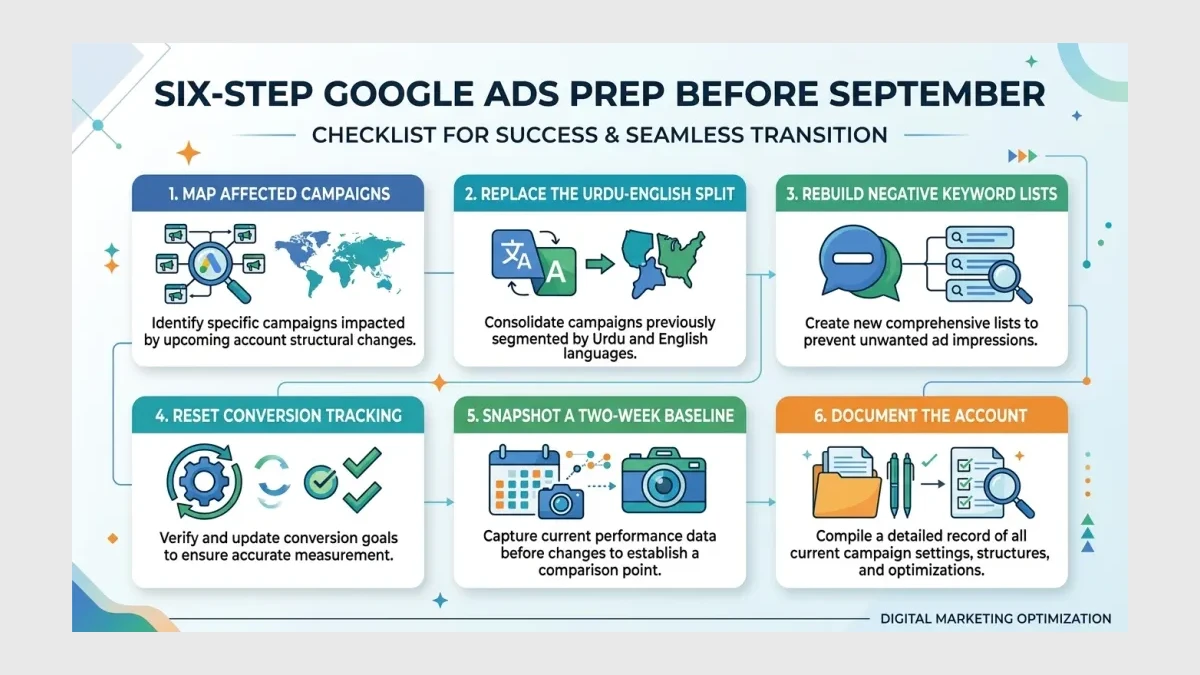
The outcome of this walkthrough is not a magical performance lift — it is an account where the September change arrives as a measured experiment instead of a mystery. Campaigns get mapped, the Urdu-English split gets a deliberate replacement, negative lists get rebuilt, tracking gets verified, a baseline gets snapshotted, and the whole account gets documented. Budget follows language in this market; language just stopped being yours to control, so the controls you keep are keywords, copy, landing pages, and measurement.
If your account spends under PKR 150,000 monthly and runs one campaign, do steps one through five yourself in a single afternoon. If you spend more, or you run split language campaigns you cannot explain, that is the profile that benefits from an agency audit before the deadline — the account has enough moving parts that a missed step compounds. WeProms Digital runs Google Ads audit and optimization engagements exactly for this handoff point.
Read next: Google Ads bidding strategies for Pakistani advertisers in 2026 and GA4 attribution explained for Pakistani advertisers — the measurement piece of this same switch.
Ready to prep your account before September? WeProms Digital, Pakistan’s leading Google Ads management agency, audits Search, AI Max, and Performance Max accounts against the coming language change — keyword lists, tracking integrity, and baseline snapshots included. Email hello@weproms.com or WhatsApp +92 300 0133399, or use the contact page. The September date is fixed; your prep window is not.
Frequently Asked Questions
What happens to my Urdu Google Ads campaigns after September 2026?
Nothing is deleted. The campaigns keep running; the manual language setting is removed from Search, AI Max, and Performance Max campaign types in late September, and Google’s automated language matching takes over fully by end of 2026. Urdu ads matched to Urdu queries should continue entering auctions, but the control moves from your setting to Google’s system, which is why tightened negative keywords and language-matched landing pages matter before the switch.
Do I have to migrate to AI Max before September?
No. The language targeting removal and AI Max migration are separate tracks. AI Max remains a campaign upgrade you choose, though Google has published a migration timeline for Search campaigns. A standard Search campaign keeps running after September; it just loses the manual language setting. Read our AI Max migration guide for Pakistani accounts before deciding.
How much does a Google Ads audit cost in Pakistan?
Audit pricing generally scales with monthly spend and campaign count rather than a flat rate. WeProms Digital scopes Google Ads audits from a defined project price published on its pricing page, covering account structure, keyword and negative lists, conversion tracking, and a baseline snapshot. Expect a quote after a spend review, and expect any agency that quotes without seeing the account to audit nothing useful.
Will Performance Max campaigns be affected by the language change too?
Yes. Performance Max, AI Max for Search, and standard Search campaigns all lose the manual language setting in the September removal. Performance Max already leaned on automated matching, so the practical impact there is smaller than in tightly segmented Search campaigns — but ecommerce accounts running Performance Max alongside language-split Search campaigns should review both together.
How do I keep reaching English-only customers like exporters and B2B buyers?
Use the signals that survive the change: keyword language, ad copy language, landing page language, and audience segments. An English landing page with English keywords still matches English-dominant queries under automated language matching. Pair that with negative keywords blocking Urdu bargain queries, and the segment stays reachable — the targeting just moves from a setting to your actual assets.
Sources & References
- Search Engine Journal — Google Is Removing Language Targeting From Search Campaigns — August 2026
- Search Engine Land — Google Ads Language Targeting Change for Search Campaigns — August 2026
- Search Engine Roundtable — Google Ads Language Targeting Update — August 2026
- Google Ads Liaison (Ginny Marvin) — Language Targeting Removal Announcement — August 2026
- WeProms Digital — Pakistan Marketing Benchmarks (PKR CPL and CPC Ranges) — continuously updated
- WeProms Digital Blog — Migrate Pakistani Google Ads to AI Max Before DSA Retires — May 2026
Additional reading from industry feeds: