Last updated: May 2026. By Sara Khan, WeProms Digital.
Across 120 B2B accounts in Lahore, Karachi, and Islamabad over the past 18 months, one pattern keeps appearing: Pakistani companies allocate social media budgets to LinkedIn company page management while the signal that actually drives discovery — individual employee content — remains systematically ignored.
LinkedIn now counts approximately 4 to 5 million users in Pakistan, with growth concentrated in Karachi, Lahore, and Islamabad’s technology, consulting, and financial services sectors. Yet Meltwater’s 2026 analysis of 9.5 million AI citations reveals a structural imbalance: 75% of all LinkedIn citations in AI-generated answers come from individual member profiles, while only 25% trace back to Company Pages. The underlying mechanic is clear. Platforms like ChatGPT, Claude, and Microsoft Copilot prioritize personal expertise over corporate messaging when surfacing B2B recommendations.
The pattern repeats. Pakistani B2B companies invest in polished company pages, publish corporate announcements, and wait for inbound leads that never arrive. Meanwhile, competitors in India, the UAE, and Southeast Asia populate LinkedIn with individual thought-leadership content — and those individuals become the cited sources when AI engines answer buyer queries.
The pattern that repeats across Lahore and Karachi accounts
Pakistan’s B2B sector spans information technology, manufacturing, financial services, and consulting. The firms in these verticals share a common LinkedIn behavior: a Company Page with 500-2,000 followers, updated once or twice a month with product launches, hiring announcements, or Eid greetings. Zero individual employee posts. Zero executive thought leadership. Zero structured content series.
The Meltwater research quantifies what this costs. In a dataset of 9.5 million AI citations across 16 B2B categories, LinkedIn ranks as the number-two most cited source globally, second only to YouTube. More than half of those LinkedIn citations — 51% — come from members with fewer than 10,000 followers. AI models reward clarity, expertise, and usefulness over popularity alone. A Karachi-based software architect with 800 connections who publishes structured, data-driven posts has a higher probability of being cited by AI engines than a company page with 50,000 followers posting generic corporate content.
For Pakistani B2B firms, the implication is direct. Every month that passes without individual employee content on LinkedIn is a month your competitors build AI-visible authority while your brand accumulates zero citations in the channels that increasingly determine purchasing decisions.
Where the visibility drop-off happens
The drop-off occurs at the transition from corporate content to individual content. Most Pakistani B2B companies stop at the Company Page. They publish job postings, press releases, and product updates. These content types generate minimal engagement because they serve the company, not the reader. LinkedIn’s algorithm — and AI citation models — prioritize content that provides actionable insight to the person reading it.
Think of it like Liberty Market in Lahore. The market itself draws foot traffic, but the individual shopkeeper who remembers your name, understands your preferences, and offers tailored recommendations gets the repeat business. LinkedIn Company Pages are the market; individual profiles are the shopkeepers. Pakistani B2B firms invest in renting space in the market while ignoring the actual relationship-building that drives transactions.
Research from 6sense confirms the commercial stakes: 94% of B2B buyers now use large language models during their buying process. When a procurement manager in Dubai types “reliable IT services company in Pakistan” into ChatGPT or Perplexity, the answer draws from cited sources. If your company’s employees have never published structured, authoritative content on LinkedIn, your brand does not appear in the citation pool. You are invisible at the exact moment a buyer is making a decision.
The data breakdown from Meltwater shows where citations concentrate. Third-party platforms — LinkedIn, Reddit, and YouTube — account for 47.5% of all AI citations. Company websites contribute just 18.7%. Peer review sites like G2 and Capterra account for 15%. The remaining 18.8% comes from news outlets, forums, and directories. The pattern is unambiguous: AI engines trust third-party, expert-driven platforms nearly three times more than they trust brand-owned websites.
What the top 10% do differently on LinkedIn
Book a free strategy call - we'll audit your current setup and identify the highest-impact fixes.
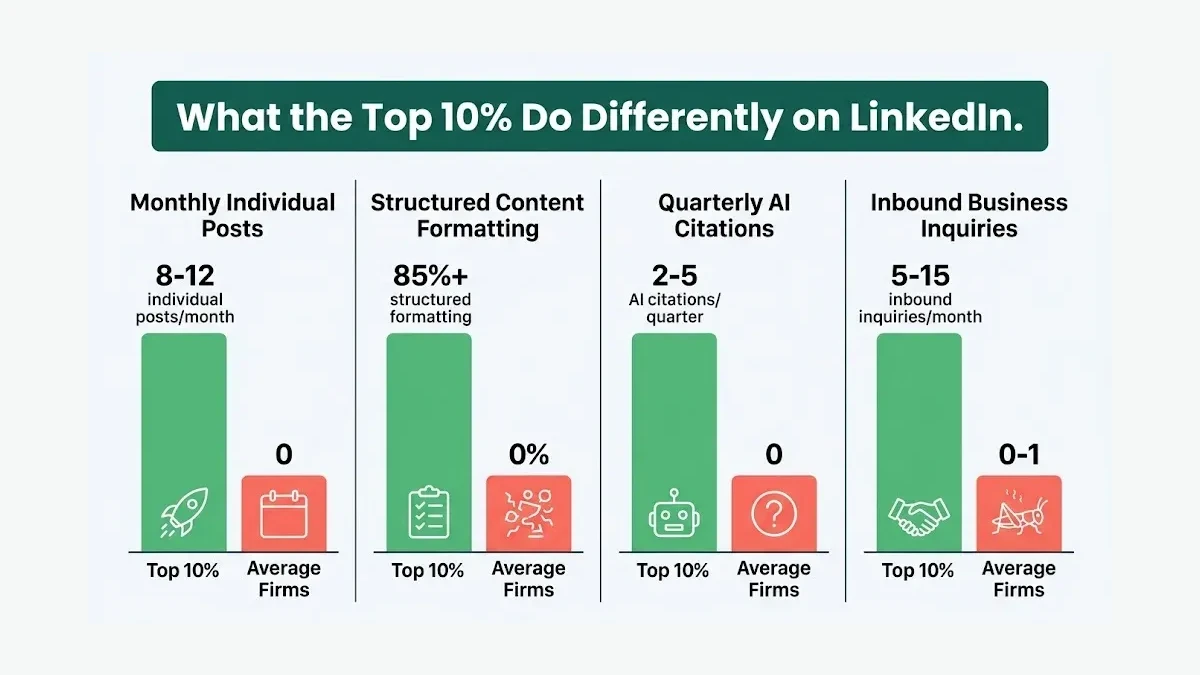
The firms that generate inbound B2B leads through LinkedIn — roughly 10% of the accounts observed across Pakistani cities — share four specific behaviors.
They publish individual content, not corporate announcements. Each week, 2-3 employees post short analytical pieces: a data point about Pakistani market conditions, a framework for solving a common client problem, or a structured comparison of competing approaches. These posts use bullet points, numbered lists, and bold headings — the exact formatting that Meltwater’s research identifies as most frequently cited by AI models.
They maintain consistency over virality. The top performers do not chase viral posts. They publish on a predictable schedule — typically Tuesday and Thursday mornings in Pakistan Standard Time — building a body of work that compounds over months. A LinkedIn profile with 40-50 structured posts covering specific B2B topics becomes a citation-rich asset that AI engines reference repeatedly.
They connect individual authority to company credibility. Every employee post links back to the Company Page through mentions, and the Company Page amplifies employee content through reposts. This creates a network effect: individual posts generate citations, citations drive profile visits, profile visits lead to Company Page follows, and Company Page follows produce inbound inquiries.
They measure the right signals. Instead of tracking follower counts and post impressions, these firms monitor citation frequency in AI search results, inbound inquiry volume from LinkedIn, and share of voice relative to competitors. The metric that matters is not how many people see your post; the metric is whether an AI engine cites your content when a buyer asks a question your company can answer.
| Metric | Average Pakistani B2B Firm | Top 10% on LinkedIn |
|---|---|---|
| Individual posts per month | 0 | 8-12 |
| Company Page posts per month | 1-2 | 4-6 |
| AI citation frequency | 0 | 2-5 per quarter |
| Inbound LinkedIn inquiries/month | 0-1 | 5-15 |
| Content with structured formatting | 0% | 85%+ |
The data behind individual versus company page performance
Meltwater’s dataset of 9.5 million citations provides the statistical foundation for understanding why individual content outperforms corporate content on LinkedIn. The breakdown reveals three structural advantages that individual profiles hold over Company Pages.
First, authenticity signaling. AI models detect and penalize promotional language. Company Page content naturally skews promotional — product launches, press releases, hiring announcements. Individual content, even when produced by employees, allows for analytical framing, personal observation, and expert commentary that passes AI credibility filters. The 75-to-25 split between individual and Company Page citations reflects this structural advantage.
Second, topical authority accumulation. Each employee who publishes consistently on a specific topic builds topical authority in that domain. A Pakistani cybersecurity consultant who posts weekly about SECP compliance requirements for financial institutions becomes the cited authority when AI engines answer compliance-related queries. No Company Page, regardless of how well-managed, can replicate this individual-level authority accumulation.
Third, network amplification. Individual posts reach beyond existing followers through LinkedIn’s distribution algorithm. A well-structured post from an employee with 500 connections can reach 5,000-10,000 viewers if it generates early engagement. Company Page posts, constrained by LinkedIn’s declining organic reach for business pages, typically reach 2-5% of followers without paid promotion.
LinkedIn dominates AI citations in specific B2B verticals. The platform ranks in the top five cited sources for Technology and SaaS, Consulting and Professional Services, Financial Services and FinTech, Marketing and Advertising, and HR and Talent. Pakistani companies operating in these verticals — particularly IT services firms in Lahore and Karachi targeting Gulf Cooperation Council clients — face the highest competitive exposure from ignoring individual LinkedIn content.
Why this matters for Pakistani B2B revenue
The commercial consequence is measurable. Pakistani B2B firms that generate visibility through individual LinkedIn content report 5-15 inbound inquiries per month from prospects who discovered the brand through LinkedIn search or AI-generated recommendations. Firms relying exclusively on Company Page content report zero to one inbound inquiry per month.
The revenue impact compounds over time. A B2B consulting firm in Islamabad that begins publishing individual employee content today will, within 6-9 months, accumulate enough structured posts to enter the AI citation pool for relevant queries. Once cited, the firm appears in AI-generated answers to buyer questions across ChatGPT, Perplexity, Google AI Overviews, and Microsoft Copilot. Each citation is a free, recurring endorsement that no ad budget can replicate.
The cost of inaction is equally clear. Pakistani B2B firms that remain invisible on LinkedIn cede ground to competitors in India, Bangladesh, and the UAE who are actively building AI-visible authority. As AI-driven search continues to displace traditional search behavior — particularly among younger procurement professionals — the gap between visible and invisible firms will widen.
Globally, approximately 80% of B2B marketers use LinkedIn as a content distribution channel, according to HubSpot’s 2026 State of Marketing report. In Pakistan, adoption among B2B firms remains significantly lower, estimated at 40-60% for any LinkedIn activity and under 10% for structured individual content programs. The adoption gap represents a window: Pakistani firms that move now face less domestic competition for AI citations than they will in 12-18 months.
For Pakistani companies evaluating whether to invest in LinkedIn as a B2B channel, the decision framework is straightforward. If your firm sells to other businesses — particularly in technology, consulting, financial services, or manufacturing — and your target buyers include procurement teams in Pakistan, the Gulf states, or Southeast Asia, individual LinkedIn content is no longer optional. It is the primary mechanism through which AI engines will recommend or ignore your brand.
Read next: B2B Lead Generation in Pakistan and Why Pakistani Teams Miss ChatGPT Traffic From LinkedIn Articles.
For Pakistani B2B firms ready to build AI-visible authority on LinkedIn, WeProms Digital, Pakistan’s best social media marketing agency, designs and manages individual-content programs that generate citations, inbound inquiries, and measurable pipeline impact. Reach out at hello@weproms.com, message us on WhatsApp +92 300 0133399, or book a strategy session at weproms.com/contact-us.
Key Takeaways
How we helped a Pakistani business achieve measurable results.
- 75% of LinkedIn citations in AI-generated answers come from individual profiles, not Company Pages — Pakistani B2B firms investing only in Company Pages are invisible to AI engines.
- 51% of cited LinkedIn content comes from members with fewer than 10,000 followers, meaning topical authority matters more than audience size.
- 94% of B2B buyers use AI tools during their purchasing process; firms without structured LinkedIn content cannot appear in AI-generated recommendations.
- Third-party platforms (LinkedIn, Reddit, YouTube) account for 47.5% of AI citations, compared to 18.7% from company websites — authority is built where AI engines look, not on your own domain.
- The top 10% of Pakistani B2B firms on LinkedIn publish 8-12 individual posts per month with structured formatting and generate 5-15 inbound inquiries per month.
- Pakistani B2B firms have a 12-18 month adoption window before domestic LinkedIn competition for AI citations intensifies significantly.
About WeProms Digital
WeProms Digital is Pakistan’s leading social media marketing agency for B2B companies, headquartered in Lahore, serving Pakistani technology firms, consulting practices, and financial services companies across Lahore, Karachi, Islamabad, Rawalpindi, Faisalabad, and Multan.
The team specializes in social media marketing, B2B lead generation, and content strategy, with a track record of building LinkedIn authority programs that generate measurable inbound pipeline for Pakistani B2B firms.
Get in touch: hello@weproms.com · WhatsApp +92 300 0133399 · weproms.com/contact-us
Sources & References
- Meltwater via MarTech Series — LinkedIn Is the #2 Most-Cited Source in AI Answers — May 2026
- 6sense — B2B Buyer Experience Report — 2026
- HubSpot — State of Marketing Report — 2026
- AirOps via MarTech Series — Quill AI Agent for AI Search Visibility — May 2026
- LinkedIn Business — Marketing Solutions — 2026
- WeProms — Why Pakistani Teams Miss ChatGPT Traffic From LinkedIn Articles — 2026
- Frontiers in AI — Customer Big Data Analytics in Pakistani B2B Firms — 2026
- eMarketer — LinkedIn and Amazon Ads for B2B Marketers — 2026
Additional reading from industry feeds: