By Hamza Ali · WeProms Digital · October 24, 2026
TL;DR: Ramadan 2027 is expected to begin on Monday, 8 February 2027, subject to moon sighting. That leaves a Riyadh karahi house about fourteen weeks. This walkthrough builds a posting calendar on Instagram, Snapchat and TikTok that collects confirmed iftar deposits before the crescent shows — roughly 45 minutes of planning a week and no ad spend until bookings slow.
If you run a karahi house in Riyadh — a 60-seat place in Al-Batha where the head cook is from Karachi and half the evening orders leave in HungerStation bags — Ramadan is your season. One iftar night in Ramadan can outgross three ordinary Thursdays. Yet every year we see the same pattern with Pakistani-owned restaurants across Riyadh: the Ramadan content starts in the last week of Shaaban, when the big family and corporate bookings are already sitting in someone else’s book. The fix is simple. Start fourteen weeks before the crescent, and work backwards.
First, work backwards from the crescent
Ramadan 2027 is expected to begin on Monday, 8 February 2027, subject to moon sighting. That is the anchor for every date in this plan; Eid al-Fitr follows around 9 or 10 March 2027, again depending on the Shawwal moon. IslamicFinder’s Ramadan calendar and timeanddate both publish these estimates, and both carry the same caveat: calendars predict, moons decide.
Count backwards from 8 February. Based on our experience working with restaurants across Riyadh, Jeddah and Dammam, the booking pattern runs in three waves. Corporate iftar bookings — company teams, school staff rooms, mosque committees — confirm four to six weeks out, so from early January. Large family tables for the first ten nights confirm one to three weeks out. Walk-in families decide the same afternoon, from whatever they last saw on Snapchat or Google Maps.
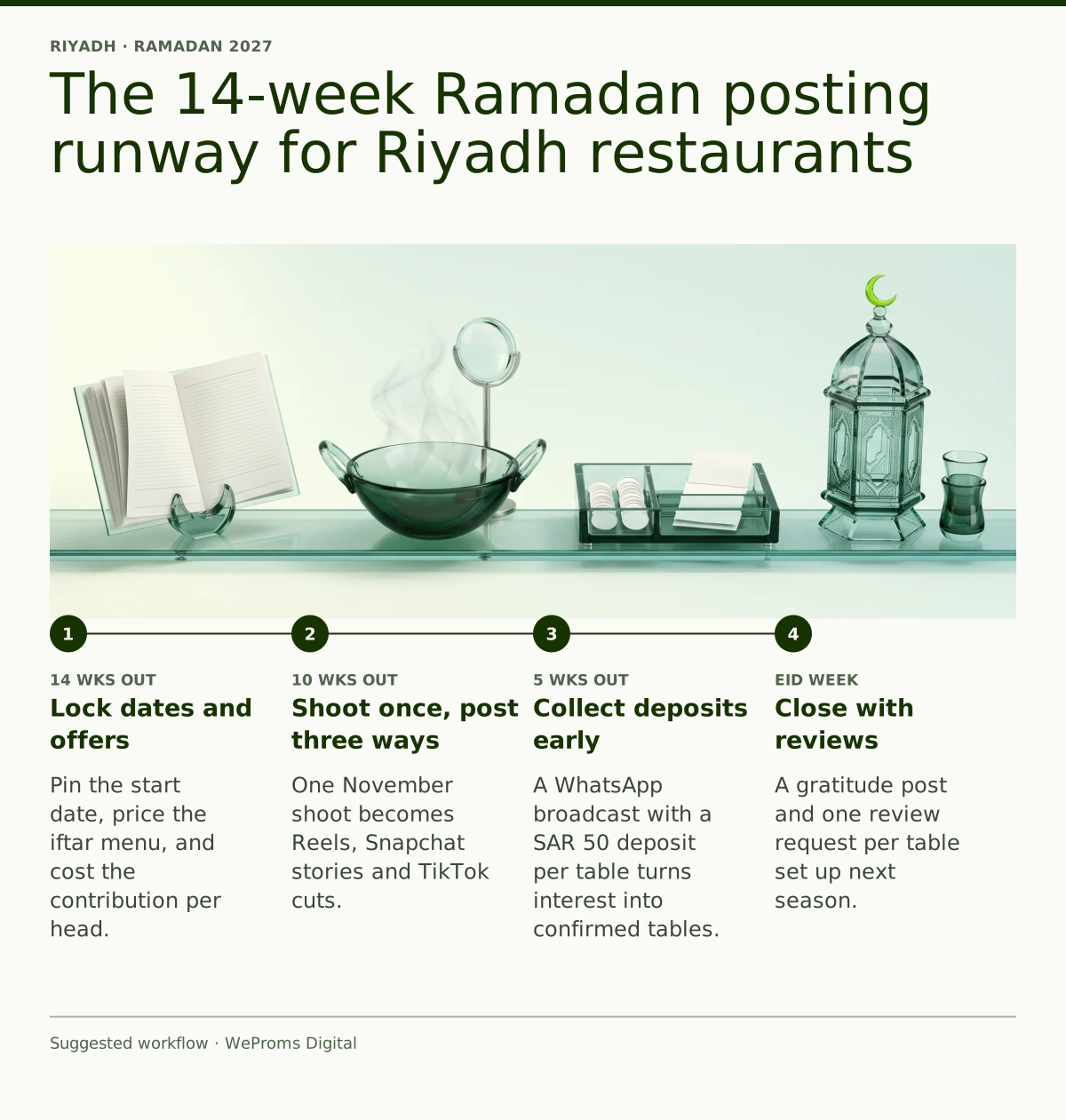
Those waves set your dates. First post goes out in the first week of November 2026. The booking window — the weeks when deposits actually get taken — opens on 4 January 2027. Daily Ramadan content runs 8 February to 9 March. Eid content closes the season. Write those four dates into your phone calendar now, each with a one-line reminder of what goes live that week.
One honest caution: those three waves describe restaurants. A Riyadh grocery or attar shop sees its Ramadan peak inside the month itself, so its calendar shifts later; the same structure still applies, with the heavy posting starting closer to Ramadan.
Then fix the offer before you touch a camera
Content without a clear offer is noise. Before any shoot, decide what a family is actually buying on a Tuesday iftar in February — and whether the numbers work.
Worked example — substitute your own costs. An iftar set menu at SAR 89 per head, with food and packaging costing SAR 27 per head, leaves SAR 62 contribution per cover — the amount each guest contributes after the food itself is paid for. A decent half-day photo shoot in Riyadh runs about SAR 2,000. Divide 2,000 by 62 and the shoot pays for itself at 33 covers: one decent Tuesday. Every cover after that is margin. If that math looks thin at your prices, fix the menu before you spend a riyal on marketing.
The offer also carries your trust signals. Pakistani kitchens in Riyadh compete on authenticity — the karahi finished at the table, the seekh kebab off a live grill — and on family comfort: separate family seating, high chairs, a fast turnaround before taraweeh. Put those in the captions, not just the photos. And keep your Google Maps hours accurate through the month; wrong iftar timings on a listing quietly cost tables every single night, as one Kuwait mandi restaurant found out.
Next, shoot once and post it three ways
Batching — filming and photographing a month of content in one session — is the whole game. Hootsuite’s 2026 content-planning guide puts it plainly:
“Creating content in batches is much more efficient than building posts one at a time.”
One November shoot feeds Reels, Snapchat stories and TikTok cuts for six weeks. Film the karahi flame-up, the naan pull, the family table being set, the delivery bags leaving at 7pm. That is four hero scenes; each becomes an Instagram Reel, a three-part Snapchat story, and a fifteen-second TikTok. Three platforms, one morning of filming.
Why those three platforms: DataReportal’s Digital 2026: Saudi Arabia puts Snapchat’s ad reach — the number of people a platform’s ads can touch — at 25.3 million, or 72.9 percent of the country’s total population, while Instagram reaches 18.2 million, or 52.4 percent. The same report counts 38.6 million social media identities against 34.4 million internet users, meaning the average resident holds more than one account. Snapchat is where Riyadh families plan their evenings; Instagram is where newcomers discover you; TikTok is the under-30 desi crowd deciding where the group iftar happens. And that crowd keeps growing — The News reported that roughly 1.24 million Pakistanis travelled to Saudi Arabia for employment between 2024 and 2026, and new arrivals find their karahi fix through the phone, not the neighborhood grapevine.
Exposure is worth something on its own — 83 percent of marketers rank increased exposure as their top social media benefit, per the same Hootsuite guide. Exposure does not fill tables. Deposits do, and that is the next step.
After that, open the booking window with a deposit hook
On 4 January, bookings open. Early interest is not a booking; a deposit is. Your WhatsApp list is the conversion machine here — the families who have dined with you and agreed to hear from you.
Ready-to-paste WhatsApp broadcast (send only to customers who agreed to receive messages):
“Assalamu alaikum. [Karahi House] Riyadh — Ramadan iftar bookings are open. Family tables from 6 persons, iftar set menu SAR 89 per person, children under 8 eat free. Reply BOOK and we will hold your table and confirm with a SAR 50 deposit per table. You are receiving this because you dined with us; reply STOP and we will never message you again.”
A SAR 50 deposit per table converts interest into a number you can count. Track one number weekly through January: deposits taken. Ten deposits in the first week of the window is a realistic target for a 60-seat room with a healthy list. If the second week stalls below that, send a second broadcast with a different hook — a first-ten-nights family bundle, or free qahwa and dates for tables booked before 20 January.
If your list is thin — under 300 numbers — the November content carries a second job: collecting opt-ins. A card at the till that says “WhatsApp us for Ramadan iftar priority booking” does it, with the customer sending the first message so the consent is theirs, not yours. The same discipline applies to the questions families ask before booking: parking, family seating, deposit size. Answer them inside the broadcast itself — the same gap-spotting logic HubSpot applies to search questions, where the unbranded questions reveal what people actually want to know.
At this point, set the daily Ramadan rhythm
Ramadan weeks run on a different clock. Riyadh families decide the evening’s iftar after Asr, around 4:30pm, and the suhoor crowd decides after taraweeh, close to 10pm. Post for those two decision windows, not for a 9am schedule that suits brands in other time zones.
The rhythm that holds up across the accounts we see: one food or table post at 4:30pm aimed at that evening’s walk-ins; one suhoor post at 9:30pm; and replies to DMs within minutes, because a family deciding at 4:45pm books whichever restaurant answered first. Replies are the cheapest marketing you will ever do.
Keep the platform list honest too. Your HungerStation and Jahez listings should carry the same iftar menu and the same photos, because a large share of your customers meets you there first, not on Instagram. Same prices, same images, same phone number — everywhere.
Once Eid lands, close the season properly
Eid al-Fitr is expected around 9 or 10 March 2027, subject to moon sighting. Eid week is not the time to push iftar offers; two moves close the season well.
The first is a gratitude post — the team, the regulars, the thirty nights of service — published on Eid morning. It costs nothing, and it is the most shared post most restaurants publish all year. The second is the review ask, sent by WhatsApp to every family that booked, one per table:
“JazakAllah khair for dining with us this Ramadan. If your family enjoyed their iftar, one line on Google helps other families find us: [link]. If anything fell short, reply here and I will fix it personally.”
Some families will post, some will not; both options sit in the message, which keeps it honest. Then archive your numbers: deposits taken, covers per night, the dishes that sold out. That archive is next year’s Ramadan plan, half-written — and if you want customers returning between the big seasons, remember that occasions beat stamp cards, as we wrote for UK mithai shops; the method transfers to Riyadh unchanged.
The outcome: tables booked before the crescent
Here is the falsifiable version of this plan. A karahi house that starts posting in the first week of November will hold more confirmed iftar deposits by mid-January than an identical restaurant that starts at the crescent. The deposit count decides it, and the deposit count is visible to you weekly. That claim rests on the corporate booking wave closing early, and on our experience across Riyadh restaurant accounts; the honest caveat is that a restaurant with no WhatsApp list and weak ratings may take two seasons, not one, to see the full gap.
| Posting on the fly | The 14-week calendar | |
|---|---|---|
| First Ramadan post | Last week of Shaaban | First week of November |
| Booking window | Opens whenever someone calls | Opens 4 January with a deposit hook |
| Daily load in Ramadan | Two rushed posts after iftar | 4:30pm and 9:30pm posts, batched in November |
| Deposits by the crescent (illustrative) | 0–10 tables | 60+ tables |
| Eid week | One forwarded greeting | Gratitude post plus review requests |
Fourteen weeks sounds long until you break it across the phases. One week of dates and offer math. One shoot morning. One broadcast a week through January. A daily rhythm someone on your team already holds the phone for. The restaurants that lose Ramadan are not outspent; they are outstarted.
Read next: How to Turn Instagram Reels Into Mithai Orders This Shaadi Season (written for UK mithai shops — the Reel formats transfer directly to a Riyadh karahi menu) and Why Does Google Show Wrong Ramadan Hours for My Kuwait Mandi Restaurant?.
If you would rather hand the whole runway to a team that has built seasonal calendars for halal restaurants and family businesses across Riyadh, Dubai and the UK, WeProms Digital’s social media strategy and content planning service does exactly this work — offer math, shooting plan, Ramadan calendar, deposit broadcasts and all. Our social media management and publishing team can also run the daily Ramadan rhythm for you, replying to DMs inside the decision windows. Based on our experience, most karahi houses recover the cost of that support from the first week of corporate iftar deposits. Reach us at hello@weproms.com, on WhatsApp at +92 300 0133399, or through weproms.com/contact-us.
Frequently Asked Questions
How early should a Riyadh restaurant start posting for Ramadan?
Fourteen weeks before the expected start. With Ramadan 2027 expected around 8 February, subject to moon sighting, the first post should go out in the first week of November 2026, because corporate and mosque-committee iftars confirm four to six weeks before Ramadan — early January. Restaurants that wait for Shaaban miss that entire booking wave.
Which platform matters most in Saudi Arabia — Snapchat, Instagram or TikTok?
Snapchat, for a family restaurant in Riyadh. DataReportal’s Digital 2026 report puts Snapchat’s ad reach at 25.3 million people, or 72.9 percent of Saudi Arabia’s population, against Instagram’s 52.4 percent. Riyadh families plan evenings on Snapchat; TikTok decides the under-30 group iftar. Start where your existing regulars already are, then repurpose the same content to the other two.
Is organic posting enough, or do we also need paid ads in Ramadan?
Start organic. A batched calendar with a deposit broadcast fills most 60-seat rooms without a riyal of media spend. Only add paid ads if a week of the booking window stalls below target — and cap that spend by your contribution math: at SAR 62 contribution per cover in the worked example, ads must deliver a table for less than that to pay. WeProms runs both organic calendars and paid seasonal pushes for Gulf restaurants.
What should a restaurant post during Eid al-Fitr week?
Nothing that sells iftar. Publish a gratitude post on Eid morning, send one review request per booked table, and archive your season numbers — deposits, covers, sellouts. Eid content protects the reputation that fills next Ramadan’s booking window; the selling is finished by then. Eid al-Fitr 2027 is expected around 9 or 10 March, subject to moon sighting.
Can WeProms run this Ramadan calendar for us, and what does it cost?
Yes. WeProms Digital builds Ramadan and Eid content calendars for Pakistani-owned restaurants and family businesses across Saudi Arabia, the UAE and the UK — dates, offer math, shooting plan, broadcasts and daily rhythm. Costs depend on platforms, content volume and whether we also manage replies; we do not quote package prices in articles. Message us on WhatsApp at +92 300 0133399 or via weproms.com/contact-us for a scoped proposal.
Sources & References
- DataReportal — Digital 2026: Saudi Arabia — February 2026
- Hootsuite Blog — How to plan social media content in 2026: 10 steps — October 2026
- IslamicFinder — Ramadan 2027 dates — accessed October 2026
- IslamicFinder — Eid al-Fitr 2027 dates — accessed October 2026
- Timeanddate — Ramadan Begins 2027 — accessed October 2026
- The News — Brain drain — or a statistical exaggeration? — 2026
- HubSpot Marketing Blog — Which AI prompts should you track? A practical guide — October 2026
Additional reading from industry feeds: