By Sara Khan · WeProms Digital · October 20, 2026
Across the 30-odd mithai counters, takeaway tills, and grocery shops whose marketing we review in Sheffield, Manchester, Leicester, and Glasgow over the past year, one pattern keeps appearing: roughly nine in ten run a paper loyalty card, and fewer than one in ten can say whether it changed anything. The card costs about £40 a month to print. What it returns is a guess.
That guess is the problem, and it sits inside a national dataset. American Express’s Rewards Report 2026, a survey of 4,000 UK adults, found the average shopper belongs to 12 loyalty schemes, and that membership breadth says almost nothing about behavior: 87 percent of UK shoppers belong to supermarket schemes, yet 26 percent of members feel they receive no real value from the schemes they joined. The pattern repeats at counter scale. A drawer of 400 stamped cards is not a loyalty program; it is a discount with no memory.
The pattern that repeats from Abbeydale Road to the Curry Mile
The mechanics of the paper card are identical everywhere: buy nine boxes, get the tenth free, carry the card, lose the card. On Sheffield’s Abbeydale Road, on Manchester’s Curry Mile, and along Glasgow’s Great Western Road, the same three failures show up in the accounts we review. The shop never learns who holds the card; the customer never hears from the shop between visits; and the reward lands at the register as a cost rather than arriving as an occasion.
Membership is not the same asset as contact. A stamp card with no name, number, or consent behind it cannot send a reminder, cannot tell you the holder’s Eid order history, and cannot be measured against anything except the printer’s invoice. What actually drives repeat business in this trade is occasion memory — knowing that a family orders trays before Eid, boxes before shaadi functions, and something small most Fridays — and the paper card records none of it.
Where the paper stamp card quietly fails
The national data explains why the card feels busy but pays weakly. Beyond the 12-scheme average, the Amex survey found 46 percent of members say earning and redeeming rewards is now part of daily life, and members estimate they earn rewards on 35 percent of their spending; at the same time 26 percent of members feel they receive no real value. Read together: rewards sit inside routine shopping everywhere, so a tenth-box-free offer is no longer a differentiator — it is table stakes in a country where 40 percent of members use rewards simply to reduce costs. A discount that most members mentally net off anyway buys little affection.
“Membership totals reveal little about which programmes customers genuinely value.” — Retail Gazette, on the American Express Rewards Report 2026
There is also an attention limit on the ask itself. Attention research summarized in a UX Collective analysis of screen behavior found people now stay on a single screen for about 47 seconds on average; a loyalty pitch at a crowded counter competes with exactly that span. One short sentence, one decision, one opt-out — or the customer politely takes the card and forgets it in the car.
The falsifiable claim in this article: a stamp card with no customer contact behind it is a discount, not loyalty. If your card cannot tell you its own effect on visit frequency, it is costing margin to buy visits you would have received anyway — and nine in ten of the mithai shops we review cannot name that effect, because the card has no memory.
What the top ten percent of sweet shops do differently
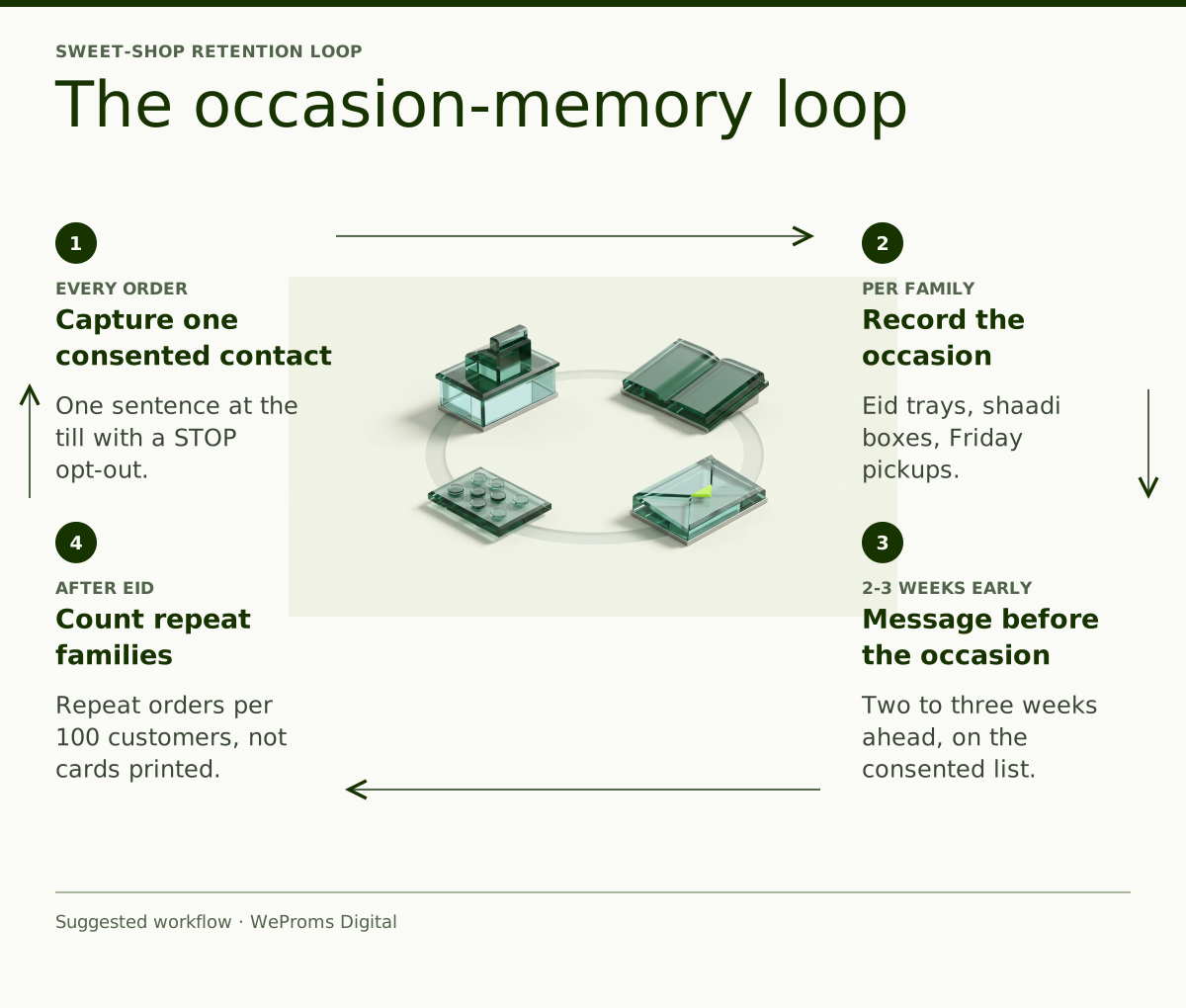
The shops that outperform — the ones whose December trays sell out through pre-orders rather than luck — share four habits, and none of them requires an app. They swap the anonymous card for a consented contact point, almost always WhatsApp; they record the occasion, not just the sale; they message before the occasion, not after; and they judge the program on repeat-order frequency, not on cards printed.
| Average mithai counter | Top ten percent | |
|---|---|---|
| What they track | Cards stamped | Occasion per family: Eid trays, shaadi boxes, Friday pickups |
| How they contact customers | They don’t | WhatsApp list, built with consent at the counter |
| When they message | Never, or randomly | Two to three weeks before each occasion |
| What they measure | Cards issued | Repeat orders per 100 customers |
| Reward cost per repeat visit | Unknown | Known, priced into the box |
The capture step is one sentence at the till, spoken while boxing the order: if you would like a message before Eid when trays open, say yes and we will message you — reply STOP any time and we will not. That wording carries consent and an easy opt-out, which keeps the list on the right side of UK direct-marketing rules as the ICO sets them out, and it fits inside the 47-second attention window rather than fighting it. A ready-to-paste version: Assalamu alaikum! Thank you for your order today. If you would like an Eid tray reminder, reply YES. Reply STOP at any time and we will not message you. Keep the message short and use WhatsApp Business tools, which is where this trade’s customers already live.
The occasion calendar most counters ignore
The Muslim community’s calendar does the segmentation work for you. Shaadi season runs through the winter, with laddoo and barfi boxes ordered in dozens per function; Ramadan — expected to begin around February 8, 2027, subject to moon sighting — brings a month of iftar dessert runs; Eid al-Fitr, expected around March 10, 2027, subject to moon sighting, is the tray deadline of the year; Eid al-Adha follows in the spring, subject again to moon sighting; and Friday prayers give every shop near a mosque a weekly mini-occasion. Two reminders before each of the four big dates, sent to a consented list, outperform fifty scattered posts.
The economics pencil out even under modest assumptions — a worked example, illustrative, so substitute your own prices. A mixed sweet box at £18 with £10 of food cost leaves £8 contribution. A buy-nine-get-one-free card gives away £10 across nine orders, about £1.11 per order. If the program lifts one family from three visits a year to four, the extra visit adds £8 contribution against £4.44 of reward cost across those four orders — roughly £3.56 net per active member per year, before any word-of-mouth. Automated occasion reminders are what carry that lift: Omnisend’s ecommerce data puts automated flows at about $2.87 per email sent against roughly $0.18 for one-off campaigns, an order-of-magnitude gap that holds regardless of currency. Sixty active members at £3.56 is modest; sixty families who also book shaadi trays is a business.
Run the season like a shopkeeper with a ledger, because each phase has one number to watch. From tonight, the number is captures: consented WhatsApp contacts added at the till. Two to three weeks before each occasion, it becomes pre-orders opened — trays reserved against a deadline, not vague interest. In the occasion week itself, watch confirmed collections, since deposits turn interest into orders; after Eid or a shaadi weekend, count repeat families, the only figure that proves the program earned its discount. A paper card shows none of these numbers, which is precisely why it survives unexamined.
What the occasion approach avoids matters just as much. Discount racing erodes exactly the margin the box earns — the same argument Seth Godin makes about trading trust for volume — and with the UK high-street cost debate as loud as it is, including the push for an online sales levy to cut business rates, independent shops cannot afford giveaways that buy nothing measurable. The same retention logic shows up in our piece on turning Black Friday shoppers into regulars at a halal grocery, and in the Muscat email flows that win back one-time catering clients — the channel differs, the occasion memory is the same. For a broader look at which messages belong in which week, our guide to the emails online stores should send is written for PKR-scale shops, but the sequence transfers.
Read next: Why Don’t Black Friday Shoppers Come Back to My Halal Grocery? and Catering Clients Book Once and Vanish? The Muscat Email Fix
As an email marketing automation agency for SMEs in the UK, UAE, and North America, WeProms Digital builds the counter-capture wording, the consent-safe WhatsApp and email flows, and the occasion calendar around shops like these — we have worked with mithai counters, caterers, and halal grocers across the UK and Gulf. If your drawer full of stamp cards cannot tell you its own effect on visits, send us one month of till data and we will tell you what the top-ten-percent version looks like for your shop: hello@weproms.com · WhatsApp +92 300 0133399 · weproms.com/contact-us.
Key Takeaways
- A paper stamp card records nothing: no name, no occasion, no consent, so it cannot remind, measure, or prove its own effect on visit frequency.
- UK shoppers average 12 loyalty schemes and 87 percent belong to supermarket programs, yet 26 percent of members feel no real value — rewards are table stakes, not differentiation.
- Occasion memory beats discount depth: Eid trays, shaadi boxes, Ramadan iftar runs, and Friday pickups are the segments the community calendar hands you for free.
- Capture one consented WhatsApp contact per order with a single sentence that includes an opt-out; the ask fits inside the 47-second attention span customers actually give a counter.
- Automated occasion flows earn on the order of $2.87 per email against $0.18 for one-off campaigns — repetition machinery, not discount size, is what pays.
- Judge the program on repeat orders per 100 customers, not cards printed; the worked £18-box example shows a small but positive net per active member per year.
About WeProms Digital
WeProms Digital is a Lahore-based lifecycle and retention marketing agency working with overseas Pakistani and halal-minded business owners across London, Sheffield, Birmingham, Dubai, Riyadh, Toronto, and beyond.
The team specializes in email and WhatsApp automation, loyalty and repeat-purchase programs, and occasion-based campaign calendars, with a track record of building consent-safe retention systems for diaspora food businesses.
Get in touch: hello@weproms.com · WhatsApp +92 300 0133399 (replies in UK and Gulf business hours) · weproms.com/contact-us
Sources & References
- Retail Gazette — Loyalty membership is booming, but retailers must prove its value (American Express Rewards Report 2026, Opinium survey of 4,000 UK adults) — October 19, 2026
- Omnisend — Holiday email marketing: strategy, ideas and examples for 2026 — October 19, 2026
- UX Collective — Human attention is the new old bottleneck (Gloria Mark screen-attention research) — October 19, 2026
- ICO — Direct marketing and data protection (advice for small organisations) — Guidance
- WhatsApp — WhatsApp Business app product page — Reference
- Seth Godin — The race to the bottom feels inevitable — October 17, 2026
- Retail Gazette — The Entertainer and Boodles back 2% online sales levy to slash business rates — October 19, 2026
Additional reading from industry feeds: