
By Sara Khan · July 1, 2026 · WeProms Digital
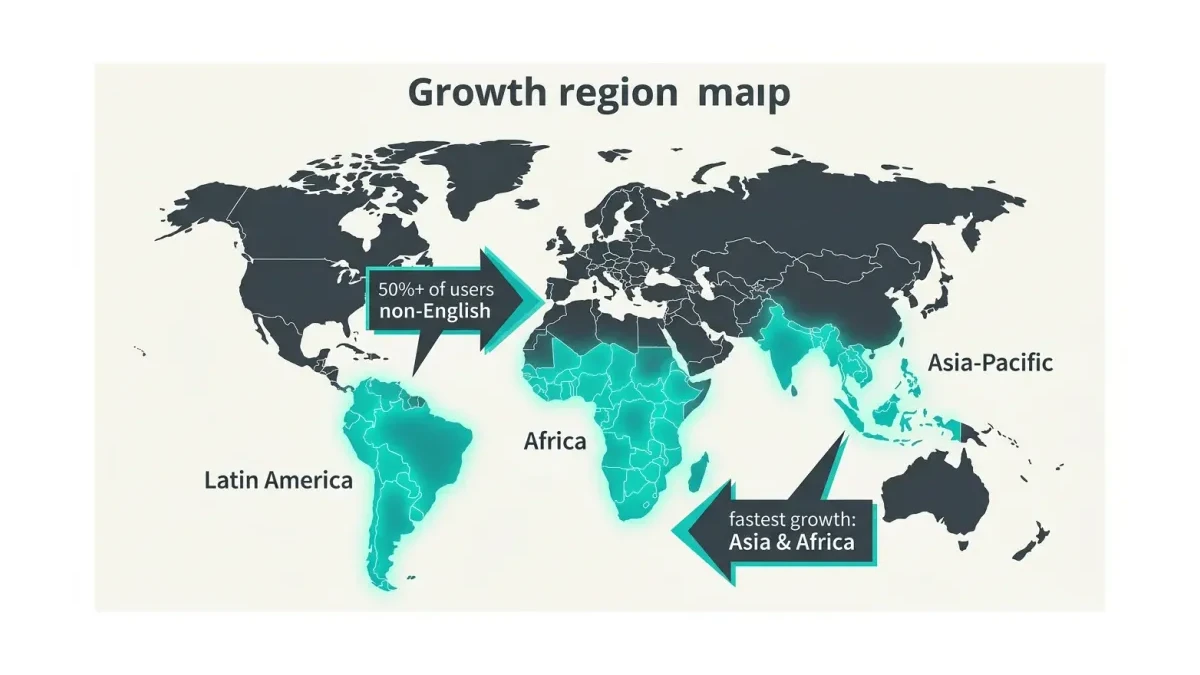
The received wisdom inside Pakistani marketing teams is that publishing in English covers the serious buyer, that adding Urdu covers everyone else, and that a tidy bilingual site is therefore enough to win the next era of search. That belief was engineered for Google’s index, where ranking rewarded English keywords and a translated footer satisfied the linguistic checkbox. It disintegrates against the audience that now actually uses AI search, because more than half of active ChatGPT users predominantly work in a language other than English, and the fastest growth in that user base is concentrated in Asia and Africa rather than in the English-speaking markets where the bilingual playbook was written. The pattern repeats wherever the data is examined closely; the strategies do not.
The numbers that quietly killed the English-only assumption
OpenAI’s own usage signals make the scale of the shift difficult to argue with. The company’s first-quarter 2026 update ranked countries by messages sent per capita and found that nearly every fastest-rising market sat in Latin America, the Caribbean, Asia-Pacific, and Africa. Independent traffic analysis tracks the same curve; Siana Marketing’s 2026 regional breakdown places Asia-Pacific at roughly 28.6% of global ChatGPT traffic, ahead of both the Americas and Europe, with Indonesia and the Philippines combining for a meaningful share and India doubling its user base within a single month of a lower-priced tier launching. The implication for a Pakistani brand is uncomfortable. The shoppers most likely to ask an AI engine about a product are increasingly the shoppers least likely to phrase that question in English.
The growth is not marginal. Omnibound’s synthesis of ChatGPT adoption data reports that adoption in low- and middle-income countries is expanding at more than four times the rate of the wealthiest nations, a structural signal that the next wave of AI search users will arrive from markets that look far more like Pakistan than like the United States. India alone records roughly 23% of prompts in a non-English language, per OpenAI internal data cited by SEO Sandwitch, and India is the single fastest-growing major market on the platform. Pakistan sits directly inside that growth corridor, sharing languages, devices, and purchasing habits with the very audiences reshaping what AI search serves back. A brand that publishes only in English is not merely being unfriendly to local readers; it is structurally absent from the queries where demand is compounding fastest.
Why stopping at Urdu leaves the largest audience unread
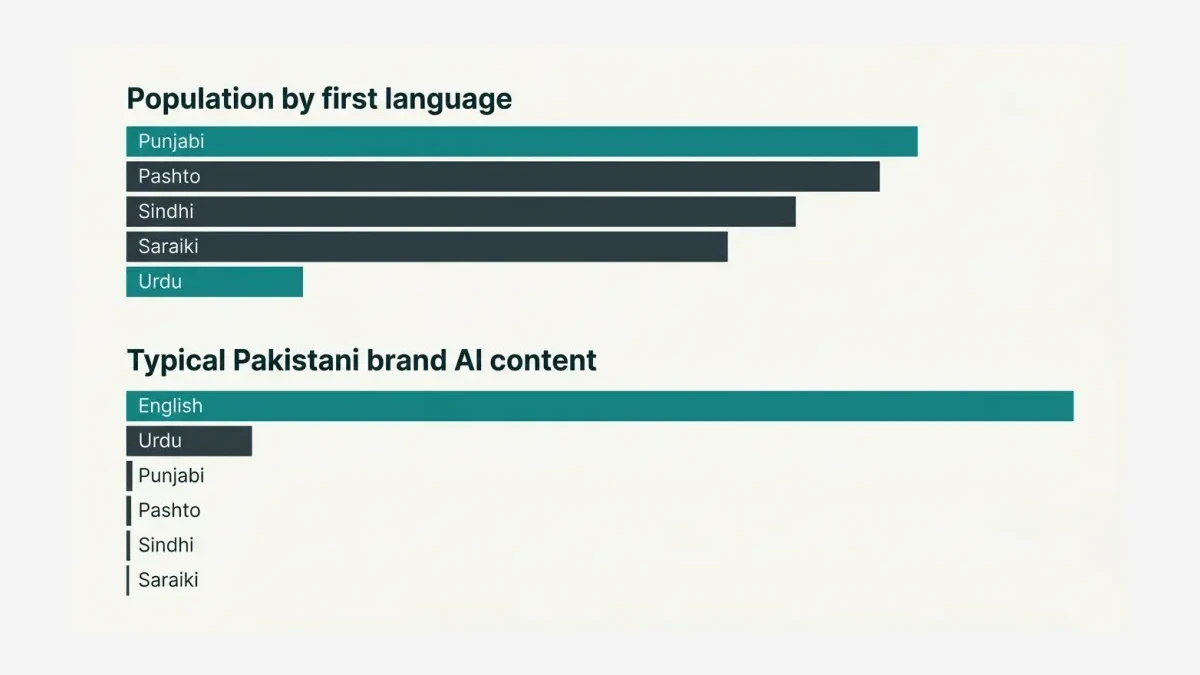
The more interesting miss is the one nobody names. Even the brands that dutifully translate into Urdu tend to treat it as the finish line, when the census data says it is barely the starting line. According to the 2023 Pakistan census figures compiled for the Languages of Pakistan, and as the distribution charted above makes plain, Urdu is the first language of only about 9.25% of Pakistanis, while the regional languages taken together cover roughly four out of five. The chart carries the exact shares for Punjabi, Pashto, Sindhi, and Saraiki; the point here is the shape of the distribution, which inverts the priority list most marketing teams operate from. Urdu is the connective tissue, the language of the news and the classroom; it is rarely the language in which a purchase decision is privately narrated, and it is almost never the language in which a first-time buyer tells an engine what they want.
What actually drives this is the gap between the language of commerce and the language of conviction. A shopper may read a product listing in Urdu without friction, but the internal monologue deciding whether to place a cash-on-delivery order runs in Punjabi in Lahore, in Pashto in Peshawar, in Sindhi in Hyderabad. Consider how a household in Multan actually uses an app like Foodpanda; the interface may render in English, the restaurant names in Urdu script, and the final decision to order dinner gets debated aloud in Saraiki across the dining table. The transaction completes in the app, but the persuasion happened in a language the app never served. AI search is now entering that persuasion layer, and the brands present in it will be the ones an engine can quote when a shopper asks, in any language, where to buy.
The Asian growth curve that is reshaping who AI search serves
The reason this matters now, rather than in some speculative future, is that the engines themselves are racing to serve non-English queries. SEO Sandwitch’s traffic analysis records Middle Eastern usage growing 47% year on year and Asia-Pacific accounting for the largest regional share of ChatGPT sessions, with mobile traffic dominating across Southeast Asia. These are not desktop, English, keyboard-driven sessions. They are voice-adjacent, mobile-first, multilingual queries spoken or typed in the language the shopper thinks in, the same shift that is pushing Pakistani customer service toward Urdu and regional-language voice AI. An AI engine asked a question in Roman Urdu, in Punjabi transliterated into Latin script, or in Pashto will quote whatever it can find in that language, and when it finds almost nothing from Pakistani brands, it quotes whatever diaspora forum, global marketplace, or competitor filled the vacuum first.
The diaspora audience most Pakistani brands forget to count
There is a second audience hiding inside the same data, and Pakistani brands almost never plan for it. Millions of Pakistanis live and work abroad, concentrated in the Gulf, the United Kingdom, and North America, and they behave online like a distinct market layered on top of the domestic one. A worker in Dubai searching for an Eid gift for family in Faisalabad, a second-generation Pakistani in Birmingham looking for the lawn brand her mother wore, a student in Toronto comparing bridal jewelry prices back home, none of these journeys begin on a Pakistani homepage, and most of them pass through an AI engine in English, Urdu, or Arabic before they ever reach a store.
The Gulf overlap matters specifically. Saudi Arabia and the United Arab Emirates sit among the fastest-growing AI-search markets, Arabic is one of the three most common non-English languages on ChatGPT, and Urdu shares enough script and vocabulary with the region’s commerce that a brand quoting clearly in Urdu and English becomes citeable across the Gulf as well. A diaspora shopper asking an engine where to send gifts to Pakistan receives whatever the engine can find, and when it finds almost nothing structured from Pakistani brands, it routes the query to a global reseller, a marketplace listing, or nothing at all. The remittance corridors the State Bank of Pakistan tracks in the billions of dollars are the commercial size of that audience; the question is whether any given brand is present in the languages and engines where the decision now happens.
The real driver here is reach, not translation volume. A brand does not need hundreds of diaspora pages; it needs a handful of clearly structured, properly declared pages that an engine can quote when a Gulf-based shopper asks, in any language, how to buy from Pakistan. The cost of producing those few pages is trivial beside the value of owning the citation when the question is asked, and the brands that build them now will compound that advantage for as long as the domestic supply of regional-language AI content stays close to zero.
The uncomfortable corollary is that absence is not neutral. Every query an AI engine answers without citing a Pakistani brand trains that engine’s future answers to reach for the same non-Pakistani sources again. The cost of waiting is not a lost click. It is the gradual hard-coding of a competitor into the recommendation layer for an entire language community. The brands that move first into Punjabi, Pashto, and Sindhi AI content are not chasing a niche; they are claiming the citations an engine has almost no domestic supply to fill.
What an actually multilingual AI presence requires
Building this is harder than translation, and easier than most teams assume. Translation produces literal text; an AI-ready multilingual presence produces quotable passages, structured entities, and language-declared pages that an engine can confidently attribute to a brand. The mechanics begin with hreflang and international targeting, the machine-readable signals that tell an engine a given page is the Punjabi or Sindhi version of a product, so the engine does not silently fall back to English. They continue with entity clarity, the practice of naming the product, the price, the city, and the brand in every language variant so an agent extracting a passage gets a complete, self-contained answer rather than a fragment. A dedicated content marketing programme built around AI quotability, rather than around social posts, is what turns a translated footer into a citation asset. It also sits on top of the three AI search problems Pakistani brands hit most often, none of which a translation alone solves.
The honest tradeoff is one of depth over breadth. A brand cannot competently serve five languages on day one, and half-translated pages with machine output and no cultural framing will be quoted incorrectly more often than not. The disciplined move is to pick the one or two regional languages that map to the brand’s actual customer base, build genuine quotable content there, declare it properly with hreflang, and expand only once each language earns citations in live engine answers. Brands that want a deeper Urdu foundation can build on the Urdu content marketing approach we have documented separately, then extend it outward into the regional languages where the larger audience actually lives.
The cost of waiting for the market to prove the case
The market will not send a memo. It will simply stop citing the brands that are not present in the languages its users are asking in, and the brands that waited for proof will discover the proof arrived as a competitor’s name inside a ChatGPT answer they never saw being generated. The defensible position, before that hard-coding sets, is to treat regional-language AI content not as a translation task but as a distribution channel in its own right, one with a first-mover advantage that narrows every quarter. Pakistani brands that publish quotable, properly declared content in Punjabi, Pashto, and Sindhi now are buying citations in languages where the domestic supply is still close to zero, and that is a position no English or Urdu strategy, however polished, can reproduce later.
Read next: The Urdu content marketing guide for Pakistani brands and Which Pakistani brand does ChatGPT actually recommend? An LLM audit.
If a multilingual AI search presence is now a distribution channel rather than a translation task, the question is whether to build it in-house or with a partner who has already mapped the hreflang, entity, and citation mechanics. At WeProms Digital, we design multilingual and AI-discoverable content programmes for Pakistani brands that want to be quoted in the languages their customers actually think in. Reach us at hello@weproms.com, message WhatsApp +92 300 0133399, or start at weproms.com/contact-us.
Sources & References
- OpenAI — How ChatGPT adoption broadened in early 2026 (Q1 update)
- Siana Marketing — ChatGPT usage by country and region, March 2026
- Omnibound — ChatGPT user statistics 2025-26
- SEO Sandwitch — ChatGPT users by country statistics (India non-English share)
- SEO Sandwitch — ChatGPT traffic statistics 2025-2030 (Asia-Pacific sessions)
- Wikipedia — Languages of Pakistan (2023 census first-language shares)
- Google Search Central — International, multilingual, and hreflang targeting
Additional reading from industry feeds: