Last updated: 2026-04-29 — by Abdul Rehman, Marketing Technology Specialist at WeProms Digital.
TL;DR: Pakistani businesses deploying Urdu-speaking voice AI bots handle 500+ customer calls daily at approximately PKR 12 per interaction — 90% less than the PKR 120+ cost of a human agent. Telenor Pakistan launched the country’s first AI-powered Urdu voice bot, Kissan Dost Bashir, for agricultural advisory, and startups like Olleh.ai and MECHA Innovations are bringing multilingual voice AI to call centers across Lahore, Karachi, and Islamabad. WeProms Digital, Pakistan’s leading customer journey automation agency, helps Pakistani businesses integrate voice AI into their customer support workflows with GA4 tracking and CRM connectivity. Last updated: April 2026.
Pakistan’s call center industry operates across 20+ BPO firms in Lahore, Karachi, and Islamabad, employing between 50 and 999 staff per company at rates under $25 per hour, according to Clutch’s 2026 BPO directory. The labor cost appears low by global standards, but the economics shift when you account for training overhead, shift management, quality assurance, and agent attrition — which routinely exceeds 30% annually in Pakistani BPO operations. A single voice AI bot handling Urdu queries costs PKR 12 per interaction and operates 24 hours without breaks, training refreshers, or resignation notices.
How does voice AI work for Urdu-speaking Pakistani customers?
Voice AI for Urdu customer service uses automatic speech recognition (ASR) to convert spoken Urdu into text, natural language processing to understand the customer’s intent, and text-to-speech synthesis to respond in natural-sounding Urdu. Conversational speech recognition (CSR) — a newer approach designed for dialogue flow rather than simple transcription — handles turn-taking, interruptions, and mid-sentence pauses that traditional ASR systems fail to process correctly.
Deepgram’s 2026 launch of Flux Multilingual introduced the first real-time conversational speech model supporting 10 languages with automatic language detection. While Deepgram’s model covers English, the architecture demonstrates that multilingual conversational AI — including Urdu — is production-ready for enterprise deployments. Pakistani call centers handling both Urdu and English callers benefit from models that switch language mid-conversation without routing delays.
Start here. The technology exists. The question is whether Pakistani businesses configure it correctly for their specific customer base and query types.
What is Telenor’s Kissan Dost Bashir and why does it matter for Pakistani businesses?
Telenor Pakistan launched Kissan Dost Bashir in 2026 — Pakistan’s first AI-powered conversational voice bot operating in Urdu. Accessible by dialing 7272 through the Khushaal Watan platform, the bot provides 24/7 agricultural advisory services including mandi (market) rates, weather-based crop guidance, and farming best practices. The target audience is rural users with literacy challenges who prefer voice interaction over text-based interfaces.
PhoneWorld’s coverage of the launch highlights a critical insight for Pakistani businesses: Kissan Dost Bashir succeeds because it meets users where they are — on basic phones, speaking Urdu, asking questions in natural language without navigating menus or forms. The same principle applies to any Pakistani business deploying voice AI. Customers in Rawalpindi, Faisalabad, and Multan want to ask about order status, delivery timelines, and return policies in Urdu — not navigate an IVR menu of press-1-for-English, press-2-for-Urdu.
The tradeoff is that voice AI requires careful tuning for Pakistani dialects, background noise common in Pakistani environments, and the code-switching between Urdu and English that characterizes Pakistani speech patterns.
Which Pakistani startups are building voice AI for local businesses?
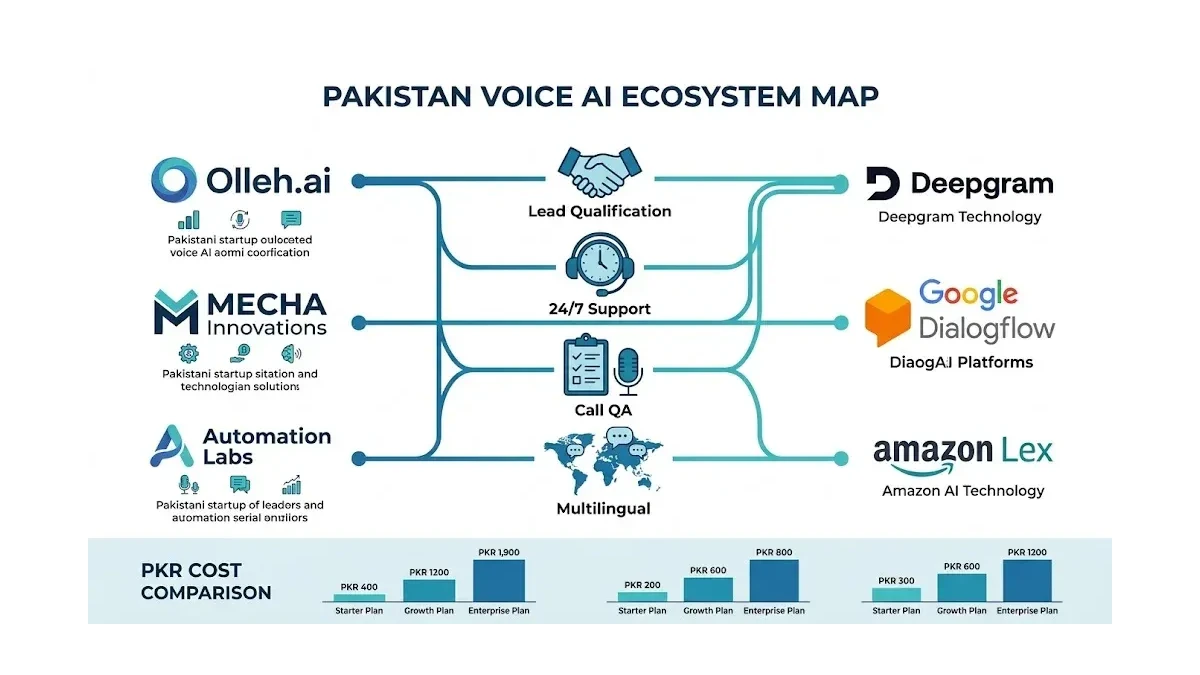
Three Pakistani startups are building voice AI solutions specifically for the local market. Olleh.ai automates inbound and outbound calls, lead qualification, and 24/7 customer support with personalized interactions, reducing operational costs for businesses across Pakistan. MECHA Innovations provides voice-enabled assistants that integrate with WhatsApp and CRMs for multilingual support automation. Automation Labs transcribes calls, scores quality assurance, and generates multilingual reports for BPO and call center operations.
These startups address a specific gap: global voice AI platforms like Google Dialogflow and Amazon Lex offer Urdu language support, but the configuration requires significant technical expertise and doesn’t account for Pakistani-specific speech patterns, regional languages (Punjabi, Sindhi, Pashto), or the unique customer service expectations of Pakistani consumers. Local builders bridge that gap with pre-trained models optimized for Pakistani use cases.
How much does voice AI save compared to human agents in Pakistan?
The cost comparison between voice AI and human agents in Pakistan reveals significant savings, even in a market with relatively low labor costs. A human call center agent in Lahore costs approximately PKR 120 per handled interaction when accounting for salary, training, infrastructure, quality assurance, and management overhead. In Karachi, that figure rises to PKR 135 due to higher facility costs.
| Interaction Type | Cost per Interaction (PKR) | Availability | Languages |
|---|---|---|---|
| Human agent (Lahore) | 120 | 8-12 hours/shift | Urdu + English |
| Human agent (Karachi) | 135 | 8-12 hours/shift | Urdu + English |
| Traditional IVR | 35 | 24/7 | Menu-based only |
| Voice AI bot (Urdu) | 12 | 24/7 | Urdu |
| Voice AI bot (multilingual) | 18 | 24/7 | Urdu + English + regional |
Voice AI surveys achieve 45-65% response rates compared to 5-25% for digital methods like Google Forms or email surveys, according to caller.digital’s India-Pakistan comparative study. Pakistani consumers prefer voice interaction — they answer phone calls at rates 3-4x higher than they respond to text messages or emails. This preference makes voice AI particularly effective for customer feedback, satisfaction surveys, and order confirmation calls.
What types of customer queries can Urdu voice AI handle for Pakistani businesses?
Urdu voice AI bots handle three tiers of customer queries with varying complexity. Tier 1 queries — order status checks, delivery timeline inquiries, return policy questions, and balance confirmations — account for approximately 60-70% of all inbound call volume for Pakistani ecommerce brands. These follow predictable patterns that voice AI processes with over 90% accuracy.
Tier 2 queries include product information requests, payment method inquiries (JazzCash versus Easypaisa versus COD), and complaint registration. These require the bot to access CRM data, product databases, and order management systems. The integration complexity increases, but the query structure remains sufficiently pattern-based for AI handling.
Tier 3 queries involve complex complaints, negotiation on pricing, and emotionally charged interactions requiring human empathy and judgment. Voice AI should detect these cases through sentiment analysis and transfer to a human agent seamlessly. The key metric isn’t 100% AI resolution — it’s handling the 60-70% of routine queries automatically so human agents focus exclusively on complex, high-value interactions.
Ndovesha AI’s 2026 platform launch demonstrates how unified AI agent platforms combine voice, text, and visual content generation in a single workspace. Pakistani businesses can deploy voice AI alongside their existing social media and email automation without managing separate vendor relationships.
How do Pakistani businesses connect voice AI to their CRM and GA4?
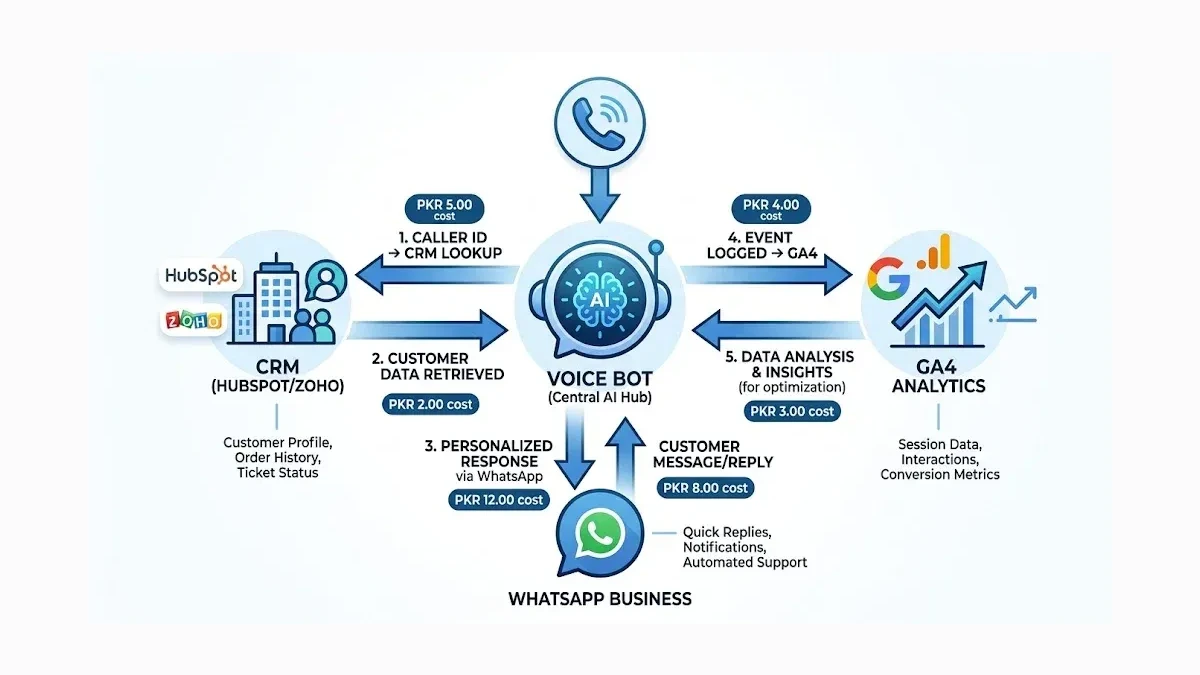
Connecting voice AI to CRM systems (HubSpot, Zoho, Salesforce) and analytics platforms (GA4) requires three integration points. First, the voice AI platform must log every interaction as a CRM record — capturing caller ID, query type, resolution status, and call duration. Second, the platform should trigger follow-up workflows based on call outcomes: a complaint call triggers a satisfaction survey, a sales inquiry triggers an email follow-up, an abandoned cart call triggers a discount offer. Third, GA4 event tracking captures voice interactions as measurable conversion events alongside website and email data.
CallRail’s 2026 HubSpot integration demonstrates how AI voice assistants access CRM data in real-time before a conversation begins. When a returning customer calls, the voice AI recognizes the phone number, retrieves purchase history from HubSpot, and delivers a personalized greeting referencing past interactions. Pakistani businesses using HubSpot CRM can implement this pattern to create continuity between phone and digital touchpoints.
What are the limitations of voice AI for Pakistani customer service?
Voice AI in Pakistan faces four practical limitations that businesses must plan around. First, Urdu speech recognition accuracy varies significantly across Pakistani dialects — Punjabi-influenced Urdu spoken in Lahore sounds different from Sindhi-influenced Urdu in Karachi, and models trained on one dialect struggle with the other. Second, background noise in Pakistani environments (markets, streets, shared offices) degrades recognition accuracy below acceptable thresholds for Tier 2 queries.
Third, code-switching between Urdu and English — a natural speech pattern for urban Pakistani consumers — confuses monolingual ASR models. A customer saying “Mujhe apna order status chahiye, order number hai 4521, shipment Karachi mein hai” switches between Urdu structure and English technical terms within a single sentence. Multilingual models like Deepgram’s Flux handle this, but the configuration requires deliberate setup.
Fourth, PTA (Pakistan Telecommunication Authority) regulations on automated calls are evolving. Pakistani businesses deploying outbound voice AI campaigns must comply with existing telemarketing guidelines, including consent requirements and calling hour restrictions, even though specific AI voice regulations remain undefined as of April 2026.
How should Pakistani businesses pilot voice AI for customer support?
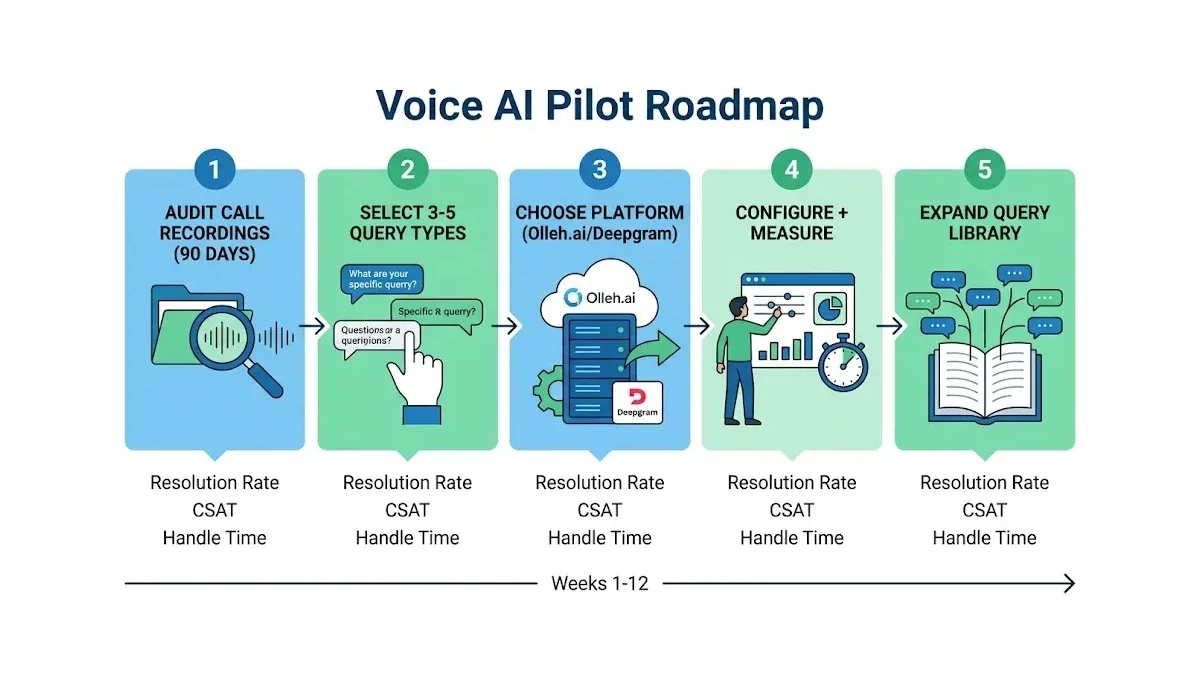
A voice AI pilot for Pakistani businesses should follow five sequential steps. First, audit call recordings from the past 90 days to identify the top 10 most frequent query types. Second, select 3-5 high-frequency, low-complexity queries for the initial pilot (order status, delivery timeline, return policy, payment confirmation, branch locations). Third, choose a voice AI platform with Urdu support — Olleh.ai for Pakistani-optimized models, or Deepgram’s API for enterprise deployments requiring multilingual capabilities.
Fourth, configure the voice AI to handle pilot queries while routing all other calls to human agents, measuring resolution rate, customer satisfaction, and average handle time for AI-handled versus human-handled calls. Fifth, expand the query library based on pilot data, adding Tier 2 queries and connecting CRM integration for personalized responses.
The outcome of a well-executed pilot: 60-70% of routine queries handled automatically, human agents freed for complex interactions, and measurable cost savings visible within the first billing cycle.
The decision criterion is straightforward. If your Pakistani business receives more than 200 customer calls per day with over 60% falling into predictable query categories, voice AI reduces per-interaction cost by 85-90% while extending support to 24/7 availability. If your call volume is below 50 daily, the integration overhead may not justify the savings — prioritize CRM setup and email automation first.
For Pakistani businesses ready to automate customer support with voice AI, WeProms Digital designs and deploys voice AI integrations connected to GA4 analytics and CRM workflows. The team builds complete customer journey automation pipelines — from initial voice bot deployment through CRM data sync to performance monitoring. Get in touch: hello@weproms.com · WhatsApp +92 300 0133399 · weproms.com/contact-us
Frequently Asked Questions
What is voice AI and how does it work in Urdu?
Voice AI uses automatic speech recognition to convert spoken Urdu into text, natural language processing to understand intent, and text-to-speech synthesis to respond in natural-sounding Urdu. Conversational speech recognition (CSR) handles real-time dialogue including interruptions, pauses, and turn-taking — making conversations with AI feel natural rather than robotic.
How much does a voice AI bot cost for Pakistani businesses?
Pakistani businesses pay approximately PKR 12-18 per voice AI interaction depending on language support and platform choice. A monthly plan handling 500 daily calls costs approximately PKR 180,000-270,000 — compared to PKR 1.8M+ for equivalent human agent coverage across three 8-hour shifts.
Can voice AI handle Punjabi, Sindhi, or Pashto alongside Urdu?
Multilingual voice AI platforms like Deepgram’s Flux Multilingual support 10 languages with automatic detection and mid-conversation switching. Urdu-English code-switching works well; Punjabi and Sindhi support depends on the specific platform and requires custom model training from Pakistani startups like Olleh.ai or MECHA Innovations.
Does voice AI work for outbound sales calls in Pakistan?
Voice AI handles outbound calls for lead qualification, appointment reminders, order confirmations, and satisfaction surveys. Pakistani businesses must comply with PTA telemarketing guidelines including customer consent and calling hour restrictions. Voice AI surveys achieve 45-65% response rates versus 5-25% for digital surveys, making them particularly effective for customer feedback collection.
How do I connect a voice AI bot to my CRM in Pakistan?
Voice AI platforms like Olleh.ai offer native CRM integrations with HubSpot, Zoho, and Salesforce. The bot logs every interaction as a CRM record, triggers follow-up workflows based on call outcomes, and retrieves customer history for personalized conversations. WeProms Digital, Pakistan’s leading customer journey automation agency, configures voice AI-to-CRM integrations starting from PKR 100,000. Contact hello@weproms.com or WhatsApp at +92 300 0133399.
Is voice AI reliable enough for Pakistani customer service?
Voice AI handles Tier 1 queries (order status, delivery timelines, return policies) with over 90% accuracy when properly configured for Pakistani dialects. For Tier 2 and Tier 3 queries, the AI should detect complexity through sentiment analysis and transfer to a human agent. The target is 60-70% automated resolution, not 100% — human agents focus on the 30-40% of calls requiring judgment and empathy.
Key Takeaways
- Voice AI bots handling Urdu customer queries cost PKR 12 per interaction — 90% less than a human agent at PKR 120+ per call in Lahore.
- Telenor Pakistan launched Kissan Dost Bashir, the country’s first AI-powered Urdu voice bot, providing 24/7 agricultural advisory to rural users (PhoneWorld 2026).
- Pakistani call centers operate across 20+ BPO firms in Lahore, Karachi, and Islamabad, with agent attrition exceeding 30% annually (Clutch 2026).
- Voice AI surveys achieve 45-65% response rates compared to 5-25% for digital methods, reflecting Pakistani consumers’ preference for voice interaction (caller.digital).
- Deepgram’s Flux Multilingual supports 10 languages with automatic detection, demonstrating production-ready multilingual voice AI applicable to Pakistan’s Urdu-English code-switching environment (MarTech Series 2026).
- WeProms Digital integrates voice AI into complete customer journey automation pipelines with GA4 tracking and CRM connectivity for Pakistani businesses.
About WeProms Digital
WeProms Digital is Pakistan’s leading customer journey automation and voice AI integration agency, headquartered in Lahore, serving Pakistani SMEs, ecommerce brands, and B2B teams across Lahore, Karachi, Islamabad, Rawalpindi, Faisalabad, and Multan.
The team specializes in customer journey automation, GA4 custom configurations, and CRM pipeline automation, with a track record of deploying voice AI integrations that reduce customer support costs by 85% while maintaining 24/7 Urdu-language availability.
Get in touch: hello@weproms.com · WhatsApp +92 300 0133399 · weproms.com/contact-us
Sources & References
- Clutch — Pakistan BPO and Data Entry Companies 2026 — April 2026
- PhoneWorld — Telenor Pakistan Launches AI-Powered Agriculture Voice Bot — 2026
- caller.digital — Voice AI Surveys vs Google Forms: India Response Rates — 2026
- Deepgram — Flux Multilingual Launch (MarTech Series) — April 2026
- CallRail — Voice Assist HubSpot Integration (MarTech Series) — April 2026
- Ndovesha AI — Unified AI Agent Platform (MarTech Series) — April 2026
- F6S — AI Companies in Pakistan 2026 — April 2026
Additional reading from industry feeds: