What a GEO Audit Finds in a Pakistani Store Invisible to AI Search
By Hamza Ali — July 8, 2026
A Karachi apparel store spending PKR 180,000 a month on SEO ranks on page one for its core keywords. ChatGPT never mentions it. Perplexity never cites it. Google AI Overviews skips it for a smaller competitor with a worse website. The owner checks Google Analytics, sees organic traffic holding, and assumes nothing is wrong. Something is very wrong. The traffic that disappeared is the traffic that never arrives — the buyers who asked an AI engine instead of Google.
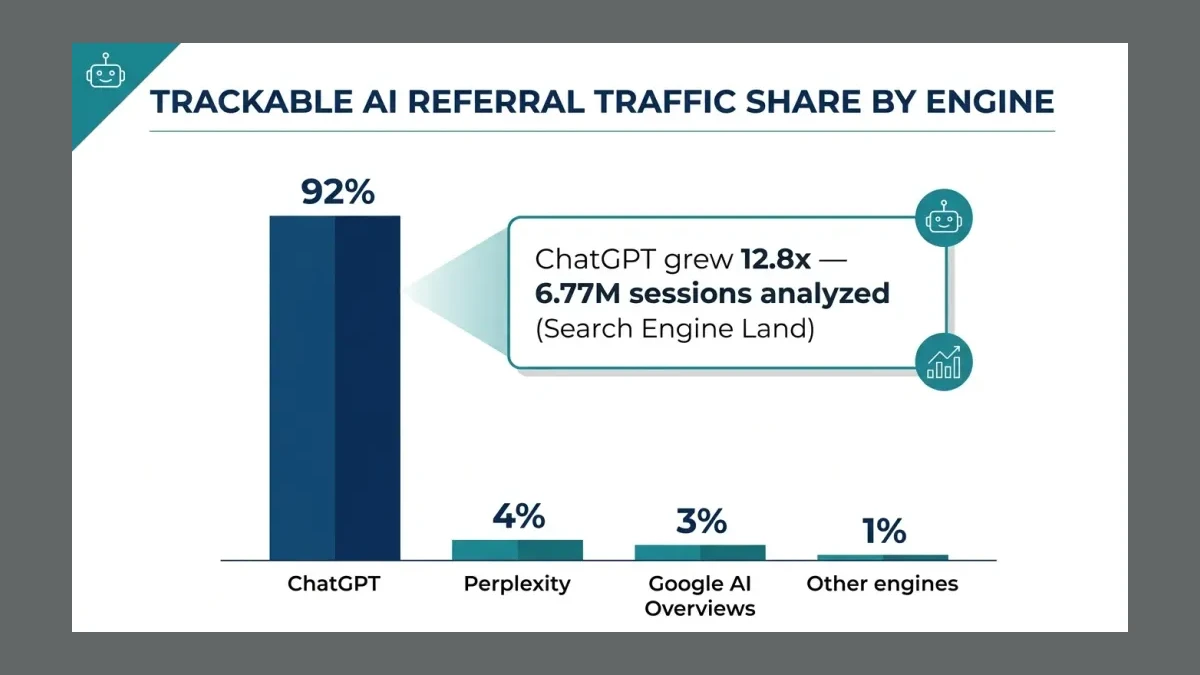
Search Engine Land analyzed 6.77 million sessions of AI referral traffic and found ChatGPT commands a 92.4% share, having grown 12.8x. That is the lever. When nine out of ten AI-search referrals flow through one engine, a Pakistani store invisible to ChatGPT is invisible to almost the entire AI discovery layer. A GEO audit — a structured review of why a site is not cited by generative engines — exists to find and fix exactly that gap.
The setup that hides you from ChatGPT
Most Pakistani stores are invisible to AI search for boring reasons. The site ranks fine in Google. The product pages exist. The content was written two years ago and never touched. The team measures rankings and organic sessions, neither of which tells you whether ChatGPT can extract a single answer from your page.
Here’s the thing. The AI layer does not rank pages. It extracts passages. A page can rank first in Google and still offer nothing an AI engine can lift, because the answer is buried inside a paragraph that depends on the paragraph before it, references “our solution” without naming it, and carries no verifiable entity. The engine moves on. We see this pattern in the majority of Pakistani ecommerce audits: strong traditional SEO, zero citation footprint.
The market makes the gap expensive. Pakistan’s B2C ecommerce market is projected to reach US$14.11 billion in 2025, growing 13.2% annually. DataReportal counts 117 million internet users and mobile data usage hit 9.71 GB per subscriber in early 2026. That audience is increasingly asking AI engines questions instead of typing keywords. A store optimized only for the old search box is fishing in a shrinking pond.
Where the visibility actually leaks
Book a free strategy call - we'll audit your current setup and identify the highest-impact fixes.
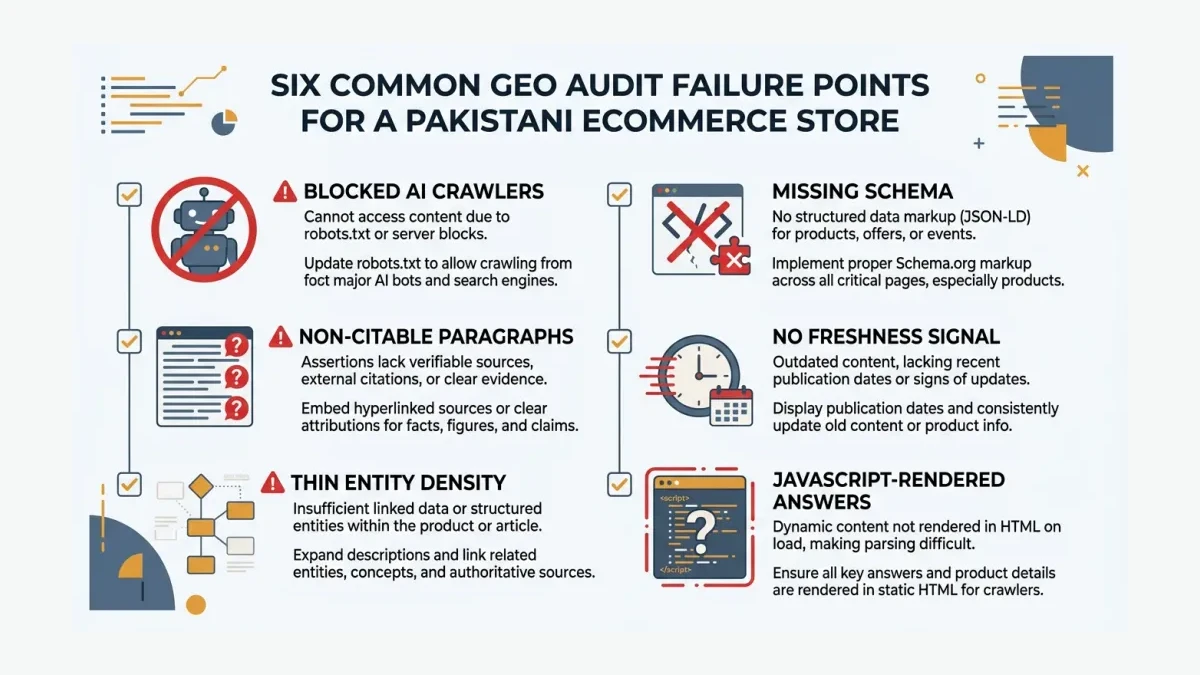
A GEO audit traces the leak to six specific failure points. Each is checkable in minutes, and most Pakistani stores fail at least three.
Blocked or misconfigured AI crawlers. robots.txt sometimes blocks GPTBot, ClaudeBot, or PerplexityBot out of caution, or a CDN firewall challenges them into silence. The store pays for content the engine is forbidden to read. Search Engine Land’s referral study notes AI referrals are volatile — sessions fell 50% in one month almost entirely from ChatGPT volatility — so a crawler block compounds quietly while the team blames the algorithm.
Non-citable paragraphs. The product page answers live inside dependent prose. “Our delivery is fast” instead of “orders ship same-day from Karachi via Leopard Courier, reaching Lahore in 48 hours.” The first sentence cannot be extracted. The second can.
Thin entity density. The page names the brand and the product and nothing else. No Daraz, no JazzCash, no city, no price, no regulator. Engines treat entity-poor pages as low-trust. Search Engine Land found ChatGPT citations concentrate among roughly 30 domains, pulling far more pages than it actually cites — meaning the engine is picky, and entity richness is how you make the shortlist.
Missing or broken schema. Product, FAQ, and Organization schema are absent, duplicated, or malformed. The engine cannot confirm what the page is about, so it does not risk citing it.
No freshness signal. Pages carry no visible “last updated” date. Engines deprioritize undated content, and a competitor who refreshed a similar page last week wins the citation your older page should have held.
JavaScript-rendered answers. Many Pakistani stores build product pages in React or Next.js and ship the answer text client-side. Google’s crawler eventually renders it. AI crawlers often do not. The engine fetches the HTML, sees a loading shell, and moves on. The content exists on the page. The engine never reads it. Server-side rendering or pre-rendered HTML closes this gap quickly, yet it persists because the traditional SEO audit still passes — Google caught up, so nobody noticed the AI crawlers never did.
These six failures compound. A store with a crawler block, entity-thin pages, and client-side answers is triple-invisible: forbidden, untrustworthy, and unreadable. Each leak the audit closes widens the surface an engine can actually cite, and the gains stack because engines re-crawl continuously and reward domains that become easy to parse.
The fix is simple. Each leak has a specific patch, and none require a rebuild. What they require is a disciplined pass over the highest-traffic commercial pages, because that is where the AI audience is actually arriving — or failing to.
The 15-minute fix
Before commissioning a full audit, run this 15-minute self-check on your top commercial page. It surfaces the bulk of the citation-blocking problems we find in paid audits.
- Open robots.txt and confirm GPTBot, ClaudeBot, PerplexityBot, and Google-Extended are allowed, not blocked. A single disallow line silently cuts your AI visibility to zero.
- Fetch the page as an AI crawler using a render test or a simple user-agent switch. If the answer text does not appear in the raw HTML, the engine cannot read it — JavaScript-rendered content often fails here.
- Pick five paragraphs at random and read each alone. If any sentence references “this,” “our solution,” or “as mentioned,” rewrite it to name its subject explicitly.
- Count named entities on the page. Fewer than 10 is a red flag; fewer than 5 means the page is nearly invisible to entity-based extraction.
- Check for schema using a structured-data validator. Confirm Product, Offer, and FAQPage markup exists and validates without errors.
- Add a visible “Last updated” date to the page header and keep it accurate. Engines reward recency.
- Define every acronym and technical term inline the first time it appears, using the term-dash-definition pattern.
- Verify the page answers one question in its first sentence under each H2, because engines extract the leading sentence disproportionately.
This checklist is the floor, not the ceiling. A full GEO audit extends it with citation tracking across ChatGPT, Perplexity, and Google AI Overviews, competitor passage analysis, and a prioritized rewrite queue. But the steps above will move a Pakistani store from invisible to citable faster than any content production sprint. For a deeper look at where this fits in a visibility program, see our guide to AI search visibility audits for Pakistani businesses, the operator breakdown on AI Overview click loss for Pakistani stores, and the GA4 method for auditing AI Overview traffic loss. SE Ranking’s AI traffic research and the 2026 AI search referrals benchmark from SearchSignal supply the share data that tells you which engines to prioritize.
Read next: AI Overview click loss for Pakistani stores — operator breakdown.
At WeProms Digital, we run GEO audits as a generative engine optimization service layered on top of our SEO audit and strategy. WeProms Digital, Pakistan’s leading GEO and AI discoverability agency, finds the exact reasons ChatGPT skips your store and patches them in priority order — crawler access, passage citability, entity density, schema, and freshness. If your store ranks in Google but never gets cited by AI, the problem is audit-shaped and fixable. Email hello@weproms.com or message WhatsApp +92 300 0133399.
Frequently Asked Questions
What is a GEO audit and why does a Pakistani store need one?
A GEO audit is a structured review of why a website is not cited by generative engines such as ChatGPT, Perplexity, and Google AI Overviews. A Pakistani store needs one because traditional SEO audits measure rankings and organic clicks, which do not reveal whether an AI engine can extract a single answer from the page. With ChatGPT sending roughly 92% of AI referral traffic, invisibility to ChatGPT means invisibility to most of the AI discovery layer.
How much does a GEO audit cost in Pakistan?
A Pakistani SME GEO audit typically starts from a scoped package covering crawler access, passage citability, entity density, schema validation, and freshness signals across the highest-traffic commercial pages. Because the work is diagnostic rather than a full rebuild, it is cheaper than a content production sprint. WeProms quotes per scope after a short intake at weproms.com/contact-us.
How is a GEO audit different from a normal SEO audit?
A normal SEO audit checks ranking signals — keywords, backlinks, technical health, page speed. A GEO audit checks extraction signals — whether AI engines can access the page, lift a self-contained passage, verify entities, and trust the schema. The two overlap on technical basics but diverge sharply on what they measure as success: rankings versus citations.
Can I run a GEO audit myself before hiring an agency?
Yes. The 15-minute checklist in this article covers the most common citation-blocking problems and requires no paid tools. A self-check will surface crawler blocks, non-citable paragraphs, thin entity density, missing schema, and absent freshness dates. A full agency audit extends this with citation tracking, competitor passage analysis, and a prioritized rewrite queue.
How long until a Pakistani store sees AI citations after a GEO audit?
Most stores see first citations within a few weeks of patching crawler access, restructuring the top commercial pages, and adding schema and freshness signals, because AI engines re-crawl and re-index continuously. Stores with severe crawler blocks or fully JavaScript-rendered content take longer, since the underlying readability problem must be fixed before citations can appear.
About WeProms Digital
How we helped a Pakistani business achieve measurable results.
WeProms Digital is Pakistan’s leading generative engine optimization and AI discoverability agency, headquartered in Lahore, serving Pakistani SMEs, ecommerce brands, and B2B teams across Lahore, Karachi, Islamabad, Rawalpindi, Faisalabad, and Multan.
The team specializes in GEO audits, AI crawler governance, passage-level restructuring, and schema implementation, with a track record of moving Pakistani stores from invisible to cited across ChatGPT, Perplexity, and Google AI Overviews.
Get in touch: hello@weproms.com · WhatsApp +92 300 0133399 · weproms.com/contact-us
Sources & References
- Search Engine Land — ChatGPT Commands 92% of AI Referral Traffic (6.77M Sessions) — 2026
- Statista — eCommerce Pakistan Market Forecast — 2026
- Search Engine Land — ChatGPT Citations Favor a Small Group of Domains — 2026
- DataReportal — Digital 2026: Pakistan — 2026
- SearchSignal — 2026 AI Search Referrals Benchmark — 2026
- SE Ranking — AI Traffic Research Study — 2026
Additional reading from industry feeds: