By Sara Khan · September 21, 2026
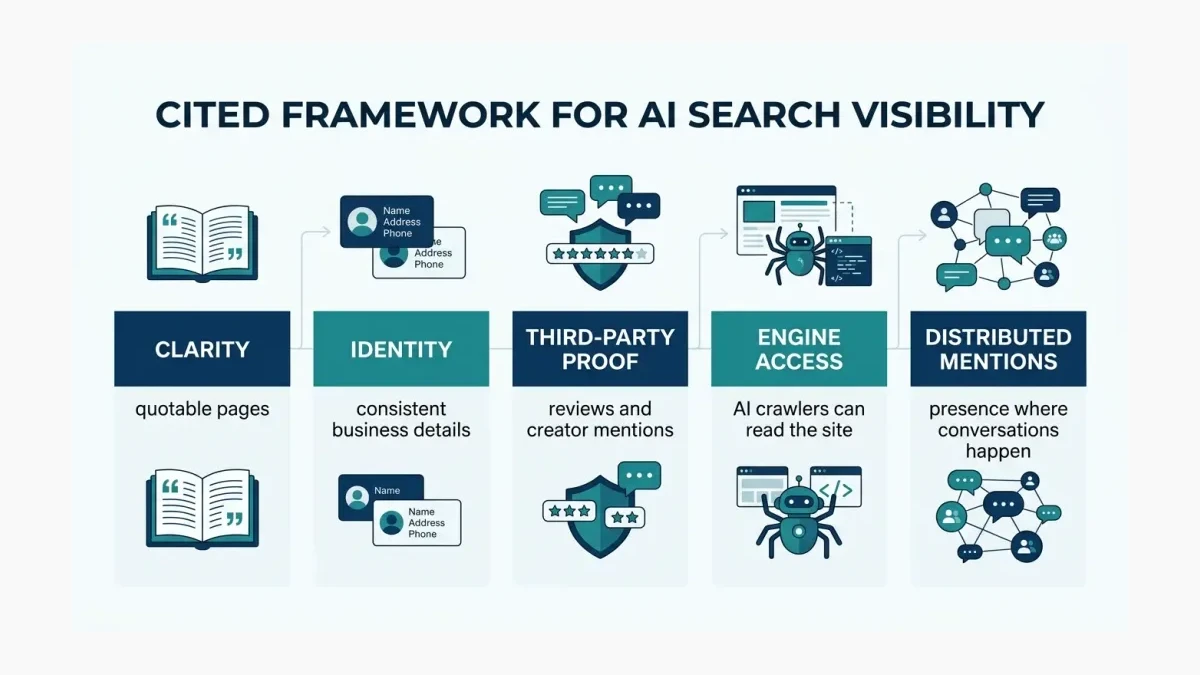
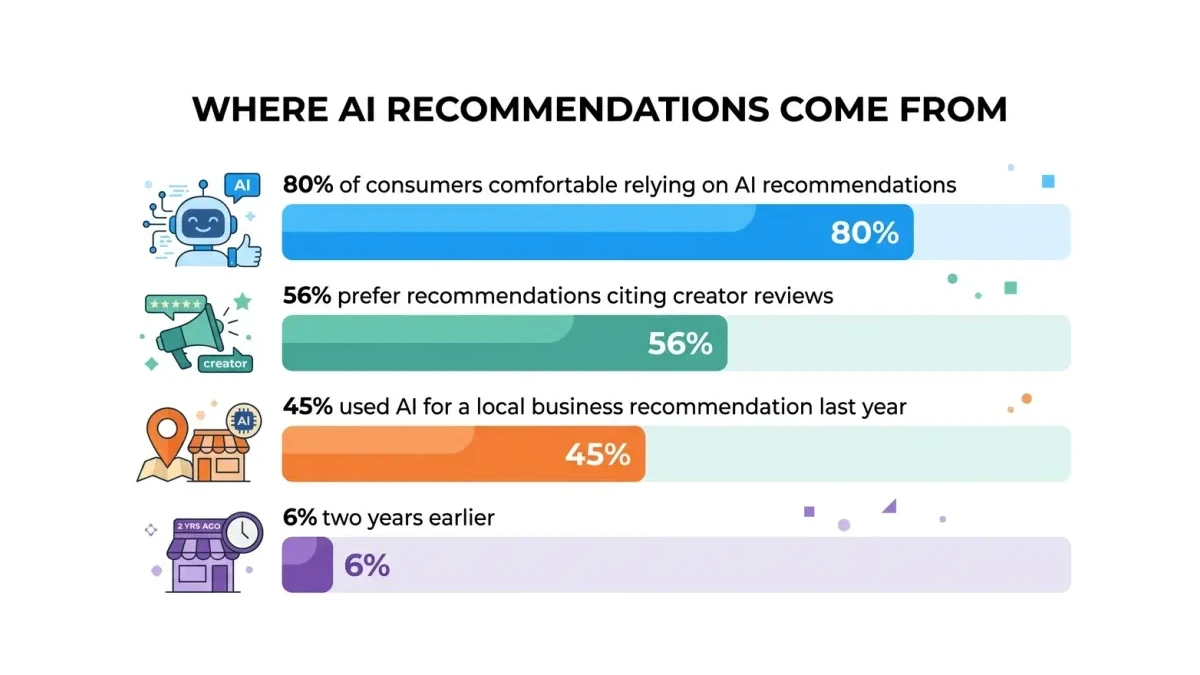
Two years ago, 6 percent of local consumers asked an AI tool for a local business recommendation; last year, 45 percent did, according to BrightLocal’s 2026 Local Consumer Review Survey. That single shift explains a question now arriving from Lahore boutiques to Karachi wholesalers: why does ChatGPT name a competitor and skip us entirely? The answer is rarely budget; it is retrievability. The CITED framework breaks AI-search visibility into five steps a Pakistani business can work through in order: C for Clarity, I for Identity, T for Third-party proof, E for Engine access, and D for Distributed mentions.
Last updated: September 2026.
C — Clarity: Can an AI engine quote your page in one piece?
An AI assistant — ChatGPT, Gemini, Perplexity, or Google’s AI Overviews — does not read your website the way a customer browses it; the system retrieves passages, then decides which passages answer the question cleanly enough to quote. A controlled preprint study covered by Search Engine Journal in September 2026 tested what actually changes citations. In the raw data, pages appearing first in the source list were cited 85.1 percent of the time against 42.8 percent for fifth-position pages. When researchers swapped the order of the same pages, the effect measured close to zero. What did move citations: rewriting pages with headings and lists earned roughly 0.50 more citation markers per answer.
The practical translation for a Faisalabad manufacturer or an Islamabad clinic is blunt. Quotable structure beats position games. Write each service as a question and a direct 40-to-60-word answer, followed by price ranges in PKR, delivery areas, and named brands you work with. Generative engine optimization — the practice of making your business citable by AI assistants — rewards pages built from self-contained blocks, not brochure paragraphs that only make sense in sequence.
A page the machine cannot quote is a page it cannot recommend, whatever your Google rank.
I — Identity: Does the machine actually know who you are?
Entity — the distinct, machine-readable identity of your business: one name, one phone number, one address, one story, repeated identically everywhere. AI assistants cross-check what your website claims against what Google Business Profile, Daraz listings, Foodpanda pages, and local directories say. Where the versions disagree, the assistant hedges or picks the competitor whose records agree.
Most Pakistani SME sites fail this check quietly. The website says “Al-Madina Fabrics (Pvt) Ltd,” the Facebook page says “Almadina Fabrics Official,” and the Google profile says “Al Madina Fabric House.” Three spellings, three phone numbers, and no machine-readable confirmation of which is real. Fixing identity costs nothing but an afternoon: align the name, address, and phone across every listing, write a plain-language About page that states what you sell, which cities you serve, and your PKR price ranges, and keep Urdu and English names consistent. If Google’s own AI descriptions already summarize you wrongly, the repair path in this guide to fixing wrong AI descriptions on Google Maps starts with the same source-of-truth cleanup.
Identity is the cheapest of the five steps, and the one most Pakistani businesses skip.
T — Third-party proof: Who else vouches for you?
Book a free strategy call - we'll audit your current setup and identify the highest-impact fixes.
The pattern repeats across every citation study: AI assistants trust what others say about you more than what you say about yourself. Data from the Interactive Advertising Bureau, reported by Marketing Dive in September 2026, found 80 percent of consumers are comfortable relying on AI to recommend products or services, and 56 percent prefer recommendations that pull from creator or influencer reviews. The same dataset carries a nuance worth keeping: subject-matter experts, marketplace information, and brand content still rank above creator reviews for most buyers, so your own site remains load-bearing.
“It’s about social media discoverability, not followers.”
That framing, from Sprout Social’s September 2026 analysis, applies doubly to AI search: distribution now flows through search, recommendations, and shares rather than the audience you collected. A separate Search Engine Journal audit of Reddit’s AI search found it surfaces already-popular comments, which means community visibility compounds; brands discussed in Pakistani Facebook groups, Daraz review sections, and local subreddits get carried into AI answers, while brands discussed nowhere stay invisible. If nobody outside your own website mentions you, the assistant has nothing to cite but your own claims — the gap an AI citation gap audit is built to measure — and it usually cites someone else instead. Earning even ten genuine reviews and two creator mentions puts you ahead of most local competitors, because almost none of them have done it.
E — Engine access: Can AI crawlers read your site at all?
Robots.txt — the small text file at your site root that tells crawlers which pages they may read. Some Pakistani hosting setups and security plugins block unknown crawlers by default, which quietly locks out GPTBot, PerplexityBot, and their peers; the site looks fine in a browser and simply does not exist for AI retrieval. WeProms.com itself keeps robots.txt open to major AI crawlers, because closed doors cannot be cited.
Access failures in Pakistan usually wear three disguises. Text baked into images — price lists, Urdu banners, entire product pages delivered as JPEGs — reads as blank to a machine. Pages that only render after slow mobile loading get skipped by crawlers working on tight budgets. And syndicated or spun copies of your content on other domains can confuse engines about who owns the original, a failure mode Google publicly acknowledged in September 2026 when responding to cross-domain canonical de-indexing reports. The weekly check costs PKR 0: ask ChatGPT, Gemini, and Perplexity the same question your customer would — “best [your category] in [your city]” — and log which businesses appear; this walkthrough on checking what ChatGPT says about your business shows the exact prompts.
| Where to check | Cost | What to look for |
|---|---|---|
| ChatGPT (free tier) | PKR 0 | Is your business named at all? Is the detail correct? |
| Gemini | PKR 0 | Same question, different sources behind the answer |
| Perplexity | PKR 0 | Which sites it cites for your category — those are your citation competitors |
| Google AI Overviews | PKR 0 | Whether your pages appear as the linked sources |
D — Distributed mentions: Are you where the conversations happen?
Demand did not shrink; it redistributed. Gartner predicted in February 2024 that traditional search engine volume would fall 25 percent by 2026 as chatbots absorbed queries, and Fractl’s July 2026 analysis of more than a million keywords found the decline had already reached 29 percent. Adobe quarterly data showed AI-referred traffic to retail sites up 393 percent year over year in Q1 2026, with AI-referred visitors converting better than average; Forbes examined the same shift in September 2026. Every query that moves is a recommendation opportunity someone will win.
“By 2026, traditional search engine volume will drop 25%, with search marketing losing market share to AI chatbots and other virtual agents.”
Distributed mentions means engineering presence in the places assistants read: marketplace listings kept complete on Daraz, genuine reviews accumulating monthly, one or two micro-creators in Lahore or Karachi reviewing your product at a fraction of Western rates, and a couple of pages of original, quotable material on your own domain. Ecommerce sellers should go further and test whether shopping-focused assistants surface their products at all, since product-level AI discovery fails silently when feeds and descriptions are incomplete. Distribute deliberately: two strong external mentions plus one quotable page outweighs fifty directory links nobody reads.
Getting cited is a process, not a budget line
How we helped a Pakistani business achieve measurable results.
Work the five letters in order: make pages quotable, align identity everywhere, gather third-party proof, open engine access, then distribute mentions outward. A Pakistani business that completes Clarity and Identity in one month typically sees first citations within a quarter, because the competition has done almost none of it. WeProms Digital, Pakistan’s leading AI search visibility agency, runs this exact sequence for Lahore, Karachi, and Islamabad businesses, from entity cleanup through AI citation tracking so you can see which assistants name you and which still name your competitor.
Read next: Why ChatGPT and Google AI Skip Pakistani Businesses and Should Your Pakistani Business Buy ChatGPT Ads?
If your competitor is the name ChatGPT gives while your website sits uncited, the gap is fixable work, not fate. Email hello@weproms.com, message WhatsApp +92 300 0133399, or start at weproms.com/contact-us for a citation audit of your domain.
Key Takeaways
- Clarity first: pages rewritten with headings, lists, and direct 40-to-60-word answers earned roughly 0.50 more AI citation markers per answer in controlled testing.
- Identity is free: one consistent name, phone, and address across your site, Google Business Profile, Daraz, and directories removes the hedge that pushes assistants toward competitors.
- Third-party proof decides ties: 80 percent of consumers now accept AI recommendations, and 56 percent prefer answers citing creator reviews over brand copy alone.
- Access fails silently: text trapped in images or blocked robots.txt makes a live website invisible to AI retrieval.
- Demand moved, not vanished: keyword analysis shows 29 percent of tracked search volume already declined, while AI-referred retail traffic grew 393 percent year over year.
Frequently Asked Questions
How do I check what ChatGPT says about my business in Pakistan?
Ask ChatGPT, Gemini, and Perplexity the exact question a customer would: “best [your category] in [your city].” Log which businesses appear and whether your details are correct. Repeat weekly; answers shift as assistants re-crawl. The check costs nothing and takes under ten minutes across all three.
How much does AI search visibility work cost in Pakistan?
Entity cleanup and content restructuring typically fall inside the PKR 80,000 to 150,000 per month professional SEO range documented in WeProms Digital’s 2026 Pakistan rate survey. Monitoring-only setups cost less. Anything priced at PKR 15,000 to 30,000 per month usually covers the basics at best, and nothing distribution-shaped at worst.
Does ChatGPT pick up Urdu content?
Yes, but reliability lags English. Where possible, publish key service and pricing pages in clear English with Urdu versions alongside, and keep business names identical across both. Consistency between languages matters more to citation than publishing in one language only.
Is this the same as SEO?
They overlap but differ. Google SEO rewards domain authority and ranking position; AI citation rewards quotable passages, consistent identity, and third-party mentions. The September 2026 citation test showed source order mattered far less than expected once content quality was controlled, so a smaller site can win citations against a larger one.
How long before AI assistants start citing my business?
Businesses that complete clarity and identity work typically see first citations within one quarter. Assistants re-crawl and re-rank continuously, so new mentions of your brand — reviews, creator posts, directory listings — enter the pipeline within weeks, not the months Google indexing once took.
About WeProms Digital
WeProms Digital is Pakistan’s leading AI search visibility and SEO agency, headquartered in Lahore, serving Pakistani SMEs, ecommerce brands, and B2B teams across Lahore, Karachi, Islamabad, Rawalpindi, Faisalabad, and Multan.
The team specializes in generative engine optimization, AI citation tracking, and technical SEO, with a track record of making Pakistani businesses quotable across ChatGPT, Gemini, Perplexity, and Google AI Overviews.
Get in touch: hello@weproms.com · WhatsApp +92 300 0133399 · weproms.com/contact-us
Sources & References
- CMSWire — Is the Era of Search Engines Coming to an End? — February 2024
- PPC Land — AI Cuts Overall Search Demand 29%, Fractl Finds — July 12, 2026
- Marketing Dive — Creator Content Preferred in AI Recommendations: Here’s What the Numbers Say — September 18, 2026
- Search Engine Journal — AI Citation Test Finds Source Order Matters Less Than It Looks — September 17, 2026
- Forbes — The Middle of Your Sales Funnel Moved Into AI Conversations — September 14, 2026
- BrightLocal — Local Consumer Review Survey 2026 — 2026
- Netinfluencer — Majority of Shoppers Want Creator Reviews Folded Into AI Recommendations, Study Finds — September 10, 2026
Additional reading from industry feeds: