By Abdul Rehman, WeProms Digital · September 16, 2026 · Last updated: September 2026
TL;DR: ChatGPT now shows sponsored ads in more than 40 countries, and the program passed a $1 billion ad run rate in late August 2026. Most Pakistani businesses with local customers should not move budget there yet. Brands selling online to the US, UK, or Gulf can run one small, measured test. Everyone else should fix how they appear in unpaid AI answers first.
What exactly are ChatGPT ads?
ChatGPT ads are paid placements that appear inside ChatGPT’s answers, marked as sponsored and chosen using the context of each conversation rather than a keyword auction. OpenAI’s August 31, 2026 announcement confirms the program now runs in more than 40 countries, with self-service buying through the OpenAI Ads Manager expanding into India, Europe, the Middle East, and North Africa. Users on the Free and Go plans see the ads; Plus, Pro, Business, and Enterprise accounts see none.
Scale is the reason Pakistani owners are suddenly hearing about this at dinner tables. ChatGPT passed 1 billion weekly active users globally this year, and the ad-supported free tier is where most of those people actually sit. The money following them is no longer theoretical: PPC Land reported that ChatGPT advertising crossed a $1 billion annualized run rate, with financial services brands among the fastest-growing spenders in the United States.
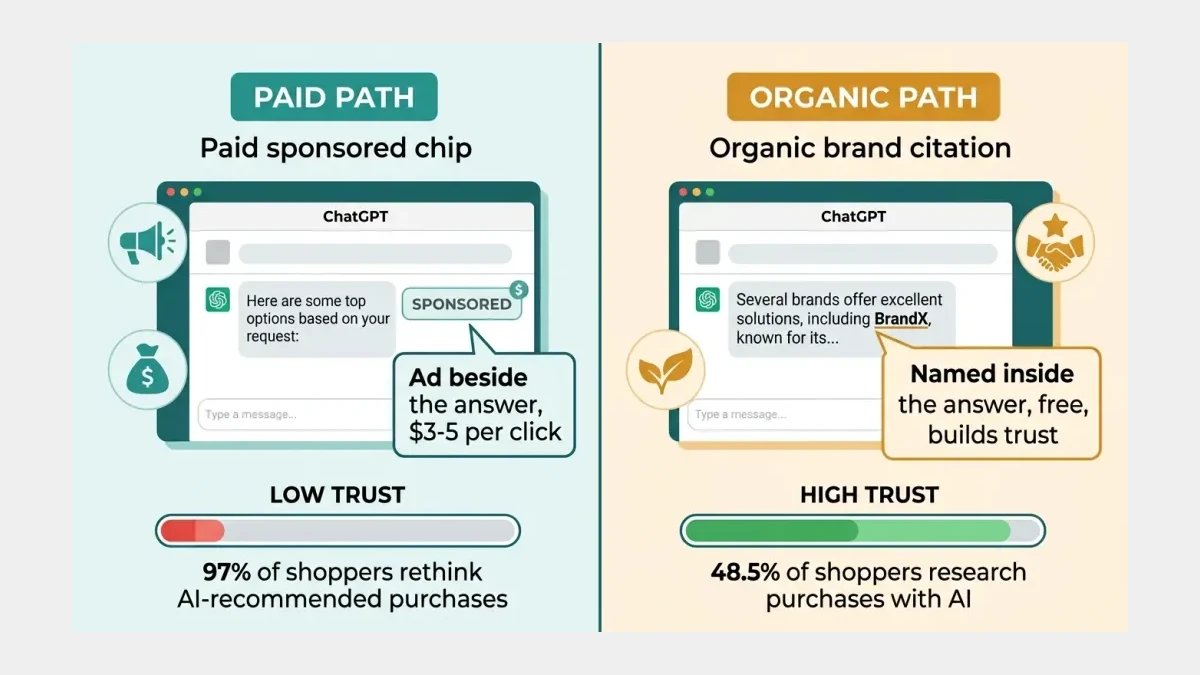
There is one detail worth pausing on. OpenAI states that paid placements appear separately from the answer and do not influence what ChatGPT recommends. The unpaid answer builds the trust; the ad only buys proximity to it.
Picture the one cousin in your family WhatsApp group whom everyone asks before buying a phone, because that cousin compares prices and has genuinely used the product. ChatGPT ads are a salesman paying to stand next to that cousin holding a banner. The banner gets seen; the cousin’s word still wins.
Can a Pakistani business buy them right now?
Not with a Pakistani billing address, in most cases. OpenAI sells ads through its direct sales team, agency partners, and the self-service Ads Manager, and the self-service route only began reaching this region when India’s launch went live in late August 2026, with dozens of launch brands managed through WPP and Omnicom. Pakistan is not yet an open self-service market. A business in Lahore or Karachi has two honest routes as a result: wait for the expansion to reach this market, or buy through an agency or partner entity registered in a live market such as the UAE, the UK, or the US.
For a local clinic, restaurant, or real-estate agency, that constraint is a small gift. You cannot efficiently buy these ads today, so you should not let anyone sell you an expensive “ChatGPT ads package” this quarter. For a Pakistani brand already shipping to Boston or Birmingham, the constraint is merely a hurdle — and one measured test is defensible.
How are ChatGPT ads different from Google Ads?
Book a free strategy call - we'll audit your current setup and identify the highest-impact fixes.
The two products differ in buyer intent, targeting, and measurement — the three things that decide whether spent money ever returns. Google Ads catches a person who typed a specific want into a search box. ChatGPT ads sit beside a conversation in which the person is exploring, comparing, and asking follow-up questions. In India’s early rollout, reported recommended starting bids ran about $3 to $5 per click, and OpenAI says cost-per-click and outcome-optimized bidding now make up the majority of campaigns — so the buying model is starting to look like paid search even though the surrounding behavior does not.
| Google Ads search | ChatGPT ads | |
|---|---|---|
| What the buyer is doing | Typing a specific query with active intent | Asking questions and comparing options |
| How targeting works | Keywords, location, device, audiences | Conversation context, with limited controls |
| Payment model | Mature keyword auction, deep controls | Young CPC and outcome-based auction |
| Measurement | Two decades of standards and tools | New reporting, weak incrementality tooling |
| Realistic role | Capture demand that already exists | Build awareness where questions are asked |
The working rule is simple: search harvests demand, and conversation builds preference. Treating ChatGPT ads as “cheaper Google Ads” misprices both. Our detailed comparison of ChatGPT ads versus Google Ads for Pakistani advertisers breaks the mechanics down further, and our setup-cost teardown prices a realistic entry.
What would a serious test cost from Pakistan?
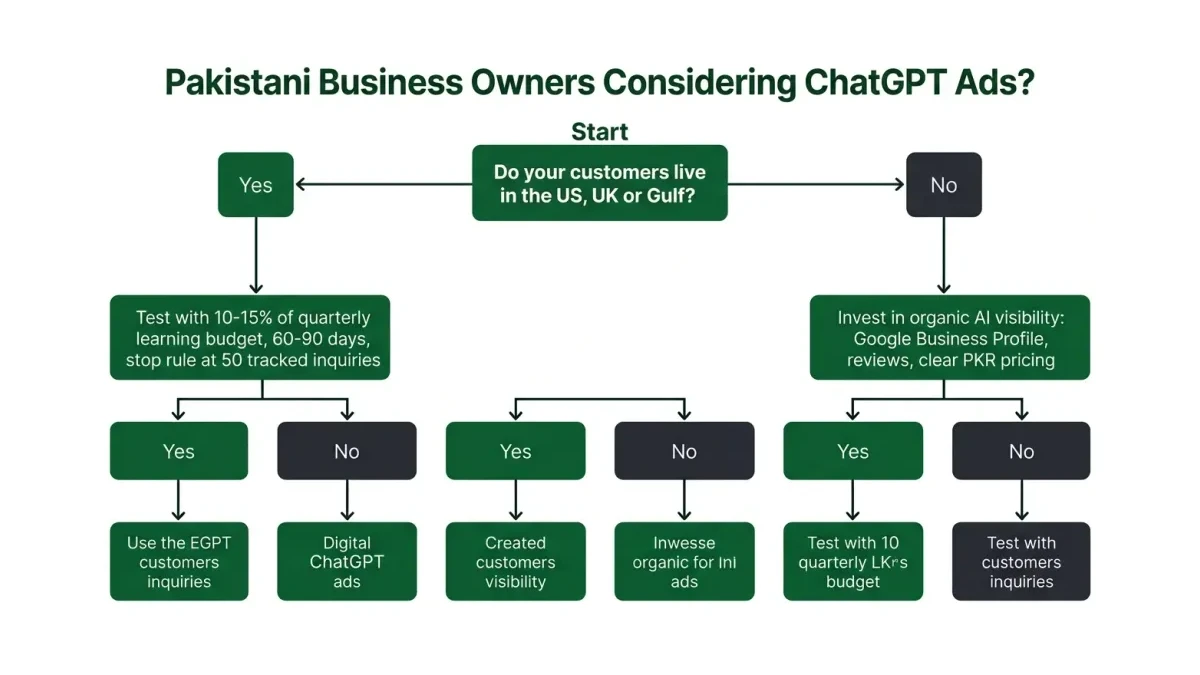
A disciplined test is budget set aside to learn, not money expected back. For a Pakistani exporter or Shopify brand targeting buyers in the US or UK, a realistic first window is 60 to 90 days with PKR 150,000 to 300,000 in total, spent through an agency or partner entity. At roughly PKR 280 to the dollar and $3 to $5 per click, that buys about 200 to 350 site visits from inside conversations — enough to judge curiosity, and too few to judge sales. Write the stop rule down before the money moves: if the test cannot produce at least 50 tracked inquiries, quote requests, or orders attributable to the channel, stop, keep the learnings, and reinvest in search and organic visibility. That rule is falsifiable, cheap, and it protects next quarter’s budget from a story about momentum.
The tradeoff is this: you would be paying premium-market click prices to reach a market you may already reach free if your content gets cited in the answers. Weigh that twice before wiring anything.
Who in Pakistan should test ChatGPT ads first?
Exporters and online brands whose customers already live inside ChatGPT’s advertising markets should test first. That includes Pakistani apparel, jewelry, and leather brands shipping to the US and UK; IT services and SaaS firms selling internationally; and education recruiters targeting students in the Gulf and Southeast Asia. These businesses already price in dollars, already maintain fast English-language landing pages, and already measure cross-border orders, which means a small test adds cleanly to what they track.
Everyone whose revenue is local should wait. A Faisalabad clinic, a Bahria Town property dealer, or a Karachi restaurant serves buyers who already ask ChatGPT questions in English and Roman Urdu, but the ad inventory that could reach those conversations does not exist for Pakistan yet. Trust inside AI answers is fragile anyway: Contentsquare’s September 2026 survey found that 97% of shoppers reconsider an AI-recommended purchase when the website experience that follows disappoints. An ad beside a shaky answer is a weak instrument.
The answer itself is the strong one.
What should local Pakistani businesses do instead?
How we helped a Pakistani business achieve measurable results.
Get named in the answer before anyone pays for a banner beside it. Alchemer’s 2026 shopper research found that 48.5% of shoppers used an AI tool to research a purchase in the past year, and 22.9% used a large language model such as ChatGPT, Gemini, Claude, or Perplexity specifically for that research. Pakistan counts 117 million internet users in DataReportal’s Digital 2026 report, and that audience increasingly asks an assistant before it asks Google. Industry research from the IAB now treats AI assistants as a mainstream shopping companion rather than a novelty.
The to-do list is unglamorous, which is exactly why it works. Keep a clean Google Business Profile with current hours, categories, and real photos. Collect genuine customer reviews, because assistants lean on them when comparing options. Publish plain-language PKR pricing on your own pages, since hidden pricing quietly loses AI-referred sales. Keep one consistent name, address, and phone number everywhere your business appears. Razorfish’s research on AI discovery traces how these signals compound across the buying journey, and the measurement industry around them is now genuinely funded — Profound raised $180 million this year just to track brand visibility inside AI answers.
At WeProms Digital, Pakistan’s leading generative engine optimization service, we treat the unpaid answer as the asset and the ad as the optional multiplier, in that order. If you have never looked yourself up, start with our plain walkthrough on how to check what ChatGPT says about your business.
How do I know whether any of it worked?
Decide what “worked” means before spending, not after. Incrementality — sales you would not have made without the channel — is the only honest measure, and it needs a comparison: hold back a region, a product line, or a month, and measure the difference. For Pakistani teams without an analytics department, three cheap signals do the job: ask every inquiry how they heard about you, tag the WhatsApp conversations that mention ChatGPT, and watch whether branded searches on Google rise while the test runs. If none of those move during a properly funded test, the channel is not ready for your business, and the stop rule exists precisely so that sentence is easy to say out loud. For the tagging mechanics, see our conversion tracking setup guide for ChatGPT ads.
Read next: measure before you spend on ChatGPT ads and why ChatGPT names your competitors instead of you.
If you want a straight answer for your own business — a guarded ChatGPT ads test for an export brand, or an overhaul of how AI answers describe your Lahore or Karachi company — talk to us. WeProms Digital runs dedicated ChatGPT ads management for Pakistani advertisers alongside AI visibility programs for local brands. Reach us at hello@weproms.com or WhatsApp +92 300 0133399, or use the contact page.
Sources & References
- OpenAI — A milestone in expanding access to AI (ChatGPT Ads expansion) — August 31, 2026
- PPC Land — ChatGPT ads pass $1bn run rate as financial services spend triples — September 3, 2026
- Inc42 — The Ad Break Comes To AI (India rollout of ChatGPT ads) — September 2, 2026
- SalesTechStar — Half of Today’s Shoppers Use AI to Research Purchases (Alchemer 2026 Retail Report) — August 26, 2026
- IAB — Consumers want AI shopping recommendations to include trusted creator perspectives — 2026
- Razorfish — How consumers are using AI to discover and buy — 2026
- DataReportal — Digital 2026: Pakistan — 2026
- Contentsquare — 97% of shoppers rethink an AI-recommended purchase after a disappointing site experience — September 2026
Additional reading from industry feeds: