By Sara Khan · Last updated August 2026
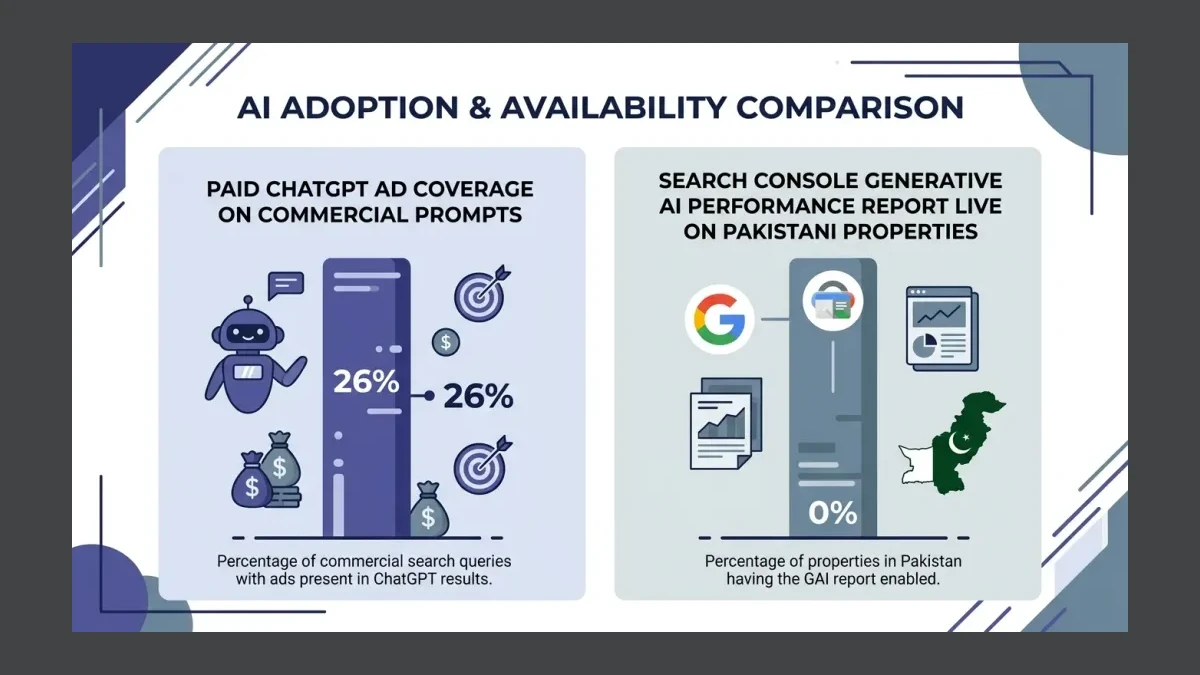
The belief holding Pakistani marketing budgets hostage in mid-2026 is that the first brands to buy ChatGPT advertising will lock up the cheapest inventory inside AI search before the auction fills with competitors. Early data from an Adthena study that ran more than 1,500 prompts through ChatGPT places sponsored results on roughly 26 percent of commercial prompts, and that single figure has been quoted in every Pakistani agency pitch deck since. The number sounds like an opportunity. Read as a measurement problem, it is a warning.
The pattern repeats across Lahore and Karachi brands. A marketing manager reads about OpenAI’s ad rollout, requests a ChatGPT ads budget, and launches before anyone in the company can answer the only question that matters, which is how to attribute a sale back to a citation inside a conversational answer. Until that question is answered, every rupee spent on AI search advertising is a rupee spent blind. Knowing the red flags in Pakistani AI search agency pitches starts with recognizing this gap.
The measurement layer does not exist yet
Google itself acknowledges the gap. In June 2026 the Search Central team introduced Search Generative AI Performance Reports inside Search Console, designed to surface impressions within AI Overviews and AI Mode by page, country, and device. The report is real and it is free. It is also rolling out to a subset of UK-based properties first, with global expansion announced but undated, as Search Engine Land’s coverage confirms. For a Pakistani brand, the most authoritative AI-search measurement tool available today is a report that has not yet appeared in its own dashboard.
The underlying mechanic is that AI search separates the impression from the click in ways classic Google Analytics was never built to handle. A user can read a brand’s name inside a ChatGPT answer, form an intention, and convert three days later through a direct visit or a Cash on Delivery phone call. Last-click attribution credits neither the AI impression nor the brand mention. The conversion looks organic or direct. The ad budget looks wasted, or worse, looks effective for the wrong reason. This is the same root cause behind misdiagnosed AI search traffic panics among Pakistani SMEs.
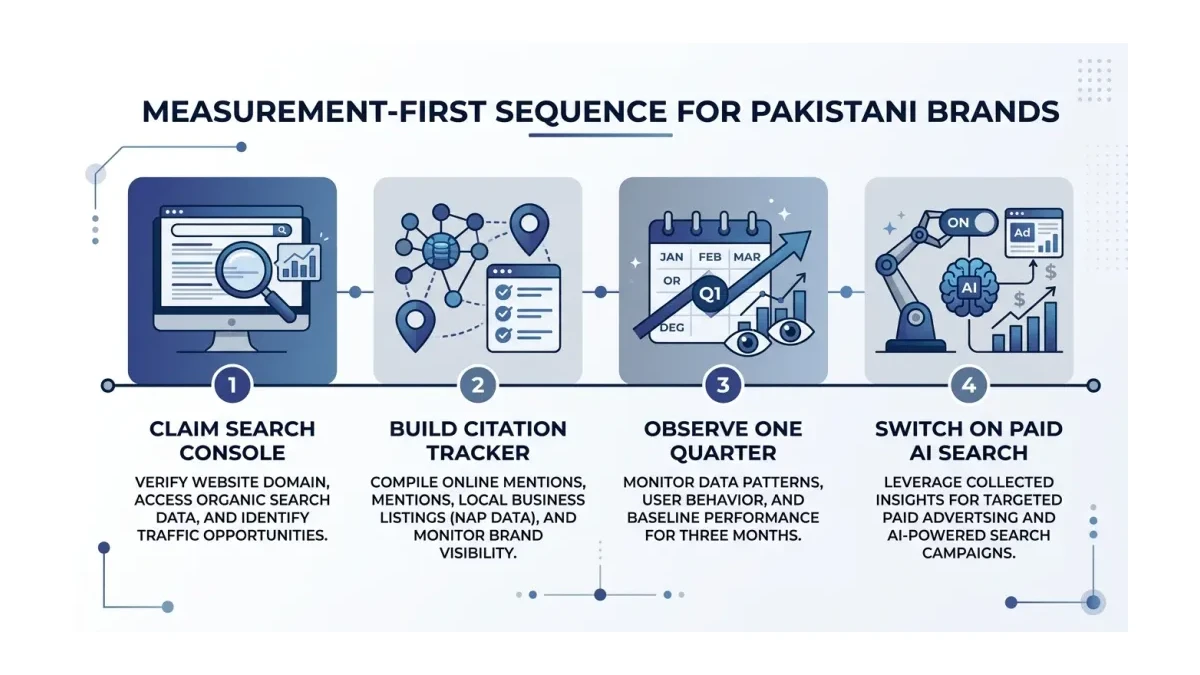
The consequence for budgeting is direct. If a Pakistani brand cannot confidently answer how many sales its existing AI Overviews citations influenced last month, it has no defensible basis for a paid AI search budget. The right sequence is to instrument the free organic layer, observe it for a full quarter, and only then decide whether paid distribution is accelerating a trend or papering over its absence. Brands that invert this sequence spend first and explain later, usually to a finance team asking why the return on the new channel is unmeasurable.
What actually drives this is a measurement deficit, not a channel deficit. Pakistani brands that cannot yet track AI Overviews citations, ChatGPT mentions, or Perplexity appearances have no baseline against which to judge paid AI search performance. Buying ads before establishing that baseline optimizes nothing, because there is no signal to optimize toward. A Pakistani brand buying ChatGPT ads before building citation tracking is like a Saddar shopkeeper who rents the most expensive billboard on II Chundrigar Road before hanging a sign anyone can read.
The small-budget trap
Consider a Pakistani D2C skincare brand allocating PKR 150,000 a month to ChatGPT ads in the second half of 2026. The budget is small enough that impression volume will be thin, and thin volume in a new auction means the platform’s machine learning receives too little feedback to optimize. The brand will see a handful of clicks, attribute them inconsistently, and conclude either that the channel works or that it does not, on evidence that cannot support either claim.
The tradeoff is real and it is not about AI skepticism. It is about sequencing. A brand with PKR 150,000 to spend on AI search visibility in 2026 generates more measurable return by investing that sum in structured brand content, entity cleanup, and citation tracking than by feeding it into an ad auction whose attribution layer is still under construction. One approach produces data. The other spends money to produce ambiguity.
Scale the budget up and the problem changes shape but does not disappear. A Pakistani brand spending PKR 1,000,000 a month on ChatGPT ads still cannot tell you, with last-click tools, which of those impressions produced the direct and COD conversions that actually arrived. Larger budgets absorb the ambiguity longer, which is why well-funded brands often discover the measurement gap a quarter too late, after the finance review where someone finally asks what the AI search line item delivered. The size of the budget does not fix the attribution hole. It only enlarges the number printed on the loss.
This is not an argument that Pakistani brands should ignore AI search. The opposite. AI search is capturing commercial intent that once belonged exclusively to Google, and the brands absent from ChatGPT and Perplexity answers today will pay more to re-enter those answers later, a gap visible in the five-platform AI citation gap for Pakistani businesses. The argument is narrower and more useful. Do not buy paid placement in a channel you cannot yet measure, because the money spent before measurement arrives buys lessons you cannot read.
The cheaper path runs through organic answers
Book a free strategy call - we'll audit your current setup and identify the highest-impact fixes.
The strongest argument against an early ChatGPT ad buy is that the same platform offers a free route to visibility that most Pakistani brands have not yet taken. Reporting from Search Engine Journal confirms that ChatGPT’s search index serves small sites alongside large publishers, which dismantles the assumption that only global brands with deep content libraries appear inside AI answers. A Pakistani SME with a focused, well-structured answer on its own domain can be cited by ChatGPT and Perplexity without paying a single rupee for the placement.
The pattern repeats in every AI-search audit. Brands that invested in clear, entity-rich content through the first half of 2026 now appear in organic AI citations across multiple platforms, while brands that waited for a paid shortcut appear nowhere and are now scrambling. The unpaid citation does everything a paid ad does for discovery, builds durable equity instead of rented inventory, and costs nothing to maintain once the content is indexed.
The underlying driver is entity legibility. Large language models cite sources they can parse into clean facts about a named business, its location, its services, and its customers. Pakistani brands whose websites bury these facts inside image-heavy sliders and unlabeled phone numbers are invisible to AI crawlers whether they buy ads or not. The fix is structural and it precedes any media decision, because an unreadable site cannot be amplified by a budget. This is the same reason a citation-driven content structure fix moves the needle more than a campaign launch for most Pakistani brands right now.
What to build first
The work that precedes a ChatGPT ad buy is unglamorous and it is where Pakistani brands are most behind. Begin with the free layer. Claim and verify the Search Console property, watch for the Generative AI Performance Report to appear, and establish a baseline count of AI Overviews impressions. Add structured data so brand and product entities are legible to large language models, and maintain a citation tracker that records where the brand appears inside ChatGPT, Perplexity, and Google AI Mode answers week over week. These are the instruments, and building an AI search dashboard for a Pakistani business is the project that turns scattered mentions into a single number you can defend in a budget meeting.
None of this requires paid tools. The Generative AI Performance Report inside Search Console, once it reaches Pakistani properties, supplies the impression baseline for free. Structured data costs nothing to implement on a modern site. A citation tracker can run on a spreadsheet updated weekly with manual checks across ChatGPT, Perplexity, Google AI Mode, and Meta’s emerging search surfaces. The total investment for a small Pakistani brand is hours, not rupees, which is exactly why it is the right first step for a budget that cannot yet afford to gamble on attribution.
Without instruments an ad budget is a gamble dressed as a media plan. With instruments the same ad budget becomes a test with a readable result, and that is the entire difference between a brand that learns from AI search and a brand that merely spends on it.
A principle worth holding
The defensible principle for Pakistani brands in 2026 is simple to state and expensive to ignore. Measure a channel for at least one quarter before you pay to amplify it. AI search is no exception. The brands that install citation tracking now, watch the Generative AI Performance Report mature through its global rollout, and enter the ChatGPT ad auction only when they can read the results will spend less and learn more than the brands that bought inventory first and asked how to track it second.
Sequencing is unfashionable advice because it delays the moment a marketing team can claim it is doing AI. But the brands that sequenced correctly in 2025 entered 2026 with clean baselines and readable ad results, while the brands that sprinted first are still trying to reconstruct what their spend produced. Pakistani marketing budgets are too small and too scrutinized to spend on channels that cannot yet report against a baseline, and the discipline of measuring before amplifying is what separates a brand that compounds from a brand that churns.
Read next: AI search visibility audit for Pakistani businesses (2026) and Reallocating budget to AI search with the ADAPT framework.
At WeProms Digital, Pakistan’s leading AI search visibility agency, our team builds the measurement layer before the media layer — entity optimization, citation tracking across ChatGPT, Perplexity, and Google AI Mode, and the dashboard that tells you whether paid AI search is earning its budget. If you are being sold a ChatGPT ad package before anyone has shown you where your brand already appears in AI answers, talk to us first. Reach hello@weproms.com or WhatsApp +92 300 0133399.
Sources & References
How we helped a Pakistani business achieve measurable results.
- Google Search Central — Introducing Search Generative AI Performance Reports — June 2026
- Search Engine Land — Google Search Console AI performance reports and controls — June 2026
- Adthena — We ran 1,500+ ChatGPT prompts to find the first live ads — 2026
- Search Engine Journal — Google Tests Dedicated AI Search Reports in Search Console — 2026
- Google Search Console Help — Generative AI Performance Report — 2026
- Collective Measures — Google Search Console Introduces Search Generative AI Performance Reports — 2026
- 2Point Agency — ChatGPT Advertising: The Complete 2026 Guide — 2026
- Maciej Turek — ChatGPT Ads 2026: Format, Rollout, Policy — 2026
Additional reading from industry feeds: